

Have a question about Rhinoplasty?
In this article
- Who is qualified to operate on your nose in Turkey?
- How do you verify credentials before paying a deposit?
- What do before-and-after photos really tell you?
- Which technique questions reveal a real planner?
- Red flags, green flags and sales pressure
- What drives the price, and what the quote should include
- Consultation, stay length and aftercare you can actually reach
Working out how to choose a rhinoplasty surgeon in Turkey is harder than it should be, because almost every website looks reassuring and almost every gallery looks impressive. The information that actually predicts a good result is rarely on the homepage — it sits in training records, in photo sets of noses that resemble yours, and in how a surgeon answers an awkward question. This guide walks through the checks that are worth your time, in the order they usually matter.
Who is qualified to operate on your nose in Turkey?
Two specialties perform nose surgery in Turkey, and both can do it well. Plastic, reconstructive and aesthetic surgeons complete a long residency covering the whole body, including the face. Ear, nose and throat surgeons — also called otolaryngologists — train specifically around the nose and airway, and many of them sub-specialise in rhinoplasty. A plastic surgeon is not automatically better than an ENT surgeon, or the other way round.
What matters more is how much of that surgeon’s week is nasal work. Someone performing nose surgery several times a week sees more variations of thick skin, crooked bridges and collapsed airways than a generalist who does a handful a year. It is a fair question to ask directly, and a confident surgeon will answer it without drama.
Turkey also has a formal specialty system. Surgeons qualify through a national specialty examination, and some go further with the European Board of Plastic Reconstructive and Aesthetic Surgery (EBOPRAS) examination or membership of international bodies such as ISAPS. These are not guarantees of a beautiful nose, but they tell you the person has been assessed by people other than their own marketing team.
⚠️ Get the surgeon’s name in writing Some bookings are made with an agency or a clinic brand rather than a named doctor. Before you pay anything, ask for the full name and specialty of the surgeon who will operate, and ask for it in your written treatment plan. If nobody will put a name on paper, you cannot check anything else on this list.
How do you verify credentials before paying a deposit?
Verification is slow but it is the single most useful hour you will spend. Once you have a name, you can check it in several independent places rather than relying on the clinic’s own biography.
- ✓Search the surgeon’s full name against hospital staff pages, university or training-hospital listings, and conference programmes — real careers leave a paper trail outside their own website.
- ✓Check whether they publish or present on nasal surgery; a search of their name on a medical literature database such as PubMed shows academic involvement, though plenty of excellent surgeons publish little.
- ✓Ask which hospital or surgical centre you will be admitted to, whether it is licensed by the Turkish Ministry of Health, and whether it holds international accreditation such as JCI.
- ✓Ask who gives the anaesthetic, whether that person is a specialist anaesthetist, and whether an overnight stay is included.
The hospital question is not a side issue. Rhinoplasty is usually done under general anaesthesia, so the quality of the operating theatre, the anaesthesia team and the overnight observation matter as much as the surgeon’s hands. A surgeon who only operates in a small office-based setting should be able to explain exactly what happens if something goes wrong.
- ✓Named surgeon: Full name and specialty confirmed in writing before any payment.
- ✓Licensed facility: The hospital or surgical centre is named, licensed and, ideally, internationally accredited.
- ✓Specialist anaesthetist: Anaesthesia is given by a specialist, not improvised sedation.
- ✓Written plan: Your plan states the technique discussed, the inclusions and the follow-up arrangements.
What do before-and-after photos really tell you?
Galleries are evidence, but only when you read them properly. The most common mistake is admiring a result on a nose that has nothing in common with yours. If you have thick skin, look for thick-skinned patients; if your concern is a wide tip or a crooked bridge, find those cases specifically. Our article on how surgeons create definition in a thick-skinned nose explains why that distinction changes both the plan and the timeline.
Check the photo discipline too. Matched lighting, matched angles and a profile view on every case suggest a surgeon who documents work systematically. Soft focus, different lighting between the two images, heavy make-up in the “after” only, or results shown at two weeks rather than at twelve months are all reasons to look harder.
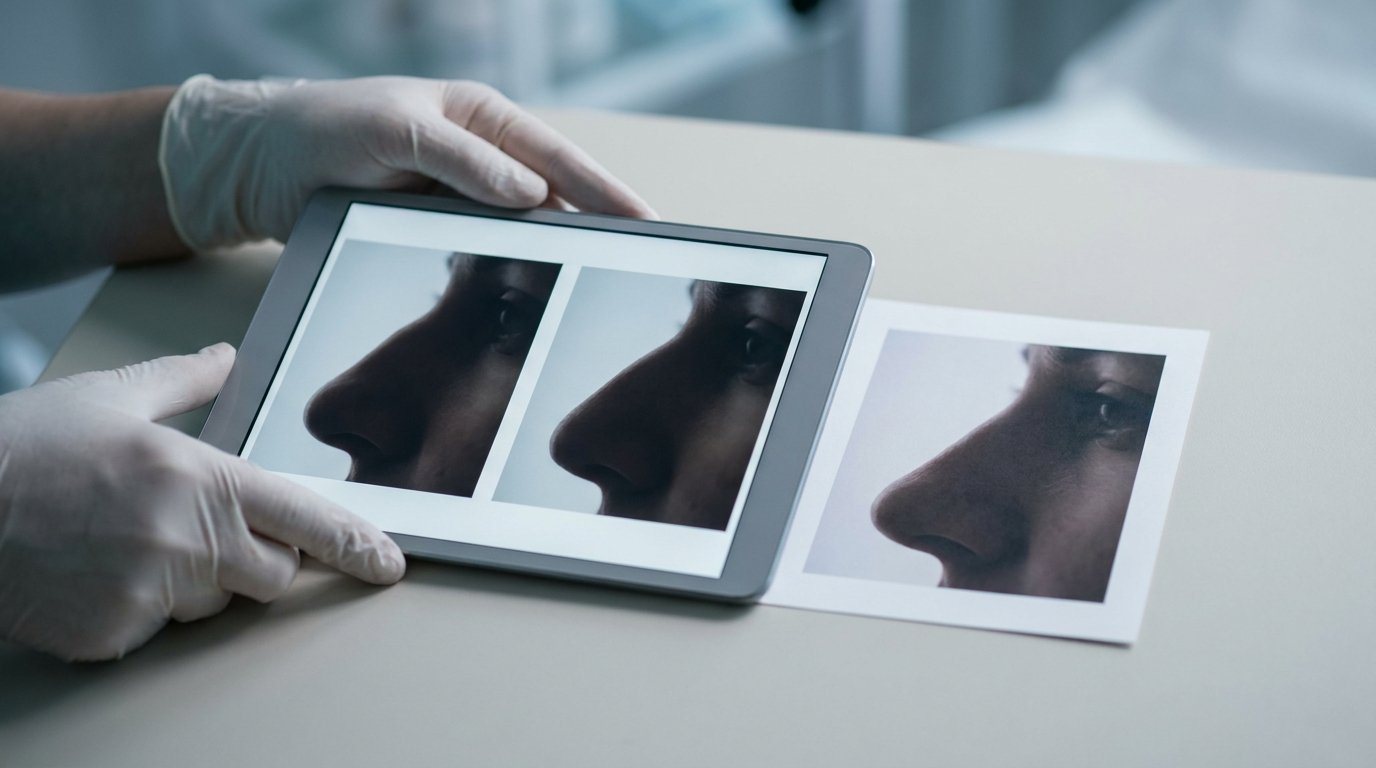
Ask to see something uncomfortable: a case with a difficult starting point, or a revision they performed on someone else’s work. Surgeons who do a lot of revision rhinoplasty are used to this question, because corrective work is where structural skill shows.
Consistent angles and lighting, several noses similar to yours, long-term photos at a year or more, and the surgeon can explain what they did in each case.
Only flattering three-quarter views, no profiles, results photographed within weeks, stock-looking images, or the same handful of cases recycled across unrelated websites.
Which technique questions reveal a real planner?
You do not need to understand surgery to ask good questions. You need to notice whether the answer is specific to your nose or copied from a brochure. Three topics separate a planner from a salesperson.
The first is the approach. Ask whether they plan an open or closed operation for you and why. Both are legitimate; the reasoning is what counts, and our comparison of open versus closed rhinoplasty sets out the trade-offs so you can judge the answer.
The second is the bridge. If a dorsal hump is part of your concern, ask whether they would reduce it by removing bone and cartilage or by preserving the dorsum and lowering it. Dorsal preservation methods such as the push-down and let-down techniques have become widely used for hump reduction, as described in work published in Aesthetic Plastic Surgery in 2020 and 2021. A surgeon should be able to say which family of techniques suits your bone and cartilage structure, rather than insisting one method fits everyone.
The third is support. Ask what happens if your tip needs cartilage support, and where that cartilage would come from. In secondary cases, combinations of grafts — spreader, dorsal onlay and columellar — are described in the reconstructive literature for rebuilding a weakened middle section of the nose, and a surgeon planning revision work should discuss graft sources with you in advance. Our guide to septal, ear or rib cartilage grafts covers what each option means for your recovery.
Breathing is part of the aesthetic plan
If you snore, block on one side or have a deviated septum, raise it in the first consultation. A surgeon who only discusses the outside of your nose is planning half the operation. Function and shape are decided together, not sequentially.
Red flags, green flags and sales pressure
Most disappointing experiences are predictable from the booking stage. The pattern is usually the same: fast promises, no named surgeon, and a price that is quoted before anyone has looked at your face properly.
A consultation should include a proper look at your photographs or, better, an in-person examination, and it should include limits. Hearing what cannot be achieved with your skin thickness or cartilage is a sign of honesty, not weakness. Any claim of a guaranteed outcome, a “perfect” nose or a result with no swelling phase should end the conversation.
🚨 Never book around a deadline Time-limited pricing is a sales tool, not a clinical reason. Rhinoplasty changes your face permanently, and no legitimate plan expires in 24 hours.
A named, verifiable surgeon; a plan that mentions your specific anatomy; clear discussion of risks and limits; written inclusions; direct contact for follow-up questions after you fly home.
Discounts that expire today, refusal to name the surgeon or hospital, no mention of risk, a quote given without any assessment, or pressure to book flights before the plan is confirmed.
A clinic using patient coordinators or translators is normal in health tourism. The question is whether you also get access to the surgeon’s own assessment before surgery.
What drives the price, and what the quote should include
Cost talk in health tourism is often misleading because quotes cover different things. One figure may include the hospital, anaesthesia and an overnight stay; another may cover the surgeon’s fee alone. Before comparing anything, ask for the inclusions in writing and check what is specifically excluded.
The main drivers are the surgeon’s experience and demand, the complexity of your case, the hospital setting, the anaesthesia team, whether you need grafts from the ear or rib, and whether revision work is involved. Secondary surgery takes longer and is technically harder, so it is quoted differently from a first operation. A personalised price is only confirmed after a proper consultation and assessment of your photographs or examination; our breakdown of what affects a rhinoplasty quote goes through the variables in more detail.
One thing worth factoring in when you compare quotes: roughly one in seven of the patients who come to us for nose surgery also has a second operation in the same trip, most often breast augmentation, a breast lift with implants or upper eyelid surgery. If that is your plan too, make sure the quote and the surgeon question are answered for both procedures — including whether the same surgeon performs them, and how the combined operating time changes your stay.
📋 Ask about revision terms before, not after Noses settle over a year or more, and a small number of patients eventually want a refinement. Ask in writing what happens if a revision is advised: who decides, what is covered, and who pays for travel.
Consultation, stay length and aftercare you can actually reach
A good process has a face-to-face consultation before surgery, usually on arrival day, where the surgeon examines your nose, reviews your medical history and confirms the plan. If the first time you meet your surgeon is in the operating theatre, that is a structural problem with the clinic, not a scheduling detail.
Plan the trip around the follow-up rather than the operation. Most patients stay in Turkey for several days after surgery so that dressings, any internal splints and the external cast can be checked and removed before flying. Our guide to stay length, hotels and transfers explains how to arrange the days around the procedure, and what to expect on the flight home.
Finally, test the aftercare before you commit. Ask who you message at week three if your tip looks uneven, whether the surgeon reviews photographs remotely, and how long that support continues. Swelling settles gradually over many months, so the people answering your questions in month six matter as much as the person operating in week one.
This article is for informational purposes only and does not constitute medical advice. Always consult a qualified surgeon for personalised guidance.
Frequently Asked Questions
References
- 📎New Approaches for the Let-Down Technique — Aesthetic Plastic Surgery, 2020
- 📎Combination of the Push-Down and Let-Down Techniques: Mix-Down Approaches — Aesthetic Plastic Surgery, 2021
- 📎Combined use of triple cartilage grafts in secondary rhinoplasty — Journal of Plastic, Reconstructive & Aesthetic Surgery, 2007
- 📎EBOPRAS — European Board of Plastic Reconstructive and Aesthetic Surgery
- 📎NHS — Cosmetic procedures
Related Articles


You Might Also Like



Related articles



Our specialists
 Clineca SpecialistErkan PinegözPlastic & Reconstructive Surgery
 Clineca SpecialistHakan AktaşPlastic & Reconstructive Surgery
 Clineca SpecialistOrkun UzuneyüpoğluPlastic & Reconstructive Surgery
 Clineca SpecialistSalim İskenderPlastic & Reconstructive Surgery
 Clineca SpecialistEngin SelamioğluPlastic & Reconstructive Surgery
 Clineca SpecialistCem AydınPlastic & Reconstructive Surgery
 Clineca SpecialistAlperen ÖnalEar, Nose & Throat (ENT)