Have a question about Rhinoplasty?
In this article
- How Male Rhinoplasty Differs From Rhinoplasty in Women
- Are You a Candidate — Age, Expectations and the Consultation
- What Men Most Often Ask to Change
- Technique Choices: Open, Closed, Grafts and Preservation
- Breathing, the Septum and Functional Work
- Recovery Timeline for Men, Week by Week
- Risks, Complications and the Realistic Chance of Revision
- What Drives the Cost of a Male Nose Job in Turkey
- How Long to Stay in Turkey and How the Trip Runs
- Choosing a Surgeon and Clinic You Can Verify
Men tend to ask different questions about nose surgery than women do, and they often ask them a decade later than they first thought about it. Male rhinoplasty sits in a slightly awkward space: the operation itself follows the same surgical principles in both sexes, yet the aesthetic target, the skin thickness, the cartilage strength and even the practical recovery problems (shaving, gym, hard hats, glasses) behave differently. What follows is a walk through what genuinely changes when the patient is a man, and what that means for planning, healing and judging the result.
How Male Rhinoplasty Differs From Rhinoplasty in Women
The surgical steps overlap almost completely. What differs is the brief. Most men want the nose to stop drawing attention without looking as though anything was done — a straight profile rather than a sloped one, a tip that is defined but not delicate, and a nose that still reads as proportionate to a larger brow, jaw and chin.
A 2024 review in Facial Plastic Surgery Clinics of North America on contemporary male rhinoplasty makes the same point: the principles are shared between male and female patients, but there are specific anatomical considerations in men that need deliberate attention during planning.
In practice, three physical differences matter most. Male skin over the nose is often thicker and more sebaceous, which hides fine refinement and slows the final tip definition. Male cartilage is frequently stronger, which resists reshaping but also holds structure well once set. And the male bony bridge is usually wider and taller, so the amount of hump you remove has to be judged against a broader face rather than a smaller one.
Over-reduction is the classic mistake in men. A bridge taken down too far, a tip rotated too high, or a scooped profile can leave a nose that looks surgically softened rather than simply tidier — and that impression is hard to undo later.
📋 Bring photographs, not adjectives "Smaller" and "straighter" mean different things to different surgeons. Images of noses you find acceptable on faces similar to yours give a far more reliable brief than words alone, and they expose unrealistic goals early.
Are You a Candidate — Age, Expectations and the Consultation
Candidacy for a nose job in men turns on three things: the nose has finished growing, your general health allows a general anaesthetic, and what you want is physically achievable with your own skin and cartilage.
Age worries come up constantly in enquiries from men, usually in the form of being too late rather than too early. Roughly one in eight of the rhinoplasty patients we treat is past 40, so the window is wider than most men assume — if your breathing and skin quality are good, your thirties and forties are an ordinary time to do this rather than an exception. Healing simply tends to be a little slower and swelling lingers longer with age, which affects the timeline more than the result.
The consultation matters more for men than many patients realise. The same 2024 review notes that men seeking rhinoplasty show a higher rate of body dysmorphic disorder — a condition where distress about appearance is out of proportion to what others see — and that patient satisfaction is harder to achieve in this group, which is exactly why a thorough, unhurried consultation is recommended rather than a quick yes.
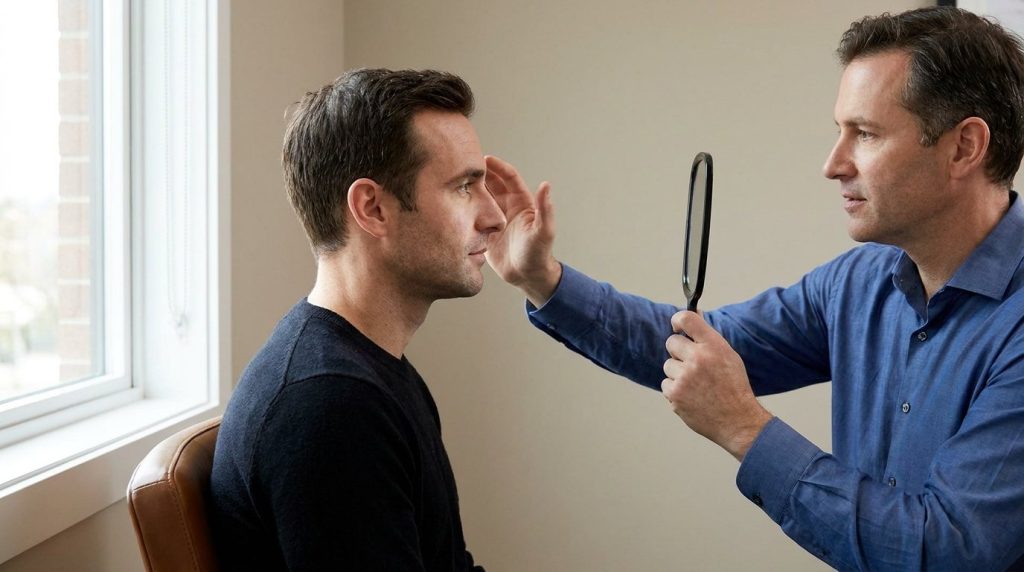
A good assessment should include an inside-the-nose examination, not just a look at your profile. If a surgeon never checks your septum and airflow before quoting, that is a planning gap, not a time-saver.
You can name one or two specific features that bother you, you accept that swelling takes months to settle, you are a non-smoker or willing to stop, and you have no untreated bleeding or breathing condition.
You cannot point to what you dislike, you are chasing a very different face rather than a tidier nose, you are deciding in the middle of a crisis, or you have had several procedures that never felt like enough.
What Men Most Often Ask to Change
Four complaints account for the majority of male consultations: a dorsal hump on the bridge, a tip that hangs low and makes the nose look long in profile, a wide or bulbous tip, and a nose that visibly leans to one side. Blocked breathing frequently sits underneath all of them.
A hump is reduced by lowering the bone and cartilage together, then narrowing the bridge so the roof of the nose stays smooth rather than flat and wide. In men this is deliberately conservative work — leaving a hint of height usually looks more masculine than a perfectly flat line.
A drooping tip is not usually treated by removing bulk. It is supported and rotated upward with sutures and small cartilage grafts, which also helps the tip hold its shape over the following years. For a wide or bulbous tip, the cartilages are reshaped and brought closer together, though thick skin limits how much of that refinement actually shows. If your skin is heavy, it is worth reading how surgeons create definition in a thick-skinned nose before expecting a sharply sculpted result.
A crooked nose is the hardest of the four to promise anything about. Most leaning noses involve a bent septum, old trauma, or asymmetric cartilage, and straightening them is a question of degree — noticeably straighter is realistic, perfectly symmetrical is not.
Technique Choices: Open, Closed, Grafts and Preservation
Closed rhinoplasty places every incision inside the nostrils, so there is no external scar. Open rhinoplasty adds a small incision across the columella, the strip of skin between the nostrils, giving the surgeon direct sight of the tip framework.
For men, the choice often tips toward whichever approach allows reliable structural support, because stronger cartilage and thicker skin both pull on the result for years afterwards. Open access tends to be favoured for crooked noses, significant tip reshaping and revision work; closed access suits more limited hump and bridge adjustment. If you want a fuller comparison, our guide on open versus closed rhinoplasty sets out the trade-offs side by side.
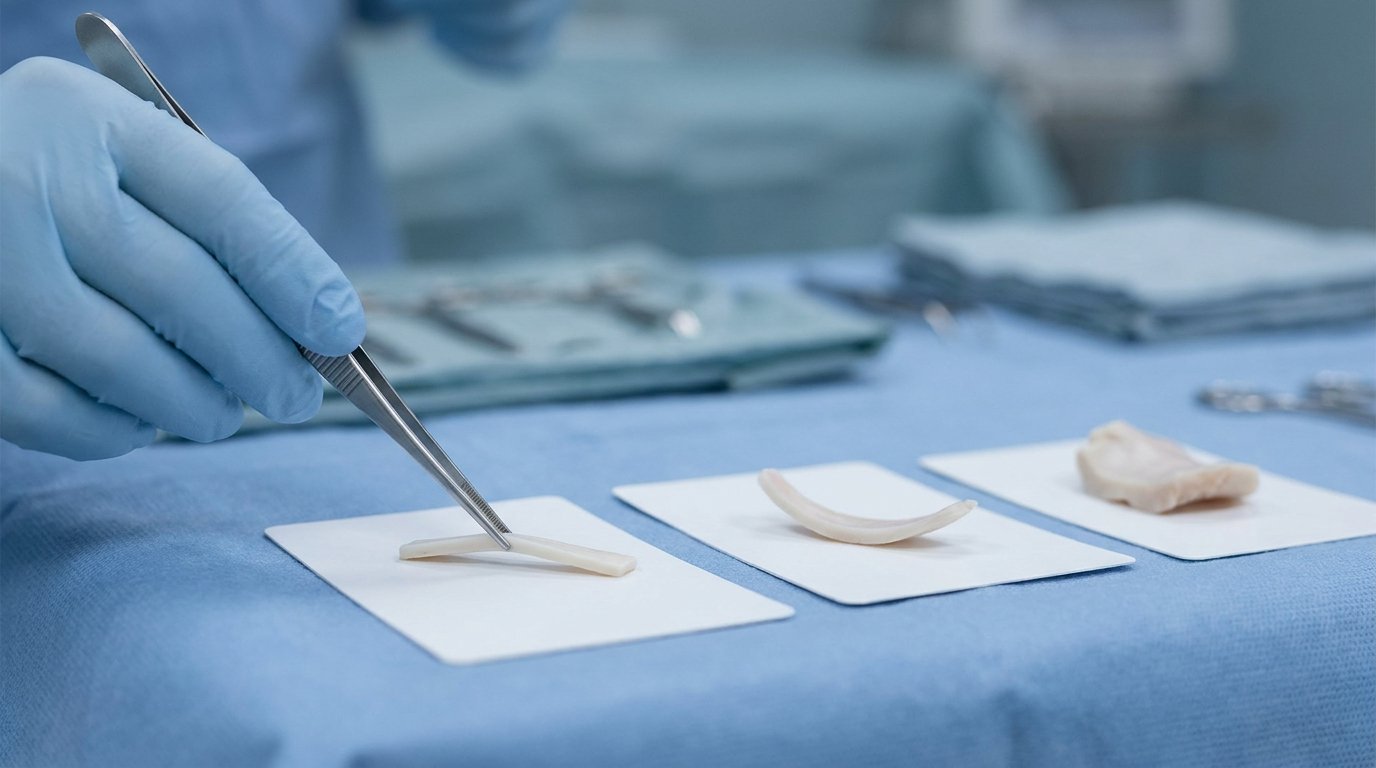
Graft material comes up quickly in male planning. Septal cartilage from inside the nose is the first choice when there is enough of it. Ear cartilage suits softer curved grafts, and rib cartilage is reserved for cases needing substantial structure — revisions, collapsed bridges, or noses with very little septum left. Rib adds a chest incision, a longer operation and a slower first week, so it should be a reasoned decision rather than a default.
Preservation techniques, which reshape the bridge while keeping more of its own roof intact, have become a common part of the conversation. They can suit a straightforward hump in a man with good skin, but they are not a universal upgrade — ask your surgeon why the approach they propose fits your particular nose.
⚠️ Technique should follow your anatomy Be cautious with any clinic that performs one approach for everyone, or markets a single branded method as superior for all noses. The reasoning behind the plan matters more than the label attached to it.
Breathing, the Septum and Functional Work
A large share of men come in for appearance and leave with better airflow as well, because the two problems usually share a cause. A deviated septum, enlarged turbinates or weak sidewalls that collapse on hard inhalation are all common findings in a nose that also looks crooked.
Septoplasty — straightening the dividing wall inside the nose — and turbinate reduction are routinely performed in the same session as cosmetic reshaping, under the same anaesthetic. That avoids a second operation and a second recovery, and the straightened septum often supplies the cartilage needed for grafting. Our article on whether septoplasty and rhinoplasty can be done together covers how that combination is planned.
Functional support is also what protects the look long term. A 2012 review in Archives of Facial Plastic Surgery highlighted how much of the past decade of rhinoplasty literature focused on nasal valve surgery and septal reconstruction — the structural work that keeps the airway open rather than the purely cosmetic steps.
One honest caveat: a nose that has been narrowed cosmetically can breathe slightly worse if the internal valve is not supported during surgery. If breathing already bothers you, say so clearly at consultation so that support grafts are built into the plan from the start.
Recovery Timeline for Men, Week by Week
Most men are presentable in public within two weeks and back to normal life well before the nose is finished changing. The visible recovery and the final result run on completely different clocks.
The first two days are the most uncomfortable part, mainly because of congestion rather than pain. Bruising around the eyes usually peaks around day two or three and fades over the following week. Splints and any external tape typically come off about a week after surgery, which is the point at which most travelling patients fly home.
Swelling is the long part. The bridge settles comparatively quickly, but the tip keeps refining for many months, and thicker male skin extends that further. A detailed week-by-week rhinoplasty recovery timeline is worth reading alongside the table below.
Practical issues specific to men
Shaving around a healing nose is the complaint we hear most. For the first couple of weeks, work around the nose rather than over it, avoid pressing the upper lip upward hard, and use an electric razor if a blade means stretching the skin. Beard trimming is fine as long as you are not resting a device against the splint or the nostril rims.
Glasses are the second issue, because the frame sits exactly where the bone was reshaped. Most surgeons ask patients to keep weight off the bridge for several weeks, which means contact lenses, prescription sunglasses taped to the forehead, or temporary frames supported above the nose. Safety helmets, respirator masks and anything strapped across the face belong in the same conversation with your surgeon before you return to work.
Contact sport, boxing, football, climbing and heavy lifting all wait longer than general exercise. Light cardio often resumes within a few weeks, while anything carrying a risk of an impact to the nose is typically deferred for a couple of months or more, on your surgeon’s instruction.
📋 Sleep position earns its keep Sleeping on your back with your head raised for the first couple of weeks genuinely reduces morning swelling and protects the nose from accidental pressure. Side sleepers should set up pillows before surgery, not after.
Risks, Complications and the Realistic Chance of Revision
Rhinoplasty is a safe elective operation in appropriate hands, but it is real surgery under general anaesthesia and the risks deserve a plain list rather than a reassuring sentence.
- ✓Bleeding. Light oozing and occasional nosebleeds in the first week are expected. Significant bleeding is uncommon but can need repacking or, rarely, a return to theatre.
- ✓Infection. Also uncommon, usually managed with antibiotics; infection risk is higher when implants or extensive grafts are used.
- ✓Numbness and altered sensation. The tip of the nose and sometimes the upper front teeth feel odd or numb for weeks to months. It nearly always recovers, though a small patch of reduced sensation can persist.
- ✓Breathing changes. Breathing often improves, particularly when the septum is corrected. It can occasionally get worse if the nose is narrowed without supporting the internal valve.
- ✓Asymmetry and contour irregularity. Small irregularities along the bridge, slight tip asymmetry or uneven nostrils are the most frequent reasons men consider a second procedure.
- ✓Scarring. Internal incisions leave no visible mark; an open approach leaves a fine line under the tip that usually fades but never disappears entirely.
- ✓Septal perforation and skin problems. Rare, more likely with heavy septal work, smoking or repeated surgery.
Revision is the risk that gets understated in marketing. Secondary rhinoplasty is a recognised part of this field — some patients want further refinement once swelling has fully resolved, and thick-skinned noses can take a full year or more before that judgement is even possible. Ask any surgeon directly how often they revise their own primary cases and what their written policy covers, rather than accepting a general reassurance.
Travel adds its own layer. General anaesthesia plus a flight raises the question of blood clots, so follow the mobility, hydration and compression advice you are given, and never fly home earlier than your surgeon permits just to save a hotel night.
🚨 Contact a doctor without waiting Heavy bleeding that does not stop with pressure, fever with increasing pain or spreading redness, sudden severe one-sided blockage with swelling, vision changes, or calf pain and breathlessness after flying all need urgent assessment — locally if you are already home.
⚠️ No one can guarantee a result Healing varies between individuals, and no surgeon can promise an exact shape or a revision-free outcome. Treat any guarantee of a specific result as a warning sign about the clinic, not a selling point.
What Drives the Cost of a Male Nose Job in Turkey
Cost for male rhinoplasty is not set by gender. It is set by the complexity of your nose, who operates, where they operate, and how much of the trip the clinic takes on.
Complexity is the biggest lever. A straightforward hump reduction in a previously unoperated nose sits at one end; a crooked, revision or rib-grafted nose with functional airway work sits at the other, because it needs a longer operation, more graft material and closer follow-up. Adding septoplasty or turbinate reduction changes the theatre time as well.
The second lever is the team and the facility: a surgeon’s experience and case volume, whether a dedicated anaesthetist and fully accredited hospital are used, and what standard of post-operative care is included. The third is the travel package — nights of accommodation, airport and clinic transfers, interpreter support and follow-up appointments.
A written quote should make clear exactly what is covered and what is not, including the policy if a revision is ever needed. Prices are confirmed only after a consultation and a review of your photographs or examination, because the plan determines the price rather than the other way around. Our breakdown of what affects a rhinoplasty quote goes through the same drivers in more detail.
⚠️ The cheapest quote is rarely the comparable one If one quote is dramatically lower, check what has been removed: surgeon seniority, hospital accreditation, anaesthetist cover, nights of stay or follow-up. Compare inclusions line by line before comparing totals.
How Long to Stay in Turkey and How the Trip Runs
Plan on roughly a week to ten nights in the country for a nose operation. The schedule is built around splint removal, which usually happens about a week after surgery and is the appointment you should not fly before.
A typical sequence is arrival and transfer, a face-to-face consultation with examination and pre-operative blood tests, surgery the following day, one night in hospital, then several quiet recovery days at the hotel with scheduled check-ups. Splints and sutures come out towards the end of the stay, and you fly home once your surgeon confirms you are fit to travel.
Book a flexible return ticket if your budget allows. It is unusual to need extra days, but a nosebleed or slower-than-average swelling is a bad reason to be forced onto a plane. Choose accommodation close to the hospital rather than a scenic district, keep the first few days free of sightseeing, and bring someone with you if you can — not for medical reasons, but because the first 48 hours are easier with a second pair of hands.
One scheduling note that catches men out: book the trip when you can protect two weeks afterwards from meetings, filming, weddings or physical work. The nose will be fine; the bruising and the splint will not photograph well.
Choosing a Surgeon and Clinic You Can Verify
Verification beats marketing every time. You are looking for a surgeon who performs rhinoplasty regularly rather than occasionally, who operates in an accredited hospital, and who shows you male results on faces that resemble yours.
Ask to see several male before-and-after sets at a consistent distance, lighting and angle, including profile views at least a year post-operative. Ask who holds the scalpel, who gives the anaesthetic, and who you contact at two in the morning from your hotel. Ask what happens if something is not right in six months, and get the answer in writing. Our guide on how to choose a rhinoplasty surgeon in Turkey sets out the documentation worth requesting before you pay a deposit.
A single face-to-face consultation before surgery day is not negotiable, even when the initial assessment has been done remotely from photographs. The inside of the nose cannot be assessed over a video call.
This article is for informational purposes only and does not constitute medical advice. Always consult a qualified surgeon for personalised guidance.
A surgeon qualified in plastic surgery or ear, nose and throat surgery with heavy rhinoplasty experience, an accredited hospital, an examination of your airway, written aftercare instructions, named emergency contacts and consistent long-term male photographs.
A price before an assessment, pressure to pay within hours, no named surgeon, guaranteed results, heavily filtered or inconsistent photographs, and no plan for follow-up once you are back home.
Minor contour irregularities can sometimes be camouflaged with injectable filler by a qualified doctor — a temporary option that does not change the underlying bone or cartilage and is not a substitute for correcting breathing problems.
Frequently Asked Questions
References
- 📎Contemporary Male Rhinoplasty Surgery — Facial Plastic Surgery Clinics of North America, 2024
- 📎Contemporary Review of Rhinoplasty — Archives of Facial Plastic Surgery, 2012
- 📎NHS — Cosmetic procedures
- 📎Mayo Clinic — Tests and procedures
- 📎American Society of Plastic Surgeons — Cosmetic procedures
Related Articles


You Might Also Like



Related articles



Our specialists
 Clineca SpecialistErkan PinegözPlastic & Reconstructive Surgery
 Clineca SpecialistHakan AktaşPlastic & Reconstructive Surgery
 Clineca SpecialistOrkun UzuneyüpoğluPlastic & Reconstructive Surgery
 Clineca SpecialistSalim İskenderPlastic & Reconstructive Surgery
 Clineca SpecialistEngin SelamioğluPlastic & Reconstructive Surgery
 Clineca SpecialistCem AydınPlastic & Reconstructive Surgery
 Clineca SpecialistAlperen ÖnalEar, Nose & Throat (ENT)