Have a question about Rhinoplasty?
In this article
- Rhinoplasty in plain language: what the surgery changes
- How rhinoplasty is performed, step by step
- Open or closed: how the approach changes the operation
- Naming the result you want before you discuss technique
- The honest risk list
- Recovery: what the first weeks and months look like
- Can rhinoplasty be combined with other surgery?
- Cost, length of stay and choosing a clinic in Turkey
Rhinoplasty is surgery to reshape the nose: the surgeon works through incisions hidden inside the nostrils, sometimes with a small one across the skin between them, and alters the bone and cartilage that give the nose its shape so the skin settles over a new framework. That is what rhinoplasty is; how it is performed is the part that takes longer to explain, because almost every step is chosen for your particular nose. The sections below follow the operation from the anaesthetic room to the moment the swelling finally leaves your tip.
Rhinoplasty in plain language: what the surgery changes
Your nose is built from bone at the top, cartilage in the middle and at the tip, and a dividing wall inside called the septum. Skin and soft tissue drape over all of it. Rhinoplasty changes that underlying framework, and the outside appearance follows.
Some operations are purely cosmetic, such as lowering a bridge hump or narrowing a wide tip. Others are functional, correcting a bent septum or a collapsed airway so air moves more freely. Many are both at once, which is why a surgeon may describe your plan as a septorhinoplasty rather than a simple nose job.
It helps to know what the surgery cannot do. It cannot give you someone else’s nose, because your skin thickness, cartilage strength and facial proportions set the limits. A thick-skinned nose will never show the same sharp edges as a thin-skinned one, however carefully the cartilage underneath is shaped — our article on definition in thick-skinned noses explains how surgeons work around that.
How rhinoplasty is performed, step by step
The operation is almost always done under general anaesthetic, so you are fully asleep. NHS patient guidance on cosmetic nose reshaping describes it the same way, with most procedures taking roughly one and a half to three hours depending on how much work is planned. You arrive fasting, meet the anaesthetist, and wake up in recovery with a dressing or splint on your nose.
What happens in between follows a fairly consistent sequence, even though the detail changes from patient to patient:
- Access. The surgeon makes incisions inside the nostrils, adding a small external incision across the columella (the strip of skin between the nostrils) if an open approach is planned.
- Lifting the skin. The soft tissue is gently raised off the bone and cartilage so the framework can be seen and measured directly.
- Reshaping the bridge. A hump is filed or cut down, and if the bones need narrowing the surgeon makes controlled cuts in them, known as osteotomies.
- Rebuilding support. Cartilage grafts, usually taken from your own septum or ear, are stitched in to hold the tip or the bridge in its new position.
- Refining the tip. Fine sutures and small cartilage trims rotate, project or narrow the tip; this is often the slowest part of the operation.
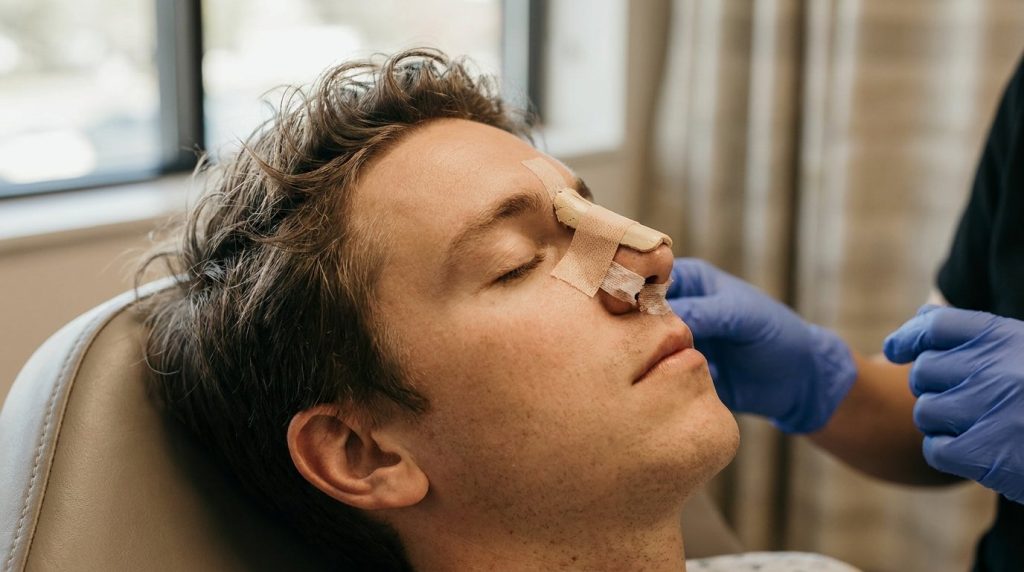
- Straightening the septum and closing. Breathing problems are addressed, the skin is laid back down, incisions are stitched, and tape plus an external splint are applied.
For building up or supporting a nose, cartilage from your own body is still regarded as the benchmark material. A 2019 review in Current Opinion in Otolaryngology & Head and Neck Surgery concluded that autologous cartilage remains the gold standard in augmentation rhinoplasty, even as various implants have gained ground in surgery for nasal valve collapse. Donor rib cartilage is another option in complex cases; a 2024 systematic review in Aesthetic Plastic Surgery examined outcomes with fresh frozen rib grafts in rhinoplasty.
Soft internal splints or dissolvable packing are sometimes placed inside the nostrils at the end. If that applies to you, what internal splints feel like and when they come out covers the part patients find most uncomfortable.
📋 Why the plan matters more than the technique name Two surgeons can reach a similar result through different routes. What should worry you is not whether the approach is called open or closed, but whether the surgeon can explain, in front of your own photographs, which structure they intend to change and why.
Open or closed: how the approach changes the operation
The two approaches differ mainly in how the surgeon reaches the framework. In a closed (endonasal) rhinoplasty everything is done through incisions inside the nostrils. In an open (external) rhinoplasty a small incision is added across the columella, which lets the surgeon see the tip cartilages directly and stitch grafts under full view.
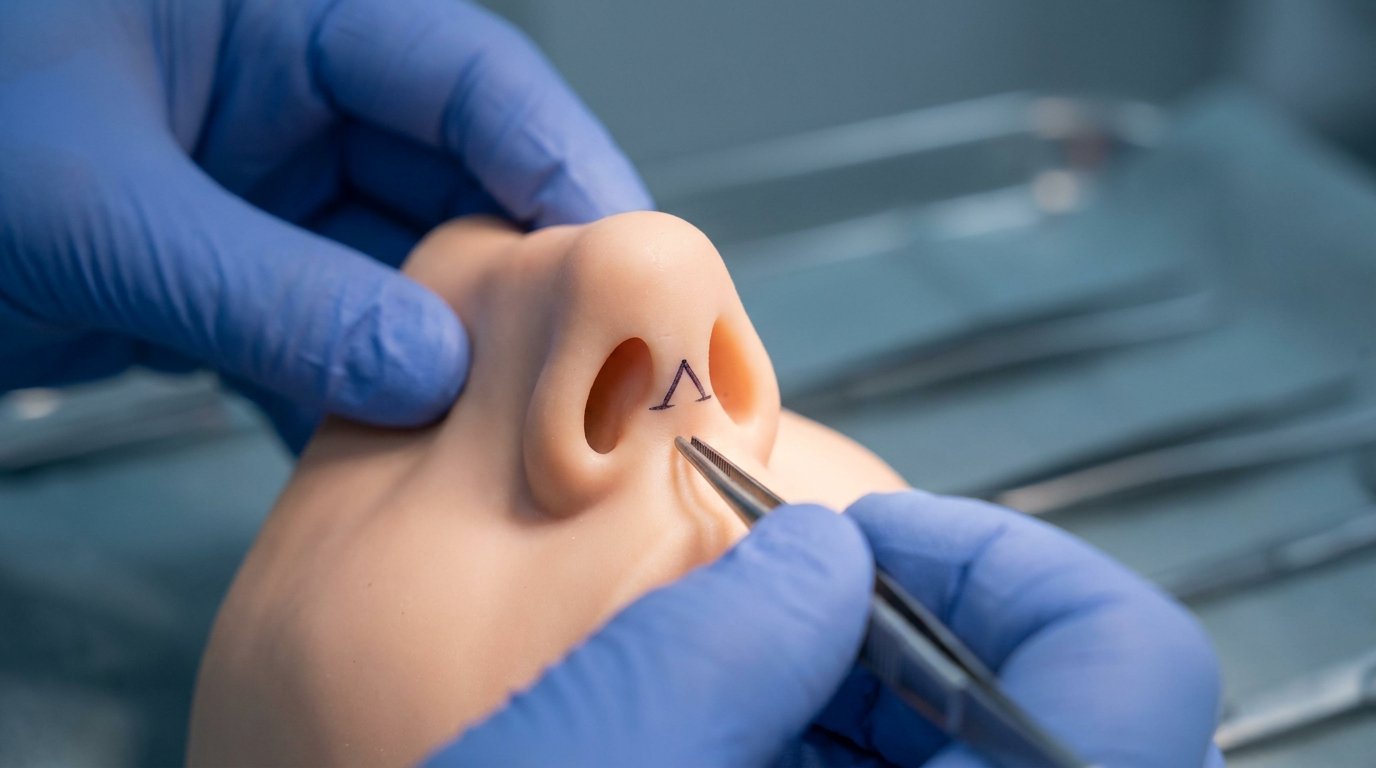
Neither is automatically better. Open access suits complicated tips, revisions and markedly crooked noses; closed access can mean slightly less tip swelling and no external scar at all. If you want the longer comparison, read open or closed rhinoplasty and how to choose.
Naming the result you want before you discuss technique
Technique follows the goal, not the other way round. Among the people who write to us about their nose, the single most common wish is a slimmer or thinner nose — roughly one in six say exactly that, ahead of a smaller nose, a straighter bridge or a more defined tip, and well ahead of the word everyone assumes dominates, “natural”. That matters for you because each of those wishes points to a different operation: narrowing involves work on the nasal bones, a straighter profile means addressing the bridge, and tip definition is mostly suture and graft work. Arriving with the wish named in your own words gives the surgeon far more to work with than a photograph alone.
Being specific also protects you from disappointment. A 2024 review in Facial Plastic Surgery Clinics of North America on male rhinoplasty noted that satisfaction can be harder to achieve in men and that a deliberate, thorough consultation is essential — including attention to body dysmorphic concerns. That advice holds for everyone: if you cannot say what bothers you, the operation cannot target it.
If your main complaint is only the tip, a smaller operation may be enough. How tipplasty differs from a full rhinoplasty sets out where that line falls.
The honest risk list
Rhinoplasty is a safe operation in trained hands, but it is still surgery with a general anaesthetic, and no surgeon can promise an outcome. The risks worth understanding before you consent are bleeding in the first days, infection, reactions to the anaesthetic, altered sensation in the tip or upper lip, scarring at the columella in open cases, and asymmetry as the swelling resolves unevenly.
Breathing can also change in either direction. A well-planned operation often improves airflow, particularly when the septum is straightened, but over-narrowing or weakened cartilage support can make the airway worse. This is one reason surgeons now favour rebuilding support rather than simply removing tissue.
Numbness in the tip is common early on and usually temporary; how long numbness lasts after rhinoplasty explains the normal pattern. Revision surgery is the other honest caveat: a minority of patients want a second operation for a small residual irregularity, and reputable clinics will tell you upfront how they handle that and when it could be considered, which is generally not before the nose has fully settled.
⚠️ Contact your clinic rather than waiting Heavy bleeding, a fever, spreading redness, worsening one-sided pain or a sudden change in vision are not part of normal healing. Call the clinic’s on-call line the same day, even if you have already flown home.
Recovery: what the first weeks and months look like
Most people are surprised by two things: how little pain there is, and how long the last of the swelling takes. Discomfort is usually described as pressure and blockage rather than sharp pain, and it is normally controlled with simple painkillers. The external splint typically comes off about a week after surgery, which is also when most patients feel ready for light desk work.
Swelling is the slow part. The bridge settles fairly quickly, the tip takes months, and thick skin takes longest of all. Our week-by-week rhinoplasty recovery timeline goes through it in detail, and when you can exercise again covers the return to the gym.
Can rhinoplasty be combined with other surgery?
Yes, and it often is. Breathing surgery is the most natural pairing, since the septum and turbinates are already within reach — see combining septoplasty with rhinoplasty. Facial combinations such as upper eyelid surgery or chin augmentation are also common, because profile balance depends on the chin as much as the nose.
Combining adds anaesthetic time and lengthens the recovery you should plan around, which is why surgeons assess your general health before agreeing to it. What to consider before combining rhinoplasty with another operation sets out the trade-offs.
Cost, length of stay and choosing a clinic in Turkey
Price is the question patients raise most often, and it is the one that cannot be answered honestly without an assessment. What drives it is the complexity of your nose — a primary cosmetic case is not priced like a revision or a case needing rib cartilage — along with the surgeon’s experience, whether functional work is included, the hospital and anaesthesia team, and the length of your stay. A personalised quote follows a consultation with your photographs and medical history; our breakdown of what affects rhinoplasty cost and what a quote includes explains the components to check line by line.
For travelling patients, plan on roughly a week in Turkey so the splint can be removed and your surgeon can see you before you fly. Stay length, hotels and transfers for rhinoplasty patients covers the logistics.
On choosing a surgeon, look for formal credentials in plastic surgery or ear, nose and throat surgery, an accredited hospital, a named surgeon you actually meet, and a written plan for follow-up once you are home. Ask to see results from noses that resemble yours rather than a curated highlight reel, and ask what happens, practically and financially, if a small revision is needed later.
This article is for informational purposes only and does not constitute medical advice. Always consult a qualified surgeon for personalised guidance.
You speak directly with the operating surgeon, see before-and-after cases with noses like yours, receive a written plan naming the hospital and anaesthesia team, and are given a direct contact for problems after you fly home.
A price quoted before anyone has seen your photographs, pressure to book within a day, no named surgeon, guarantees of a specific result, or vague answers about who manages complications once you leave Turkey.
Our rhinoplasty in Turkey cost and safety guide goes deeper into prices, stay length and how to vet a surgeon.
Frequently Asked Questions
References
- 📎Rhinoplasty outcomes and trends — Current Opinion in Otolaryngology & Head and Neck Surgery, 2019
- 📎Fresh Frozen Cartilage in Rhinoplasty Surgery: A Systematic Review of Outcomes — Aesthetic Plastic Surgery, 2024
- 📎Contemporary Male Rhinoplasty Surgery — Facial Plastic Surgery Clinics of North America, 2024
- 📎NHS — Cosmetic procedures
Related Articles



You Might Also Like



Related articles


Our specialists
 Clineca SpecialistErkan PinegözPlastic & Reconstructive Surgery
 Clineca SpecialistHakan AktaşPlastic & Reconstructive Surgery
 Clineca SpecialistOrkun UzuneyüpoğluPlastic & Reconstructive Surgery
 Clineca SpecialistSalim İskenderPlastic & Reconstructive Surgery
 Clineca SpecialistEngin SelamioğluPlastic & Reconstructive Surgery
 Clineca SpecialistCem AydınPlastic & Reconstructive Surgery
 Clineca SpecialistAlperen ÖnalEar, Nose & Throat (ENT)