
Have a question about Gynecomastia?
In this article
- Does the NHS fund male breast reduction, or is it always private?
- What actually drives gynecomastia surgery cost
- Which grade are you likely to be? A quick self-check
- UK private pricing versus a Turkey package: what you are comparing
- Recovery, time off work and how long to stay if you travel
- Safety and how to judge the clinic behind the price
Men researching gynecomastia surgery cost in the UK usually hit the same wall: clinic websites talk in vague terms, the NHS pathway is unclear, and two quotes for what sounds like the same operation can look nothing alike. That confusion is not marketing trickery — male chest surgery covers a wide range of work, from a small fat reduction to a full reshaping with skin removal. This guide walks through how pricing is actually built, who pays for what, and how your own chest anatomy pushes you toward the simpler or the more complex end.
Does the NHS fund male breast reduction, or is it always private?
For most men, this is private surgery. The NHS treats chest reduction done for appearance as a cosmetic procedure, and cosmetic work is generally not funded. The NHS’s own patient information on cosmetic procedures makes the same point: these operations are usually paid for by the patient, and you are expected to weigh up the risks before committing.
There are narrow exceptions. If the breast tissue is causing genuine physical problems, if there is a suspicious lump, or if the enlargement is part of a diagnosed hormonal or endocrine condition, a GP referral can lead to NHS assessment and sometimes treatment. Funding decisions sit with local commissioning policies, so two men with similar chests in different parts of the country can get different answers.
One step is worth doing before you shop for prices: see your GP. Enlarged male breast tissue can be driven by medication, thyroid or liver problems, testicular conditions, or steroid and cannabis use. If an underlying cause is found and treated, the chest sometimes settles without surgery — and if it does not, you at least go into a surgical consultation with the medical picture already clear.
📋 Get the cause checked first A new, tender or one-sided lump in the male chest always needs medical assessment before any cosmetic planning. Ask your GP about blood tests and medication review rather than booking surgery straight away.
What actually drives gynecomastia surgery cost
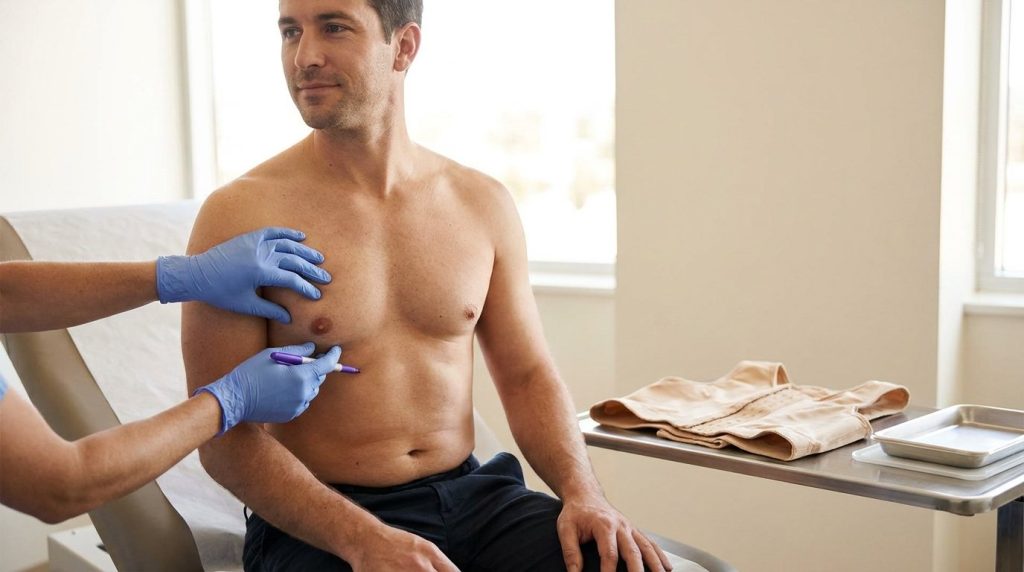
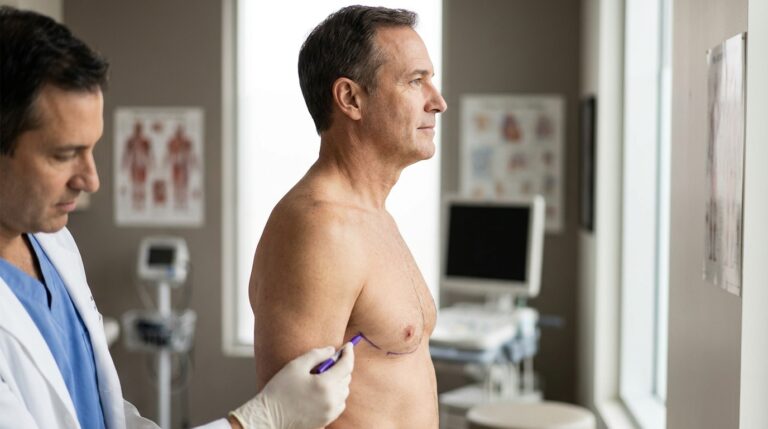
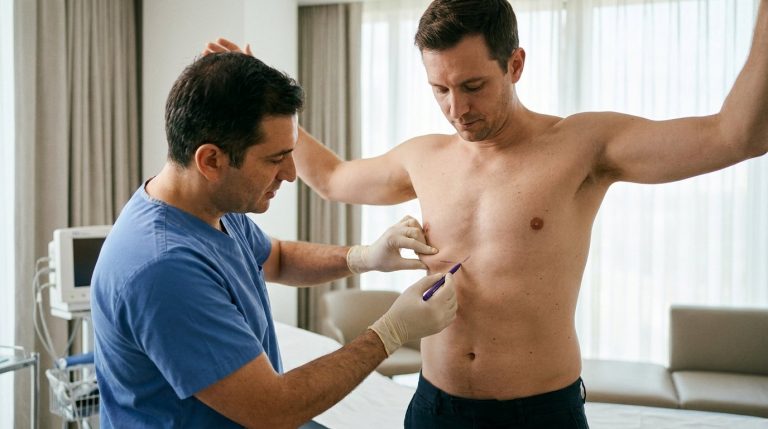
No surgeon can price male chest surgery honestly from a photo alone, because the operation is not one fixed procedure. The biggest single driver is how much true glandular tissue sits behind the nipple compared with soft fat, and whether the skin will shrink back on its own once that bulk is gone.
A chest that is mostly fat, with firm skin and only a small gland, can often be treated with liposuction and a small incision at the edge of the areola. Shorter theatre time, lighter anaesthetic needs, simpler dressings. Once significant skin excess enters the picture — usually after major weight loss or in longstanding cases — the surgeon has to remove and redrape skin, sometimes repositioning the nipple. That is a longer, more technical operation with a more involved recovery, and the quote reflects it. Our guide on gynecomastia surgery with excess skin explains how candidacy and scars change in that group.
Beyond the surgery itself, the setting matters. A fully accredited hospital with an anaesthetist and an overnight bed costs more to run than a day-case clinic room. Surgeon seniority and sub-specialisation, the number of follow-ups built into the price, and whether revision work is covered all move the final figure.
⚠️ Watch for the ‘from’ price Headline figures advertised as a starting price usually describe the simplest liposuction-only case. If your chest needs gland removal or skin tightening, expect the personalised quote after consultation to sit above that starting point.
Which grade are you likely to be? A quick self-check
Surgeons grade male chest enlargement roughly by how much tissue is present and how much the skin has stretched. You cannot diagnose yourself, but you can get a sense of which end of the pricing range you are closer to before you ever speak to a clinic.
Stand in front of a mirror, relaxed, arms down, and look at the shape rather than the size:
- ✓Mild, no skin excess. A small puffiness confined to the areola, with skin that still looks tight. Usually the shortest, simplest operation and the lowest-complexity quote.
- ✓Moderate, skin still firm. A visible chest contour beyond the areola, but no fold under the breast and no drooping. Often liposuction plus removal of the firm tissue behind the nipple.
- ✓Moderate with mild skin laxity. The chest sits slightly low, a faint fold appears, and the skin feels loose when you pinch it. Skin tightening may be added, which lengthens surgery.
- ✓Marked, with clear droop. The nipple sits at or below the chest fold and the breast hangs. This is reconstructive-level reshaping with longer scars and sometimes a staged plan.
Two extra clues matter. First, press gently behind the nipple: a firm, rubbery disc suggests true glandular tissue, which does not respond to the gym. Second, if you have lost a lot of weight, skin laxity tends to dominate the plan even when the remaining volume is small. If diet and training have already plateaued, our piece on whether you are a candidate when diet and exercise haven’t helped covers that decision in more detail.
- ✓Firm disc behind the nipple that does not shrink with training
- ✓Shape unchanged for more than a year in an adult
- ✓Stable weight for several months before surgery
- ✓Non-smoker or willing to stop well before the operation
- ✓Realistic about scars in exchange for a flatter contour
UK private pricing versus a Turkey package: what you are comparing
When men compare a UK private quote with a Turkey package, they are often comparing two different shopping baskets. A UK private price is usually quoted as a surgical fee plus hospital and anaesthetist charges, with consultation, garments and some follow-up listed separately or bundled depending on the provider. A health-tourism package is built the other way round: one figure that absorbs hospital, anaesthesia, garment, transfers and hotel nights, because you are travelling and those items cannot be left loose.
That packaging is part of why the headline numbers differ, but it is not the whole story. Staff costs, facility overheads, insurance and currency all sit lower in Turkey, which is the underlying reason international patients see a meaningful gap on the same operation. We break down that comparison across procedures in our overview of plastic surgery prices in Turkey versus the UK and Europe.
The honest trade-off is proximity. If you need a revision or a long-running complication reviewed, a UK surgeon is a train ride away, while an overseas revision means another flight and more time off work. Ask directly how revisions are handled, who sees you if a seroma or asymmetry appears at week six, and whether a UK-based GP letter is provided for continuity of care.
📋 What a personalised quote needs A firm price comes after assessment: photographs, a tissue examination, your medication and medical history, weight stability and skin quality. Clinics that price before seeing any of that are guessing.
Recovery, time off work and how long to stay if you travel
Most men are surprised by how manageable the early days are compared with the restrictions that follow. Discomfort is usually described as tightness and soreness rather than sharp pain, and simple pain relief covers it for the first few days. The compression vest is the part people underestimate — it is typically worn almost around the clock for several weeks, and skipping it is one of the easier ways to end up with fluid collecting or an uneven contour.
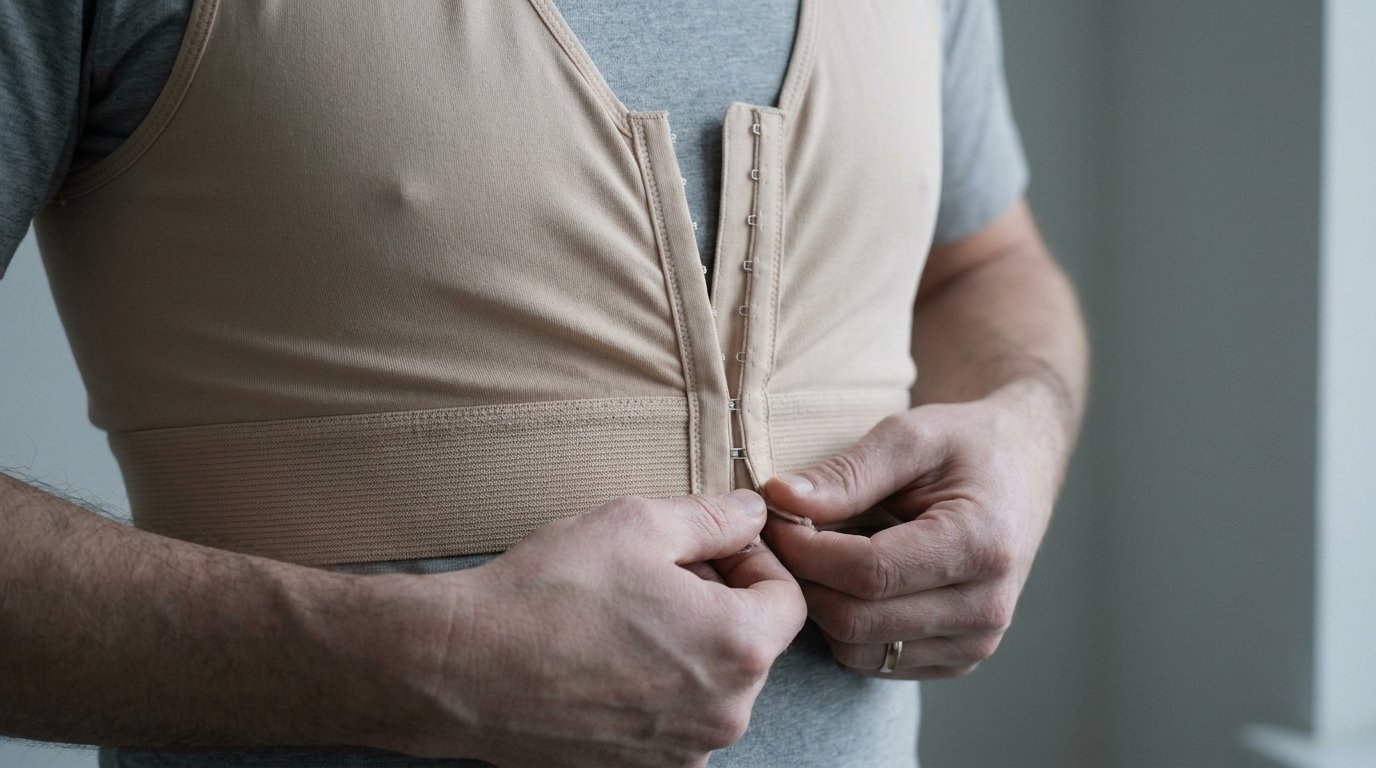
Desk work is often realistic within about a week, physical jobs need longer, and upper-body training usually waits four to six weeks depending on what was done. Swelling settles gradually, and the final chest shape takes months rather than weeks to declare itself. Our week-by-week gynecomastia recovery timeline sets out that progression in detail, and the scar expectations guide covers how the incisions mature.
If you are travelling for surgery, build the stay around the first wound check rather than around the flight price. A week in the country is a common plan: a day or two before surgery for assessment and tests, then enough time afterwards for the dressing change and a clearance review before flying. Keep moving gently to reduce clot risk, wear the garment on the plane, and accept that lifting heavy luggage is off the table.
- →Days 1-3: Tightness, bruising and drainage from small incisions; garment on continuously.
- →Week 1: Wound check, dressings simplified, light desk work often possible.
- →Weeks 2-4: Bruising fades, swelling still masks the contour, no gym.
- →Weeks 4-8: Gradual return to upper-body training with surgeon approval.
- →Months 3-6: Shape settles, scars begin to pale, final result becomes clear.
Safety and how to judge the clinic behind the price
Price only means something once you know who is operating and where. In the UK, you can confirm a surgeon is on the GMC specialist register and look for plastic surgery credentials; organisations such as BAAPS exist partly so patients can sanity-check a surgeon’s standing. Abroad, the equivalent is asking for the surgeon’s specialist board certification by name, the hospital’s accreditation, and confirmation that an anaesthetist is present for general anaesthesia.
Be wary of any arrangement where you cannot find out who will hold the scalpel until you arrive. Coordinator-led bookings that name the hospital but not the surgeon are a recurring complaint in overseas cosmetic surgery, and gynecomastia in particular is often treated as a quick add-on to a busy list. Our broader look at whether plastic surgery in Turkey is safe sets out the checks that matter, and the gynecomastia surgery in Turkey page explains how the pathway typically runs.
Results also depend on realistic expectations. Chest surgery removes tissue; it does not guarantee a particular silhouette, and some men need a small touch-up for residual fullness or asymmetry. Ask how often that happens in the surgeon’s own practice and who pays if it does. Longevity is generally good once mature glandular tissue is removed, though weight gain, steroid use or new medication can change the chest again — a point we expand on in how long gynecomastia results usually last.
This article is for informational purposes only and does not constitute medical advice. Always consult a qualified surgeon for personalised guidance.
Named, board-certified surgeon you can verify; written quote listing what is and is not included; clear revision policy; an accredited hospital with an anaesthetist; honest discussion of scars and the chance of a touch-up.
Price quoted before any assessment; surgeon’s identity withheld until arrival; pressure to pay a deposit the same day; promises of a flawless or scar-free chest; no plan for what happens if a complication appears after you fly home.
If the enlargement is recent, medication-related or hormonal, treating the cause can help. Fat-dominant chests can respond to sustained weight loss and training. True glandular tissue, however, does not shrink with diet or exercise.
Frequently Asked Questions
References
- 📎NHS — Cosmetic procedures: what to consider and who pays
- 📎British Association of Aesthetic Plastic Surgeons (BAAPS)
Related Articles


You Might Also Like


Related articles

Our specialists
 Clineca SpecialistErkan PinegözPlastic & Reconstructive Surgery
 Clineca SpecialistHakan AktaşPlastic & Reconstructive Surgery
 Clineca SpecialistOrkun UzuneyüpoğluPlastic & Reconstructive Surgery
 Clineca SpecialistSalim İskenderPlastic & Reconstructive Surgery
 Clineca SpecialistEngin SelamioğluPlastic & Reconstructive Surgery
 Clineca SpecialistCem AydınPlastic & Reconstructive Surgery
 Clineca SpecialistAlperen ÖnalEar, Nose & Throat (ENT)