

Have a question about Face Lift?
In this article
- What is the real difference between a deep plane facelift and a standard facelift?
- Who usually benefits more from a deep plane facelift?
- When is a standard facelift the smarter choice?
- How do results, scars and recovery usually compare?
- What are the trade-offs in safety, cost and travel planning?
- What should you ask in consultation before choosing either option?
If you are wondering whether you should choose a deep plane facelift or a standard facelift, the real question is not which one sounds more advanced. It is which technique matches your face, your ageing pattern, your scar tolerance, your recovery window, and your surgeon’s actual skill with that method.
What is the real difference between a deep plane facelift and a standard facelift?
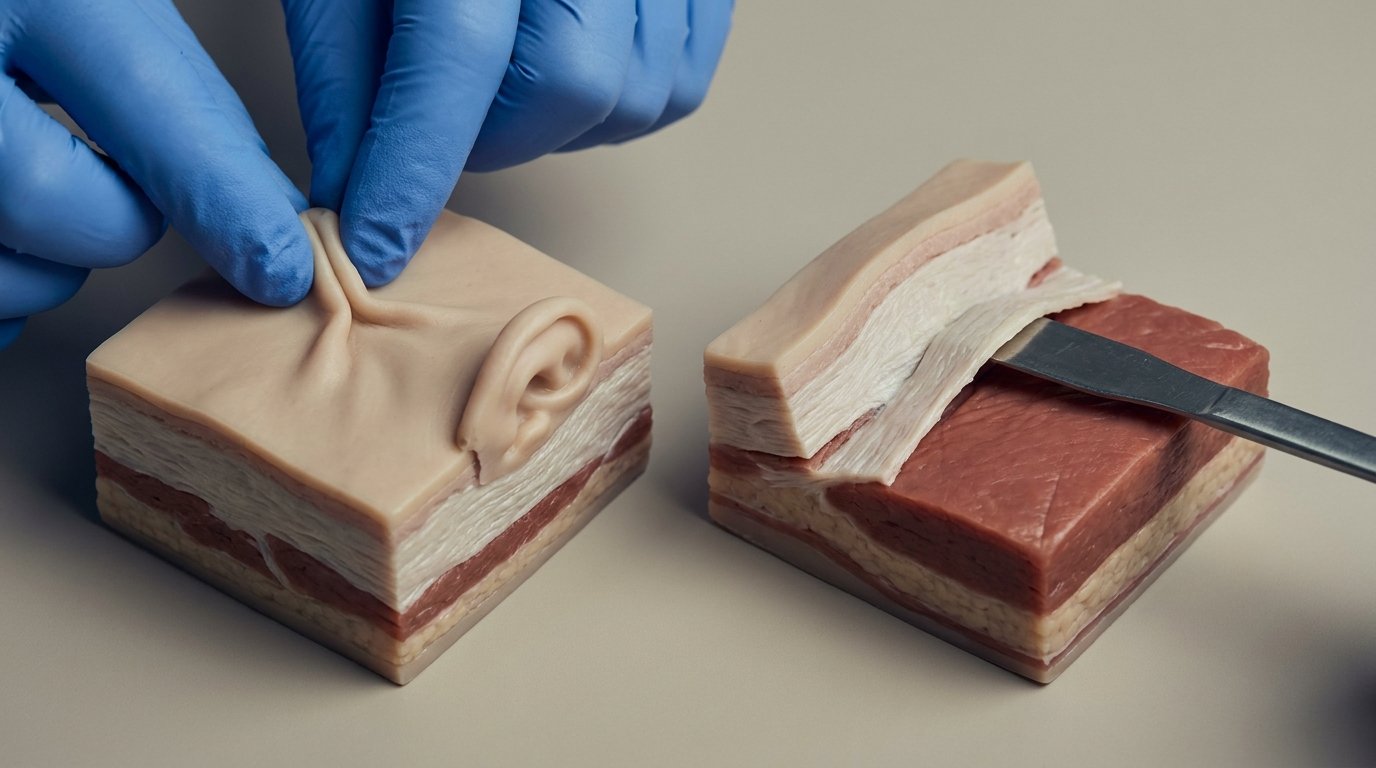
Both operations aim to lift a descended face, soften jowls, improve jawline definition, and reduce loose skin. The difference is the layer where the surgeon works and how the lift is created.
In a standard facelift, the surgeon usually lifts and repositions the skin and the SMAS layer. SMAS stands for the fibrous layer under the skin that helps shape the cheeks and jawline. There are several “standard” methods inside this category, which is why patients sometimes get confused: one surgeon may mean a SMAS plication or SMAS flap, while another may mean a more traditional skin-plus-SMAS lift.
In a deep plane facelift, the surgeon works under the SMAS in a deeper tissue plane, releasing retaining ligaments so the cheek and jaw can move as one unit with the skin. That is why deep plane surgery is often discussed for patients with heavier midface descent, deeper folds around the mouth, or a “pulled skin” look they want to avoid.
According to a 2016 review in Facial Plastic Surgery Clinics of North America, facelift surgery has evolved into multiple techniques that can achieve good outcomes, and the real debate is often not whether one method is universally superior, but which approach best fits the anatomy and goals of the patient. That is the most useful way to think about this choice.
A deep plane facelift is not automatically better because it is newer-sounding or more specialised. A standard facelift is not automatically outdated. The right operation is the one that addresses the tissues that are actually ageing on your face.
It lifts deeper facial tissues together rather than pulling mainly on the skin.
It usually lifts skin and the SMAS layer, with several proven technique variations.
Who usually benefits more from a deep plane facelift?
Deep plane surgery is often a better fit when the cheeks have dropped noticeably, the nasolabial folds are deeper, and the lower face looks heavy rather than simply loose. In those patients, lifting deeper tissue can create a more integrated change from the cheek down to the jawline.
It can also suit patients who want stronger improvement in the midface. A standard facelift usually does a very good job on jowls and the jawline, but it may do less for cheek descent depending on the exact technique used. That distinction matters, because many people think they need “skin tightening” when the bigger issue is tissue descent lower down.
This does not mean every patient with visible ageing needs a deep plane lift. If your main concern is early jowling, mild skin laxity, or the beginning of neck looseness, a well-done standard SMAS facelift may be enough. Some patients are better served by a mini facelift, especially if ageing is still limited. If that sounds close to your situation, this article on a mini facelift in your 40s may help you frame the question more clearly.
A qualified surgeon should assess your skin quality, facial volume loss, ligament tightness, neck ageing, and bone structure before recommending a technique. A face with heavy sagging but poor skin elasticity is different from a face with mild sagging and volume loss. Those two people may need very different plans.
📋 A common misconception Deep plane surgery is not chosen by age alone. Two people of the same age can need very different operations.
When is a standard facelift the smarter choice?
A standard facelift can be the smarter choice when your ageing changes are real but not severe, and when your main goal is cleaner jawline definition rather than major midface repositioning. It can also be a sensible option if your surgeon has much stronger experience with SMAS-based facelifts than with deep plane surgery.
That last point matters more than marketing. A technically sound standard facelift from a surgeon who performs it regularly is usually a safer bet than choosing a deep plane lift from someone who offers it because patients ask for it but does not have a long, consistent track record.
Standard facelifts may also make sense in patients who need a broader plan rather than a deeper dissection alone. Sometimes the best result comes from combining a standard facelift with a neck lift, fat transfer, or eyelid surgery. If the neck is a major issue, you may also want to read about neck lift candidacy when you have loose skin.
One more practical point: “standard facelift” is not one operation with one fixed result. It covers several established methods, so you need to ask which standard technique the surgeon means, what it improves best, and where its limits are on your face.
Because it sounds more premium or because social media presents it as the only modern facelift.
Because your ageing pattern is moderate and your surgeon can show consistent, natural results with that method.
How do results, scars and recovery usually compare?
Patients often expect a dramatic difference in every category, but the reality is more nuanced. The scar pattern is often similar because many facelifts, whether deep plane or standard, use incisions around the ear and hairline. In everyday life, the bigger visible difference tends to come from how natural the lift looks, not from the label attached to the technique.
Recovery can overlap more than people think. Swelling, bruising, tightness, numbness around the ears, and a socially presentable phase that takes a few weeks are common with either method. Deep plane surgery may involve more dissection, which can mean a more involved early recovery in some hands, but that is not a universal rule. Individual healing, drain use, combined procedures, and how much neck work is done can matter just as much.
If you are comparing the two because you are trying to plan travel and time away from work, focus less on the name of the facelift and more on the actual recovery plan your surgeon uses. This guide on how long recovery takes after a facelift is useful for that part of the decision.
A 2025 article in Aesthetic Surgery Journal discussed endoscopic deep plane facelift approaches and highlighted the need for clearer frameworks for patient selection and reproducibility. That is important for patients: advanced techniques can be appealing, but they still depend heavily on careful case selection and surgeon experience.
What are the trade-offs in safety, cost and travel planning?
Neither operation should be framed as a simple upgrade over the other. Both are real surgery. That means bruising, swelling, asymmetry during healing, fluid collection, bleeding, infection, delayed wound healing, visible scarring, nerve irritation, and the possibility of revision. The NHS notes that cosmetic surgery carries risks and should be undertaken only after careful consideration. The American Society of Plastic Surgeons also stresses the importance of board-certified training, informed consent, and realistic expectations.
Deep plane facelift discussions often focus on elegance of movement and natural results, which can be true in the right hands, but patients should also ask about nerve safety, how often the surgeon performs this exact procedure, and whether the clinic can manage complications. A facelift is not just an operation day decision. It is also a follow-up and problem-solving decision.
Cost should be looked at qualitatively, not as a headline number. A quote may differ because of the surgeon’s experience, whether deep plane or SMAS work is planned, whether a neck lift is added, the hospital setting, anaesthesia, overnight nursing, garments or dressings, medication, and how many follow-up visits are included. If you are travelling, airport transfers, hotel nights, and in-person checks also affect the overall package. This article on an all-inclusive surgery package in Turkey explains the practical side well.
For international patients, the stay is usually longer than many first assume because stitches, swelling checks, drain removal if used, and early wound assessment need planning. Do not book a very short trip on the assumption that facelift surgery is just a one-day event. Ask who you contact after hours, how quickly the team replies, and whether the surgeon personally sees you before you fly home. Those organisational details strongly shape patient satisfaction.
⚠️ Be careful with premium branding A higher-sounding technique name does not prove better safety or better results for your face.
What should you ask in consultation before choosing either option?
The best consultation does not start with “Which facelift is your most advanced one?” It starts with “What is ageing on my face, and what operation actually fixes that?” A good surgeon should be able to explain this clearly, using your own photos and anatomy.
Ask to see before-and-after results from patients with a face similar to yours, not just the clinic’s most dramatic cases. Ask whether the improvement you want comes mainly from lifting, volume restoration, neck work, or eyelid surgery. Many patients considering facelift surgery also benefit from upper eyelid surgery or a neck lift, and some combine procedures for one recovery period. The key is whether that combined plan is safe for the length of anaesthesia and your health profile.
You should also ask these questions during consultation:
- ✓How often do you perform deep plane facelifts, and how often do you perform standard SMAS facelifts?
- ✓Which exact technique are you recommending for me, and what limitation would the other option have on my face?
- ✓Where will my incisions sit, and what parts of my face and neck will improve the most?
- ✓What is the expected recovery timeline for swelling, social downtime, and flying home?
- ✓What problems would make you advise against surgery or suggest a smaller operation instead?
If the answers feel vague, overly sales-driven, or dismissive of trade-offs, step back. Good facelift planning should feel specific and calm, not pressured.
This article is for informational purposes only and does not constitute medical advice. Always consult a qualified surgeon for personalised guidance.
- ✓Choose the surgeon before you choose the technique.
- ✓Ask what anatomical problem is being corrected on your face.
- ✓Request before-and-after examples close to your own ageing pattern.
- ✓Clarify travel stay, follow-up schedule and who manages complications.
Frequently Asked Questions
References
- 📎Facelift Controversies — Facial Plastic Surgery Clinics of North America, 2016
- 📎Endoscopic Deep Plane Facelift: A Classified Approach — Aesthetic Surgery Journal, 2025
- 📎Temporal Facelift: A New Method for Temporal and Mid-face Lifting — Journal of Craniofacial Surgery, 2023
- 📎Cosmetic procedures guidance — NHS
Related Articles



You Might Also Like



Related articles



Our specialists
 Clineca SpecialistErkan PinegözPlastic & Reconstructive Surgery
 Clineca SpecialistHakan AktaşPlastic & Reconstructive Surgery
 Clineca SpecialistOrkun UzuneyüpoğluPlastic & Reconstructive Surgery
 Clineca SpecialistSalim İskenderPlastic & Reconstructive Surgery
 Clineca SpecialistEngin SelamioğluPlastic & Reconstructive Surgery
 Clineca SpecialistCem AydınPlastic & Reconstructive Surgery
 Clineca SpecialistAlperen ÖnalEar, Nose & Throat (ENT)