
Have a question about Face Lift?
In this article
- A simple facelift swelling timeline
- How swollen will your face actually look in the mirror?
- Why does swelling vary so much from one person to another?
- When should swelling worry you rather than reassure you?
- What helps swelling settle faster without risking the result?
- How long should you stay in Turkey, and what affects the quote?
- Does combining a facelift with other facial surgery change the swelling timeline?
If you are wondering how swollen will my face be after a facelift and when does it settle, you are asking one of the most practical questions in facelift recovery. Most people are less worried about the stitches than about when they will look presentable, when the tightness eases, and how to tell normal puffiness from a problem.
A simple facelift swelling timeline
Swelling after a facelift is usually most obvious in the first several days, often peaking around day 2 to day 4. By the end of the first week, many people still look clearly swollen, especially around the cheeks, jawline and in front of the ears, but the direction should be gradual improvement rather than worsening.
By 2 to 3 weeks, a lot of the heavier puffiness has settled. You may still feel tight, firm or slightly uneven, and there can be more swelling on one side than the other for a while. That asymmetry is often unsettling, but it is common during healing.
By 4 to 6 weeks, most people look much more like themselves in day-to-day life. There can still be mild fullness, especially first thing in the morning, after salty food, or after a long day upright. Final settling is slower. A facelift can keep refining over several months, particularly if you had a deeper dissection, a neck lift, fat grafting, or eyelid surgery at the same time.
That broad pattern fits many recoveries, but it is not a promise. The NHS notes that bruising and swelling are expected after cosmetic surgery, and plastic surgery texts and journal literature describe facelift recovery as a process measured in weeks for social recovery and months for final tissue settling rather than days.
📋 Early swelling can look worse than expected A facelift often looks tight and overfilled in the first week. That early look is not your final result.
How swollen will your face actually look in the mirror?
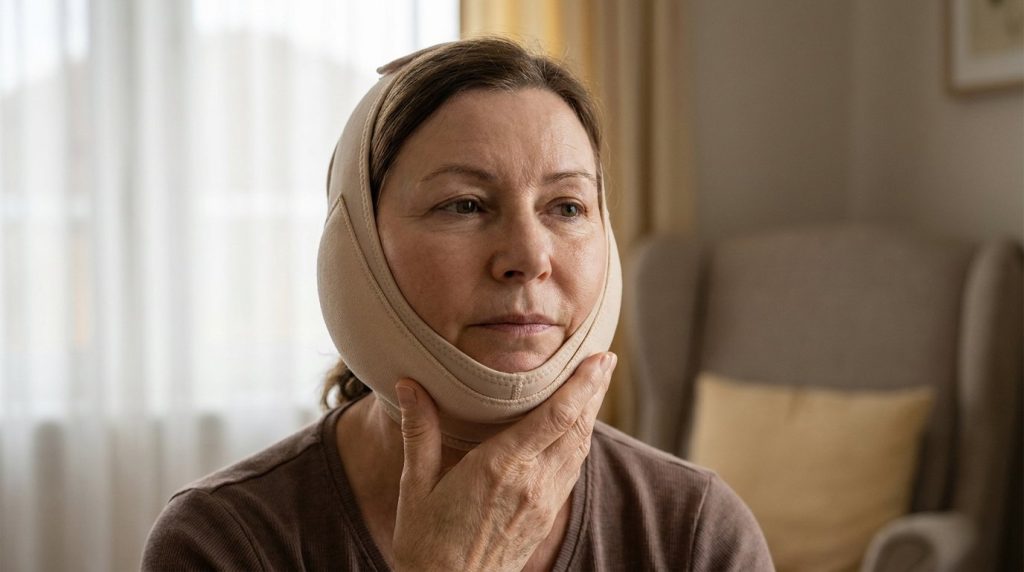
The honest answer is that the first week can be a shock if you were picturing a neat, discreet recovery. A normal amount of facelift swelling can make the lower face look broad, the cheeks look higher or heavier than expected, and the area under the chin feel thick or stiff. Some people describe it as looking like they are wearing a puffy version of their own face.
It is also normal for the skin to feel firm, numb and tight, not just swollen. Those feelings are part of the healing process because the skin and deeper tissues have been lifted and repositioned. If your facelift included the neck, swelling often travels downward under the jaw, which can temporarily blur the sharper angle you expected.
Bruising and swelling do not always match. You can have a lot of swelling with little bruising, or the opposite. If you also had a neck lift or eyelid surgery, expect the whole face to look more “worked on” for longer than someone who had a more limited lift alone.
If you want a broader view of recovery rather than swelling alone, our article on how long recovery takes after a facelift explains when most patients return to normal routines. If your surgeon is discussing technique, the trade-offs in deep plane vs standard facelift also help explain why one recovery may look more swollen than another.
Why does swelling vary so much from one person to another?
There is no single facelift swelling timeline that fits everyone. The amount of swelling depends on how extensive the surgery was, how much tissue was lifted, whether the neck was treated too, and whether another procedure was added. A mini facelift usually settles faster than a more extensive deep-plane or full lower-face-and-neck operation, although your own anatomy matters just as much as the technique.
A few practical factors make a real difference:
- ✓Surgical extent: a larger dissection usually means more swelling.
- ✓Combined procedures: neck lift, fat transfer or eyelid surgery can lengthen the visible recovery phase.
- ✓Bleeding tendency: some patients bruise and swell more easily than others.
- ✓Aftercare: keeping the head elevated, avoiding strain and following dressing advice can reduce lingering puffiness.
- ✓Smoking and nicotine exposure: these can impair healing and increase complication risk.
- ✓Salt, dehydration and activity: these often make swelling fluctuate day to day.
Age alone does not tell you much. Skin quality, tissue laxity, previous facial surgery, and general health can matter more. This is one reason good clinics avoid making firm promises from photos alone.
If you are travelling for surgery, it helps to ask not only how long you need to stay, but also when the team expects peak swelling, what reviews are scheduled, and who you contact if one side suddenly enlarges after discharge. Those small organisation details often matter as much as the operation itself.
When should swelling worry you rather than reassure you?
Most swelling after a facelift is normal. The concern is not that you look puffy, but how the swelling behaves and what comes with it.
A small left-right difference can be normal. What is not reassuring is rapidly increasing one-sided swelling, especially if it is tense, painful, and appears suddenly in the first hours or first couple of days. That pattern raises concern for a haematoma, which means a collection of blood under the skin. Facelift literature in journals such as Plastic and Reconstructive Surgery describes haematoma as one of the best-known early complications after rhytidectomy, the medical term for facelift. It needs prompt assessment because pressure on tissues can affect healing.

Infection is less common early on than simple swelling, but the warning pattern is different: increasing redness, warmth, tenderness, foul-smelling drainage, fever, or swelling that gets worse after it had started improving. The Mayo Clinic and NHS both advise patients after procedures to seek medical review for worsening pain, fever, discharge, or unexpected swelling rather than assuming it is routine recovery.
You should contact your surgeon or the emergency contact provided by your surgical team urgently if you have:
- ✓Sudden enlargement on one side of the face or neck
- ✓Significant increasing pain or tight pressure not relieved as advised
- ✓Bleeding that soaks dressings
- ✓Fever, spreading redness, or pus-like drainage
- ✓Shortness of breath, chest pain, or calf swelling
The last group is not specific to facelift swelling, but it still matters. Any surgery carries general postoperative risks, and those symptoms should never be watched at home.
If your neck was lifted too, some swelling patterns overlap with neck-lift healing. Our article on how long swelling lasts after a neck lift can help you understand what is shared and what is different.
⚠️ Call urgently for fast one-sided swelling A suddenly expanding, tense, painful area in the first day or two can suggest a haematoma and should be assessed promptly.
🚨 Do not wait on infection signs Redness that spreads, heat, fever, bad-smelling drainage or swelling that worsens after initial improvement needs medical review.
What helps swelling settle faster without risking the result?
The basics are not glamorous, but they work. Keep your head elevated, even when resting, unless your own surgeon has given different instructions. Avoid bending, straining, heavy lifting and vigorous exercise too early, because those can increase pressure and prolong swelling.
Cold compresses are sometimes advised for nearby areas in the very early phase, but only if your surgeon specifically allows them and tells you where to place them. You should not improvise pressure or ice directly over healing facelift flaps. Facelift skin can have reduced sensation for a while, so tissue is easier to over-cool or irritate than you might think.
Hydration, gentle walking and a lower-salt diet in the first recovery period often help day-to-day swelling control. So does patience. Many patients become anxious at two weeks because they expected a finished result by then. In reality, week two is usually the phase when things are better, but still not settled.
If you are planning treatment abroad, it is worth asking what the package includes in practical terms rather than only focusing on the operation itself. Our article on what an all-inclusive surgery package usually includes explains why nursing support, transfers and follow-up access can make recovery feel much smoother.
How long should you stay in Turkey, and what affects the quote?
For a facelift, travel plans should leave room for the period when swelling is changing quickly and early checks matter most. In practice, patients usually need to stay long enough for the first postoperative review, dressing changes if used, and confirmation that there is no concerning fluid collection, skin-healing issue or blood-pressure-related problem. Flying too soon is less about a fixed rule than about whether your surgeon is happy with your early recovery.
A personalised quote usually depends on the extent of the facelift, whether a neck lift or eyelid surgery is added, the hospital setting, anaesthesia, aftercare intensity and what non-medical services are bundled in. Good quotes also make clear whether hotel stay, transfers, garments or dressings, medication, and follow-up reviews are included. The safest way to compare offers is not to look for the lowest headline figure, but to check who the operating surgeon is, what accreditation they hold, where the surgery takes place, and how complications are handled if swelling does not follow the expected path.
Professional standards matter here. Look for surgeons with recognised specialist training and board credentials, and ask where the operation will be performed and who is responsible for aftercare. EBOPRAS is one recognised European board in plastic surgery, and BAAPS and ASPS patient guidance both stress choosing a properly qualified surgeon and having clear postoperative support.
The clinic gives a written recovery plan, named emergency contact, and clear review schedule before you travel.
You are given a generic quote with little detail about who operates, where surgery happens, or what happens if swelling suddenly worsens.
Does combining a facelift with other facial surgery change the swelling timeline?
Yes, often quite a bit. A facelift combined with a neck lift usually creates more visible lower-face and under-chin swelling than a facelift alone, even when the final contour may end up better balanced. Adding upper eyelid surgery can make the whole face look more bruised and puffy, which sometimes makes patients think the facelift itself has gone wrong when it has not.
Rhinoplasty can also complicate the social recovery picture because the swelling is then spread across more than one facial area, each with its own timeline. That does not always mean combining is a bad idea. It means you should judge recovery by the slowest-healing area, not the fastest one.
This is one reason surgeons sometimes advise staging procedures rather than doing everything at once, especially for patients who need a very predictable social return. If you are considering combination surgery, ask which procedure is most likely to control when you look presentable, when you can fly home comfortably, and how many days you should reserve before public-facing work.
Frequently Asked Questions
References
- 📎PubMed: rhytidectomy hematoma complication facelift postoperative
- 📎PubMed: facelift recovery swelling postoperative rhytidectomy
- 📎NHS: Cosmetic procedures
- 📎EBOPRAS
Related Articles



You Might Also Like



Related articles



Our specialists
 Clineca SpecialistErkan PinegözPlastic & Reconstructive Surgery
 Clineca SpecialistHakan AktaşPlastic & Reconstructive Surgery
 Clineca SpecialistOrkun UzuneyüpoğluPlastic & Reconstructive Surgery
 Clineca SpecialistSalim İskenderPlastic & Reconstructive Surgery
 Clineca SpecialistEngin SelamioğluPlastic & Reconstructive Surgery
 Clineca SpecialistCem AydınPlastic & Reconstructive Surgery
 Clineca SpecialistAlperen ÖnalEar, Nose & Throat (ENT)