
Have a question about BBL?
In this article
- How long after a BBL can you fly?
- Why flying soon after a BBL raises the risk of a blood clot
- Will sitting on the plane ruin your BBL results?
- How to plan the flight itself
- How long to stay in Turkey before flying home
- Warning signs that mean you should not board
- What travel after a BBL adds to your budget
Most people book the return flight long before they read the post-operative instructions. Then the surgery date arrives, and flying after a BBL turns out to be the one part of the trip that cannot simply be rescheduled around a cheap fare. It is worth understanding why the timing matters as much as it does, because two very different problems are competing for your attention in the same week: the health of your veins and the survival of the fat that was just transferred.
How long after a BBL can you fly?
There is no single number that applies to everyone, and any clinic that gives you one before surgery is guessing. In practice, most surgeons want at least seven to ten days between a Brazilian butt lift and a flight, and they often prefer closer to two weeks when the journey is long or when liposuction was extensive.
The reason the window stretches is that flight length, not the flight itself, is what raises the risk. A short hop where you are seated for ninety minutes is a very different proposition from a twelve-hour journey with a connection, a delayed gate and three hours of sitting before you even board.
Count door to door, not wheels up. Transfer to the airport, check-in queues, security, waiting at the gate, the flight, baggage reclaim and the drive home can easily double the time you spend sitting or standing still. When your surgeon asks how long the journey is, that total is the honest answer.
The figures below reflect how post-operative travel is commonly timed in practice. Your own clearance depends on how much fat was harvested, whether another procedure was done at the same time, your weight, whether you smoke, your clotting history and how your first week actually went.
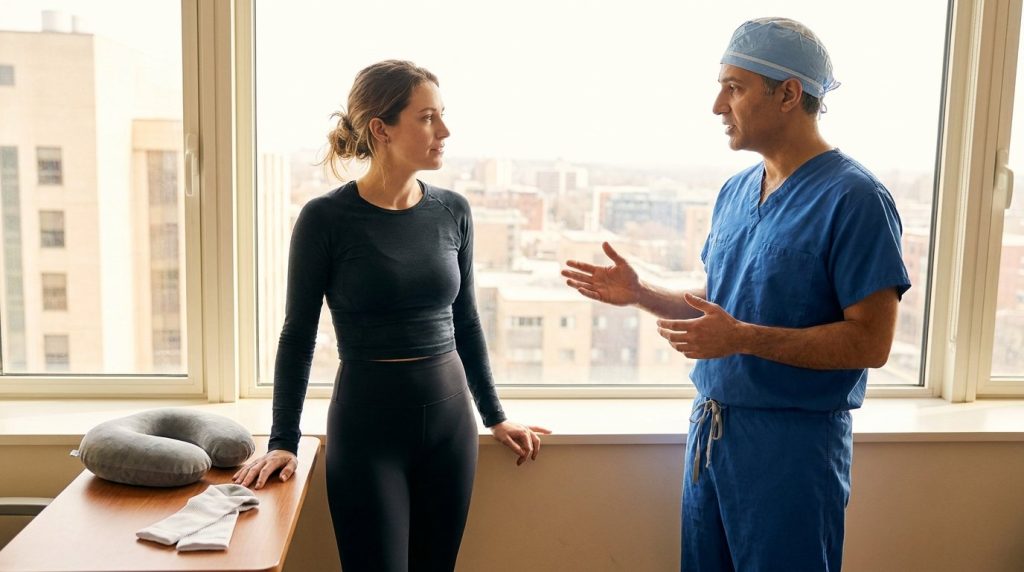
📋 Your clearance is a clinical decision, not a date The final answer comes from the surgeon who operated on you, after a physical check close to your travel date. Build a few days of slack into your plans so that a cautious "wait another three days" does not cost you a non-refundable ticket.
Why flying soon after a BBL raises the risk of a blood clot
Any operation makes the blood more likely to clot for a while afterwards. That is a normal healing response, but it is also the reason surgeons pay such close attention to travel in the first weeks. A BBL involves liposuction to harvest the fat, so the operation treats a wide area of the body and often takes several hours under general anaesthesia — a combination associated with a higher clotting risk than a short, small procedure.
A long flight then adds the things that make clots more likely: hours with your legs still and bent, a cabin that is dry enough to leave you mildly dehydrated, cramped footwells, and often a glass of wine or a sleeping tablet that keeps you in one position far longer than you intended.
A clot that forms in a leg vein is called a deep vein thrombosis. The serious complication is a piece of that clot travelling to the lungs, known as a pulmonary embolism, which is a medical emergency. This is the single reason flight timing after body contouring surgery is treated so seriously, and it is why early walking matters more than rest in the first week.
What actually lowers the risk
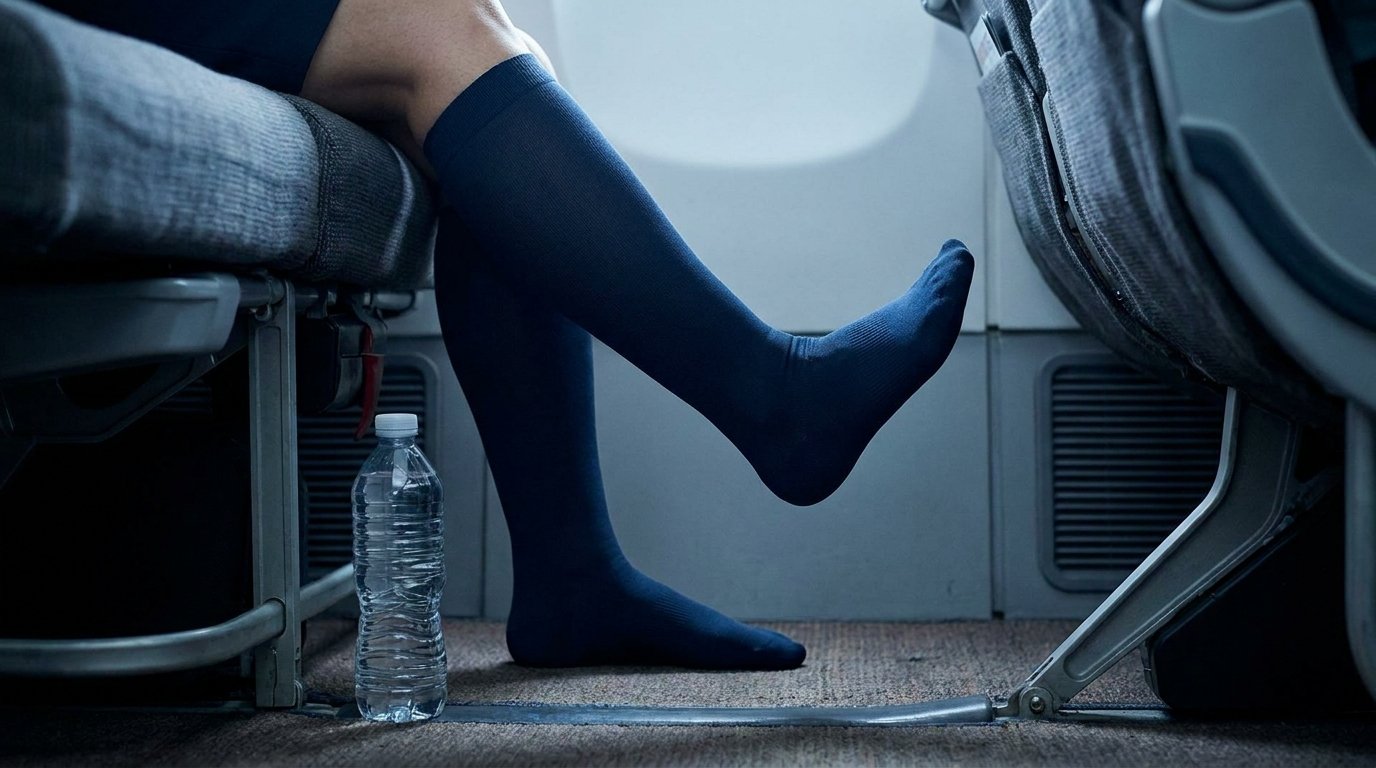
Moving is the most effective thing you control. Short, frequent walks from the day after surgery, graduated compression stockings if your surgeon prescribes them, proper hydration, and in higher-risk patients a short course of injectable blood thinners are the standard measures. Some patients are advised to stay longer rather than fly at all within the first fortnight.
None of this makes a flight risk-free, and preventive medication is not a licence to sit for ten hours without moving. Treat the stockings and the walking schedule as a package, not alternatives to each other.
⚠️ Alcohol and sleeping tablets are the wrong travel companions Both leave you more dehydrated and far less likely to get up and move. For the first flight after surgery, water and an aisle seat do more for you than anything from the drinks trolley.
Will sitting on the plane ruin your BBL results?
Transferred fat has no blood supply of its own at first. It survives by connecting with the tissue around it over the following weeks, and firm, sustained pressure on the area works against that process. This is why you are told to avoid sitting directly on your buttocks after a BBL, and why many surgeons allow only short, cushioned sitting for the first few weeks. Our longer piece on how long you need to avoid sitting after a BBL goes through the full schedule.
An aeroplane seat is the hardest place in the world to honour that rule, which is exactly why the flight home is scheduled rather than assumed. The goal is not to avoid sitting entirely — that is impossible on a flight — but to keep your body weight off the grafted area and spread it onto your thighs and the back of your legs instead.
A firm cushion placed under your thighs, with nothing under the buttocks, does most of that work. Reclining the seat shifts weight onto your back. Standing briefly whenever the cabin allows it breaks up the pressure. If two seats next to you are free, lying across them on your side is better than any cushion.
One carefully managed flight is unlikely to undo a good result. Hours of direct, unrelieved pressure in the first couple of weeks is a different matter, and it is one of the avoidable reasons some patients end up disappointed with volume on one side. If you want the wider picture of how shape settles, the week-by-week BBL recovery timeline explains what is normal and when.
An aisle seat so you can stand without climbing over anyone, extra legroom if available, a bulkhead row, or a direct flight over a cheaper route with a connection.
A window seat in a full row, a long layover, a middle seat that leaves you wedged in place, or a tight connection that forces you to rush through a terminal with hand luggage.
How to plan the flight itself
Most of the difficulty on travel day comes from the airport rather than the aircraft. Long walks between terminals, standing in queues and lifting a bag into an overhead locker are all things you can plan away in advance, and most of them are free.
Request airport assistance when you book, not at the desk on the day. It is a routine service, it removes the longest walks, and it usually means you board early and settle without a queue behind you. Keep your medication, garment spares and your surgeon’s contact details in your hand luggage, and let someone else lift it.
Ask your clinic for a short letter confirming the surgery, the date and your fitness to travel. Some airlines ask for medical clearance after recent surgery, policies differ between carriers, and the letter also helps if a security pat-down raises questions about your compression garment.
- ✓Move roughly once an hour: Walk the aisle when the seatbelt sign is off, and do ankle circles and calf pumps in your seat when it is on.
- ✓Drink water steadily: Skip alcohol and sedatives entirely on this flight; aim to need the toilet, which conveniently forces you to stand.
- ✓Wear your compression garment and any prescribed stockings: Choose loose, soft clothing over the top so nothing digs in during a long day of travel.
- ✓Bring a firm cushion for under your thighs: A dedicated post-operative pillow or a rolled blanket both work; what matters is that your buttocks are not bearing your weight.
- ✓Carry your paperwork: Fit-to-fly letter, operative summary, medication list and a 24-hour clinic contact number, in your hand luggage rather than the hold.
- ✓Choose flexible tickets if your budget allows: A changeable fare costs more up front and is far cheaper than rebooking at short notice if your surgeon asks you to stay longer.
How long to stay in Turkey before flying home
For patients travelling to Turkey, the stay is usually planned around the same window as the flight clearance: broadly seven to ten days, sometimes longer. That time is not padding. It covers the first dressing changes, drain removal if drains were used, a lymphatic massage programme in some plans, a garment fitting once the early swelling settles, and at least one face-to-face review before anyone signs off on travel.
It also keeps you within reach of the operating team during the days when problems are most likely to appear. A wound issue noticed on day six is a clinic appointment; the same issue noticed at home, three time zones away, becomes a much bigger logistical problem.
Worth knowing when you plan the trip: just over half of our BBL patients have a second procedure in the same session, most often liposuction or a tummy tuck. For them the flight home is paced by the larger operation rather than by the fat transfer, so if you are considering adding anything, plan a longer stay from the outset instead of hoping to compress it later. Our overviews of BBL in Turkey and combined surgery in a single trip set out how the schedules differ.
Book accommodation that is close to the clinic, has a lift, and lets you lie on your front or side comfortably. A hotel bed you cannot get in and out of without pressing on your buttocks will undo a lot of careful aftercare.
📋 Ask who covers you if you need to stay longer Before you travel, confirm in writing what happens to your accommodation, transfers and follow-up if your surgeon advises delaying the flight. Clinics differ, and it is a far easier conversation to have beforehand.
Warning signs that mean you should not board
Some symptoms are a reason to postpone a flight. A few are a reason to stop travelling altogether and get emergency care, wherever you happen to be.
Pain, swelling, warmth or redness in one calf or thigh can be a sign of a deep vein thrombosis. Breathlessness, chest pain, coughing up blood or feeling faint can signal a clot on the lung, which is a medical emergency — those same symptoms can also reflect blood loss after larger-volume liposuction, but the clot must be ruled out first and fastest. In either case this is not something to monitor overnight or save for a clinic appointment.
Infection behaves differently. A rising fever, spreading redness around the incisions, foul-smelling discharge or pain that is getting worse rather than better all need same-day assessment by your surgeon before you fly. Flying with an untreated infection takes you away from the only team that knows exactly what was done.
If symptoms begin during the flight, tell the cabin crew immediately rather than waiting for landing. Crews are trained for this, they can give oxygen and they can arrange for you to be met by medical staff on arrival.
This article is for informational purposes only and does not constitute medical advice. Always consult a qualified surgeon for personalised guidance.
🚨 Calf pain, breathlessness or chest pain: emergency care first If you develop pain or swelling in one leg, breathlessness, chest pain or you feel faint, go to A&E or call the local emergency number straight away, and contact your operating surgeon as well. Do not wait for a clinic appointment, and do not board a flight.
What travel after a BBL adds to your budget
The surgical fee is only part of the real cost of the trip, and the travel side is where people most often under-budget. Flying after a BBL tends to push you towards the more comfortable, more flexible and therefore more expensive version of every booking you make — and that is usually money well spent rather than an upsell.
Quotes are built around your individual plan, so the only figure that means anything is a personalised one issued after a consultation and a review of your medical history. What you can do in advance is understand which parts of the budget move, and why.
Standard travel insurance frequently excludes anything arising from elective surgery abroad. Read the policy wording before you buy, and look specifically for complications cover and repatriation. If you are comparing clinic packages, our breakdown of what an all-inclusive surgery package in Turkey actually includes is a useful checklist of what should already be covered.
Frequently Asked Questions
References
- 📎NHS – Deep vein thrombosis (DVT)
- 📎NHS – Pulmonary embolism
- 📎American Society of Plastic Surgeons – Complications from travelling after a Brazilian butt lift
Related Articles

You Might Also Like

Related articles


Our specialists
 Clineca SpecialistErkan PinegözPlastic & Reconstructive Surgery
 Clineca SpecialistHakan AktaşPlastic & Reconstructive Surgery
 Clineca SpecialistOrkun UzuneyüpoğluPlastic & Reconstructive Surgery
 Clineca SpecialistSalim İskenderPlastic & Reconstructive Surgery
 Clineca SpecialistEngin SelamioğluPlastic & Reconstructive Surgery
 Clineca SpecialistCem AydınPlastic & Reconstructive Surgery
 Clineca SpecialistAlperen ÖnalEar, Nose & Throat (ENT)