
Have a question about Rhinoplasty?
In this article
- Why your nose is not treated as a first-time case
- What the surgeon assesses before agreeing to operate
- How the operation itself is likely to differ
- Recovery: breathing usually gets worse before it gets better
- The honest trade-offs nobody should gloss over
- Cost, stay length and combining with other procedures
- Timing: how long to wait after polyp surgery
If you are asking what you should expect if you have rhinoplasty after nasal polyp surgery or a collapsed nasal passage, you are already asking a better question than most patients do. A nose that has been operated on, or one whose side walls have weakened and fallen inward, does not behave like an untouched nose on the operating table or during healing. That changes the planning, the technique and the honest conversation about what can and cannot be promised.
Why your nose is not treated as a first-time case
Polyp surgery — usually endoscopic sinus surgery — works inside the nose and sinuses rather than on the outer shape. It can still change what the surgeon finds: scar tissue in the nasal lining, altered turbinates, sometimes a septum that has already been partly used or straightened. None of that stops you having rhinoplasty. It simply means the surgeon is working with less spare tissue and more scarring than in a textbook first operation.
A collapsed nasal passage is a different problem with a similar consequence. When the side wall of the nose or the internal valve area is weak, the airway narrows every time you breathe in hard. Cosmetic reduction alone would make that worse, because thinning a nose that is already structurally weak removes the very support the airway depends on. So the operation is planned as a structural one: rebuild first, refine second.
This is also why the consultation matters more than usual. A 2011 review in Plastic and Reconstructive Surgery emphasised assessing both the appearance and the function of the nose before surgery and discussing the likely postoperative nose with the patient in advance — which is exactly the conversation a previously operated or collapsed nose demands. Expect questions about your breathing, your allergies, your sprays and your previous surgical reports, not only about the bump on your bridge.
📋 Bring your old records Operation notes, discharge summaries and any CT scan from your polyp surgery genuinely change the plan. If you can get a copy, send it before your consultation rather than mentioning it on the day.
What the surgeon assesses before agreeing to operate
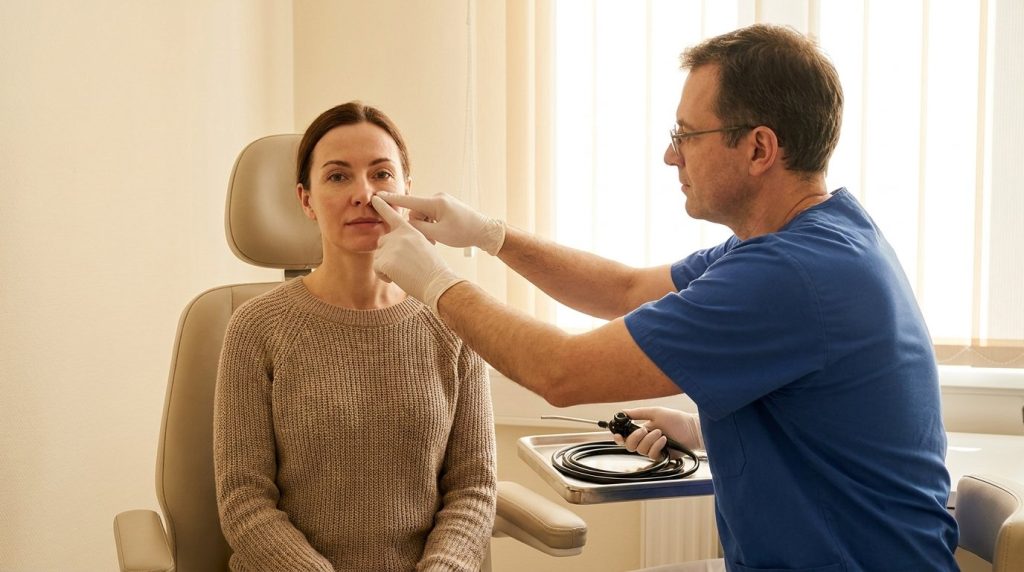
A previously operated nose needs more information before anyone quotes you a plan. Most surgeons will want a recent CT scan of the sinuses if polyps were the original problem, an internal examination (often with an endoscope, a thin camera passed into the nose) and a simple functional test where you breathe in while the surgeon gently supports the side wall of the nose. If your breathing improves noticeably when the wall is supported, valve collapse is part of your problem and the surgery has to address it.
Active polyps are the main reason a surgeon will ask you to wait. Inflamed nasal lining bleeds more, heals less predictably, and polyps that are still growing can return regardless of how well the outer nose is rebuilt. Your ENT treatment — sprays, rinses, sometimes biologic therapy — is expected to be stable and working before cosmetic and structural work is planned on top of it.
Age is rarely the obstacle patients assume it is. People who had sinus surgery years ago often come to us in their forties or later, and about one in seven of our rhinoplasty patients is over 40; the range is genuinely wider than the before-and-after photos online suggest. What matters far more than your age is whether your inflammation is controlled and whether there is enough usable cartilage to rebuild with.
How the operation itself is likely to differ
The word you will hear most is graft. To open and hold a collapsed passage, surgeons commonly place spreader grafts (thin strips of cartilage along the top of the septum), batten grafts against a weak side wall, or a columellar strut to support the tip. These pieces add support that a purely reductive operation would remove. Functionally that is the point; cosmetically it means the nose is built up in places rather than only trimmed down.
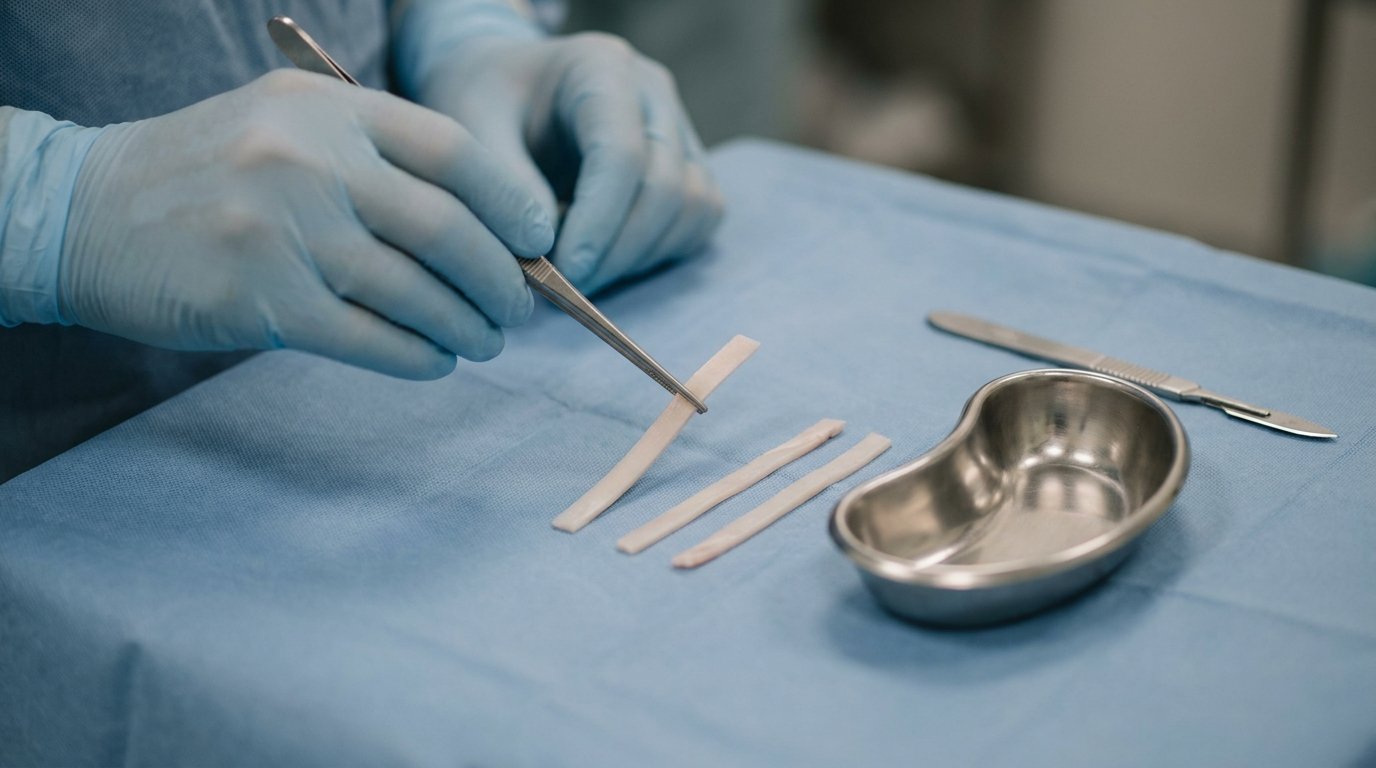
Where that cartilage comes from depends on your history. If your septum is intact, it is the first choice. If earlier surgery or a septal perforation has used it up, ear cartilage or a small piece of rib may be needed — which adds a second small incision, a little more discomfort in the first week and some extra operating time. This is worth clarifying in your consultation, because it affects both your recovery and your quote.
Septal work and turbinate work are often part of the same session rather than separate trips. If that applies to you, our explainers on combining septoplasty with rhinoplasty and on turbinate reduction alongside septum surgery cover what each part actually does.
- ✓Spreader grafts: Widen and stabilise the narrow internal valve where most collapse-related blockage happens.
- ✓Alar batten grafts: Stiffen a side wall that sucks inward when you breathe in deeply or exercise.
- ✓Columellar strut or septal extension graft: Support a drooping or weak tip so it holds its position long term.
- ✓Lining repair: Scarred or thinned lining from previous surgery sometimes needs releasing or grafting before shape work begins.
Recovery: breathing usually gets worse before it gets better
This is the part patients with a breathing history find most unsettling, so it is worth stating plainly. For the first week to ten days your nose will feel more blocked than it did before surgery, because of swelling inside the nasal lining, crusting and any internal splints. That is normal healing, not a failed operation. Patients who have had sinus surgery often recognise the feeling from that recovery.
Crusting and dryness tend to be more noticeable in a nose that has already been operated on inside, and saline rinses become your main job for several weeks. Pain itself is usually milder than people expect. A 2023 review in Facial Plastic Surgery reported that patients frequently use less than half of the opioid painkillers they are prescribed after rhinoplasty, and that simple combinations such as paracetamol and anti-inflammatories are the backbone of modern pain control — though what you are given depends on your surgeon and your own medical history.
Functional improvement follows a slower curve than the outside of the nose. Many people notice clearly easier breathing between weeks three and six, with further gains as internal swelling settles over several months. Our guides on when breathing feels normal again after rhinoplasty and the week-by-week rhinoplasty recovery timeline go into more detail.
⚠️ Contact your clinic, not a forum Fever, spreading facial pain, thick foul-smelling discharge, heavy bleeding or sudden one-sided blockage after things had improved all need to be assessed promptly. These are uncommon but worth acting on the same day.
The honest trade-offs nobody should gloss over
Rhinoplasty can rebuild the framework of your nose. It cannot cure the underlying condition that produced polyps in the first place. If chronic sinus inflammation or nasal polyposis is part of your history, it can return after a structurally perfect operation, and you will probably need to stay on your ENT treatment afterwards. Any clinic that implies surgery ends your sprays and follow-ups is overselling.
Scarred tissue is also less predictable. Skin that has been lifted before, or lining thinned by earlier surgery, contracts in ways that are harder to forecast, so the chance of needing a small revision is higher than in a first-time cosmetic case. Most surgeons will not consider revision before around a year, once swelling has fully resolved — our piece on swelling after revision rhinoplasty explains why that wait exists.
There is a genuine aesthetic trade-off too. A nose that needs structural support may end up very slightly wider or straighter along the bridge than a purely cosmetic plan would produce, because the grafts holding your airway open take up space. Good surgeons will say this out loud at the consultation and show you where the compromise sits. If breathing is your priority, it is usually the right compromise.
A stronger, straighter nose that breathes more reliably, with a refined but not dramatically narrowed appearance.
A very narrow, heavily reduced nose plus perfect airflow, with no further need for ENT treatment.
Functional surgery alone — septal, valve or turbinate work without cosmetic reshaping — may be all you need, and can be discussed with an ENT surgeon first.
Cost, stay length and combining with other procedures
No honest quote for this kind of nose can be given from a photograph. What drives the price is the complexity of the work: whether grafts are needed and where the cartilage comes from, whether septal or turbinate surgery is included, how long you will be under anaesthesia, and whether imaging or an ENT assessment is part of the workup. A quote for a complex functional case is normally higher than for a straightforward cosmetic reshaping, and a package usually covers the surgeon and anaesthesia team, hospital time, standard medication and follow-up while you are in the country — you should ask exactly what is listed and what a possible revision would involve. Your personalised price is confirmed after consultation and review of your records. Our breakdown of what affects rhinoplasty cost, your quote and your stay sets out the variables in more detail.
Plan on roughly a week to ten days in Turkey rather than the shorter trip sometimes advertised, because splint removal and a proper airway check should happen before you fly. If your case includes internal work, that first post-op review is not optional — see our notes on rhinoplasty travel plans and stay length.
Combining rhinoplasty with another operation in one anaesthetic is common, and eyelid surgery or breast procedures are the usual partners. With a reconstructed airway, though, comfort in the first days matters more than usual: you will be breathing through a swollen nose while recovering from a second site. It is a reasonable plan for fit patients, but it should be your surgeon’s suggestion after examining you, not a package upgrade offered before anyone has seen your scan.
📋 Choosing a clinic for a complex nose Ask specifically how many previously operated or valve-collapse noses the surgeon handles, whether rib or ear cartilage is used when needed, and who reviews you if you develop a problem after flying home. A surgeon who works alongside ENT colleagues is a good sign for this type of case.
For prices, package contents and safety checks for a primary case, see our rhinoplasty in Turkey cost and safety guide.
Timing: how long to wait after polyp surgery
Most surgeons prefer a clear gap between sinus or polyp surgery and structural rhinoplasty, commonly several months, so that inflammation has settled and the internal lining has healed. The decision is less about the calendar and more about the state of your nose: controlled symptoms, stable medication, no active infection and a clean endoscopic examination.
If you are still in the first weeks after polyp surgery, use the time to get your records together, photograph your nose in good light from the front, side and below, and note what your breathing is actually like at rest, at night and during exercise. That description is genuinely useful to a surgeon planning your case, and it makes the consultation far more productive than a list of celebrity noses.
Rhinoplasty also has a psychological side that is worth naming. A 2024 literature review in Maedica examined the psychosomatic dimensions of rhinoplasty and its effect on quality of life, noting how closely outcomes are tied to these factors — which is a reasonable argument for going into surgery with clear, discussed expectations rather than hopes formed online.
This article is for informational purposes only and does not constitute medical advice. Always consult a qualified surgeon for personalised guidance.
Frequently Asked Questions
References
- 📎Rhinoplasty — Plastic and Reconstructive Surgery, 2011
- 📎Opioid-Sparing Pain Control after Rhinoplasty: Updated Review of the Literature — Facial Plastic Surgery, 2023
- 📎Psychosomatic Dimensions of Rhinoplasty and Their Role in Quality of Life and Self-Care — Maedica, 2024
- 📎NHS: Cosmetic procedures
Related Articles



You Might Also Like



Related articles



Our specialists
 Clineca SpecialistErkan PinegözPlastic & Reconstructive Surgery
 Clineca SpecialistHakan AktaşPlastic & Reconstructive Surgery
 Clineca SpecialistOrkun UzuneyüpoğluPlastic & Reconstructive Surgery
 Clineca SpecialistSalim İskenderPlastic & Reconstructive Surgery
 Clineca SpecialistEngin SelamioğluPlastic & Reconstructive Surgery
 Clineca SpecialistCem AydınPlastic & Reconstructive Surgery
 Clineca SpecialistAlperen ÖnalEar, Nose & Throat (ENT)