
Have a question about Tummy Tuck?
In this article
- What diastasis recti is, and why core workouts can make it look worse
- Can physiotherapy or exercise close the gap instead?
- How surgeons repair ab separation
- Why diastasis recti repair and a tummy tuck usually go together
- Recovery after a muscle repair, week by week
- Does repairing the separation actually help back pain and leaking?
- What drives the cost of diastasis recti repair
- Risks, and the chance the separation comes back
- Choosing a surgeon and planning the trip
If your stomach still pushes forward months or years after pregnancy, even though the scales say you are back where you started, the issue may not be fat or loose skin at all. Diastasis recti repair is the surgical step that deals with the gap between the two long muscles that run down the front of your abdomen, and it sits at the centre of a lot of confusion about tummy tucks, core exercise and what each one can genuinely change. The sections below walk through how the repair is done, who actually needs it, and what the healing period really asks of you.
What diastasis recti is, and why core workouts can make it look worse
Your abdominal wall has two vertical muscle columns, the rectus abdominis, often called the “six-pack” muscles. They are joined down the middle by a strip of strong connective tissue called the linea alba. During pregnancy, repeated weight gain, or sometimes heavy lifting, that strip stretches sideways and thins out. The muscles themselves do not tear; they simply drift apart because the tissue holding them together has lost its tension.
The visible result is a bulge in the middle of the abdomen that gets more obvious when you sit up, cough or carry a toddler. Many people describe a ridge or a doming line when they tense. Others notice their waist looks thicker from the side than their weight suggests, because the abdominal wall no longer acts as a firm corset for the organs behind it.
It is not only a shape problem. The abdominal wall works with the back and pelvic floor to stabilise your trunk, so a wide separation can show up as low back ache, a feeling that your core “switches off”, bloating after meals, or leaking urine when you sneeze. A 2022 report in Surgical Endoscopy on endoscopic diastasis repair made the same point: the condition affects not just the abdominal wall but the stability of the muscles around the lower spine and pelvis, with knock-on effects on urinary and digestive comfort.
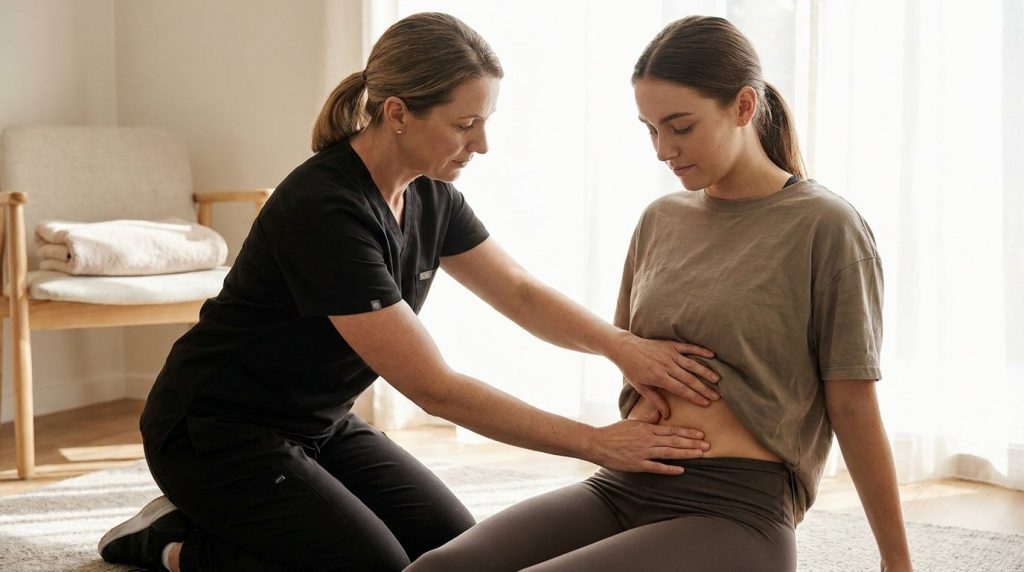
You can get a rough idea at home, although only an examination gives you a reliable answer.
📋 Width matters less than you think Surgeons look at how wide the gap is, how far up and down the abdomen it runs, and how much tension is left in the tissue. A narrow but very slack midline can bulge more than a wider gap with firm tissue, which is why finger-width counts alone are a poor guide to whether surgery is needed.
- ✓Lie flat on your back with your knees bent and feet on the floor.
- ✓Place two or three fingers flat on your midline, just above the belly button.
- ✓Lift your head and shoulders slightly, as if starting a crunch.
- ✓Feel whether your fingers sink into a soft channel between two firm muscle edges, and note roughly how wide and how deep it feels.
Can physiotherapy or exercise close the gap instead?
Conservative treatment should normally come first, and for a good number of people it is enough. Targeted work with a women’s health or pelvic floor physiotherapist teaches you to load the deep abdominal muscles properly, improves the tension across the midline and often reduces symptoms such as back pain and poor control. Posture work and breathing mechanics matter as much as any single exercise.
What exercise cannot do is shrink connective tissue that has been permanently stretched. If the linea alba is thin and slack rather than merely untrained, strengthening the muscles around it will not re-knit it, and no amount of core work removes loose skin or a crepey apron below the belly button. That is the honest dividing line between physiotherapy and surgery.
Timing is part of the picture too. In the first year after birth the abdominal wall is still recovering on its own, and many separations narrow without any intervention, so most surgeons will not operate during that window. Our tummy tuck patients tend to come to us several years after a last pregnancy rather than months — and that gap is usually deliberate, because it lets natural recovery finish first.
The sensible first step for mild to moderate separation, especially within the first year postpartum. It can improve function, posture and continence even when the visible gap stays.
For people whose main issue is the muscle gap and who have firm skin and little excess fat, a small-incision endoscopic repair can tighten the midline without removing skin.
Repeated forward-flexion work under a slack midline tends to push the bulge outward rather than flatten it, and often makes the doming more obvious.
Losing fat makes the abdomen smaller and the bulge easier to assess, but it does not tighten the midline. A stable weight before surgery gives a more predictable result.
How surgeons repair ab separation
The repair itself is simple in principle. The surgeon brings the two muscle edges back together in the midline and stitches them there, usually in two layers of strong, long-lasting suture, running from just below the breastbone down to the pubic bone. This is called plication. Done well, it rebuilds a continuous front wall, flattens the profile and narrows the waist slightly — and it is the step that produces the “flat” result people associate with a tummy tuck.
Where the gap is very wide, the tissue is extremely thin, or there has been repeated stretching over several pregnancies, some surgeons reinforce the stitched midline with a mesh. A 2024 study in Aesthetic Plastic Surgery compared standard plication with the addition of a non-absorbable onlay mesh during abdominoplasty in multiparous patients with moderate-to-severe separation, assessing function, recovery and recurrence — reinforcement is studied precisely because the suture line has to hold against years of abdominal pressure. Mesh is not routine, and a good surgeon will explain why they are or are not proposing it for you.
If you also have a small hernia at or near the belly button, which is common alongside long-standing separation, it is usually repaired in the same session rather than left for a second operation.
Keyhole repair without skin removal
Endoscopic techniques, including the preaponeurotic approach described in the Surgical Endoscopy paper mentioned earlier, reach the midline through small incisions low on the abdomen and plicate it under camera guidance. The appeal is obvious: a much shorter scar and no large skin flap. The limitation is just as clear, since nothing is done about loose skin or stretch marks, so it suits a fairly narrow group of patients.
Why diastasis recti repair and a tummy tuck usually go together
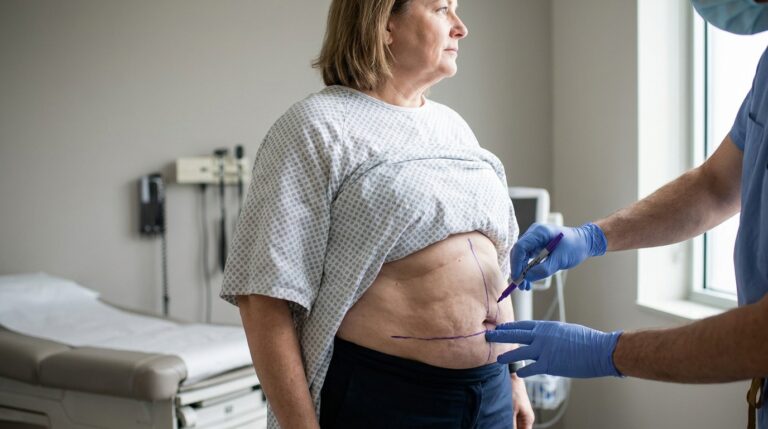
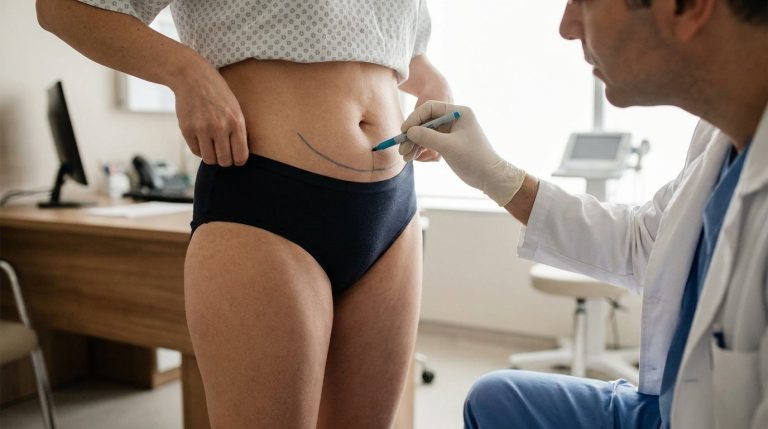
To stitch the muscle layer, the surgeon has to get to it, which means lifting the skin and fat of the abdomen off the muscle wall. Once that flap is raised, leaving behind the loose skin you came in with rarely makes sense, so the two steps are naturally combined. That is why “diastasis recti tummy tuck” is really one operation described two ways: the muscle repair restores the inner wall, and the skin removal deals with the outer envelope.
How much skin comes off is what separates the different versions of the procedure. A full abdominoplasty allows repair along the whole midline and repositions the belly button; a smaller operation treats only the lower abdomen. If you are weighing those options, our comparison of a mini versus a full tummy tuck sets out which laxity patterns suit each one.
Pregnancy planning changes the sequence. A repaired midline can stretch again with another pregnancy, so most surgeons advise finishing your family first. If you are still deciding when to book, our month-by-month view of a tummy tuck after having a baby covers the practical timing questions, including breastfeeding and weight stability.
Recovery after a muscle repair, week by week
The muscle repair, not the skin incision, is what dictates how recovery feels. Tightening the front wall shortens it, so for the first several days you will stand and walk slightly bent at the hips and feel a strong pulling sensation across the abdomen when you try to straighten up. That is expected, and it eases steadily. Many patients say it feels less like a wound and more like a severe, deep muscle strain.
You will be encouraged to walk short distances within hours of surgery, which matters for circulation and blood clot prevention, while being told firmly not to lift, strain or twist. Compression garments are worn for several weeks to control swelling and support the repair. Drains may or may not be used depending on technique.
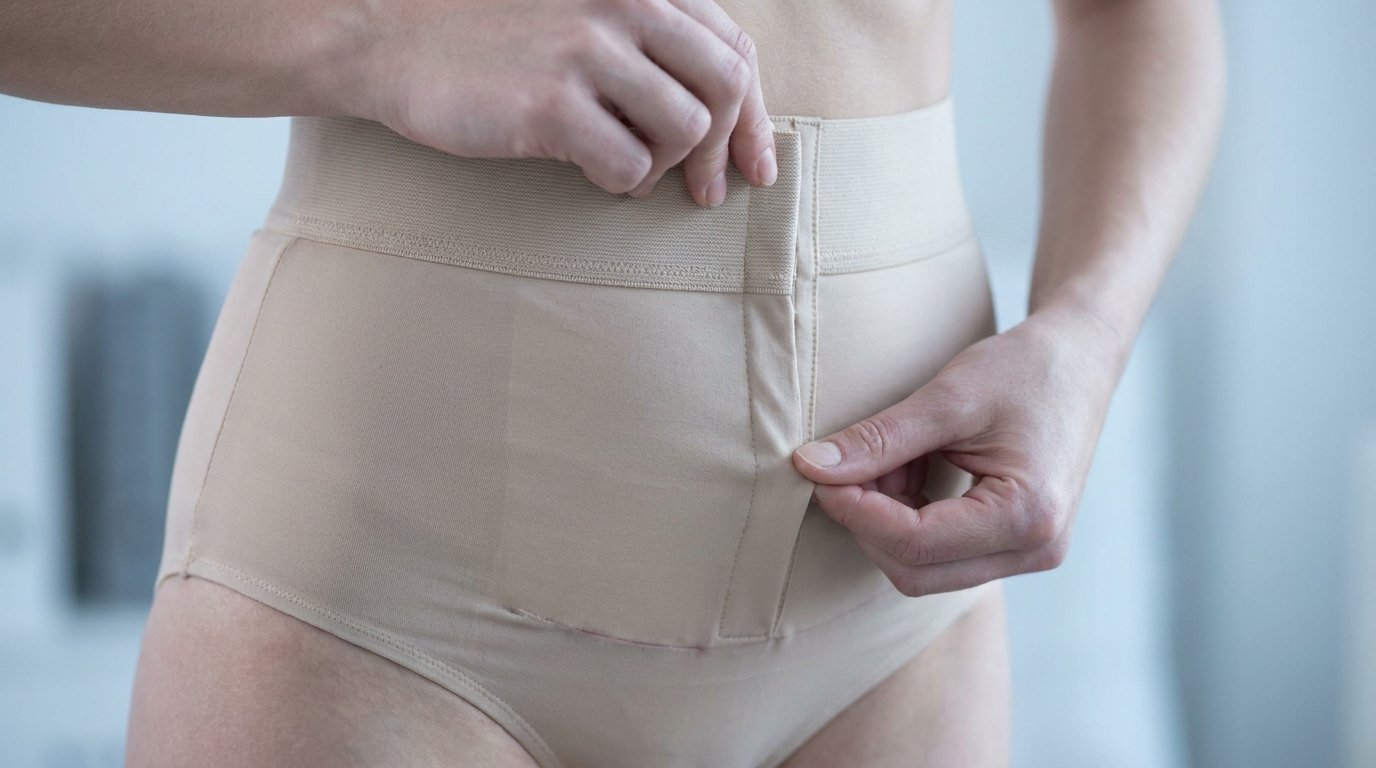
The tightness that stops you standing fully upright usually resolves within one to two weeks; our piece on standing up straight after a tummy tuck goes into that in detail, and the broader week-by-week abdominoplasty recovery guide tracks swelling and activity in the months that follow.
⚠️ Core training is the last thing to come back Direct abdominal loading — planks, crunches, heavy squats and deadlifts — is usually restricted for around two to three months, because the suture line needs time to be supported by healed tissue rather than stitches alone. Timelines vary between surgeons and between patients, so follow the instructions you are given rather than a general schedule.
Does repairing the separation actually help back pain and leaking?
This is where expectations need care. Flattening the abdomen is predictable. Functional change is likely in many patients but cannot be promised to any individual, and should never be the sole reason to operate without a proper assessment.
The reasoning behind it is sound. If the front wall is slack, the muscles that control your trunk and the pelvic floor have to work in a system that cannot hold pressure properly. Restoring tension across the midline changes how that pressure is managed. Research in Aesthetic Plastic Surgery in 2026 examined exactly this link in a series of 100 abdominoplasty patients, looking at diastasis as a contributing factor in stress urinary incontinence and at whether correcting it during surgery eased symptoms. The Surgical Endoscopy work on endoscopic repair describes the same underlying relationship between the abdominal wall and lower trunk stability.
In practice, patients commonly report that their core feels connected again, that lifting and standing for long periods is easier, and that back ache is less intrusive. Some notice improvement in bladder control, some do not. If leaking is one of your main complaints, see a pelvic floor specialist alongside your surgical consultation — the two problems overlap but they are not the same problem, and surgery on one does not reliably fix the other.
What drives the cost of diastasis recti repair
There is no single price for this operation, because what is being repaired varies enormously from one abdomen to the next. A narrow midline repair under a short skin excision and a full-length repair with mesh reinforcement, hernia correction and extensive skin removal are different operations with different theatre times, implant costs and aftercare needs. A personalised quote only becomes meaningful after a surgeon has examined you or reviewed proper photographs and your medical history.
One thing worth knowing before you compare numbers: this is rarely booked on its own. Around 87% of our tummy tuck patients have at least one other procedure in the same session, most often a breast lift, a breast lift with implants, or liposuction to the flanks. That is not a sales pattern so much as an anatomical one — the same pregnancies that separated the abdominal muscles usually changed the breasts too. For you as a reader it means the figure you should be budgeting and planning recovery around is a combined one, and a quote for a solitary abdominoplasty may not reflect what you end up choosing. Our overview of abdominoplasty in Turkey explains how packages are normally structured.
📋 Ask what a quote covers, not just what it costs A useful quote states the exact procedures planned, the anaesthesia type, how many nights in hospital, how many follow-ups, the garment, and what happens — and who pays — if a complication needs treating. Compare inclusions before you compare totals.
Risks, and the chance the separation comes back
This is real abdominal surgery under general anaesthesia, and it carries the risks that go with that: bleeding, infection, fluid collections under the skin flap, delayed wound healing at the point where tension is greatest, altered sensation over the lower abdomen, and the possibility of unfavourable scarring. Blood clots in the legs or lungs are uncommon but serious, which is why early walking, compression and sometimes blood-thinning medication form part of the protocol.
Tightening the abdominal wall also raises pressure inside the abdomen temporarily. Most patients simply feel breathless on stairs for a week or two, but it is one reason surgeons are cautious about operating on heavy smokers, on people with poorly controlled medical conditions, or at a weight well above the patient’s stable baseline.
Recurrence deserves a straight answer. A stitched midline is strong, but it is not immune to the forces that stretched it in the first place. A further pregnancy, significant weight regain, chronic heavy lifting or persistent coughing all load the repair, and the wider the original separation, the more that matters — which is the whole rationale behind reinforcing severe cases with mesh.
🚨 Signs to report immediately Calf pain or swelling, chest pain, breathlessness at rest, fever, a rapidly expanding or hardening area of the abdomen, foul-smelling discharge, or a wound edge turning dark all need urgent review — not a wait-and-see approach, and not a message left until your next scheduled call.
Choosing a surgeon and planning the trip
Because the muscle repair is the part of this operation that determines both the aesthetic result and whether it lasts, the surgeon’s judgement about technique matters more than any package detail. Ask to see before-and-after photographs of patients with a similar build and a similar degree of separation, in the same lighting and the same pose, and ask directly how they decide between plication alone and reinforcement.
Credentials should be verifiable rather than described. Look for a surgeon registered as a plastic or general surgeon with the relevant national authority, operating in a licensed hospital with intensive care facilities on site, and ask whether the facility holds international accreditation. European board certification through EBOPRAS is one recognised marker, and national bodies such as BAAPS or the ASPS maintain their own membership standards you can check against.
For travel, plan on staying in the country for roughly seven to ten days after a full repair, so that drains can be removed, the wound checked at least twice and your first upright days supervised. Build in flexibility rather than booking a tight return, and arrange a named contact for the weeks after you fly home.
This article is for informational purposes only and does not constitute medical advice. Always consult a qualified surgeon for personalised guidance.
An in-person or video consultation with the operating surgeon, a written plan naming the exact technique, honest discussion of scar length and position, accredited hospital, and clear arrangements for complications after you return home.
A price quoted before anyone has examined you, promises of a guaranteed flat result, pressure to add procedures you did not ask about, no named surgeon, or a refusal to discuss recurrence and risk.
Frequently Asked Questions
References
- 📎Preaponeurotic endoscopic repair (REPA) of diastasis recti: a single surgeon’s experience — Surgical Endoscopy, 2022
- 📎Clinical and Radiological Evaluation of Onlay Mesh Abdominoplasty in Obese Multiparous Patients with Moderate-to-Severe Rectus Diastasis — Aesthetic Plastic Surgery, 2024
- 📎Urinary Incontinence and Abdominal Diastasis: A Detailed Analysis and Surgical Outcome in 100 Patients Undergoing Abdominoplasty — Aesthetic Plastic Surgery, 2026
- 📎EBOPRAS — European Board of Plastic, Reconstructive and Aesthetic Surgery
Related Articles


You Might Also Like



Related articles

Our specialists
 Clineca SpecialistErkan PinegözPlastic & Reconstructive Surgery
 Clineca SpecialistHakan AktaşPlastic & Reconstructive Surgery
 Clineca SpecialistOrkun UzuneyüpoğluPlastic & Reconstructive Surgery
 Clineca SpecialistSalim İskenderPlastic & Reconstructive Surgery
 Clineca SpecialistEngin SelamioğluPlastic & Reconstructive Surgery
 Clineca SpecialistCem AydınPlastic & Reconstructive Surgery
 Clineca SpecialistAlperen ÖnalEar, Nose & Throat (ENT)