
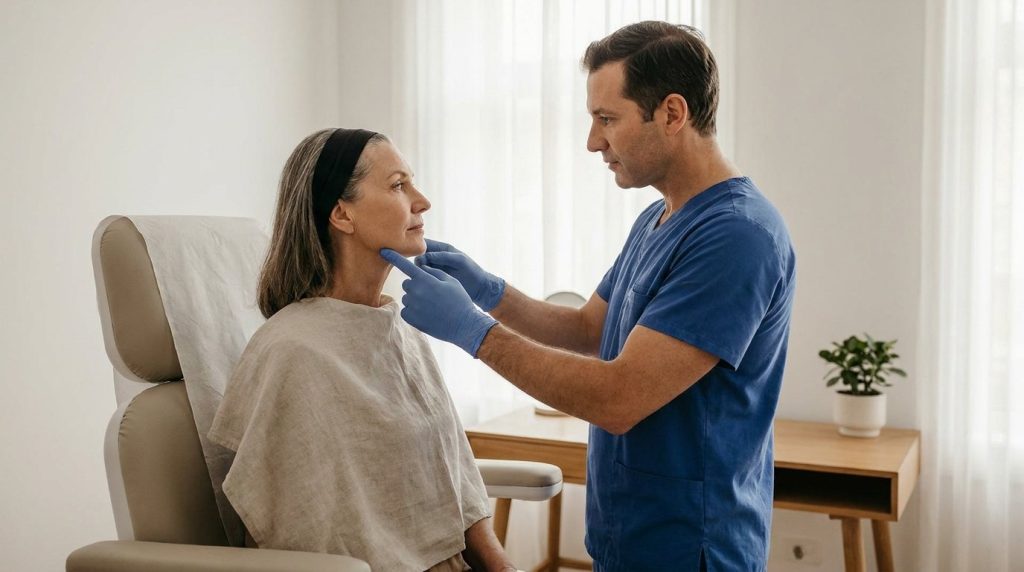
Have a question about face lift?
In this article
- What the SMAS layer is and what a SMAS facelift actually lifts
- SMAS facelift vs deep plane facelift: the real differences
- Which technique suits which face?
- SMAS facelift recovery: a realistic week-by-week picture
- What drives the cost of a SMAS facelift?
- Safety, risks and the nerve question
- Travelling for a SMAS facelift: how long to stay and when to fly
- How to judge the surgeon and clinic before you commit
If you have been reading about facelifts for more than an afternoon, two names keep coming back: the SMAS facelift and the deep plane facelift. Surgeons discuss them as though the difference is obvious, while clinic marketing often makes the choice harder rather than clearer. Both operations treat the same ageing face, but they reach it through different layers of tissue — and that single difference shapes swelling, numbness, downtime and who is actually a good candidate.
What the SMAS layer is and what a SMAS facelift actually lifts
SMAS stands for superficial musculoaponeurotic system — a thin, strong sheet of fibrous tissue and small muscle fibres that sits under the skin and fat of the cheek. Think of it as the face’s internal hammock. It wraps the mid-face, connects to the muscles around the mouth, and continues down the neck as the platysma, the flat muscle that forms those vertical neck bands.
With age, that hammock loosens. Skin stretches too, but skin alone is rarely the main problem. This is why skin-only lifts from decades ago looked tight for a few months and then relaxed again. A SMAS facelift works on the supporting layer: the surgeon lifts the skin, then separately tightens, trims, folds or repositions the SMAS before closing. Because the two layers are handled independently, the skin can be laid back down smoothly without being pulled hard — which is what keeps the result from looking stretched.
Anatomy literature treats the SMAS as a central landmark for depth in the face, the reference plane surgeons and injectors navigate around. That is a useful mental image: everything above it is skin and fat, everything below it includes the fibrous ligaments and, importantly, the branches of the facial nerve.
SMAS facelifts are not all the same operation
There is no single SMAS technique, which is part of why patients get confusing answers. Some surgeons fold the layer on itself with stitches (plication). Some remove a strip of it (SMASectomy). Others raise the SMAS as a separate flap and move it upward and backward.
The layer can also be entered at different heights. Surgical writing on the subject, including a 2025 paper in Plastic and Reconstructive Surgery describing a U-shaped SMAS technique, groups approaches broadly as “low” or “high”. Low approaches are quicker and widely used but have been criticised for doing less for the upper mid-face, while high approaches can improve cheek contour more directly and carry more technical risk in less experienced hands. When a clinic says “SMAS facelift”, it is fair to ask which variation they mean and why they chose it for your face.
📋 Why the layer matters more than the label Two surgeons can both call their operation a SMAS facelift and perform noticeably different procedures. Ask how the SMAS will be handled in your case — folded, trimmed or lifted as a flap — and what that choice is meant to achieve for your cheeks, jawline and neck.
SMAS facelift vs deep plane facelift: the real differences
A deep plane facelift goes one layer deeper. Instead of separating skin from SMAS, the surgeon releases the ligaments beneath the SMAS and lifts skin and SMAS together as one composite unit. Because the cheek fat stays attached to the layer that moves, the mid-face tends to be repositioned more directly, and the surgeon pulls on released tissue rather than on tissue still tethered down.
In practice, the deep plane approach is often favoured for heavier mid-face sagging, deep folds running from nose to mouth corner, and jowls that sit low. A SMAS facelift, especially a well-planned high SMAS variation, still addresses the jawline, jowls and upper neck very effectively, and tends to be a shorter, less extensive dissection.
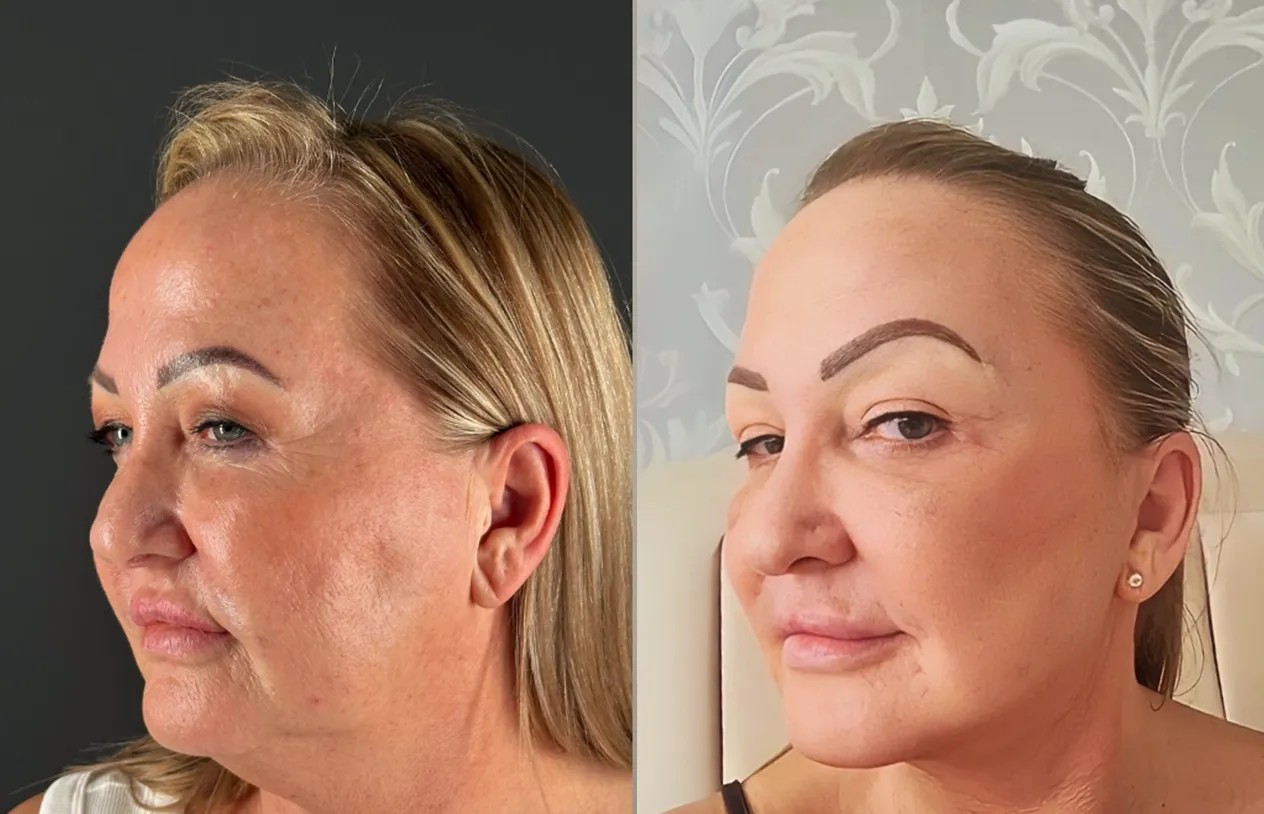
The honest summary is that neither technique has been shown to be universally superior. A 2025 systematic review and meta-analysis in Aesthetic Plastic Surgery compared patient satisfaction and complications between SMAS and deep plane facelifts precisely because the debate about which one lasts longer remains unresolved in the literature. In other words, the argument you see between clinic websites is also still an argument inside the specialty. Surgeon experience with a given technique is a more reliable predictor of a good result than the name of the technique itself.
If you want a plainer-language walk through the same decision, our comparison of a deep plane versus a standard facelift covers how surgeons choose between them in consultation.
⚠️ Be sceptical of "newer means better" Deep plane surgery is marketed heavily as the modern option, but the published comparisons have not settled the question of longevity. A technique performed hundreds of times by your surgeon is usually the safer choice over one they have recently adopted.
Which technique suits which face?
The deciding factors are the pattern of your ageing, your skin quality and your tolerance for downtime — not your age on paper. Someone in their early fifties with good skin elasticity and sagging concentrated along the jawline may get everything they want from a SMAS lift. Someone with flattened cheeks, deep creases beside the mouth and a heavy lower face often gets a more complete change from a deep plane approach.
Skin thickness matters too. Thicker, heavier tissue holds weight and may need the stronger repositioning of a deeper release. Thin, fine skin can look over-operated if it is pulled, so the quality of SMAS work underneath becomes even more important.
Men are a specific case. A 2022 review in Clinics in Plastic Surgery on male facelifts makes the point that attractive masculinity is not tied to youthfulness in the same way femininity often is, so men generally want a different endpoint — and techniques have been adapted to rejuvenate the male face while keeping it looking masculine and unoperated. Beard-bearing skin, heavier blood supply and hairline position all change how incisions are planned.
If you are earlier in the process and still wondering whether surgery is the right step at all, it is worth reading about the point where fillers stop helping before committing to either operation.
Your main complaints are jowls, a blurred jawline and early neck laxity; your cheeks still have reasonable volume; you want a shorter dissection and a quicker return to looking presentable.
The mid-face has dropped, the folds from nose to mouth are set deep, and skin-and-SMAS separation alone would not move enough tissue to change your shape.
Your laxity is moderate and well distributed. Here the surgeon’s experience, your healing priorities and whether a neck lift is added matter more than the technique name.
Your concern is mostly skin texture, pigmentation or volume loss without sagging. Lifting tissue does not resolve those, and surgery done for the wrong reason disappoints.
SMAS facelift recovery: a realistic week-by-week picture
The first 48 hours are the strangest part. Your face feels tight and heavy rather than sharply painful, you will be wearing a supportive dressing or garment, and sleeping propped up on two pillows is non-negotiable. Most patients describe the discomfort as very manageable with prescribed painkillers.
Bruising usually peaks around day three or four and then drains downward into the neck, where it can look dramatic before it fades. Swelling is often asymmetric, which worries people unnecessarily — one side simply drains faster than the other. By the end of week two most patients can go out in public with makeup and not attract attention, though they still see the swelling clearly themselves.
Numbness in front of the ears and along the cheek is normal and can last weeks to a few months as small skin nerves recover. Tightness behind the ears, odd pulling sensations when you chew, and small firm lumps under the skin along the incision are all common and typically settle without intervention.
The part nobody warns you about is the emotional dip around weeks two to four: the early “wow” swelling has gone down, the final contour has not arrived yet, and the face can look slightly flat or uneven. This is a normal stage, not a failed result. For a more detailed look at the swelling curve specifically, see our guide to how swollen your face will be after a facelift and the broader facelift recovery timeline.
Deep plane recovery follows the same shape but usually runs a little heavier in the first few weeks, with more mid-face swelling and sometimes slower return of sensation. The published comparisons of complication rates between the two approaches are part of what the 2025 meta-analysis set out to assess, and it remains an area of active study rather than a closed question.
🚨 Call your surgeon the same day if One side of your face swells rapidly, becomes tense and painful within the first 24-48 hours, you develop spreading redness with fever, or you notice a new weakness moving one side of your mouth or eyebrow. These need urgent assessment, not a wait-and-see approach.
What drives the cost of a SMAS facelift?
Facelift pricing is quoted per patient rather than per procedure name, because the operation is assembled from components. Two people can both have “a SMAS facelift” and receive very different quotes simply because one needs the neck addressed and one does not.
The biggest single driver is the surgical plan itself: how extensive the dissection is, whether a neck lift is included, and whether the eyelids, brow or fat grafting are combined in the same anaesthetic. Longer theatre time means more anaesthetist hours and more nursing time, and that flows straight into the price. Surgeon seniority and how much facelift-specific volume they do also change the figure, as does whether the hospital is a full accredited facility or a small day clinic.
When comparing quotes between countries, compare what is bundled rather than the headline number. A quote that looks lower but excludes anaesthesia, overnight stay, garments, medication and follow-up is not actually lower. We cover the components in more depth in our guide to facelift cost drivers in the UK and in the overview of having a facelift in Turkey. A personalised price can only be confirmed after a consultation where the surgeon has seen your face and agreed the plan with you.
Safety, risks and the nerve question
A facelift in a properly equipped facility, with a surgeon who does this work regularly, is a well-established operation. It is still real surgery under general anaesthesia, and the risks deserve a straight answer rather than reassurance.
The general surgical risks are bleeding, collection of blood under the skin (haematoma), infection, delayed healing at the skin edges, widened or raised scars, and asymmetry. Smoking dramatically increases the chance of skin healing problems around the ears, which is why surgeons insist on stopping well before and after surgery. Hair loss along the incision line can occur and is usually temporary.
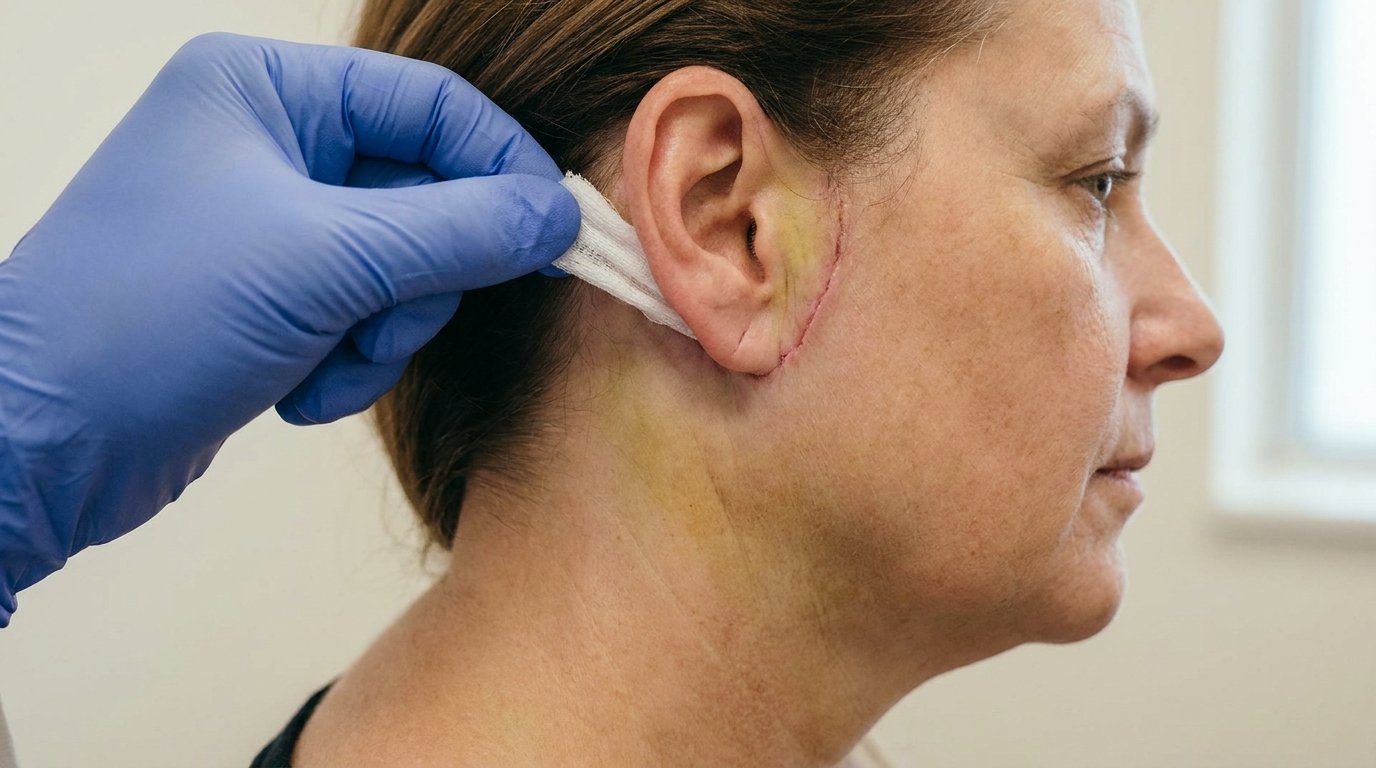
The risk patients ask about most is nerve injury. Branches of the facial nerve run below the SMAS, which is exactly why the depth of dissection matters so much. Temporary weakness is far more common than permanent injury and usually recovers over weeks to months. Deeper dissection means working closer to those branches, and surgical writing on high SMAS and deep plane techniques openly acknowledges that greater midface improvement can come with greater technical risk, particularly for surgeons with less experience in these planes.
Sensory changes are different from motor nerve injury and are almost universal early on. Numb patches, tingling and an odd “not mine” feeling in the skin in front of the ear are part of normal healing, not complications.
- ✓Stop nicotine completely: Cigarettes, vapes and nicotine pouches all constrict blood vessels. Most surgeons want at least four weeks clear before and after.
- ✓Disclose every medication and supplement: Blood thinners, some anti-inflammatories, fish oil and certain herbal products raise bleeding risk.
- ✓Get blood pressure under control: Uncontrolled hypertension is one of the clearest risk factors for post-operative bleeding under the skin.
- ✓Arrange real help for the first week: You will not want to drive, lift, bend or manage alone while dressings and drains are in place.
- ✓Insist on an in-person or video consultation with the operating surgeon: Not only a coordinator. The person holding the scalpel should examine your face and explain the plan.
Travelling for a SMAS facelift: how long to stay and when to fly
If you are travelling abroad for surgery, the logistics are not an afterthought — they are part of the safety plan. Facelift patients generally need to stay in the treatment country for around ten to fourteen days, because the critical window for bleeding is the first 48 hours and the first suture and dressing reviews fall across the first and second week. Leaving before those reviews means leaving before anyone can confirm you are healing as expected.
Plan on an overnight hospital stay, then a hotel close to the clinic rather than a scenic one far away. Expect short, slow outings only: no sightseeing marathons, no sun, no alcohol, and no hot hammam or spa treatments during the healing period. Swelling in a warm climate feels worse than swelling at home, so shade and cool rooms genuinely help.
Flying home is usually permitted once the surgeon confirms the wounds are stable, commonly around day ten to fourteen for a full facelift. Cabin pressure is not the issue; immobility and the risk of a bleed in the first days are. Book a flexible ticket, because recovery occasionally runs a few days behind schedule and you do not want financial pressure pushing you onto a plane early. Our general guidance on how long to stay in Turkey after plastic surgery covers how this fits around flights and hotels.
One detail worth settling before you travel: who manages your follow-up once you are home. A good arrangement includes scheduled remote reviews, a named contact for photographs and questions, and a clear written answer about what happens, clinically and financially, if a revision is ever needed.
How to judge the surgeon and clinic before you commit
Technique names are easy to advertise. Judgement is harder to fake, and it shows up in how a consultation is run. A surgeon who examines your face, points out which of your concerns surgery will and will not change, and explains why they favour a particular SMAS variation for you is telling you something useful. One who offers a package and a discount before examining you is telling you something else.
Ask to see before-and-after photographs of patients with your pattern of ageing, in consistent lighting, from the same angles, at least six months post-operative. A single flattering front view taken two weeks after surgery proves nothing. It is also worth asking directly how many facelifts the surgeon performs in a typical month and whether facial surgery is their main focus.
Check the facility, not only the person. A licensed hospital or accredited surgical facility with anaesthetist cover and inpatient capability is the right setting for a procedure of this length. Verify board certification or recognised specialist registration independently rather than taking a website badge at face value — the professional bodies such as ASPS, BAAPS and EBOPRAS all maintain their own listings.
Finally, decide whether your neck is part of the plan. Many people seeking a facelift are actually most bothered by their neck, and that needs explicit discussion; our article on whether the neck is included in a facelift explains where the two procedures overlap and where they do not.
This article is for informational purposes only and does not constitute medical advice. Always consult a qualified surgeon for personalised guidance.
The operating surgeon consults with you personally, declines procedures they do not think will help, shows long-term photographs of comparable faces, and gives you written details of anaesthesia, hospital, follow-up and revision terms.
Pressure to book during the first call, prices that drop when you hesitate, promises of a specific result or a "no downtime" facelift, no named surgeon before arrival, or no plan for the first 48 hours after surgery.
Frequently Asked Questions
References
- 📎The Deep Plane versus SMAS Facelift: A Systematic Review and Meta-Analysis — Aesthetic Plastic Surgery, 2025
- 📎The U-SMAS Lift — Plastic and Reconstructive Surgery, 2025
- 📎Male Facelift — Clinics in Plastic Surgery, 2022
- 📎ASPS: Cosmetic Procedures
Related Articles



You Might Also Like



Related articles

Our specialists
 Clineca SpecialistErkan PinegözPlastic & Reconstructive Surgery
 Clineca SpecialistHakan AktaşPlastic & Reconstructive Surgery
 Clineca SpecialistOrkun UzuneyüpoğluPlastic & Reconstructive Surgery
 Clineca SpecialistSalim İskenderPlastic & Reconstructive Surgery
 Clineca SpecialistEngin SelamioğluPlastic & Reconstructive Surgery
 Clineca SpecialistCem AydınPlastic & Reconstructive Surgery
 Clineca SpecialistAlperen ÖnalEar, Nose & Throat (ENT)