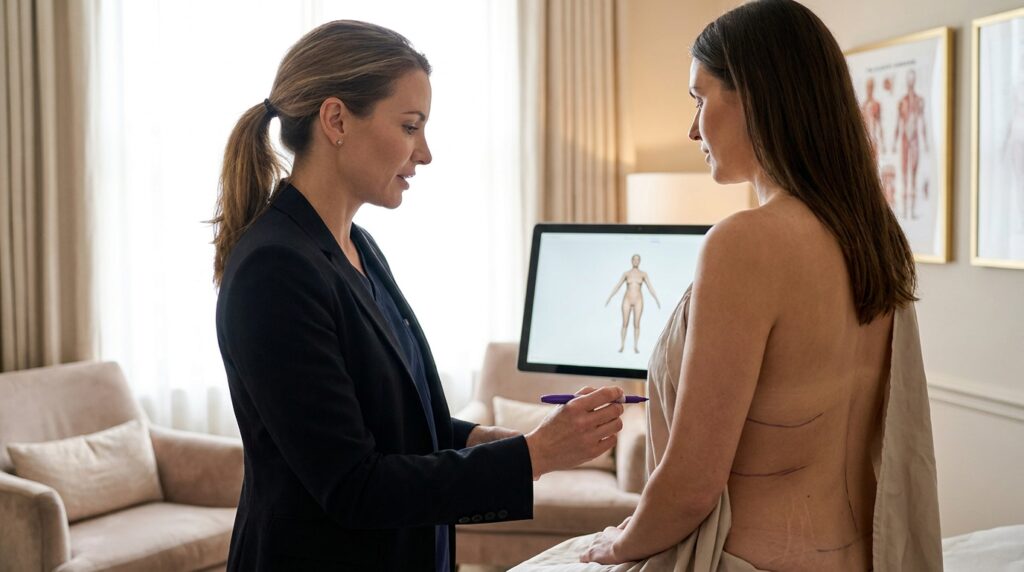
Have a question about Breast Fat Injection?
In this article
- What volume increase is realistic with fat transfer alone?
- What affects how much fat survives in the breast?
- Can fat transfer increase cup size by one or two cups?
- How long does it take to see the final breast size?
- Is breast fat transfer safe, and what about mammograms later?
- How does fat transfer compare with implants for volume alone?
- What affects the quote, travel plan and clinic choice?
How much breast volume usually comes from fat transfer alone? In most cases, breast fat transfer creates a modest increase rather than a dramatic enlargement, and many patients end up with roughly a subtle to moderate improvement after some of the transferred fat naturally settles and some is reabsorbed. The trade-off is that results can look and feel natural, but final volume is less predictable than implants, and recovery is usually measured in a few weeks with the result maturing over several months.
What volume increase is realistic with fat transfer alone?
If you are asking how much breast volume usually comes from fat transfer alone, the honest answer is: usually less than patients first imagine. Fat grafting can improve shape, upper-pole fullness, cleavage balance and overall softness, but it does not reliably create a large implant-style enlargement in one session.
A useful way to think about it is in retained volume, not injected volume. Surgeons may place more fat than the final breast keeps, because some of that fat will not establish a blood supply and will be reabsorbed by the body during the first few months. Published studies and professional guidance generally describe variable fat survival, often around 50% to 80% retained long term, depending on technique, the quality of the recipient tissue, and the individual patient. That does not mean every patient lands neatly in that range, but it is a realistic framework for planning.
Cup size is also a poor measuring tool. Bra sizing is not standard across brands, chest widths differ, and a “one-cup” change on one frame can look very different on another. In consultations, experienced surgeons often speak instead about millilitres of retained volume, skin stretch, breast footprint and how much donor fat is available.
In practical terms, many patients see a result that looks like a small to moderate enhancement, often closer to contour refinement plus some size increase than a major enlargement. Some patients are happy after one session. Others need staged treatment if they want more fullness and have enough donor fat available.
Why the final result is smaller than the transferred amount
Transferred fat behaves like a graft. Each tiny parcel of fat needs to pick up blood supply from the surrounding tissue. When that happens, it can survive. When it does not, the body gradually breaks it down and absorbs it.
That is why the first look after surgery is not the final answer. The breasts are swollen at first, and they may also contain fat that will not fully survive. Most surgeons wait a few months before judging the lasting size.
This is also why patients who want a clearly larger breast in one operation often compare fat grafting with breast augmentation options rather than assuming fat transfer can do the same job.
Fat transfer on its own usually adds modest breast volume, not the large jump many people associate with implants. In practice, surgeons often describe the outcome as a subtle to moderate increase, with part of the transferred fat surviving long term and part being reabsorbed during early healing.
What affects how much fat survives in the breast?
There is no single number that fits everyone, because the result depends on several moving parts. First is donor fat. Very slim patients may want more breast volume than their own body can comfortably provide, especially if they do not have much removable fat from areas such as the abdomen, flanks or thighs.
Second is the recipient space inside the breast. A tight breast envelope with firm skin can only accept so much fat safely in one session. Overfilling raises the risk that more fat will fail to survive, which can reduce the efficiency of the procedure and increase lumpiness.
Third is surgical technique. Fat is usually harvested with liposuction, prepared, then placed in many small tunnels rather than one large pool. This careful layering helps the fat contact healthy tissue and develop blood supply. The American Society of Plastic Surgeons has supported autologous fat grafting to the breast when used appropriately, noting that technique and patient selection matter.
Lifestyle and healing matter too. Major weight changes after surgery can affect the result because transferred fat cells behave like fat elsewhere in the body. If you gain or lose a significant amount of weight, the breasts can change with you.
The biggest planning issue, though, is expectation. Fat transfer is often best for patients who want a natural feel, a modest increase, correction of asymmetry, or improvement after pregnancy or weight loss. It is less suitable for someone whose main goal is a dramatic size jump in one step.
You want a modest increase, softer contour changes, or better symmetry, and you have enough donor fat available.
You want a larger, more predictable volume increase than one fat-transfer session usually delivers.
The final size depends on both biology and technique. The main factors are how much donor fat you have, how carefully the fat is harvested and injected, the quality of your breast tissue, and whether your goals match what one session can realistically achieve.
Can fat transfer increase cup size by one or two cups?
This is where a lot of confusion starts. Online, people often ask whether fat transfer gives one cup or two. The problem is that cup size is not a medical measurement. A 300 mL volume change may look dramatic on a petite chest and far less obvious on a broader chest. On top of that, bra brands size differently.
That said, many surgeons discuss fat transfer results in terms patients understand, and some patients do feel they moved about half a cup to around one cup, or a little more, after healing. The important point is that this is a rough consumer description, not a precise guarantee.
A clearly larger increase can sometimes be approached with more than one session, assuming there is enough donor fat and the breast tissues can accept more grafting. Even then, the route is gradual. If your goal is significant enlargement in one operation, implants are usually the more predictable volume tool.
For patients comparing methods, a combined discussion of shape, feel, scars, donor fat, imaging follow-up and size goals is more helpful than focusing only on cup size.
Sometimes a patient may describe the result as about one cup size, but cup size is too inconsistent to use as a precise promise. A two-cup increase from fat transfer alone in one session is generally not the typical expectation and is often unrealistic for many body types.
How long does it take to see the final breast size?
The first days after surgery are not a reliable guide. You may look noticeably fuller, but that early appearance includes swelling and recently transferred fat that has not yet proved it will survive.
Many patients feel comfortable going out socially within a couple of weeks, depending on bruising and soreness, but the shape keeps evolving. A more meaningful review often happens at around the three-month mark, with some maturation continuing after that.
The donor areas also need time to settle. Since fat is collected by liposuction, you are recovering from two things at once: the breast grafting and the body areas where the fat was removed. That is one reason the recovery can feel more involved than people expect from the word “injection” alone.
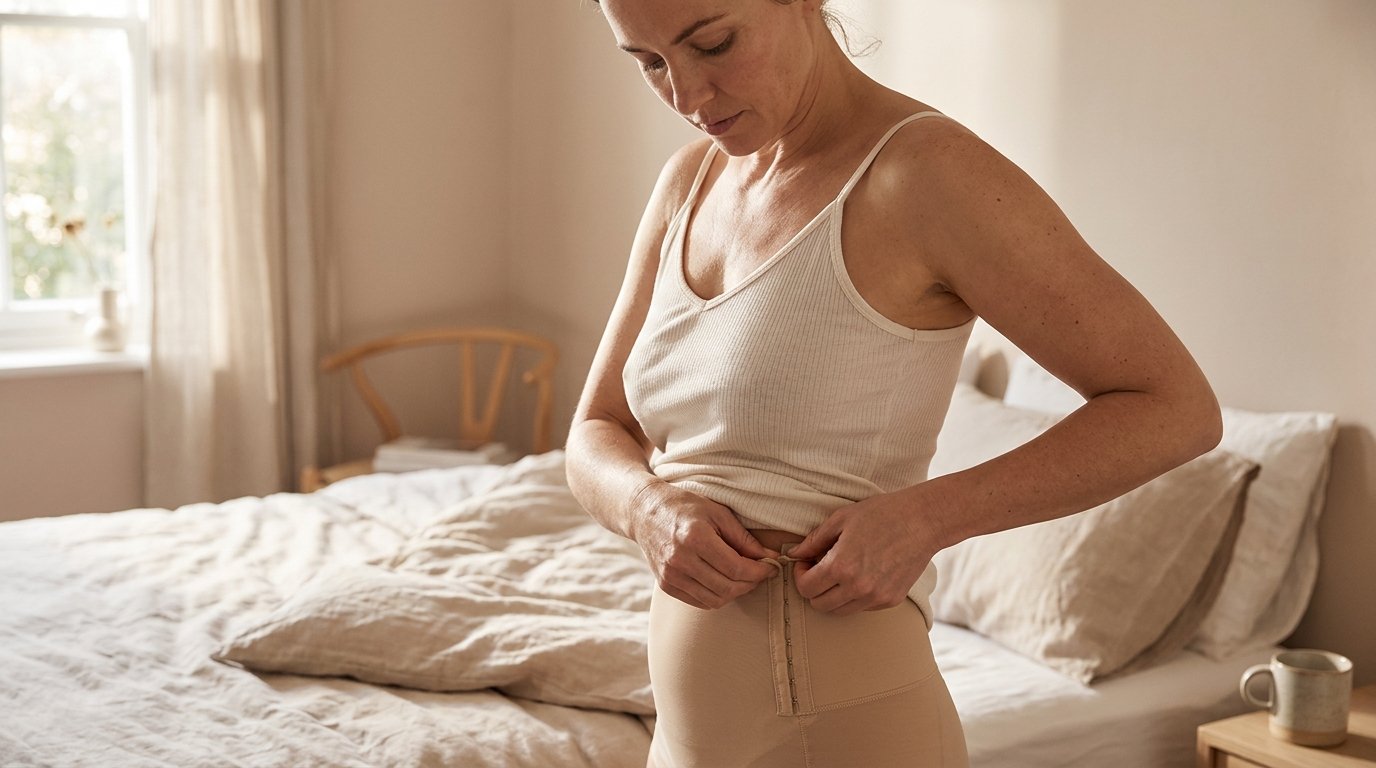
Early swelling can make the breasts look fuller than the final result. Most patients can judge the direction of the outcome within several weeks, but the more reliable long-term volume usually becomes clearer after a few months, once swelling settles and early fat reabsorption has occurred.
Is breast fat transfer safe, and what about mammograms later?
Current professional guidance supports breast fat grafting in appropriately selected patients, but this should never be presented as risk-free. The main breast-specific issues are fat necrosis (firm areas caused by fat that did not survive), oil cysts, and calcifications that may later appear on breast imaging. These changes are often benign, but they matter because they can lead to extra scans or review.
The reassuring part is that breast imaging specialists are used to assessing postoperative breast changes. Professional statements from groups such as the ASPS and radiology societies have described how modern imaging can usually distinguish typical fat-grafting changes from suspicious findings. Still, the practical step for patients is simple and important: always tell your mammography or breast imaging team that you have had breast fat transfer.
Follow-up imaging advice is not identical for everyone. It may vary with your age, symptoms, family history, personal history of breast cancer, genetic risk and local screening programme. If you already fall into a higher-risk group, your surgeon and breast imaging team may suggest a more tailored plan. This is one of those topics where personal history matters more than generic internet advice.
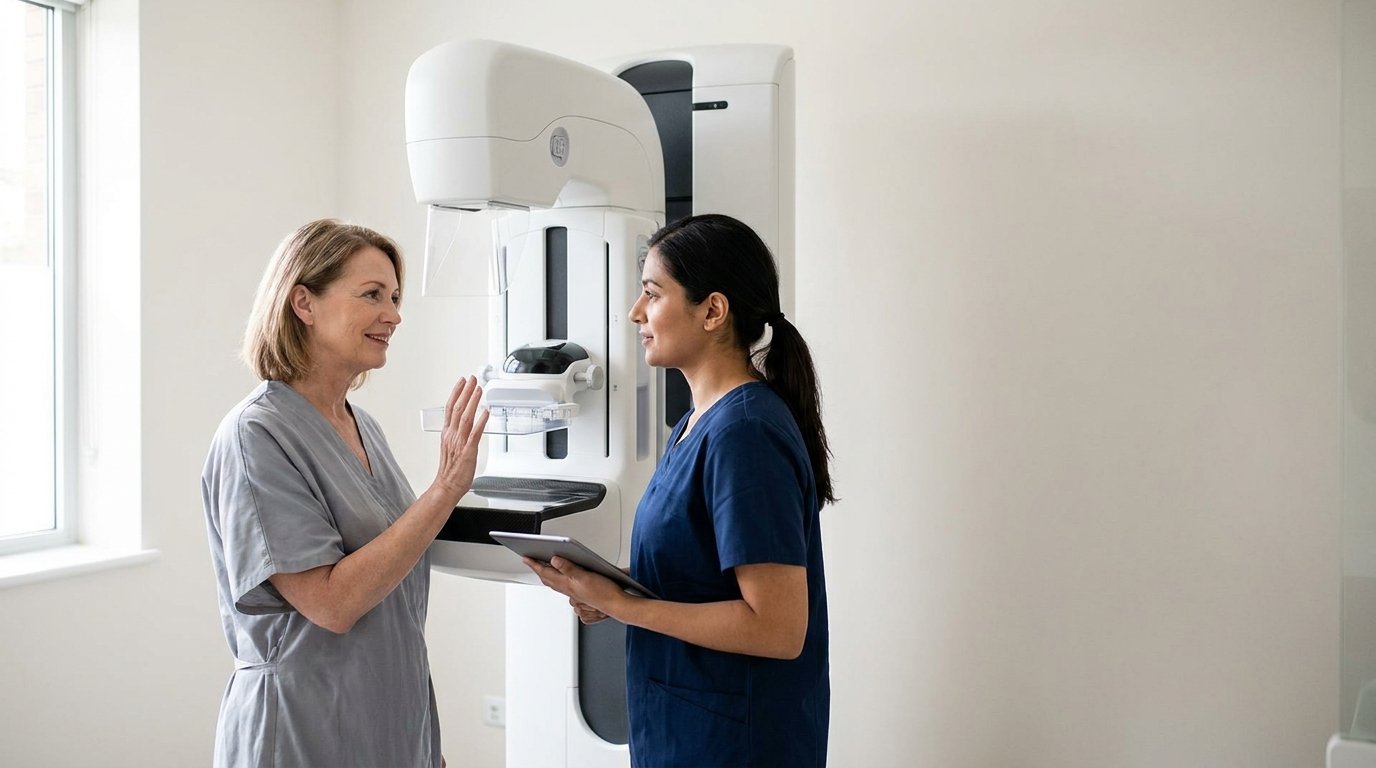
The NHS advises that all cosmetic surgery carries risk, and that patients should understand complications and recovery before going ahead. That is especially relevant here because the final size is not fully predictable, and small lumps or firmness can occur even when the overall result is acceptable.
⚠️ Tell radiology teams about prior fat transfer Before any mammogram, ultrasound or breast MRI, let the radiographer or radiologist know you have had breast fat grafting. It helps them interpret expected postoperative changes more accurately.
📋 Screening plans may differ by risk Routine follow-up may not be the same for everyone. Personal or family history of breast cancer, genetic risk, age and symptoms can all affect the advice you receive.
Breast fat transfer can be safe when performed by an appropriately qualified surgeon with proper assessment and follow-up, but it is not risk-free. The key breast-specific issues are fat necrosis, oil cysts, calcifications and the need to tell future radiology teams that you have had fat grafting.
How does fat transfer compare with implants for volume alone?
For pure volume, implants are usually the more predictable method. The implant size selected is known before surgery, while fat transfer depends on donor supply, tissue capacity and how much of the graft survives. That does not make one option better for everyone. It means they solve different problems.
Fat transfer appeals to patients who want a softer, more natural-tissue change and who like the idea of using their own fat. Implants suit patients who prioritise a stronger size increase and clearer volume planning. Some patients also discuss hybrid approaches, but that is a separate, highly individual decision.
If you are comparing options, the most useful consultation is one that starts with your goal in plain language: “I want subtle upper fullness,” or “I want to look clearly bigger in clothes.” That usually leads to better planning than asking only how many cups each method gives.
If the main goal is maximum, predictable size increase, implants usually offer more control over final volume. Fat transfer is better thought of as a natural-tissue option for modest enlargement, contour refinement and softness, with the trade-off that some transferred fat will not survive.
What affects the quote, travel plan and clinic choice?
Since there is no fixed public price for this procedure in this guide, it is better to understand what shapes the quote. The main drivers are how many donor areas are treated, how much liposuction work is needed, whether the case is straightforward or a revision, the surgical team and facility, and what aftercare is included. A personalised quote is normally confirmed only after consultation and assessment of your goals, anatomy and available donor fat.
For international patients, logistics matter almost as much as the operation itself. You need time for assessment, surgery, early checks and a short period before flying home. The exact stay varies by surgeon and by how your recovery is going, but planning only a very brief visit is usually unwise because swelling, soreness and early follow-up all need room in the schedule.
When choosing where to go, look for a surgeon with specific experience in breast surgery and fat grafting, ask who provides your aftercare once you return home, and check what happens if you develop a concern such as firmness, asymmetry or delayed swelling. A clear consultation process matters more than heavy sales language. If you want to review background details, you can use the clinic’s about page, see the listed medical team on the doctors page, or request an individual assessment through the consultation page.
A safe choice usually feels transparent. You should know who your surgeon is, what the realistic volume goal is, what the limitations are, and how imaging and follow-up will be handled later.
- ✓Ask how much of the planned result is expected to remain after fat reabsorption, not just how much fat will be injected.
- ✓Ask who reads or advises on postoperative breast imaging if you later develop lumps or firmness.
- ✓Ask how long you should stay locally before flying and what warning signs should delay travel.
- ✓Ask whether a second session is commonly needed for your goal, especially if you want more than a subtle increase.
For this topic, there is no single standard price because the quote depends on the liposuction areas, operating time, surgical complexity, facility standards and aftercare. Patients travelling to Turkey should focus on surgeon credentials, clinic accreditation, recovery planning and clear follow-up arrangements rather than chasing a low headline figure.
Frequently Asked Questions
References
- 📎NHS – Cosmetic procedures
- 📎ASPS – Cosmetic procedures
- 📎PubMed search: breast fat grafting retention volume breast augmentation
- 📎PubMed search: breast fat grafting mammography calcifications radiology
Related Articles


You Might Also Like



Related articles

Our specialists
 Clineca SpecialistErkan PinegözPlastic & Reconstructive Surgery
 Clineca SpecialistHakan AktaşPlastic & Reconstructive Surgery
 Clineca SpecialistOrkun UzuneyüpoğluPlastic & Reconstructive Surgery
 Clineca SpecialistSalim İskenderPlastic & Reconstructive Surgery
 Clineca SpecialistEngin SelamioğluPlastic & Reconstructive Surgery
 Clineca SpecialistCem AydınPlastic & Reconstructive Surgery
 Clineca SpecialistAlperen ÖnalEar, Nose & Throat (ENT)