
Have a question about Rhinoplasty?
In this article
- How many nights should you book after rhinoplasty?
- What actually makes a hotel room comfortable after nose surgery
- Which transfers do you genuinely need, and who arranges them?
- What a quote usually covers, and what you pay for separately
- If you’re combining rhinoplasty with another procedure, the stay gets longer
- Fitness to fly and the warning signs to act on while you’re still abroad
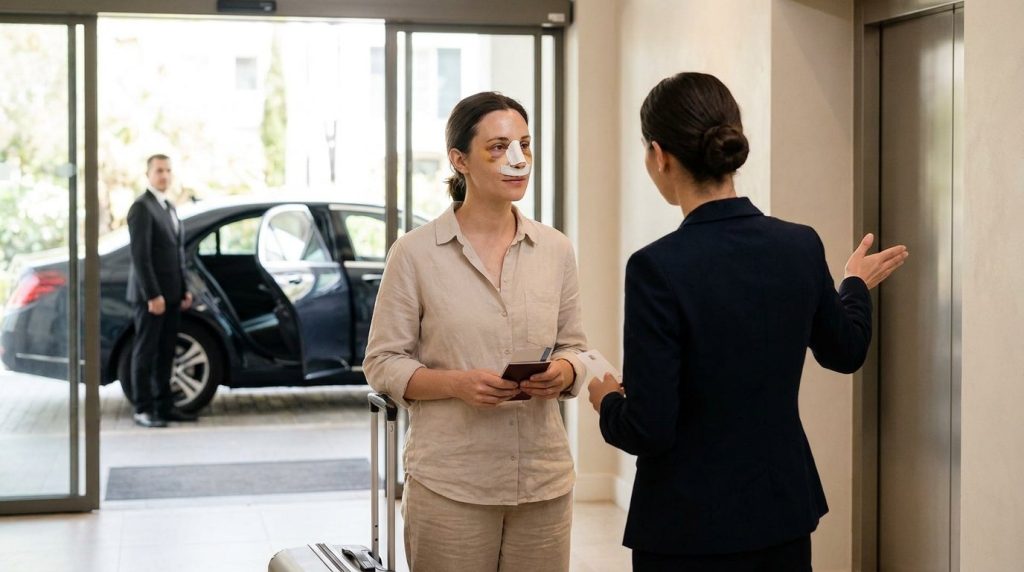
A surprising amount of nose surgery abroad is decided before you ever meet your surgeon — in the flight dates, the hotel booking and the question of who is actually waiting for you at arrivals. Accommodation and transfer arrangements for rhinoplasty patients look like pure admin, yet they shape how the whole week feels. When they are vague, people end up problem-solving in a taxi queue with a splint on their nose instead of resting.
How many nights should you book after rhinoplasty?
Most rhinoplasty travel plans are built around one fixed point: the appointment where the external splint or cast comes off, which many surgeons schedule about a week after surgery. That single date, more than anything else, sets the length of your stay. Plan for roughly seven nights in the city, and treat anything shorter as a plan that depends on your surgeon agreeing to it in writing.
The exact timing varies between surgeons and between noses. Some remove internal supports earlier and the external splint a little sooner; others prefer to wait longer if there was work on the bone. Ask for the planned check-up dates before you buy flights rather than after, and if you want the full healing picture alongside the logistics, our rhinoplasty recovery timeline week by week explains what each of those days usually feels like.
There is a practical argument for booking a flexible fare and a hotel rate you can extend. Swelling, a nosebleed that needs checking or a surgeon who simply wants one more look can shift your departure by a day. A changeable ticket costs more at the time of booking and far less than a last-minute rebooking.
⚠️ Don’t fly out on splint-removal day Leaving a buffer of at least one night after the final check-up means that if your surgeon wants to review something, you are still in the city rather than at a boarding gate.
What actually makes a hotel room comfortable after nose surgery
For the first few nights you will be sleeping propped up, breathing through your mouth and getting up slowly. That turns ordinary hotel details into things that matter. A room with a lift, air conditioning you control yourself and curtains that block morning light is worth more than a view or a pool you will not use.
Temperature and air quality deserve special attention. A dry, over-heated room makes a blocked nose and a dry mouth noticeably worse, so being able to adjust the air conditioning — or run a small humidifier — helps. Keeping your head elevated is part of the standard advice, and our guide on sleeping elevated after rhinoplasty covers how people manage it with hotel pillows, which are often too soft to hold a wedge shape on their own. Extra pillows are usually free; ask at check-in rather than at midnight.

Food logistics are easy to underestimate. Chewing is uncomfortable, and you will want soft, lukewarm food at odd hours.
- ✓Room service or a kettle and small fridge, so you are not walking out for every meal
- ✓A breakfast that includes soft options such as eggs, soup, yoghurt and fruit
- ✓A pharmacy and a small supermarket within a few minutes’ walk
- ✓A quiet floor away from the lift, the bar and the street
- ✓Realistic travel time to the clinic, ideally under half an hour in normal traffic
- ✓Lift access: Stairs with a swollen face and a day-one headache are not worth testing.
- ✓Companion space: A twin or double room so whoever travels with you is not on a sofa.
- ✓Late checkout option: Useful when your flight is in the evening and you want to rest until then.
- ✓Written address in Turkish: Makes any taxi journey you take on your own far simpler.
Which transfers do you genuinely need, and who arranges them?
A typical rhinoplasty trip involves five or six separate car journeys: airport to hotel, hotel to hospital, hospital back to hotel, one or two clinic visits in between, and hotel to airport. None of them is long, but you will not want to arrange any of them yourself on the day. The useful question to ask a clinic is not “are transfers included?” but “which of those journeys are covered, and who is driving me?”
Before you fly, you should know the name or company of the person meeting you, how they will identify themselves at arrivals, what happens if your flight is delayed, and which phone number to call if nobody appears. Sending your flight number as soon as you book avoids most of the problems that happen at this stage. If you are travelling alone, confirm that the ride home from the hospital is also covered, since that is the journey people most often assume is included.
Language is part of the service rather than a bonus. A driver who speaks only Turkish is fine for a ten-minute hotel run; a hospital discharge is not the moment to be relying on a translation app. Ask whether a patient coordinator or interpreter attends your appointments, because the quality of that communication is one of the things patients comment on most after the trip.
📋 Ask for the itinerary in writing A short written schedule with dates, pickup times and contact numbers for the coordinator and the hotel removes almost all of the day-to-day uncertainty of a surgery trip.
What a quote usually covers, and what you pay for separately
Accommodation and transfers are usually bundled into a treatment package rather than priced as separate line items, which is why two quotes can look very different for the same surgery. What drives the figure is the surgeon’s experience and technique, whether the work is primary or revision, the hospital and anaesthesia used, how many nights of accommodation are included, the hotel’s standard, and how many transfer journeys and follow-up visits are built in. Flights are almost never part of it. A personalised price is confirmed after your consultation and assessment, once the surgical plan and the length of stay are clear.
The comparison below is the one worth making before you commit, and our breakdown of what an all-inclusive surgery package in Turkey includes goes into the same question across other procedures. If something in the right-hand column matters to you, raise it before you pay a deposit rather than at check-in.
A named coordinator you can reach directly, a written day-by-day schedule, a clear number of included nights, and a hospital and surgeon you can look up by name before travelling.
No clarity on who meets you, "we’ll sort the hotel when you land", a package that cannot say how many follow-up visits it includes, or pressure to book flights before your surgery date is confirmed.
Our rhinoplasty in Turkey cost and safety guide covers what a full package includes, indicative prices and the safety checks that matter.
If you’re combining rhinoplasty with another procedure, the stay gets longer
Combining operations changes the logistics more than it changes the surgery day. About 14% of our rhinoplasty patients book a second procedure in the same session — most often breast augmentation, a breast lift with implants, or upper eyelid surgery — and for them the length of stay is set by whichever procedure heals slowest, not by the nose. If you are weighing that up, read how we approach combining rhinoplasty with another surgery before you book accommodation, because a plan sized for nose surgery alone will be too short.
Practically, a combined plan usually means a few more nights, sometimes a longer hospital stay, and transfers that have to account for limited mobility rather than just a splint. Body surgery also makes the hotel’s lift, bathroom and bed height more important than they would otherwise be. The trade-off is that one trip and one anaesthesia cover both procedures, which is why patients choose it despite the longer stay.
📋 Book the hotel after the surgical plan Agree the procedures and the planned follow-up dates with your surgeon first, then book accommodation around them. Doing it the other way round is how people end up asking to shorten a recovery to fit a flight.
Fitness to fly and the warning signs to act on while you’re still abroad
Flying home is a medical decision as much as a scheduling one. Your surgeon should confirm that you are fit to fly at the final check-up, and that clearance is the reason the appointment sits near the end of the trip rather than the start. Cabin air is dry and pressure changes can make a healing nose feel more blocked, so expect congestion on the flight, drink water, and avoid blowing your nose. Many surgeons also advise moving around the cabin and wearing compression stockings on longer flights, particularly after combined procedures.
While you are still in the country, you should know exactly who to contact out of hours — ideally a coordinator’s mobile number plus the hospital’s own emergency route. Do not wait for your next scheduled appointment if something changes suddenly. Bleeding that soaks through dressings or does not settle with gentle pressure, a fever, spreading redness, increasing pain after the first few days, foul-smelling discharge, sudden breathing difficulty, chest pain or a swollen, painful calf all need to be seen the same day. Vision changes or severe, unrelenting headache are also reasons to call immediately rather than to wait and see.
This is one genuine advantage of the trip being properly organised: if any of that happens in the first week, you are still in the same city as the surgeon who operated on you, with transport available. Patients who shorten their stay to save a night or two lose exactly that safety margin, which is the one part of the itinerary not worth trimming. For context on how nose reshaping is assessed and what recovery normally involves, the NHS and ASPS patient pages on cosmetic procedures are a useful neutral read alongside your clinic’s own instructions.
This article is for informational purposes only and does not constitute medical advice. Always consult a qualified surgeon for personalised guidance.
🚨 Call the clinic, don’t wait for the next appointment Heavy or persistent bleeding, fever, spreading redness, sudden breathing difficulty, chest pain or a painful swollen calf are reasons to contact your surgical team or local emergency services straight away, wherever you are in the trip.
Frequently Asked Questions
References
Related Articles


You Might Also Like

Related articles



Our specialists
 Clineca SpecialistErkan PinegözPlastic & Reconstructive Surgery
 Clineca SpecialistHakan AktaşPlastic & Reconstructive Surgery
 Clineca SpecialistOrkun UzuneyüpoğluPlastic & Reconstructive Surgery
 Clineca SpecialistSalim İskenderPlastic & Reconstructive Surgery
 Clineca SpecialistEngin SelamioğluPlastic & Reconstructive Surgery
 Clineca SpecialistCem AydınPlastic & Reconstructive Surgery
 Clineca SpecialistAlperen ÖnalEar, Nose & Throat (ENT)