
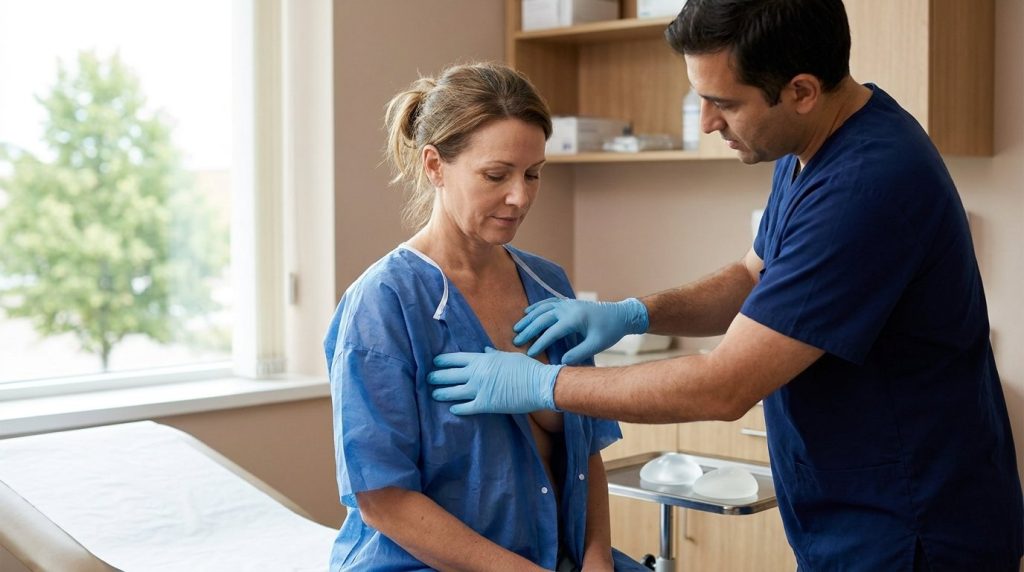
Have a question about Breast Implant Revision?
In this article
- What are the signs your implants need replacing?
- What does breast implant replacement surgery actually involve?
- What drives the cost of breast implant replacement?
- How long is recovery after implant replacement?
- Travelling to Turkey for revision: stay length and logistics
- Choosing a surgeon for secondary breast surgery
- What if you would rather not replace the implants at all?
Most women who had breast augmentation in their twenties or thirties will face a decision about their implants at some point — sometimes because something has changed, sometimes just because the years have passed. Breast implant replacement sits in an awkward middle ground: it is not the same conversation as a first augmentation, and it is rarely as simple as swapping one device for another. What follows is what actually happens, what genuinely drives the cost, and how long recovery takes when you are travelling for it.
What are the signs your implants need replacing?
There is no expiry date printed on an implant. Modern devices do not dissolve after a set number of years, and a woman who is comfortable, has soft breasts and likes her shape usually has no medical reason to book surgery just because a decade has gone by. The honest position is that implants are long-lasting but not lifelong, and the reasons for changing them are specific rather than calendar-based.
The most common trigger is a change you can feel or see. One breast starts to firm up, ride higher or look rounder than the other — often the first sign of capsular contracture, where the natural scar tissue envelope around the implant tightens. Others notice their breasts have dropped over the years while the implant has stayed put, so the shape no longer matches the position. Saline implants announce a leak fairly clearly, because the breast visibly deflates over days or weeks. Silicone gel behaves differently: a rupture can be quiet, which is why imaging matters if something feels off.
Then there are the reasons that have nothing to do with a problem. Plenty of women simply want a different size, a lower profile, a more natural upper pole, or they regret going larger than their frame comfortably carries. A long-term single-centre review published in Aesthetic Plastic Surgery in 2025 looked at why women return for revision after augmentation and how surgeons then decide between removing and replacing the implant — and that decision genuinely varies with the reason for coming back, not just with the age of the device.
If you are trying to work out which camp you fall into, our piece on how long breast implants usually last covers the timeline side, and signs of capsular contracture describes what hardening actually feels like in practice.
⚠️ Symptoms that need a prompt assessment Sudden swelling, new pain, a firm or distorted breast, a visible change in size or fluid collecting around one implant should all be checked by a surgeon rather than monitored at home. These are usually treatable, but they are not things to wait out.
What does breast implant replacement surgery actually involve?
Replacement is almost always done through your original scar, which is one of the quiet advantages of revision surgery — in most cases no new incision line is created. The old implant is removed, the pocket is inspected, and the new device is placed. That is the short version, and it is also the version that hides all the decisions.
The capsule is where most of the surgical thinking goes. That thin layer of scar tissue always forms around an implant; the question is whether it is healthy, thickened, calcified or contracted. Depending on what the surgeon finds, part of it may be released, part of it may be removed, or the pocket may be reshaped to sit the new implant differently. A 2024 paper in The Breast Journal examined selective capsulotomies and partial capsulectomy in implant-based reconstruction revision, reflecting how graded these choices have become — surgeons increasingly do only as much to the capsule as the problem requires, rather than removing everything by default.
Size and type get revisited at the same time. If your breasts have changed shape over the years, going back to the same implant you had at 25 rarely recreates the old look. Many women use the opportunity to drop a little in volume or move to a different profile, and the silicone versus saline decision is worth reopening rather than assuming.
When a lift is added
If the breast tissue itself has stretched or descended, a new implant will not lift it. Skin has to be removed and the nipple repositioned, which means a breast lift performed in the same session — a combined plan with more scarring but a far better shape than an exchange alone can deliver. Our page on breast augmentation with a lift explains that trade-off in detail. A good surgeon will tell you at consultation whether you are a straight exchange or a lift-plus-exchange, because the two have different recoveries and different costs.
- ✓Straight implant exchange: Old implant out, new one in through the existing scar. The shortest operation and the fastest recovery.
- ✓Exchange with capsule work: Scar-tissue capsule released or partly removed because it has thickened or tightened.
- ✓Exchange with pocket change: The implant is moved to a different plane or the pocket is reshaped to correct position or rippling.
- ✓Exchange with a breast lift: Skin tightened and nipple raised when the breast has descended around the implant.
- ✓Removal with fat transfer or lift only: The implant is not replaced at all; volume and shape are managed another way.
What drives the cost of breast implant replacement?
Price is the first thing almost everyone asks, and the frustrating truth is that revision quotes vary more than first-time augmentation quotes. The reason is simple: the surgeon is not doing one standard operation, but solving whatever the last one left behind.
The biggest single factor is how much work the pocket needs. Removing an intact implant and placing a new one is a shorter, more predictable procedure than removing a contracted capsule, correcting an implant that has slipped, or rebuilding support with internal stitching or mesh. Anaesthesia time, theatre time and hospital stay all follow from that. Implant choice matters too, since devices differ by manufacturer, shell, profile and warranty.
About half of our breast implant replacement patients have a second procedure in the same session — most often a breast lift, sometimes rhinoplasty on the same trip. That is worth knowing before you compare prices, because the quote you are likely to be sent reflects a two-procedure plan, and a single-procedure figure you found elsewhere is not the same thing. If you are budgeting, budget for the combination you actually need rather than the simplest version of the surgery.
A proper quote should read as a package rather than a surgeon’s fee with surprises attached. Ask explicitly what happens if a complication needs a second operation, and whether implant warranty cover is included. Your personalised price comes after a consultation with photographs and, where relevant, imaging — anything offered before that is a guess.
📋 Ask what a re-operation would cost Revision surgery carries a slightly higher chance of needing further adjustment than a first augmentation. Clinics differ in how they handle that, so ask in writing what is covered and for how long before you commit.
How long is recovery after implant replacement?
A straight exchange is usually gentler than your original augmentation. The muscle pocket already exists, so the tight, pressured feeling most women remember from the first surgery is often much milder second time round. Many patients describe it as soreness and heaviness rather than pain.
That changes if the capsule was removed, the pocket was rebuilt or a lift was added. Then the recovery resembles a fresh augmentation or a lift — more swelling, drains in some cases, and a longer wait before the shape settles. Because roughly half of these plans include a second procedure, the sensible approach is to plan your time off around the bigger operation, not the exchange.
Swelling behaves in an unhelpfully non-linear way. It drops sharply in the first fortnight, then lingers quietly for months, and the upper breast is usually the last area to soften. Photographs taken at three weeks rarely represent your result. If you want a fuller day-by-day picture, our week-by-week breast augmentation healing guide maps the same broad phases.
⚠️ Do not rush the chest Returning to pressing, pulling or heavy upper-body work too early is one of the more avoidable causes of poor implant position after revision. Clearance dates exist for the pocket, not for your pain level.
Travelling to Turkey for revision: stay length and logistics
Plan for around seven to ten nights in Turkey for a straightforward implant exchange, and closer to ten to fourteen if a lift or significant capsule work is involved. The reason is not the surgery itself but the review schedule: you want at least one wound check and a final clearance before you fly, and you want a few days of margin in case a dressing or drain needs attention. Our detailed breakdown of how long to stay in Turkey for breast surgery goes through the day-by-day schedule.
Bring your original surgical records if you can get them. The implant type, size, profile, manufacturer and the plane it was placed in all change the plan, and so do any previous complications. If you have no paperwork at all — very common when the first surgery was years ago in another country — say so early so imaging can be arranged.
Flying itself is not usually the problem. Sitting still for hours is, so move your legs, drink water and follow whatever clotting-prevention advice your surgeon gives. Also think about who is with you for the first few nights: reaching overhead and lifting are restricted, and a companion makes the hotel phase far easier. Set expectations on communication too — ask who your point of contact is after you land home, and how follow-up photos are reviewed, because the practical side of aftercare is what patients most often wish they had clarified in advance.
- →Old implant records, imaging reports and any previous operation notes
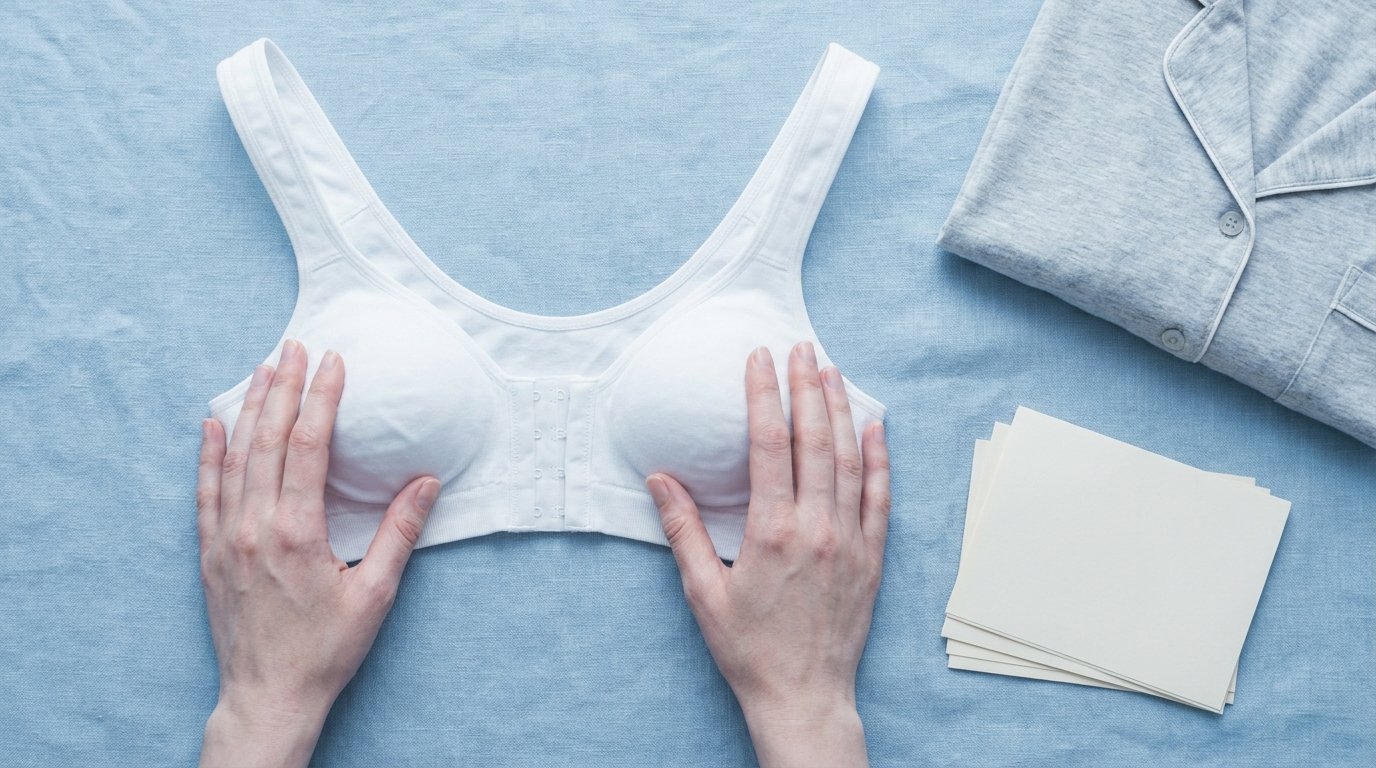
- →A front-fastening, non-wired supportive bra or two in a slightly larger band size
- →Loose button-through tops so you do not have to lift your arms
- →Your regular medication list, including anything you were asked to pause before surgery
- →Flexible flight dates, in case your surgeon wants an extra review day
Choosing a surgeon for secondary breast surgery
Revision is a different skill set from primary augmentation. Anyone doing it well is working in a pocket someone else made, with scar tissue, altered blood supply and a patient who has already been disappointed once. That is the filter to apply when you are choosing.
Ask directly how many revision cases the surgeon handles, and ask to see before-and-after photographs of women whose starting problem resembled yours — not just their best primary augmentation results. Requests for these images are extremely common and completely reasonable; a clinic that cannot show relevant cases is telling you something. Check board certification and hospital accreditation, and confirm that surgery takes place in a licensed hospital with proper anaesthetic cover rather than an office setting.
Be wary of a plan that arrives before anyone has examined you. A real consultation discusses whether you need a lift, whether the capsule needs attention, what size suits your frame now rather than a decade ago, and what the limits are. Raise future pregnancy or breastfeeding plans at that first appointment as well — it is one of the most frequent topics women bring up when weighing breast surgery, and it genuinely affects timing and technique, so it belongs in the conversation rather than after it.
Board-certified plastic surgeon, accredited hospital, a written plan that names your specific problem, revision-specific photo examples, honest talk about scars and the possibility of further surgery, and a named contact for aftercare.
A price quoted before any assessment, pressure to book within hours, no discussion of whether you need a lift, no mention of complication cover, or vague answers about who actually operates and where.
What if you would rather not replace the implants at all?
Replacement is not the only option, and it is worth knowing the alternatives before you book. Some women reach this decision point and realise they no longer want implants — they want the shape they would have had without them, only tidier. Removal with a lift can achieve a surprisingly good result in the right breast, and a 2022 study in Aesthetic Plastic Surgery described combining implant removal with a lift and fat grafting in a single stage as one way of restoring volume after explantation.
How well that works depends heavily on your own tissue. Thin skin, very large implants or years of stretching limit what a lift and fat can do, and fat transfer adds modest volume rather than a cup size on demand. If you are weighing this up, replacement versus removal — how to tell walks through the decision, and we also cover removal without replacing the implants for women who have already made up their minds.
One last point on timing, since hesitation about the right moment is so common. There is no advantage in rushing a purely aesthetic exchange, and there is no prize for waiting years with a breast that has hardened or changed shape. Symptoms deserve assessment now; preferences can wait until you are ready, financially and practically.
This article is for informational purposes only and does not constitute medical advice. Always consult a qualified surgeon for personalised guidance.
Suits women who want out of implants and have enough breast tissue to reshape. Trades volume for a tighter, more natural contour, with lift scars.
Adds some volume back using your own fat. Modest gains, results depend on how much fat survives, and it will not reproduce an implant’s fullness.
Reasonable for a comfortable, soft, symmetrical breast with no symptoms. Not reasonable if the breast is hardening, painful or visibly changing.
Frequently Asked Questions
References
- 📎A Long-Term Single-Center Study: Motivations and Strategies in Implant Management for Breast Augmentation Revision Surgery — Aesthetic Plastic Surgery, 2025
- 📎Selective Capsulotomies and Partial Capsulectomy in Implant-Based Breast Reconstruction Revision Surgery — The Breast Journal, 2024
- 📎One-Stage Mastopexy-Lipofilling after Implant Removal in Cosmetic Breast Surgery — Aesthetic Plastic Surgery, 2022
- 📎ASPS: Breast Implant Revision and Cosmetic Procedures
Related Articles

You Might Also Like



Related articles



Our specialists
 Clineca SpecialistErkan PinegözPlastic & Reconstructive Surgery
 Clineca SpecialistHakan AktaşPlastic & Reconstructive Surgery
 Clineca SpecialistOrkun UzuneyüpoğluPlastic & Reconstructive Surgery
 Clineca SpecialistSalim İskenderPlastic & Reconstructive Surgery
 Clineca SpecialistEngin SelamioğluPlastic & Reconstructive Surgery
 Clineca SpecialistCem AydınPlastic & Reconstructive Surgery
 Clineca SpecialistAlperen ÖnalEar, Nose & Throat (ENT)