

Have a question about Canthopexy?
In this article
- How Long Does Canthopexy Swelling Last?
- Why the Outer Corner Swells the Way It Does
- Normal Swelling vs Swelling That Needs a Phone Call
- What Actually Reduces Canthopexy Swelling
- How Combined Surgery Changes the Swelling Curve
- When Can You Judge the Final Shape?
- Travel, Stay Length and What Drives the Cost in Turkey
- Choosing a Surgeon Who Will Manage Your Swelling Properly
Canthopexy swelling is the part of this surgery almost nobody is fully prepared for. The operation itself is small — a stitch that lifts and re-anchors the outer corner of the eyelid — yet the eyelid skin is among the thinnest on the body, so even modest tissue fluid shows up dramatically in the mirror. Knowing how that swelling behaves over the first days, weeks and months is what stops a normal healing stage from feeling like a complication.
How Long Does Canthopexy Swelling Last?
Swelling peaks in the first 48 to 72 hours, drops sharply during the first week, and most people look socially presentable by around two weeks. From there it keeps fading quietly, and the final shape of the outer corner usually settles somewhere between four and six months.
The pattern matters more than the dates. Early swelling is fast and obvious — tight, puffy lids, sometimes a pinkish or bruised outer corner. Then comes a long, slow tail of residual swelling that only you will notice, often as a slightly fuller or firmer outer corner that looks different in morning photos than evening ones.
Morning puffiness is particularly common for the first three or four weeks, because fluid pools while you sleep flat and then drains once you are upright and moving. If your corner looks higher or tighter at breakfast than at bedtime, that is drainage behaviour, not the result changing.
A few things shift the timeline. Swelling tends to last longer when the canthopexy is combined with lower eyelid surgery, when there is pre-existing puffiness in the cheek area, in older skin with weaker elastic recoil, and in patients who bruise easily or resume hard training early.
📋 Why the two sides rarely swell equally One eye almost always drains faster than the other, and the side you sleep towards tends to stay puffier. Uneven swelling in the first six weeks is one of the most common reasons patients panic unnecessarily.
Why the Outer Corner Swells the Way It Does
The swelling concentrates at the outer corner because that is exactly where the work happens — the surgeon tightens and re-suspends the lateral canthal tendon, the small band of tissue that anchors the eyelid to the bone at the side of the eye.
That area sits over bone with very little soft tissue padding, so a suture passed through the tendon and fixed to the deeper tissue or periosteum produces local inflammation that has nowhere to spread except into thin eyelid skin. The result looks disproportionate to the size of the surgery. A procedure that takes well under an hour can leave a corner that looks swollen for weeks.
Technique influences how much swelling you get. A 2022 report in the Indian Journal of Ophthalmology described a simplified approach to lateral canthal suspension in 28 eyelids, reviewing both its outcomes and the existing variations surgeons use — a reminder that canthopexy is not one fixed operation but a family of techniques with different amounts of dissection. Less dissection generally means less bruising, though the right choice depends on how lax your lower lid is, not on recovery speed alone.
If you are still weighing up what the procedure actually involves, our explainer on what a canthopexy is and how the outer corner lift works covers the mechanics in plain terms, and the comparison of canthopexy versus canthoplasty explains why the more involved version typically swells and bruises for longer.
Normal Swelling vs Swelling That Needs a Phone Call
Normal swelling is symmetrical in character, painless or mildly achy, and clearly improving day by day after the third day. Swelling that gets worse after day three or four, affects one eye dramatically more than the other with pain, or comes with vision change or fever needs a same-day call — not a wait-and-see.
The single most useful test is direction of travel. Healing swelling may fluctuate with heat, salt and sleep, but the underlying trend from day three onwards should be downward. A corner that was settling and then suddenly tightens and hurts is telling you something different from a corner that is simply slow.
Also watch the lid position itself. Mild outward pull or a feeling that you cannot fully close the eye is common very early, because the tissue is tight and swollen. If that persists beyond a few weeks, or if the eye is drying out badly, it should be assessed rather than tolerated.
⚠️ Do not self-treat eye pressure symptoms Pain with pressure behind the eye and reduced vision is the one scenario where delay matters most. Rare bleeding behind the eye after eyelid surgery is time-critical, so go to an emergency department if you cannot reach your surgical team quickly.
Puffiness worse in the morning, yellowing bruises, mild itching as sutures dissolve, a firm or ‘rubbery’ outer corner, slight over-lift that softens, and watering or light sensitivity in the first week or two.
Swelling increasing after day three, throbbing or severe one-sided pain, blurred or double vision, a hard tense swelling behind the eye, spreading redness, pus, or a temperature. Sudden vision loss with pain is an emergency, not a next-appointment issue.
What Actually Reduces Canthopexy Swelling
Position, cold and patience do most of the work. Nothing reliably speeds up the deep, late swelling, but several habits clearly stop it getting worse — and most of them matter in the first week, when fluid control makes the biggest visible difference.
Sleeping with your head and shoulders raised for the first week or two is the highest-value thing you can do, because gravity decides where overnight fluid sits. Cold compresses help in the first 48 to 72 hours, but they should be gentle, never pressed into the eyelid or placed directly on skin, and only as your surgeon instructs. After that window, cold adds little.

- ✓Keep your head elevated for sleep for roughly the first 10-14 days, and avoid sleeping on the operated side
- ✓Skip bending, heavy lifting and straining for about two weeks, since anything that raises head pressure refills the tissue
- ✓Cut back on salty food and alcohol early on, as both hold fluid in exactly the place you do not want it
- ✓Protect the area from sun and heat, including saunas, steam rooms and hot yoga, until your surgeon clears you
- ✓Do not rub, massage or pull at the corner unless you have been specifically taught a massage technique
Makeup can usually go back on once the incisions are fully closed and your surgeon agrees, which is often around the two-week mark. Contact lenses tend to wait slightly longer, because inserting them stretches the lid you have just had tightened.
How Combined Surgery Changes the Swelling Curve
Canthopexy performed on its own has the shortest swelling curve; added to lower eyelid surgery, a fox eye lift or a facelift, expect the puffiness to behave like the bigger operation rather than the small one. Plan your downtime around whichever procedure is the most invasive.
Canthopexy is very often an add-on rather than a stand-alone. Surgeons combine it with lower blepharoplasty to support the lid while fat is reduced or repositioned, and with brow or temporal lifting when the whole outer eye region is being repositioned. A 2024 single-centre study in Cureus looked at transconjunctival lower blepharoplasty, where fat is accessed from inside the lid, and specifically assessed recovery time and how feasible it was to add other procedures to that approach — useful context for combined cases, because the access route and the amount of dissection influence how long the area stays swollen.
Cheek-level puffiness changes the picture too. A 2023 paper in Aesthetic Plastic Surgery reviewed surgical treatment of malar mounds and festoons — persistent pouches just below the eye — in 89 cases, noting that non-surgical treatment of these often disappoints. If you have that kind of pre-existing fullness, fluid tends to linger there longer after any eyelid surgery, and a canthopexy alone will not clear it.
When temporal or mid-face lifting is combined with canthal suspension, swelling spreads over a wider area and takes longer to resolve. A 2025 series in the Journal of Craniofacial Surgery reporting six years of temporal facelift experience in 250 cases describes exactly this type of combined approach, where mid-face elevation, canthopexy and brow lifting are achieved through one dissection plane.
For realistic expectations on the lower-lid side of a combined case, our guide to how long swelling lasts after lower eyelid surgery maps that recovery in more detail, and the piece on canthopexy versus fox eye surgery explains why marketing terms and surgical plans are not the same thing.
When Can You Judge the Final Shape?
Judge the shape at four to six months, not before. Until then you are looking at a corner that is still partly swollen, deliberately set slightly tight, and softening at its own pace — three things that all exaggerate the lift.
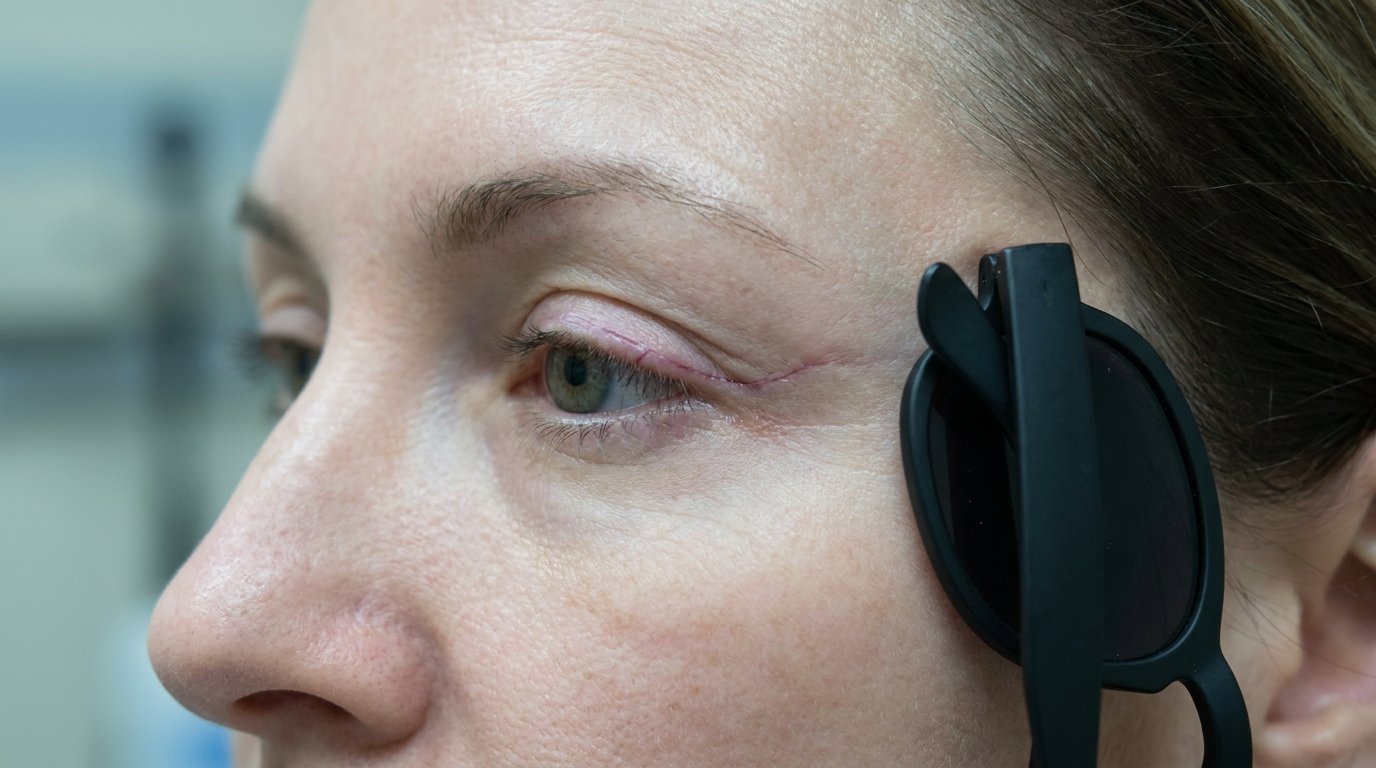
Most canthopexy techniques are intentionally over-corrected a little, because tissue relaxes as healing finishes. So the almond shape you see at three weeks is usually sharper and more upswept than the one you keep. Patients who book a revision consultation at six weeks almost always see a different eye by month five.
Scar maturation runs on the same clock. The small incision at the outer corner or in the lash line fades over months, and firmness along it can take just as long to soften as the swelling itself. Sun exposure during that period makes residual redness more stubborn, which is a practical reason to take sunglasses seriously rather than cosmetically.
If something still genuinely bothers you at the six-month point — a corner that sits lower than the other, visible scar banding, or a shape that was never what you discussed — that is the right moment to raise it. Our overview of canthopexy candidacy, recovery and the limits of the surgery sets out what this procedure can and cannot change, which is the honest starting point for any revision conversation.
Travel, Stay Length and What Drives the Cost in Turkey
For an international patient, the planning question is not really how long swelling lasts — it is how long you need to be in the country, and the answer is usually a short stay with a careful first week. Most patients having canthopexy alone are asked to stay around five to seven nights so that the surgeon can review the eye, remove or check sutures and confirm you are safe to fly. Combined facial surgery often means a longer stay.
Flying with fresh eyelid swelling is uncomfortable rather than dangerous, but cabin air is dry and long flights tempt you to sleep flat. Aisle seat, lubricating drops if your surgeon prescribes them, no eye rubbing, and sunglasses for the airport are small details that make the journey easier. Clearance to fly should come from your surgeon, not from a calendar.
Cost is quoted in Turkish lira or in a major currency depending on the clinic, and it is shaped by the factors below rather than by any single list price. A personalised figure only becomes meaningful after an in-person or video consultation, where the surgeon sees how lax your lower lid actually is and whether canthopexy alone will achieve what you want.
📋 Ask what a quote includes before comparing Two quotes are only comparable when you know whether each one covers anaesthesia, hospital fees, medication, follow-up visits and accommodation. Ask for the inclusions in writing.
Choosing a Surgeon Who Will Manage Your Swelling Properly
The best protection against a bad swelling experience is picking someone who operates on eyelids regularly and who stays reachable after you fly home. Eyelid position is unforgiving — small millimetre errors show — so specialty training matters more here than in almost any other facial procedure.
Look for a surgeon with documented plastic surgery, oculoplastic or facial plastic qualifications, a clinic working in an accredited facility, and before-and-after photos of patients with eyelid laxity similar to yours taken at consistent angles and at genuine milestones rather than a flattering week-three snapshot. European board certification such as EBOPRAS, or recognised national equivalents, is a reasonable credential check for international patients.
Just as important is the aftercare promise. Ask who answers a message at week three if one eye is suddenly puffier, whether follow-up is by video, what the written plan is if something needs revising, and whether you will have a direct contact rather than only a coordinator. Reputable clinics answer all four without hesitating.
Be cautious with anything that sounds engineered rather than medical: guaranteed shapes, fixed ‘fox eye’ templates applied to every face, or a pre-set surgery date before anyone has examined your lower lid tone. A surgeon who tells you canthopexy alone will not fix your particular under-eye problem is giving you useful information, not losing a sale.
This article is for informational purposes only and does not constitute medical advice. Always consult a qualified surgeon for personalised guidance.
Examines lower-lid laxity and dry-eye history, explains why canthopexy rather than a different operation, shares realistic swelling timelines in writing, and names the surgeon who will actually operate.
Promised outcomes, prices quoted before any assessment, no named surgeon, photos only from the first few weeks after surgery, and no clear route to reach the team once you are back home.
Frequently Asked Questions
References
- 📎Simplified technique for lateral canthal tendon canthopexy — Indian Journal of Ophthalmology, 2022
- 📎Exploring the Versatility of Transconjunctival Blepharoplasty: A Retrospective Single-Center Study — Cureus, 2024
- 📎Outcomes of Surgical Treatment of Malar Mounds and Festoons — Aesthetic Plastic Surgery, 2023
- 📎Long Term Results of Temporal Facelift: 6 Years of Experience in 250 Cases — Journal of Craniofacial Surgery, 2025
- 📎NHS — Cosmetic procedures
Related Articles



You Might Also Like



Related articles



Our specialists
 Clineca SpecialistErkan PinegözPlastic & Reconstructive Surgery
 Clineca SpecialistHakan AktaşPlastic & Reconstructive Surgery
 Clineca SpecialistOrkun UzuneyüpoğluPlastic & Reconstructive Surgery
 Clineca SpecialistSalim İskenderPlastic & Reconstructive Surgery
 Clineca SpecialistEngin SelamioğluPlastic & Reconstructive Surgery
 Clineca SpecialistCem AydınPlastic & Reconstructive Surgery
 Clineca SpecialistAlperen ÖnalEar, Nose & Throat (ENT)