
Have a question about Breast Augmentation?
In this article
If you are asking am I a candidate for breast augmentation if I have asymmetric breasts, the short answer is yes in most cases — asymmetry changes the surgical plan rather than your eligibility. Almost every woman has some difference between the two sides, and surgeons expect it, measure it and work around it. What matters is which kind of difference you have, because that decides whether implants alone will be enough.
Does breast asymmetry rule out implants?
Perfectly matched breasts are the exception, not the rule. Mild differences in volume, in how high the fold under the breast sits, or in nipple position are so common that surgeons treat symmetry as something to improve rather than something you must already have.
What your surgeon looks for is the type of unevenness, because each one is corrected differently. Volume difference is the easiest to address, since the implant on each side can simply be chosen in a different size or projection. Differences in skin envelope, breast droop or fold height are more demanding, because an implant adds volume but does not reposition tissue that has already dropped.
A few situations genuinely change the conversation. If one breast is markedly underdeveloped with a tight, narrow base — sometimes called a tuberous or constricted breast — the tissue usually has to be released and reshaped, not just filled. Visible differences in the ribcage or a slight curve of the spine can also make one breast sit further forward, which no implant corrects completely. And a breast lump, a new change in shape or discharge needs investigating before any cosmetic planning begins.
⚠️ New or rapidly changing asymmetry Asymmetry you have had since your teens is usually developmental. Asymmetry that appeared recently, or that comes with a lump, skin dimpling or nipple discharge, should be assessed by a doctor with appropriate imaging before you plan cosmetic surgery.
How surgeons actually correct uneven breasts
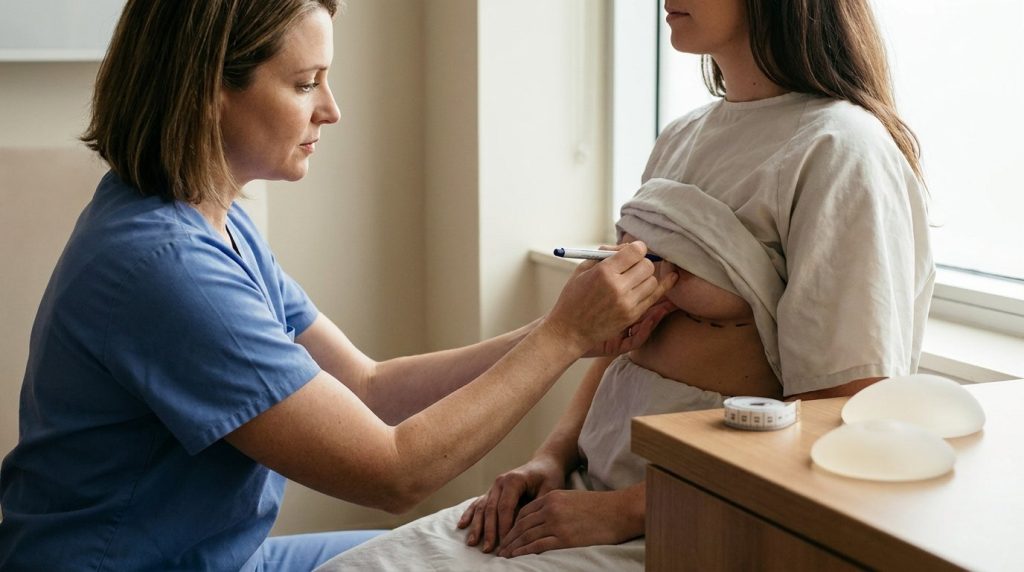
Planning starts with measurement rather than guesswork: breast base width, how much skin you have, nipple height, fold position and the stretch of the tissue on each side. Photographs taken from several angles are part of this, which is why a serious clinic will ask for them before quoting anything.
From there, the toolkit is fairly practical. Two implants of different volume or profile can balance a volume gap. The pocket can be dissected slightly differently on each side, or the fold lowered on the higher breast. A small amount of fat grafting can soften an edge or fill an upper pole that stays flat. If the areolas differ in size, an areola reduction can be done through the same incision used for a lift.
About a third of our breast augmentation patients have a second procedure in the same session, most often a breast lift — which is exactly the pairing asymmetric breasts tend to need, so a combined plan is normal rather than a sign of upselling. For you, that mainly means asking your surgeon whether your quote and your recovery plan cover one procedure or two.
Incision choice also comes into it. A 2010 review in Obstetrics and Gynecology Clinics of North America described the inframammary fold, the areolar border and the armpit as the standard routes for placing implants; when one side also needs lifting, the incision pattern on that breast is usually dictated by the lift rather than by the implant.
- ✓Different implant volumes: The most common single step for balancing a clear size difference between sides.
- ✓Asymmetric pocket or fold adjustment: Lowering or releasing the fold on one side so both breasts sit at a similar height.
- ✓A lift on one side only: Used when one nipple sits noticeably lower, even though both breasts receive an implant.
- ✓Fat grafting as a finishing touch: Small volumes added to smooth contour differences an implant cannot reach.
- ✓Reduction of the larger side: Occasionally the better option when one breast is already big enough on its own.
When implants alone will not be enough
This is the honest limit of augmentation: an implant adds volume and projection, but it does not lift skin, move a nipple or shrink a stretched envelope. If your main complaint is that one breast hangs lower rather than that it is smaller, filling it will usually make the droop more obvious instead of correcting it.

That is why many asymmetry cases are planned as implants plus a lift on one or both sides. If you are weighing that up, our piece on breast augmentation combined with a lift covers candidacy and recovery in more detail, and the comparison of what a lift fixes versus what implants fix is a useful reality check before your consultation.
Timing is worth raising too. Pregnancy and breastfeeding come up in roughly one in four of the conversations we have with women considering breast surgery, and they can change breast volume and shape on each side differently. Mention any plans at your first consultation, because it may influence implant choice, incision placement and whether your surgeon suggests waiting.
Suits small, precise volume differences in women with enough donor fat. It adds modest volume and part of the transferred fat is reabsorbed, so it is a refinement tool rather than a way to add a cup size.
If the bigger side is already the size you want overall, matching downwards avoids implants entirely — at the cost of a longer scar on that breast.
Mild asymmetry can be managed with an asymmetric bra or a light insert. Not a lesser choice — just a reversible one.
What asymmetry correction does to your plan, cost and stay
Nobody should quote you a price for this without seeing photographs and knowing what the plan involves. The drivers are straightforward: whether one side needs a lift, whether two different implants are used, the implant brand and type, the anaesthesia and theatre time, the hospital stay, and the follow-up checks built into your package.
A quote for international patients usually bundles surgery, implants, anaesthesia, the hospital night if one is needed, post-operative garments, transfers and hotel nights, and scheduled reviews before you fly. What it cannot include is a guaranteed number of hours in theatre — a combined plan simply takes longer. Your personalised figure is confirmed after consultation; our breakdown of what shapes a breast augmentation quote explains the trade-offs in more depth.
Stay length follows the bigger procedure, not the smaller one. For implants alone, most patients plan around a week in Turkey; when a lift is added on one or both sides, allow a little more and expect an extra wound check. We cover this in detail in our guide to how long to stay in Turkey for breast surgery.
📋 Before/after photos Asking to see cases with similar asymmetry to yours is a reasonable request, and a good clinic will show consented examples. Remember that photos show what was possible for that patient’s anatomy, not a promise for yours.
Realistic symmetry, safety and choosing your surgeon
The goal surgeons work to is balance in a bra and in clothes, with any remaining difference small enough that only you would notice it. Complete symmetry is not a promise anyone can honestly make, and the two sides also swell and settle at slightly different speeds — one breast often looks higher or firmer for weeks. Our week-by-week augmentation recovery guide sets out what that settling normally looks like.
The risks are the same as for any augmentation: bleeding, infection, changes in nipple sensation, scarring, implant rupture, capsular contracture and the possibility of revision surgery later. Breast implants have also been linked, in rare cases, to a type of lymphoma that develops in the scar capsule around the implant; a 2018 review in Deutsches Ärzteblatt International traced the cases documented worldwide since the condition was first described and stressed how uncommon it is relative to the number of implants placed. Any surgeon offering you implants should raise this with you unprompted, record your implant details and tell you what symptoms to report.
For surgeon choice, look for a plastic surgeon working in a licensed hospital or surgical centre, with board certification you can verify, and a consultation in which someone measures and photographs you rather than naming a cup size over chat. A clear written plan that states which side is being lifted, which implants are planned and what happens if a revision is needed matters more than any package extras.
This article is for informational purposes only and does not constitute medical advice. Always consult a qualified surgeon for personalised guidance.
🚨 No one can guarantee identical breasts Any clinic promising exact symmetry, a precise cup size or a complication-free outcome is overselling. Expect a described, realistic improvement instead.
Written plan naming each side separately, implant brand and reference recorded for you, asymmetry discussed openly in the consultation, named surgeon you can look up, clear revision policy.
A price quoted before any photographs, promises of perfect symmetry, pressure to decide within a day, no mention of implant risks, and no way to contact the surgeon after you fly home.
Frequently Asked Questions
References
- 📎Breast augmentation — Obstetrics and Gynecology Clinics of North America, 2010
- 📎Breast Implant-Associated Lymphoma — Deutsches Ärzteblatt International, 2018
- 📎NHS — Cosmetic procedures
- 📎American Society of Plastic Surgeons — Cosmetic procedures
Related Articles


You Might Also Like



Related articles


Our specialists
 Clineca SpecialistErkan PinegözPlastic & Reconstructive Surgery
 Clineca SpecialistHakan AktaşPlastic & Reconstructive Surgery
 Clineca SpecialistOrkun UzuneyüpoğluPlastic & Reconstructive Surgery
 Clineca SpecialistSalim İskenderPlastic & Reconstructive Surgery
 Clineca SpecialistEngin SelamioğluPlastic & Reconstructive Surgery
 Clineca SpecialistCem AydınPlastic & Reconstructive Surgery
 Clineca SpecialistAlperen ÖnalEar, Nose & Throat (ENT)