Have a question about Breast Augmentation?
In this article
- Can breast augmentation and breast lift be done together?
- Who suits a combined lift and implants — and who doesn’t?
- One operation or two stages — how do you choose?
- What do the scars look like when you combine them?
- What are the risks and complication rates?
- How long is recovery after a combined lift and augmentation?
- What drives the cost, and what should a quote include?
- How long should you stay in Turkey, and how do you choose a clinic?
Many women come to a consultation with two complaints at once: the breast has lost fullness at the top, and it also sits lower than it used to. That raises an obvious practical question — can breast augmentation and breast lift be done together, in one trip and one anaesthetic, or do they belong in separate operations? It is a fair question, because the two procedures pull the breast in slightly different directions, and the honest answer depends on your anatomy, your skin and how much change you are asking for.
Can breast augmentation and breast lift be done together?
Yes — the two are routinely combined in a single operation that surgeons call an augmentation mastopexy, meaning a breast lift (mastopexy) performed at the same time as implant placement. It is one procedure, one anaesthetic and one recovery, not two surgeries booked back to back.
The reason they are often needed together is that each one solves a different problem. An implant adds volume and restores upper fullness, but it does very little to move the nipple or remove loose skin — a heavy implant placed into a stretched breast tends to drop with it. A lift repositions the breast tissue and the nipple higher and removes slack skin, but it does not create volume; it reshapes what is already there. If your breast has both emptied and descended, treating only one of those things usually leaves you half-satisfied.
The technical tension is real and worth understanding. The lift tightens the skin envelope, while the implant stretches it from the inside. The surgeon is balancing two opposing forces in the same operation, which is why planning, implant choice and tissue quality matter more here than in a straightforward augmentation. If you are still weighing which of the two you actually need, our comparison of breast lift versus implants and what each one fixes goes through the decision in more detail.
Who suits a combined lift and implants — and who doesn’t?
The clearest candidates are women whose nipple has dropped to or below the crease under the breast, who have lost volume in the upper pole, and who have reasonable skin quality and are at a stable weight. Post-pregnancy and post-weight-loss changes are the two most common reasons patients arrive in this position.
If your nipple position is still good and you only want more volume, you probably do not need the lift at all — implants alone give a simpler recovery and fewer scars. At the other end, if your breast has plenty of tissue but has simply fallen, a lift on its own may be enough, and an implant would only add weight the skin has to carry. A smaller group is better served by a lift combined with fat transfer rather than an implant; our article on a breast lift without implants covers when that applies.
Age is rarely the limiting factor. Our breast augmentation patients are on average 27 at the time of surgery, and a smaller but steady group is over 40 — which means both the young patient worried she is rushing and the older patient worried she has left it late are inside the normal range. What matters far more is whether your weight and body shape have been stable, and whether your family plans are settled.
Smoking, poorly controlled diabetes and very thin, stretched skin all push a surgeon toward caution, a staged plan, or a more conservative implant. That is a sign of good judgement rather than reluctance.
📋 Raise future pregnancy at the first consultation Pregnancy and breastfeeding plans are among the most frequent topics in conversations with women considering breast surgery. Pregnancy can stretch the skin again and change the result, so say openly whether you may have children later — it can change implant choice, lift technique and recommended timing.
⚠️ Smoking is not a minor detail here A lift relies on blood supply to the nipple and the skin flaps. Smoking and nicotine products reduce that blood supply and raise the risk of poor healing and nipple complications. Most surgeons ask patients to stop several weeks before and after surgery.
One operation or two stages — how do you choose?
Both approaches are legitimate, and the decision is usually made in the consultation rather than in advance. Doing everything in one session means one anaesthetic, one recovery and one trip. Staging it — implants first, lift a few months later, or the reverse — gives the surgeon a chance to see how the tissue settles before fine-tuning the shape, which can mean a more controlled result in difficult cases.
Roughly one in ten of the patients who come to us wanting two procedures choose to split them across two visits; the rest have everything in a single stay. For you, that means combining is the common path but not the only correct one, and a surgeon who suggests staging is usually protecting the result rather than complicating it.
Staging costs more overall, because you pay for two operating sessions and two trips, and it extends the total timeline considerably. Combining concentrates the swelling, discomfort and time off into one block.
What do the scars look like when you combine them?
The implant itself adds very little scarring — the lift is what determines where your scars sit. How much skin needs to be removed decides which pattern your surgeon uses.
A small amount of sagging may be handled with a scar around the areola only, sometimes combined with areola reduction. Moderate sagging usually needs the areola scar plus a vertical line down to the crease, often described as a lollipop pattern. Significant sagging may require an additional scar along the fold under the breast, giving an anchor shape. Fresh scars look pink, firm and slightly raised for the first months, soften over roughly six to twelve months, and continue to fade for up to a year and a half.
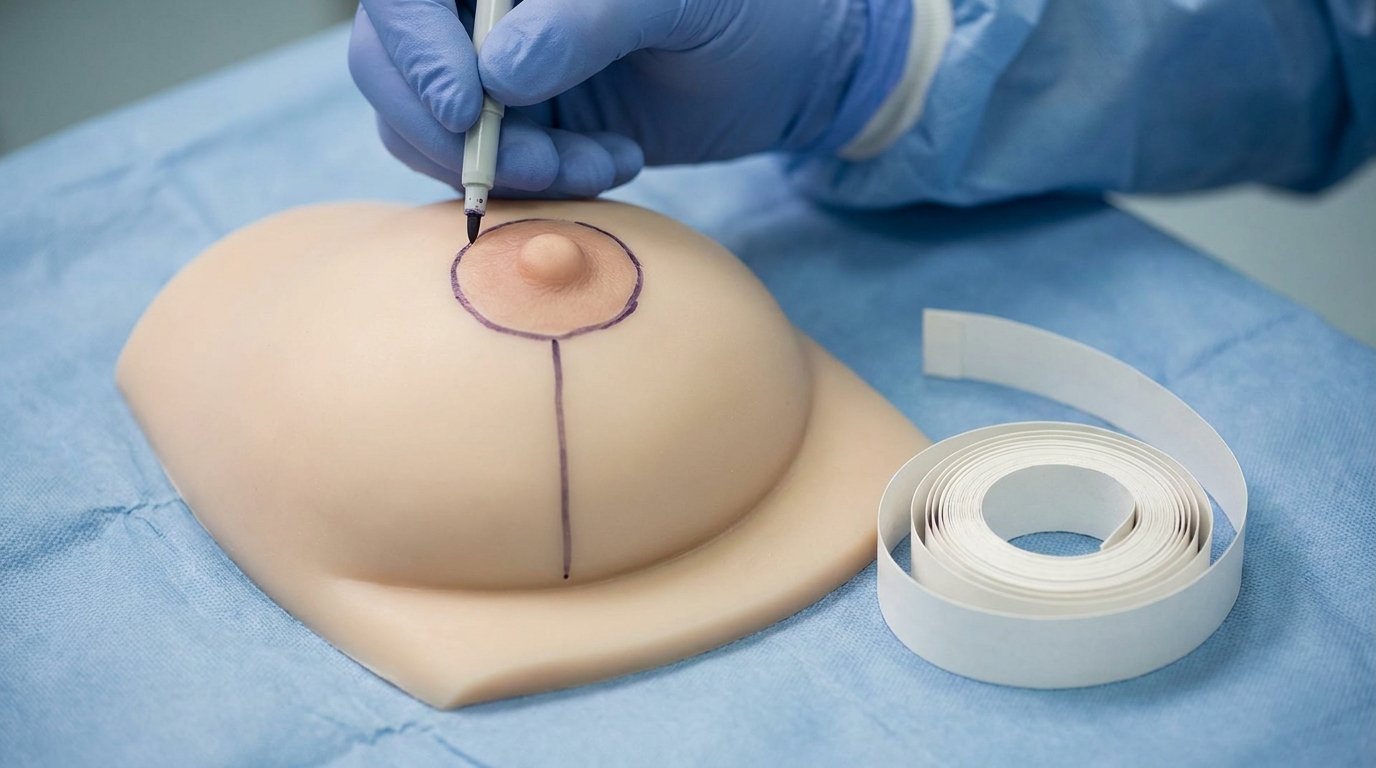
Scars are not a trivial concern, and it is reasonable to weigh them seriously. A 2022 study in Plastic and Reconstructive Surgery – Global Open used validated patient-reported scar measures across breast, abdominal and facial surgery patients and looked specifically at how scars affect symptoms, appearance and psychosocial wellbeing — a reminder that how you feel about a scar is part of the result, not a side issue. If scar placement is your main hesitation, our guide to breast augmentation scars and how they heal sets out the patterns and aftercare.
In practice, patients who accept a slightly longer scar in exchange for a genuinely lifted shape tend to be happier than those who push for minimal scarring and get less correction than they wanted. That trade-off deserves a frank conversation before surgery, not after.
What are the risks and complication rates?
Combining a lift with implants carries the risks of both operations, and it is more revision-prone than either one alone — mainly because the surgeon is tightening the skin and filling it at the same time. Any honest consultation should cover the following.
- ✓Infection and haematoma (a collection of blood): uncommon, but both may need antibiotics or a return to theatre, usually within the first days or weeks.
- ✓Capsular contracture: the scar capsule around the implant tightens, making the breast feel firm, look distorted or become painful. It can appear years later and may need surgery to correct.
- ✓Implant rupture, rippling or visible edges: silicone shells can fail over time, and thin tissue can show rippling or implant edges — more likely with larger implants in slim patients.
- ✓Changed nipple or skin sensation: numbness, hypersensitivity or patchy feeling is common early on and settles for most people, but a permanent change is possible.
- ✓Nipple or areola healing problems: in large lifts, where the nipple is moved a long distance, the blood supply to the nipple and areola is under more strain, and partial loss of skin or nipple tissue is a recognised, if rare, complication.
- ✓Asymmetry, bottoming out and loss of lift over time: breasts are never identical, and gravity, weight change and pregnancy all keep acting on the result.
Revision is a realistic possibility rather than a failure of the operation. Some women need a small adjustment to shape or scars; others return years later for implant replacement. Treating a possible second procedure as part of the long-term plan is a healthier mindset than assuming one surgery settles it forever — our article on how long breast augmentation results last is a useful reality check.
🚨 Contact your clinic urgently if One breast swells rapidly or becomes hard and painful, you develop a fever, the wound starts leaking, the nipple or surrounding skin turns dark or dusky, or you have calf pain, chest pain or breathlessness. These need same-day assessment, wherever you are.
How long is recovery after a combined lift and augmentation?
Plan on roughly two weeks before you feel reasonably normal and six to eight weeks before you return to full exercise — the lift, not the implant, is what lengthens the early recovery. Because about a third of our breast augmentation patients add a second procedure, most often a lift, the recovery most readers should budget for is the combined one rather than the shorter timeline quoted for implants alone.
Most people describe tightness and pressure across the chest rather than sharp pain for the first few days. A surgical support bra is worn day and night for several weeks, and sleeping slightly propped up is more comfortable than lying flat.
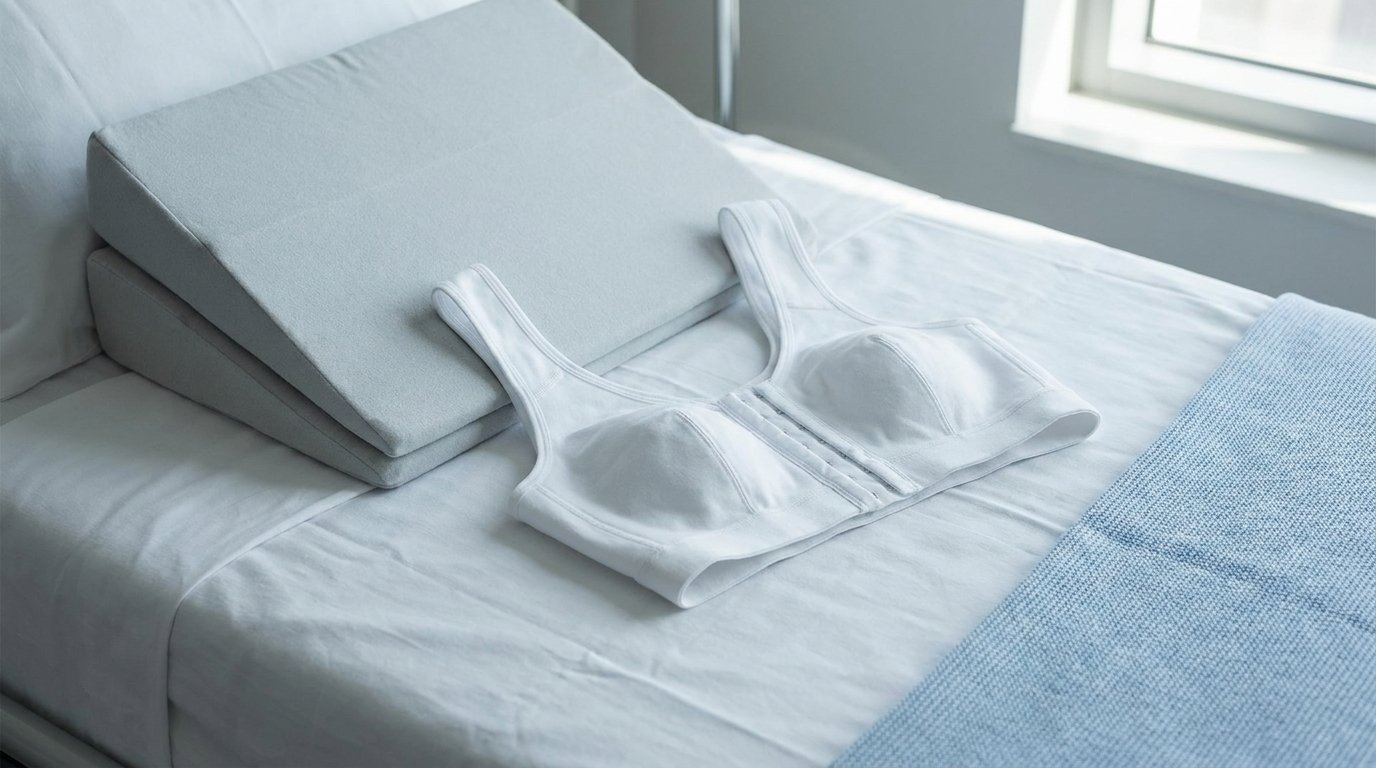
- ✓Wear the support bra exactly as instructed — it protects the lift, not just your comfort
- ✓Walk a little every few hours from day one to reduce clot risk
- ✓Avoid lifting anything heavier than a kettle for the first fortnight
- ✓Keep scars out of direct sun and start scar care only when your surgeon says the wounds are closed
What drives the cost, and what should a quote include?
A combined lift and augmentation costs more than implants alone and less than having the two procedures separately, but the figure is always personal — it depends on the lift pattern you need, the implant chosen and how long you will be monitored. Any specific price should come after a consultation and a review of your photographs or examination, never from a general price list.
The single most useful thing you can do is compare what is inside each quote rather than the headline number. Two quotes that look different often cover different things.
Ask for the breakdown in writing, and ask specifically what happens — clinically and financially — if you need a revision later. Our longer piece on what affects the cost of breast augmentation explains the same logic in more depth.
How long should you stay in Turkey, and how do you choose a clinic?
For a combined lift and augmentation, plan around seven to ten nights in Turkey. That allows pre-operative tests, surgery, an overnight stay, dressing changes and at least one proper review before you fly. Flying too early is the most common avoidable mistake — we go through the reasoning in detail in our guide to how long to stay in Turkey for breast surgery.
On the clinic itself, look at the surgeon rather than the package. You want a surgeon who is formally qualified in plastic and reconstructive surgery, who operates in an accredited hospital, and who is willing to show you results from patients with a similar starting shape — not only the most flattering cases. Verification bodies such as the Turkish Medical Association, EBOPRAS at European level and national registers like the ones behind BAAPS in the UK exist precisely so you can check credentials rather than take them on trust.
Before-and-after photographs are one of the most requested things in consultations, and a reasonable request. What matters is seeing cases that resemble you in breast size, skin quality and degree of sagging, with consistent lighting and positioning, and ideally photographs taken at least six months after surgery.
Finally, ask directly who looks after you if something goes wrong after you fly home, how quickly you can reach the surgical team, and whether there is a named coordinator. Slow communication and unclear aftercare are the things patients regret most, far more often than the surgery itself.
This article is for informational purposes only and does not constitute medical advice. Always consult a qualified surgeon for personalised guidance.
A plastic surgery specialist who examines you or reviews proper photographs, honest talk about scars and revision risk, written quote with inclusions, accredited hospital, an implant card given to you, and a named contact for aftercare.
A firm price before anyone has assessed you, pressure to book immediately, promises of a specific cup size or a scar-free lift, no named surgeon, and no clear answer about what happens if you need a revision.
Options include a lift alone, implants alone, a lift with fat transfer instead of implants, or staging the two procedures across separate trips. Each has a different scar, recovery and cost profile.
Frequently Asked Questions
References
- 📎Patient-reported Outcomes of Scar Impact: Comparing Abdominoplasty, Breast Surgery, and Facial Surgery Patients — Plastic and Reconstructive Surgery Global Open, 2022
- 📎NHS — Cosmetic procedures
- 📎American Society of Plastic Surgeons — Cosmetic procedures
- 📎British Association of Aesthetic Plastic Surgeons (BAAPS)
Related Articles



You Might Also Like


Related articles


Our specialists
 Clineca SpecialistErkan PinegözPlastic & Reconstructive Surgery
 Clineca SpecialistHakan AktaşPlastic & Reconstructive Surgery
 Clineca SpecialistOrkun UzuneyüpoğluPlastic & Reconstructive Surgery
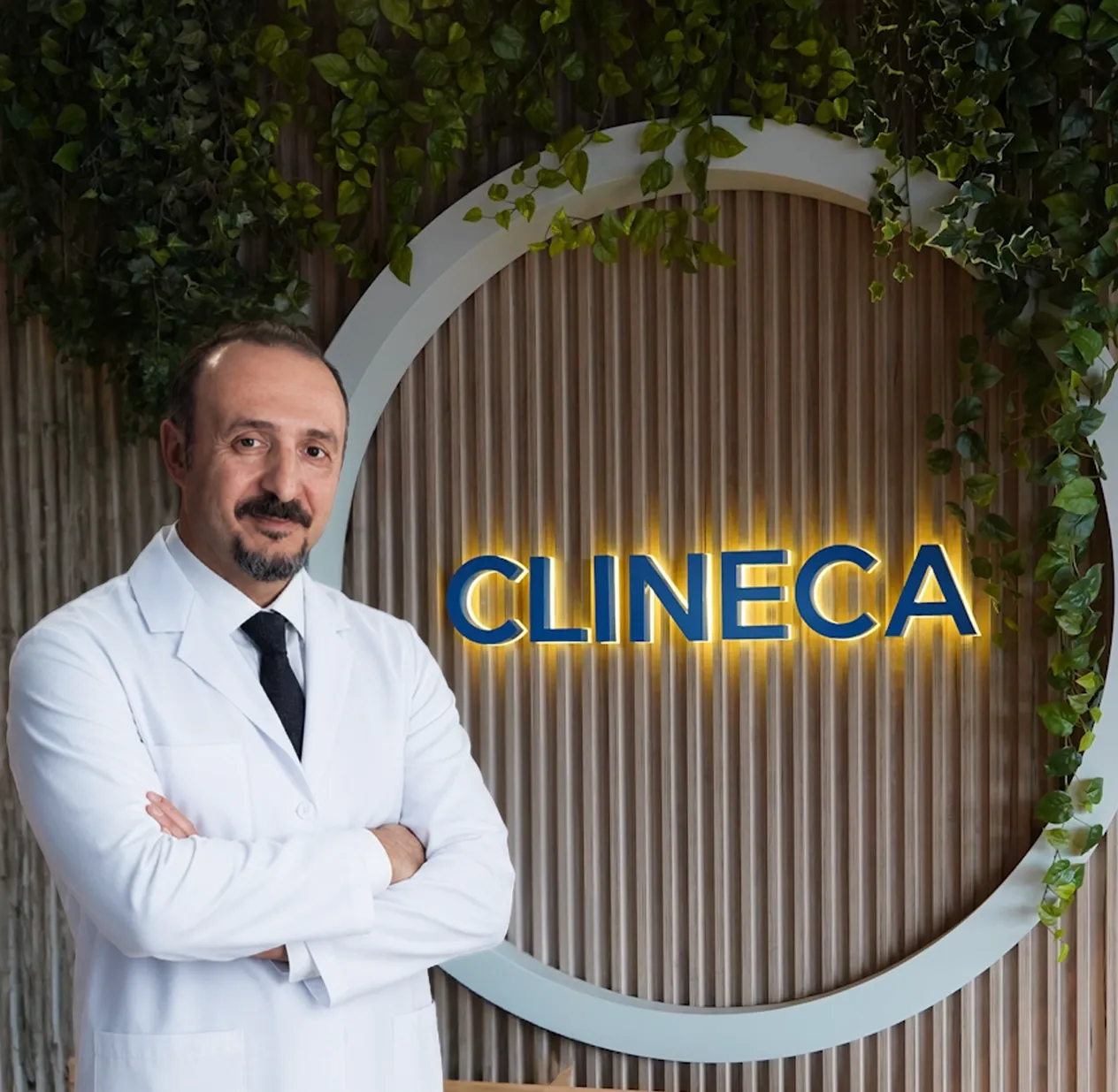 Clineca SpecialistSalim İskenderPlastic & Reconstructive Surgery
 Clineca SpecialistEngin SelamioğluPlastic & Reconstructive Surgery
 Clineca SpecialistCem AydınPlastic & Reconstructive Surgery
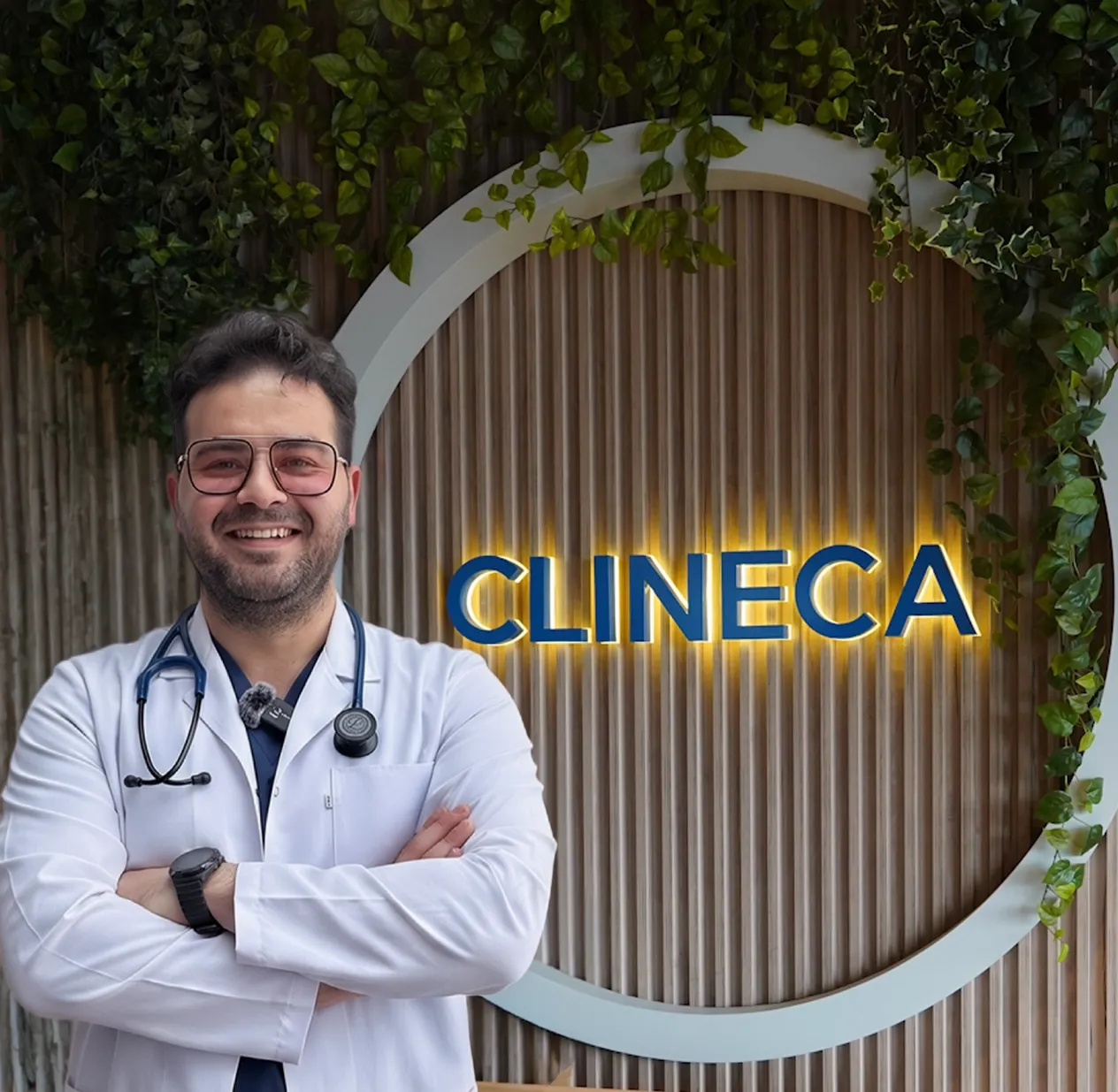 Clineca SpecialistAlperen ÖnalEar, Nose & Throat (ENT)