
Have a question about Gynecomastia?
In this article
- Does excess skin disqualify you from gynecomastia surgery?
- How surgeons assess your chest skin before planning surgery
- Which techniques handle loose chest skin
- When it is better to wait
- Scars: the honest trade-off for removing skin
- What drives the cost when skin removal is involved
- Recovery and how long to stay in Turkey
- Choosing a surgeon when skin has to be removed
Chest skin that folds, hangs slightly at the outer edge or looks deflated after weight loss raises a fair question: am I a candidate for gynecomastia surgery if I have excess skin, or does loose skin change the whole plan? Surgeons take this seriously, because skin quality shapes the technique, the scar pattern and how the chest settles months later. Here is how that assessment actually works, and what it means for your options.
Does excess skin disqualify you from gynecomastia surgery?
Loose skin is not a reason to be turned away. It is a reason for a different plan. Gynecomastia correction is not one operation with one recipe; it is a family of techniques, and the amount of skin you have is one of the main things that decides which one suits you.
When the chest has firm, elastic skin and the problem is mostly glandular tissue and fat, the skin usually shrinks and redrapes on its own once the bulk underneath is removed. When the skin has been stretched for years, or after significant weight loss, that natural retraction is less reliable. In that case the surgeon may plan to tighten or remove skin at the same time, or to stage the work.
What genuinely affects candidacy is different: your general health, stable weight, whether the breast enlargement has an untreated medical cause, smoking, and whether your expectations match what surgery can realistically deliver. Skin laxity mostly changes how the surgery is done, not whether you can have it.
📋 Skin is a planning issue, not a rejection reason Most men with loose chest skin can be treated. The honest conversation is about scar length and how many stages it might take, not about being refused.
How surgeons assess your chest skin before planning surgery
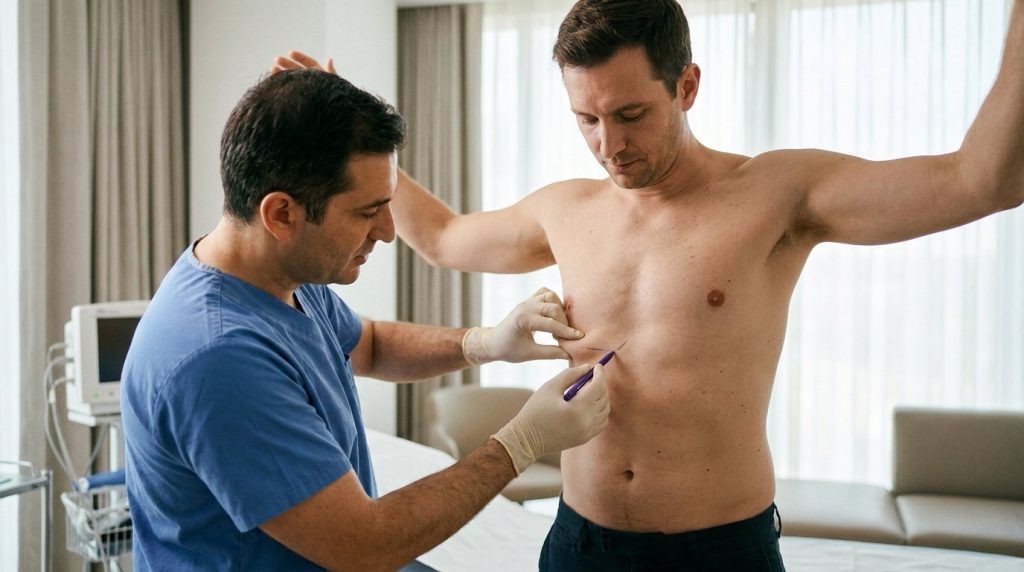
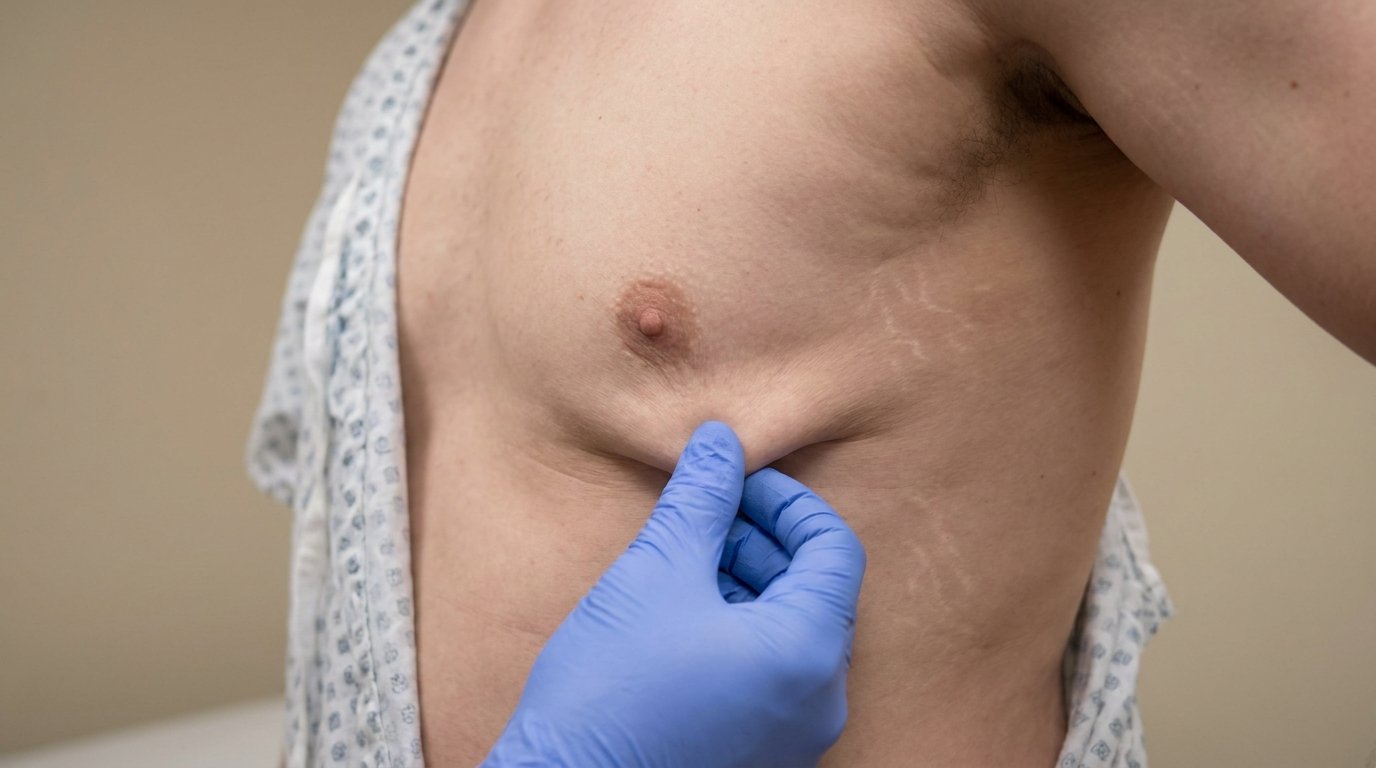
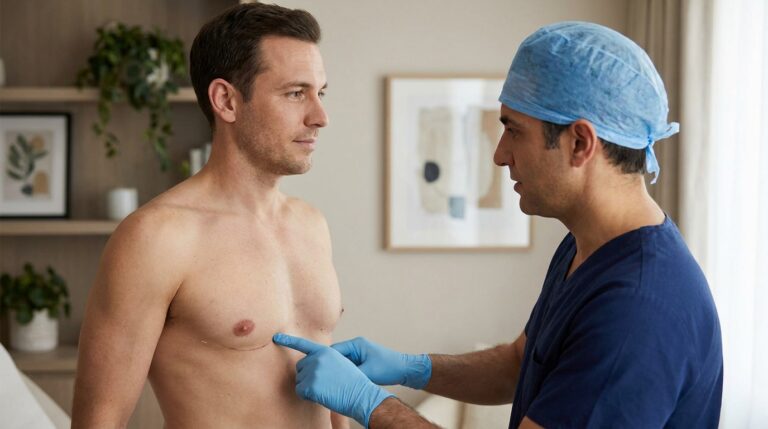
At consultation the surgeon is looking at more than size. They check how much of the fullness is firm gland behind the nipple and how much is soft fat, because those respond to different tools. Then they test the skin: how quickly it springs back when lifted, whether there are stretch marks, and whether a skin fold sits below the chest crease when you stand.
Nipple position matters a lot. If the nipple and areola sit low, point downward or have stretched wide, simply removing tissue underneath can leave them sitting in the wrong place on a flatter chest. Repositioning or reducing the areola then becomes part of the plan rather than an afterthought.
Weight history is the last piece. Skin that has been stretched by long-standing obesity and then emptied by weight loss behaves very differently from skin that has always been tight. Photographs taken with your arms down and raised, and a simple pinch test, usually tell the surgeon most of what they need before anything else is discussed. If diet and training have already plateaued for you, the reasoning behind that is covered in our piece on gynecomastia surgery when diet and exercise haven’t helped.
Which techniques handle loose chest skin
Broadly, the more skin you have, the more the surgeon has to choose between a short scar with some residual looseness, or a longer scar with a tighter contour. There is no technique that gives both, and any clinic promising a flat chest with no visible mark and heavy skin excess is overselling.
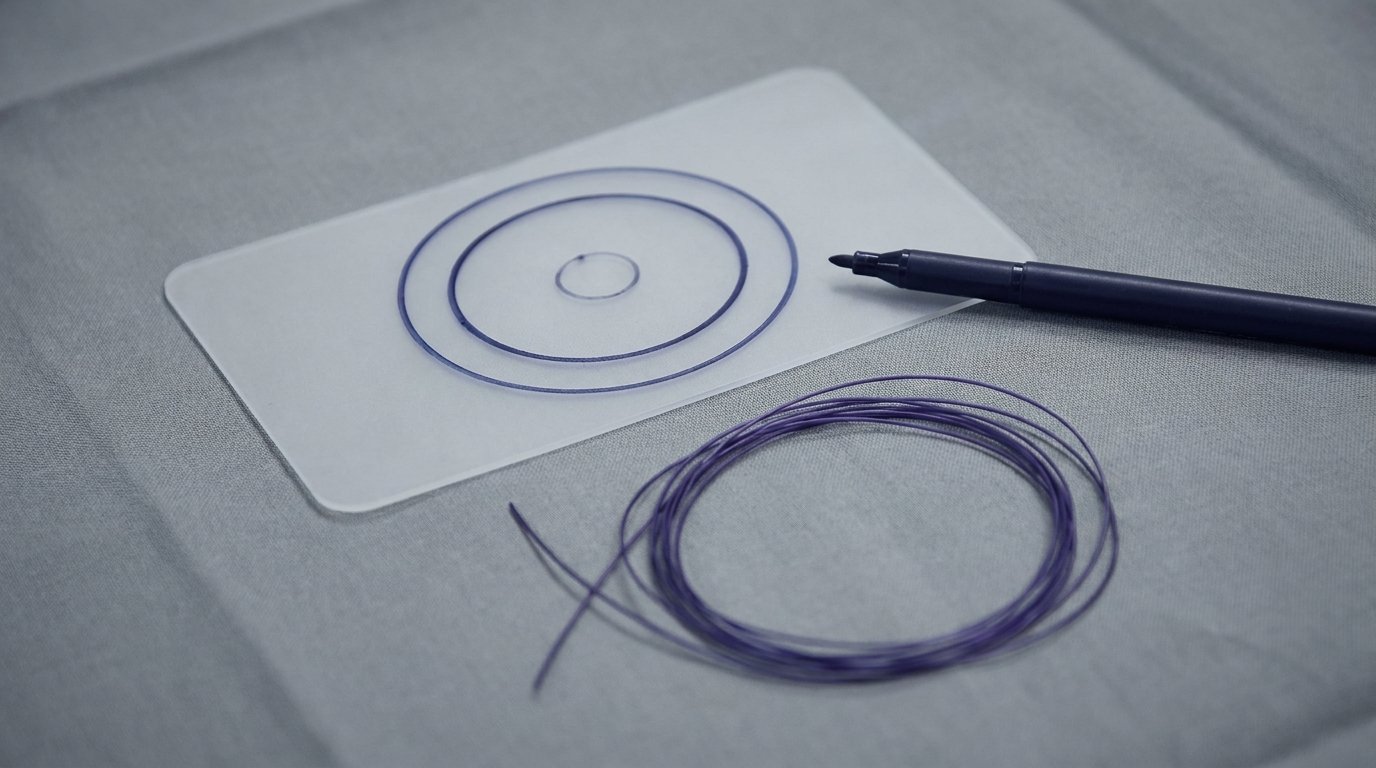
For mild looseness, liposuction plus removal of the firm gland through a small incision at the lower edge of the areola is often enough — the skin tightens gradually over several months. For moderate looseness, the surgeon may remove a ring of skin around the areola, which tightens the skin like a drawstring and lets the areola be reduced at the same time. For severe excess, particularly after major weight loss, a true chest reduction with a horizontal or vertical scar may be the only way to get a genuinely flat, contoured result.
⚠️ Staging is sometimes the better answer Some surgeons prefer to remove gland and fat first, wait several months to see how much the skin retracts, then decide whether skin excision is still needed. It means two procedures, but often a shorter final scar.
When it is better to wait
Timing is one of the things patients hesitate over most, and sometimes waiting genuinely gives a better result. If you are still actively losing weight, skin will keep changing, and a chest tightened now can look loose again later. Most surgeons want your weight stable for several months before planning skin excision.
There are a few other situations where the surgeon should pause rather than operate. Breast enlargement that appeared suddenly, is painful, affects one side only, or involves nipple discharge needs to be investigated medically first. Enlargement linked to anabolic steroids, certain medications or a hormonal condition may partly settle once the cause is addressed. In younger patients still in puberty, tissue can regress on its own, so watching for a while is reasonable.
Smoking is the other honest deal-breaker for skin-removing surgery. Nicotine reduces blood flow to skin flaps and raises the risk of wound healing problems and poor scars, so stopping well before and after surgery is not optional advice.
- ✓Stable weight: Ideally unchanged for several months, so the skin you tighten is the skin you keep.
- ✓Cause investigated: Hormonal or medication-related causes checked before surgical planning.
- ✓Nicotine-free window: No smoking or vaping for the period your surgeon specifies before and after.
- ✓Clear expectations: You accept a scar in exchange for a flatter chest, and understand results settle over months.
Scars: the honest trade-off for removing skin
If skin has to come out, you will have a scar that a scar-free technique would not have left. That is the trade many men accept willingly, because a shirt hides a fine line far better than it hides a fold of tissue. Still, it deserves a straight conversation before you book, not after.
Fresh scars look worse before they look better. They are typically pink, slightly firm and most noticeable somewhere between the first and third month, then soften and fade over six to eighteen months. Final appearance depends on your skin type, genetics, tension across the wound and how carefully you protect the area from sun. Our detailed look at gynecomastia surgery scars walks through what each pattern looks like as it heals.
Some contour irregularity is also normal early on. Swelling settles unevenly, and the chest can look slightly puffy or firm in places for weeks. Judging the result before three months is unfair to yourself and to the surgeon.
What drives the cost when skin removal is involved
Skin excision generally sits at the more involved end of gynecomastia surgery, and quotes reflect that. It usually takes longer in theatre, sometimes needs drains, and may involve nipple repositioning — all of which affect the price. Cost is one of the first things patients ask about, so it helps to understand what the figure is actually made of rather than comparing headline numbers between clinics.
A well-built quote is itemised, not a single number. Ask what happens if a second stage turns out to be advisable, and whether follow-up, garments and any revision policy are included. A personalised price can only be confirmed after a consultation with photographs or an in-person assessment, because the technique changes the workload. Our overview of gynecomastia surgery in Turkey explains how packages are normally structured.
🚨 Be cautious with unusually low quotes A price well below everything else usually means something has been left out — hospital grade, anaesthetist, garment, follow-up, or the skin excision itself. Ask for the inclusions in writing.
Recovery and how long to stay in Turkey
Recovery after skin excision takes a little longer than after liposuction alone. Expect soreness and tightness for the first few days, a compression garment worn more or less continuously for several weeks, and restrictions on chest and arm exercise for around four to six weeks. Desk work is often manageable within a week or two; heavy lifting and gym chest work wait longer.
For international patients, most surgeons ask for roughly seven to ten days in the country so that dressings can be changed, any drains removed and the wounds checked before you fly. Long-haul flights on day two are not a good idea when skin flaps are healing. The week-by-week picture is mapped out in our gynecomastia recovery timeline, and results tend to hold well when weight stays stable — something we cover in how long gynecomastia surgery results usually last.
One practical point about remote planning: send clear photographs from the front, both sides and with arms raised, and mention your weight history honestly. Vague photos lead to vague plans, and a plan built on the wrong skin assessment is the main reason a quote changes after arrival.
Choosing a surgeon when skin has to be removed
This is the part worth slowing down for. Skin-excision chest surgery is closer to a reduction than to a simple liposuction case, and the difference between an elegant scar and a poorly placed one lies almost entirely in planning and judgement. Look for a surgeon who is board certified in plastic surgery, operates in an accredited hospital, and can show healed male chest results at six months or later — not only day-one photos.
You should also feel free to ask direct questions: which technique they would use for you and why, where the scars will sit, whether they would stage the surgery, and what they would do if the skin retracts less than hoped. A clinic that answers these clearly, and that keeps communication quick and consistent before you travel, usually runs the same way afterwards.
This article is for informational purposes only and does not constitute medical advice. Always consult a qualified surgeon for personalised guidance.
Board-certified plastic surgeon, accredited hospital, honest discussion of scars, long-term healed photos of male chests, a written quote with inclusions, and a named contact for follow-up.
Promises of no visible scar despite heavy skin excess, no mention of staging, pressure to pay quickly, no surgeon consultation before booking, and refusal to discuss revision policy.
Some surgeons combine gland and fat removal with energy-based skin tightening, then reassess months later. It can reduce scar length in the right patient, but it is not a substitute for excision when the excess is significant.
Frequently Asked Questions
References
Related Articles


You Might Also Like



Related articles


Our specialists
 Clineca SpecialistErkan PinegözPlastic & Reconstructive Surgery
 Clineca SpecialistHakan AktaşPlastic & Reconstructive Surgery
 Clineca SpecialistOrkun UzuneyüpoğluPlastic & Reconstructive Surgery
 Clineca SpecialistSalim İskenderPlastic & Reconstructive Surgery
 Clineca SpecialistEngin SelamioğluPlastic & Reconstructive Surgery
 Clineca SpecialistCem AydınPlastic & Reconstructive Surgery
 Clineca SpecialistAlperen ÖnalEar, Nose & Throat (ENT)