

Have a question about Forehead Reduction?
In this article
- What does a forehead reduction scar usually look like?
- How do forehead reduction scars heal over time?
- What makes a forehead reduction scar more or less visible?
- What scar care is usually recommended after forehead reduction?
- When should you worry about a forehead reduction scar?
- How long should medical tourists stay, and what should you ask before booking?
- Can a forehead reduction scar be improved if it stays visible?
Forehead reduction scars usually start as a thin incision line near the hairline that looks pink, red, slightly raised, or crusted in the early weeks, then gradually softens and fades over months. If you are researching forehead reduction scars what they look like and how they heal, the short answer is that most scars improve slowly rather than quickly, but healing varies widely with skin type, tension on the wound, aftercare, and your own tendency to form thicker scars.
What does a forehead reduction scar usually look like?
Forehead reduction surgery, also called hairline lowering, leaves a scar because the surgeon must make an incision along the front of the scalp to move the hair-bearing scalp forward. In the first days, that scar often looks more noticeable than patients expect. It may be pink or red, slightly swollen, and uneven in places while the skin edges settle.
Over the next few weeks, the incision line often changes from a fresh healing wound into a closed scar. At that stage, it can still look darker, firmer, or a little raised. That does not automatically mean something has gone wrong. Scar tissue commonly looks most active before it starts to mature.
The final appearance is not the same for everyone. Some scars stay as a fairly fine line that is easy to hide at the hairline. Others remain more visible because of thick scar formation, widening, uneven pigment, or tension on the incision. The NHS notes that all surgery leaves a scar, and cosmetic surgery is no exception.
It is also important to be realistic about the exact hairline edge. Some surgeons design the incision to help camouflage the scar around hair-bearing skin, but you should not assume hairs will reliably grow through the scar itself. That can vary by surgical technique and individual healing, and it should be discussed case by case during a proper consultation.
For patients comparing facial procedures, a page on brow lift surgery can help explain how hairline-area incisions differ from brow-laising techniques, although the scar pattern is not the same procedure.
📋 Normal early appearance In the early healing phase, redness, mild firmness, small scabs, and a slightly uneven line can all be normal.
⚠️ Not all visible scars stay visible A scar that looks obvious at two to six weeks may still improve a great deal over the following months.
A forehead reduction scar is usually placed at or just inside the hairline, so it often begins as a fine line with redness, mild swelling, and small crusts. Over time it commonly flattens and fades, but the final look depends on incision placement, wound tension, skin tone, and scar tendency.
How do forehead reduction scars heal over time?
This is the part many patients find hardest: scar healing is slow, and the timeline is not linear. A scar can look better, then a little worse, then better again as it matures. According to scar literature indexed on PubMed, scar remodelling is a long process rather than a quick event.
In the first week or two, the main goal is wound closure. You may see swelling along the incision, dried blood, tenderness, numbness near the scalp, and small crusts. Once the skin surface has sealed, patients often expect the scar to be nearly finished. It is not. The next stage is when the scar starts laying down collagen, and that can make it look pinker or firmer for a while.
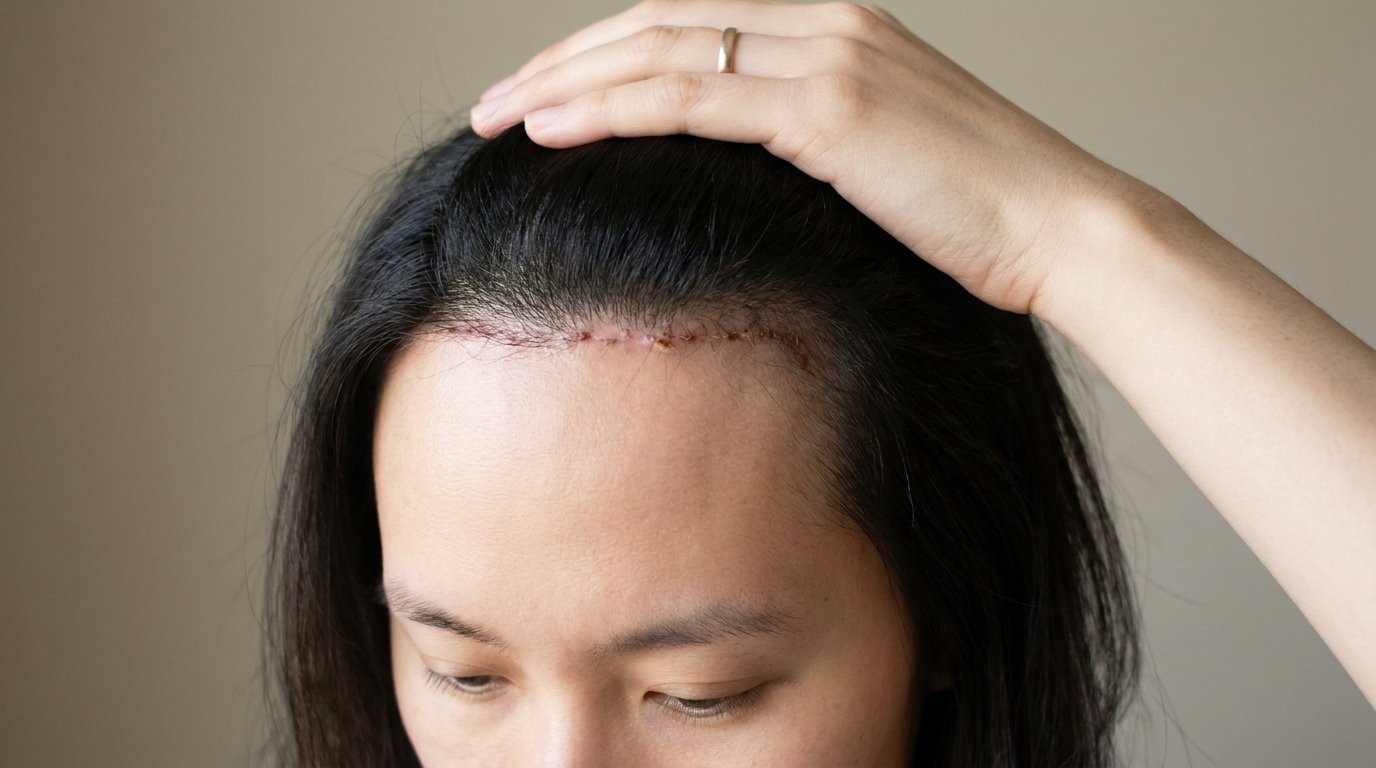
From the following weeks into the coming months, many scars begin to flatten and lose some of their colour. In some people, especially those with a personal or family history of thick scars, the line may stay raised or itchy for longer. Hypertrophic scars are scars that become thick and raised within the boundaries of the incision. Keloids extend beyond the original wound edges and are less common, but they matter when discussing risk.
The broad pattern below is more useful than trying to predict an exact date for every patient.
📋 Scar maturity takes time A forehead reduction scar often keeps changing for many months. Early appearance is a poor guide to the final result.
Forehead reduction scars usually heal in stages: early closure in the first days to weeks, then a more active scar phase when redness or firmness can increase, followed by gradual softening and fading over several months. Scar maturation is slow, and the final result may not be clear for a long time.
What makes a forehead reduction scar more or less visible?
Patients often focus on one question: will the scar show? The honest answer is that several factors work together. Some are under the surgeon’s control, such as incision planning and wound closure. Others belong to your biology, like pigment changes or a tendency toward hypertrophic or keloid scarring.
The hairline itself matters too. A scar placed where it follows the natural transition between forehead skin and hair-bearing scalp may be easier to disguise than one that heals under high tension or in a very exposed position. Thick hair can help camouflage a scar, but not every patient has the same density, hairstyle, or recession pattern.
Lifestyle and aftercare have a real effect. Smoking can impair wound healing. Sun exposure can make a healing scar stay darker for longer. Picking at crusts, restarting strenuous activity too soon, or using unapproved creams on a fresh incision can also make healing less tidy.
If you know you have formed raised scars before, say so clearly during your consultation. That history matters. A detailed surgical consultation through the clinic’s consultation page is where a surgeon can assess hairline position, skin quality, scalp laxity, and scar risk rather than offering a one-size-fits-all answer.
- ✓Your natural scar tendency, including any history of hypertrophic scars or keloids
- ✓Skin tone and how your skin reacts to inflammation or pigment change
- ✓How much tension sits on the incision after the scalp is advanced
- ✓Whether the wound heals cleanly without infection or delayed closure
- ✓Smoking, sun exposure, and how closely aftercare advice is followed
- ✓Hair density and hairstyle, which affect how easily the scar blends in
Scar visibility depends on more than surgical skill alone. Skin type, natural healing pattern, incision tension, hairline design, infection risk, smoking, sun exposure, and aftercare all affect whether the line stays fine or becomes wider, darker, raised, or more noticeable.
What scar care is usually recommended after forehead reduction?
Good scar care starts with restraint. In the first phase, the incision needs to heal without irritation. That means following the surgeon’s cleaning instructions, avoiding hair products or makeup near the incision until you are told it is safe, and not rubbing or scratching the area.
Once the wound is fully closed, many surgeons consider silicone gel or silicone sheets as part of scar management. Reviews in the medical literature, including PubMed-indexed evidence, support silicone therapy as one of the better-established non-invasive options for scar management. It is not magic, and it does not work overnight, but it is commonly recommended because it is simple and low risk when used correctly.
Sun protection matters more than many patients realise. A healing scar exposed to ultraviolet light can stay darker for longer, especially in skin that pigments easily. A hat and careful sun avoidance are often more useful early on than trying multiple active scar products.
Some patients are advised to begin scar massage later in healing, but timing matters. Starting too early or pressing too hard can irritate the incision. Always use the treating surgeon’s timeline rather than copying another patient’s routine from social media.
Practical scar-care priorities
The basics usually matter most. Keep the incision clean, protect it from sun, avoid tension and friction, and use only products your surgeon has approved for that stage of healing. More products do not always mean a better scar.
If the scar starts becoming thick, very raised, or persistently itchy, treatment options may include a review with the surgeon, prescription therapies, or in some cases steroid treatment for problematic scar overgrowth. Those decisions need a clinician’s assessment rather than home guessing.
Gentle wound care, sun protection, patience, and consistent approved scar therapy often support the best possible healing.
Picking scabs, using strong products too early, smoking, and exposing a fresh scar to sun can all make healing harder.
Scar care usually starts with simple wound protection, then moves on to scar-management steps once the incision has fully closed. Common advice includes keeping the wound clean, avoiding sun, and in suitable cases using silicone-based scar therapy, which is supported by evidence reviews for improving scar quality.
When should you worry about a forehead reduction scar?
A healing scar is not supposed to look perfect straight away, so it helps to know the difference between normal healing and warning signs. Mild redness at the incision line, numbness, itchiness, and a tight feeling can all happen during ordinary recovery.
What deserves attention is change in the wrong direction. If the area becomes increasingly hot, more swollen, more painful, or starts leaking pus, that raises concern for infection or wound problems. If the wound edges separate, or you develop fever, you should contact the treating team promptly.
Later on, persistent thickening is another reason for review. A raised scar that stays within the incision may be hypertrophic. If scar tissue appears to spread beyond the original line, keloid change is a possibility in susceptible patients. Neither should be self-diagnosed from photos alone.
For international patients, this matters even more because you may be recovering away from the operating country after the first follow-up period. Before booking surgery abroad, ask exactly who handles aftercare, how virtual reviews work, and what happens if you need urgent in-person assessment after you return home.
🚨 Get medical advice promptly if you notice Spreading redness, heat, pus, wound opening, fever, a bad smell, or pain that is getting worse instead of better.
Some redness and firmness are expected, but spreading redness, heat, pus, bad smell, wound opening, fever, or rapidly worsening pain need prompt medical review. Later on, a scar that becomes increasingly thick, itchy, or extends beyond the incision may also need assessment for abnormal scar formation.
How long should medical tourists stay, and what should you ask before booking?
If you are travelling for forehead reduction surgery, do not plan your trip around the procedure day alone. Early scar care starts immediately, and your first follow-up matters. You want time for the team to inspect the incision, manage dressings, answer questions about washing your hair, and check for swelling or wound tension before you travel back.
The length of stay varies by surgeon, clinic routine, and your own recovery. A personalised plan should be confirmed after consultation rather than guessed from online forums. The quote should also be explained clearly in words, including what follow-up is included, whether transfers or hotel are arranged, and what support is available once you are back home. Because pricing varies by surgeon, facility, complexity, and aftercare package, a personalised quote is the only meaningful figure.
When choosing a provider, look for a transparent clinic structure, named surgeons, and clear contact routes. You can review the clinic’s surgeon information and about the clinic pages before arranging a formal assessment.
The comparison below can help you ask better questions.
For forehead reduction, cost depends on the surgeon, hospital or clinic setting, anaesthesia, complexity, aftercare, and travel logistics. A proper quote comes after consultation.
For medical tourists, the key issue is not only the surgery but safe early follow-up before flying home. You need enough time for initial wound checks, dressing changes if required, and confirmation that healing is stable. The exact stay depends on the surgeon’s protocol and your progress.
Can a forehead reduction scar be improved if it stays visible?
If a forehead reduction scar remains more visible than expected, the next step is not always another operation. First, the surgeon needs to identify the actual issue. A red scar, a wide scar, a raised scar, and a scar with surrounding hairline mismatch are not the same problem.
Non-surgical options may include silicone therapy, pressure or taping advice, steroid treatment for selected raised scars, or laser-based treatment for persistent redness in suitable patients. Surgical scar revision is sometimes considered when a scar has matured and there is a clear structural issue, but timing matters because revising an immature scar too early may not help.
This is where realistic expectations matter. The goal is often to make the scar less noticeable, not to erase it completely. The American Society of Plastic Surgeons explains that scarring is an expected trade-off of surgery, even when every step is taken to help the scar heal as neatly as possible.
Yes, some visible scars can be improved, but treatment depends on the problem: redness, thickness, widening, pigment change, or hairline irregularity each need different solutions. The first step is usually time and review, because many scars continue to settle before any revision should be considered.
Frequently Asked Questions
References
- 📎PubMed search: scar maturation wound healing remodeling hypertrophic keloid
- 📎PubMed search: silicone gel sheeting scar therapy systematic review
- 📎NHS: Cosmetic procedures
- 📎ASPS: Cosmetic procedures
You Might Also Like


Related articles

Our specialists
 Clineca SpecialistErkan PinegözPlastic & Reconstructive Surgery
 Clineca SpecialistHakan AktaşPlastic & Reconstructive Surgery
 Clineca SpecialistOrkun UzuneyüpoğluPlastic & Reconstructive Surgery
 Clineca SpecialistSalim İskenderPlastic & Reconstructive Surgery
 Clineca SpecialistEngin SelamioğluPlastic & Reconstructive Surgery
 Clineca SpecialistCem AydınPlastic & Reconstructive Surgery
 Clineca SpecialistAlperen ÖnalEar, Nose & Throat (ENT)