

Have a question about Dental Implants?
In this article
- What you are actually paying for in a UK implant quote
- Why two UK quotes for the same missing tooth look so different
- Does the NHS pay for dental implants?
- Dental implants in Turkey vs the UK: what really changes
- How long you need to stay, and how many trips
- Safety and how to check a clinic in either country
- Who should delay implant treatment
- Is the saving worth it? The honest trade-offs
Few dental treatments are as hard to compare on price as implants. Two clinics can look at the same gap, describe the work in completely different language, and quote in ways that simply will not sit side by side — which is why the question of what dental implants cost in the UK feels so slippery. This guide unpacks what actually sits inside an implant quote, where Turkish treatment genuinely differs, and what each route means for your time, your travel and your long-term aftercare.
What you are actually paying for in a UK implant quote
An implant quote is a bundle of separate stages, not one price for one object. Once you see the stages, most of the confusion between quotes disappears.
The implant itself is a small titanium post placed in the jawbone. On top of it sits a connector (the abutment), and on top of that the visible crown. Before any of that happens you need assessment: a clinical exam, X-rays and usually a 3D scan of the jaw to check bone height and the position of nerves and sinuses. Afterwards you need follow-ups, a fitting appointment and long-term maintenance.
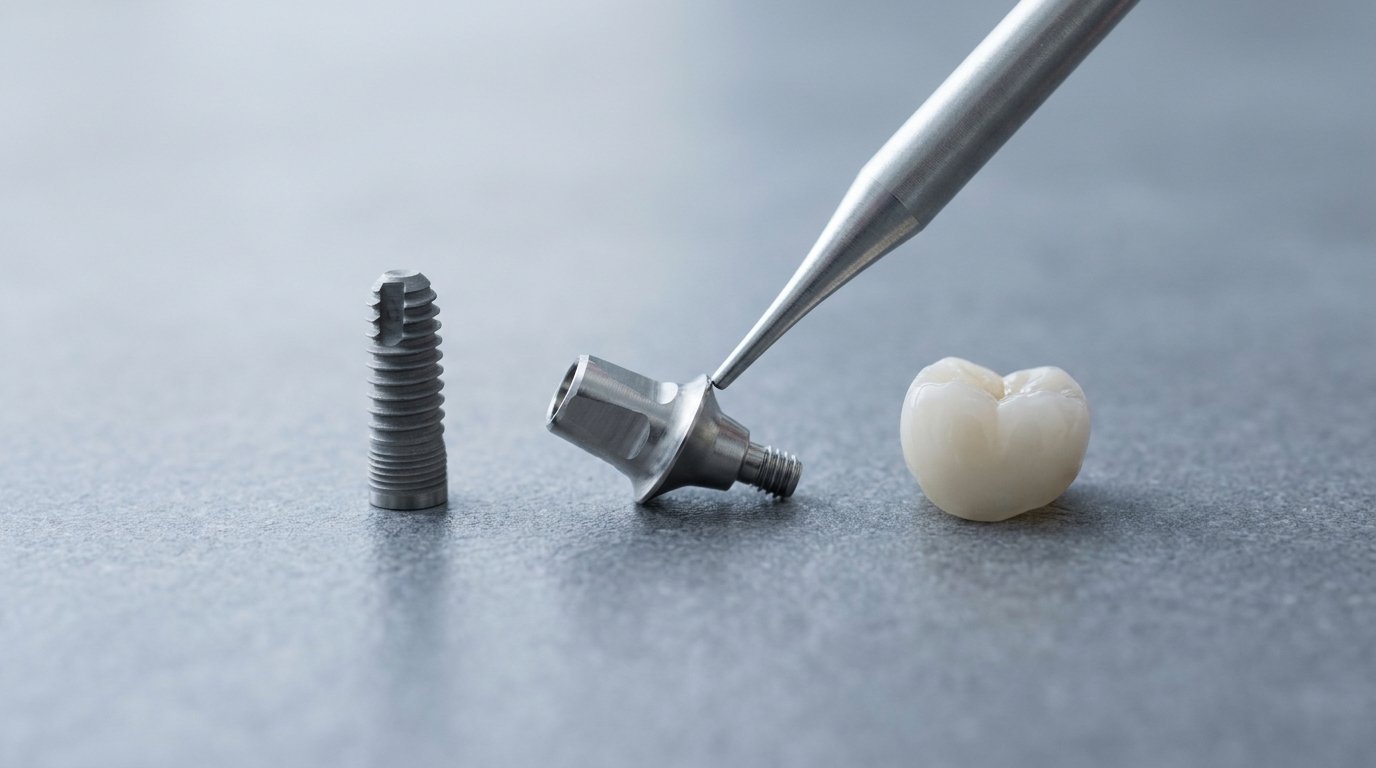
Some quotes list every one of those items. Others give you a single headline number and keep the extras in the small print. That is the single biggest reason two prices for “one implant” are not comparable, and it is why a figure quoted over the phone means very little until someone has looked at your scan.
We do not publish price lists here, because a number without your X-rays attached is not information — it is advertising. What we can do is show you exactly what moves the figure, so you can read any quote, in any country, and ask the right questions before you commit. Your own personalised price is confirmed after a consultation and a review of your scans.
⚠️ Be careful with photo-only quotes A firm price offered from a selfie or a holiday snap is a marketing estimate, not a treatment plan. Bone volume, gum health and bite problems only show up on examination and 3D imaging, and all three change the work needed.
Why two UK quotes for the same missing tooth look so different
In short: because the clinical starting point and the inclusions differ, not because one clinic is simply greedier than the other.
Bone is the first variable. If the tooth has been missing for years, the jaw in that spot usually shrinks, and an implant may need grafting or a sinus lift before it has anything solid to anchor into. That adds surgery, materials and often several more months of healing. A fresh extraction site with good bone is a much simpler job.
The number of teeth changes the maths in both directions. A single implant carries all its own costs. A full arch is a bigger procedure, yet the cost per tooth usually falls, because a set of implants can support a whole bridge rather than one crown each. If you are weighing a full upper or lower arch, our guide to All-on-4 dental implants in Turkey explains how those fixed-bridge plans are built and staged.
Materials, systems and who holds the drill
Implant systems are not interchangeable. Long-established brands cost more and come with decades of published data and a global supply of matching parts — which matters years later if a component ever needs replacing. The crown on top matters too: material choice and lab skill decide how natural it looks next to your own teeth, and that is where the zirconia versus porcelain decision comes in.
Size can also dictate cost. Narrow gaps need narrow implants, and a 2025 prospective multicentre study in Clinical Implant Dentistry and Related Research followed one-piece narrow-diameter implants used for congenitally missing upper lateral incisors with limited bone over five years — a reminder that these are specific engineering solutions for tight spaces, not budget versions of a standard implant.
Finally, there is who treats you and where. A specialist with surgical training, a practice in central London, sedation with an anaesthetist present and fully guided digital surgery all push a quote up. None of that is padding; it is a different level of service, and sometimes a clinical necessity.
- →Bone and gum condition: Grafting, sinus lifts and gum disease treatment are the most common reasons a quote rises after assessment.
- →Number and position of implants: Front teeth are aesthetically demanding; full arches change the cost per tooth.
- →Implant system and crown material: Brand track record, part availability and lab quality all feed into the figure.
- →Clinician and setting: Specialist surgical training, sedation and location shift private pricing noticeably.
- →What aftercare is included: Review visits, hygiene appointments and warranty cover are sometimes inside the quote and sometimes not.
Does the NHS pay for dental implants?
Usually not. NHS dentistry is built around restoring function with fillings, crowns, bridges and dentures, and implants sit outside routine NHS care for most adults.
There are exceptions where there is a clear clinical need rather than a cosmetic preference — for example after mouth cancer treatment, after facial trauma, or where teeth are missing because of a medical or developmental condition and a conventional denture cannot work. These cases are normally handled through hospital dental or maxillofacial services (the surgical specialty dealing with the jaws and face) after referral, not in a high-street practice. Your own dentist can tell you whether a referral is realistic in your situation.
For everyone else, implants are a private treatment in the UK. That is why the comparison most patients actually face is not NHS versus private, but UK private versus treatment abroad.
📋 Worth asking before you go private If a tooth can be saved, saving it is often the cheaper and more conservative route. Ask whether root canal treatment, a crown, or a bridge using neighbouring teeth would serve you just as well before committing to surgery.
Dental implants in Turkey vs the UK: what really changes
The honest summary is that the surgery itself is broadly the same procedure with the same materials available; what changes is the price level, the schedule, the travel and where your aftercare lives.
Turkish clinics generally quote lower than UK private practices for comparable work, and the reason is unglamorous: staff costs, rent, lab costs and overheads are lower, and busy clinics treat high volumes. It is not automatically a sign of cheaper materials — the same major implant systems and the same zirconia are available in Istanbul and Antalya as in Manchester. But it is your job to confirm which system is being used, in writing, before you travel.
The schedule is the real trade-off. Implants need time to fuse with bone, and that biology does not speed up for anyone. In the UK those months pass between local appointments. With treatment abroad, they usually mean two trips. Our overview of dental implants in Turkey walks through how that staging is planned in practice.
The other difference is what happens if something needs attention a year or two later. At home, you walk back in. Abroad, a loose screw or a chipped crown means either a flight or finding a local dentist willing to work on another clinic’s implant system — which is far easier when you hold full documentation of exactly what was placed.
Healing time is set by bone, not by geography. Any plan that promises permanent teeth in a single short trip for a complex case deserves hard questions.
Some patients have surgery abroad and arrange routine hygiene and monitoring with a UK dentist. Agree this with a local practice before you travel, not after.
How long you need to stay, and how many trips
Most overseas implant plans are built around two visits of roughly a week each, with a healing gap of several months in between.

The first trip covers assessment, any extractions, the implant surgery itself and, where appropriate, a temporary tooth or bridge so you are not left with a visible gap. Clinics generally like a few days afterwards for review before you fly, so swelling and healing can be checked in person.
Then comes the quiet part. The implant needs to integrate with the bone, which usually takes a few months and longer if bone grafting was involved. Nothing is gained by rushing this stage, and good clinics will not let you.
The second trip is for the permanent crowns or bridge: scans or impressions, a trial fit, adjustments to the bite, then the final fitting. It is calmer than the first visit but still needs several working days, because the fine-tuning is what makes the result feel like your own teeth. For a week-by-week sense of how the healing phase actually feels, see our guide to dental implant recovery.
When you budget, budget for the whole journey rather than the treatment line alone. Two sets of flights, two hotel stays, airport transfers and time away from work are part of the true cost of going abroad, and they are the numbers people most often forget to add up.
📋 Immediate-load plans Some full-arch plans fit a temporary fixed bridge on the day of surgery, so you leave with teeth. The permanent bridge still waits for healing, so the second trip remains part of the plan.
Safety and how to check a clinic in either country
Safety here is less about the country and more about verification: who is treating you, what they are placing, and what the plan says in writing.
In the UK, every dentist must be registered with the General Dental Council, and you can search the register by name before you book. Dental practices are also registered with the care regulator for their nation — the Care Quality Commission in England, with equivalent bodies in Scotland, Wales and Northern Ireland — and inspection reports are public. Use both.
For Turkey, ask for the treating dentist’s name and qualifications up front, confirm the clinic holds a Ministry of Health licence, and ask whether it carries any international accreditation such as JCI. Then ask the clinical questions: which implant system, which crown material, is a 3D scan taken before the plan is finalised, and who reviews you if something feels wrong six months later. A clinic that answers all of that plainly is telling you a lot about how it works. Our broader notes on dental treatment in Turkey cover the practical side of arranging it.
Be cautious with marketing claims about success rates. A 2023 international consensus report published in Clinical Oral Implants Research and the Journal of Clinical Periodontology set out a core outcome set for implant dentistry precisely because trials had been reporting outcomes so inconsistently that results were hard to compare — and it gave real weight to what patients themselves report. The practical lesson for you is simple: a headline percentage on a website is not a comparable measure, so judge a clinic on documentation, follow-up and honesty about risk instead.
The clinic declines to confirm a price before imaging, discusses saving teeth where possible, explains healing months honestly, and puts inclusions and exclusions in writing.
Pressure to pay a deposit the same day, a fixed price from photographs, vague answers about implant brand, or a promise of a complete new smile in a handful of days regardless of your case.
- ✓Named dentist whose registration or licence you can verify yourself
- ✓A 3D scan and written treatment plan before any final price is agreed
- ✓The implant brand, size and batch numbers recorded for you to keep
- ✓Clear written warranty terms, including who pays for travel if rework is needed
- ✓A named contact for problems after you fly home, and a realistic review schedule
Who should delay implant treatment
Implants are elective surgery, and some situations are better handled by waiting than by pushing ahead.
Active gum disease needs treating first, because the same bacteria that damage bone around teeth can damage bone around an implant. Uncontrolled diabetes, heavy smoking, recent head or neck radiotherapy and certain bone medicines all affect healing, and your dentist and GP may need to talk before a date is set. Jaws that are still growing are another reason to postpone, which is why implants are generally planned for adults.
Pregnancy timing comes up constantly in our consultations. Among the women who talk to us about breast surgery, it is raised in roughly one in four conversations — and the instinct behind it applies just as much to dental work, where elective surgery, routine imaging and some medicines are usually deferred. Raise a current or planned pregnancy at your very first implant consultation, because it can shift the whole treatment timeline and is far easier to plan around than to unpick later.
🚨 Tell the clinic everything Share your full medical history, all medicines and supplements, and whether you smoke. Withholding any of it does not get you treated faster — it raises the risk of implant failure and complications.
Is the saving worth it? The honest trade-offs
For many people the arithmetic does favour treatment abroad, especially for larger cases. For others, the convenience of local care is worth more than the difference.
The saving is most convincing when several implants or a full arch are involved, because the gap between quotes grows while your travel costs stay broadly the same. For a single tooth in otherwise healthy bone, two sets of flights and hotels can erode much of the advantage, and you still carry the aftercare question.
Against that, weigh the things money does not fix. You will be away from home for surgery, you will need a plan for routine maintenance once you are back, and any rework means travelling again unless the warranty covers it. Those are not reasons to rule out Turkey — they are simply the parts of the decision that get skipped when only the headline price is compared. Our piece on Turkey teeth costs and quote drivers goes deeper into reading an overseas quote properly.
Whichever route you choose, insist on the same three things: imaging before pricing, a written plan listing every inclusion and exclusion, and full documentation of the materials used. Implants are a long-term investment in function, and the maintenance habits that follow — careful cleaning and regular professional checks — do more for their lifespan than the price you paid at the start.
This article is for informational purposes only and does not constitute medical advice. Always consult a qualified surgeon for personalised guidance.
Frequently Asked Questions
References
- 📎Relevant domains, core outcome sets and measurements for implant dentistry clinical trials: The ID-COSM international consensus report — Clinical Oral Implants Research, 2023
- 📎Five-Year Multicenter Study on One-Piece Narrow Implants for Congenitally Missing Maxillary Lateral Incisors — Clinical Implant Dentistry and Related Research, 2025
Related Articles

You Might Also Like


Related articles

Our specialists
 Clineca SpecialistErkan PinegözPlastic & Reconstructive Surgery
 Clineca SpecialistHakan AktaşPlastic & Reconstructive Surgery
 Clineca SpecialistOrkun UzuneyüpoğluPlastic & Reconstructive Surgery
 Clineca SpecialistSalim İskenderPlastic & Reconstructive Surgery
 Clineca SpecialistEngin SelamioğluPlastic & Reconstructive Surgery
 Clineca SpecialistCem AydınPlastic & Reconstructive Surgery
 Clineca SpecialistAlperen ÖnalEar, Nose & Throat (ENT)