

Have a question about Breast Lifting?
In this article
- What is actually inside a breast lift quote?
- Why do breast lift quotes vary so much between clinics?
- Is a breast lift available on the NHS?
- Lift alone, lift with implants, or implants alone: how the costs compare
- Recovery, time off work and the hidden costs
- Risks and trade-offs you should price in before you commit
- Does having a breast lift abroad really cost less?
- How to get a price you can actually rely on
When people start looking into breast lift cost in the UK, the first surprise is usually how far apart the answers sit. Two clinics can describe the same operation, use the same word — mastopexy, meaning a lift of the breast tissue and skin — and still hand you quotes that feel like they belong to different procedures. The reason is rarely the surgeon’s fee alone, and understanding what sits underneath the number is the only way to compare anything fairly.
What is actually inside a breast lift quote?
A breast lift is a theatre procedure under general anaesthetic, so the price you are given is really a bundle. It covers the operating team, the time in theatre, the anaesthetic, the facility, and the care that follows. When one quote looks dramatically lower than another, the gap is often in the parts you cannot see on a web page.
The practical move is to ask every clinic for the same written list, then compare like with like. A quote that includes your follow-up appointments, garments and a clear revision policy can end up costing less overall than a cheaper headline figure that bills those separately.
We keep all pricing personal rather than published, because the plan changes with how much lift you need, whether implants are involved, and how long you will be in theatre. A firm figure comes after an assessment, when a surgeon has seen your breast shape, skin quality and nipple position.
📋 Ask for the written inclusion list Request the inclusions in writing before you compare prices, including who pays for theatre time if a revision is ever needed. A verbal reassurance is not something you can check later.
Why do breast lift quotes vary so much between clinics?
The biggest single driver is how much lifting you actually need. A mild droop where the nipple sits just at the breast crease can often be corrected with a shorter incision pattern and less time in theatre. Heavier breasts with significant skin laxity need a bigger reshape, more internal support and a longer operation — and theatre time is one of the most expensive ingredients in any surgical quote.
Technique matters too. Some lifts rely mainly on removing skin; others reposition the breast tissue itself and add internal stitches to hold the new shape. The second approach takes longer and asks more of the surgeon, and that shows up in the fee.
Then there are the add-ons that many patients want but do not think of as separate items. Reducing a stretched areola during the same operation, correcting asymmetry between the two sides, or removing a small amount of excess volume all add steps. If you are weighing up what each option genuinely corrects, our comparison of a breast lift versus implants is a useful starting point before you ask for figures.
Is a breast lift available on the NHS?
For almost everyone, no. The NHS does not usually fund cosmetic surgery, and a breast lift carried out to improve shape or restore position after pregnancy or weight loss falls squarely into that category. That is why the question is nearly always a private one.
There are narrow exceptions where breast surgery is funded because of a clear clinical problem rather than appearance — for example reconstruction after cancer treatment, or a very large breast size causing documented physical symptoms, which is a reduction rather than a lift. Local funding rules differ, so a GP referral is the only reliable way to find out whether your situation is considered.
If you are exploring this because of back and shoulder pain rather than shape, read about whether breast reduction can ease back and neck pain first, because that is a different operation with a different funding pathway.
Lift alone, lift with implants, or implants alone: how the costs compare
Many patients assume the lift is the cheaper, more modest option and that implants are the expensive upgrade. On our current prices that assumption does not hold: a lift without implants sits almost level with a straightforward augmentation, and adding implants to a lift costs only about a sixth more on top. For your decision, that means the choice should be driven by what your breasts actually need rather than by a hoped-for saving — the budget gap between the two routes is far narrower than most people expect.
The clinical difference is simple. A lift moves tissue and nipple position upward and tightens the skin envelope, but it does not add fullness, particularly in the upper breast. Implants add volume but do very little to raise a nipple that sits low. Choosing the wrong one is the most expensive mistake available, because the correction is a second operation.
A combined lift with implants is more technically demanding, since the surgeon is tightening the skin and filling it at the same time. It is a well-established plan, and our article on combining breast augmentation with a lift explains when one session makes sense and when staging is safer.
If you want modest fullness without a device, fat taken by liposuction can be added during the lift. Volume gain is limited and some of the transferred fat is reabsorbed, so expectations need to be realistic.
If your weight is still changing or you may have another pregnancy, delaying can protect the result. Pregnancy and breastfeeding plans come up constantly in conversations with women weighing breast surgery, so raise it at the first consultation — it genuinely changes the recommended timing and technique.
Recovery, time off work and the hidden costs
Most people underestimate the non-surgical side of the budget. Time off work, help at home for the first few days, travel to follow-up appointments and a few weeks of being unable to lift anything heavy all have a real cost, even when they never appear on a quote.
For a straightforward lift, desk-based work is usually realistic within one to two weeks, provided nothing requires reaching or lifting. Driving comes back when you can perform an emergency stop without hesitation, which for many patients is around the two-week mark. Gym work, running and anything involving the chest or shoulders generally waits until about six weeks, and scars keep maturing for a year or more. Our week-by-week breast lift recovery guide sets out that timeline in more detail.
Two practical points are worth planning for. Needing help at home for the first two or three days is normal, not a sign that something has gone wrong. And a supportive surgical bra is worn almost around the clock at first, so having a second one saves a lot of inconvenience.
If you are combining procedures
Combined plans are the norm rather than the exception. Nearly two thirds of the breast lift patients we treat have at least one other procedure in the same session, most often an augmentation, a tummy tuck or liposuction — which means the quote many readers receive is for two operations, and the recovery they should plan around is paced by the bigger one, not by the lift. If you are budgeting time off, build it around the more demanding procedure.
Risks and trade-offs you should price in before you commit
A breast lift is a well-established operation, but it is still surgery with a general anaesthetic, and an honest cost conversation includes the possibility of complications and the time they take to resolve.
The risks a surgeon should talk through with you include:
- ✓Infection, which may need antibiotics and, rarely, a return to theatre — more likely in smokers and poorly controlled diabetes.
- ✓Haematoma, a collection of blood under the skin in the first days, sometimes needing drainage.
- ✓Changed or lost nipple sensation, which is common in the early weeks and usually improves over months, though in some patients a degree of altered sensation is permanent.
- ✓Delayed wound healing, most often at the junction where incisions meet below the nipple, which can mean weeks of dressings.
- ✓Scar quality, which is partly outside anyone’s control: scars can widen, thicken or stay pink longer than expected, and darker skin types carry a higher risk of raised scarring.
- ✓Asymmetry or shape change over time, since skin, gravity, weight shifts and future pregnancy continue to act on the breast after surgery.
- ✓Rarely, partial loss of nipple or skin tissue, a serious complication strongly linked to smoking and to very large lifts.
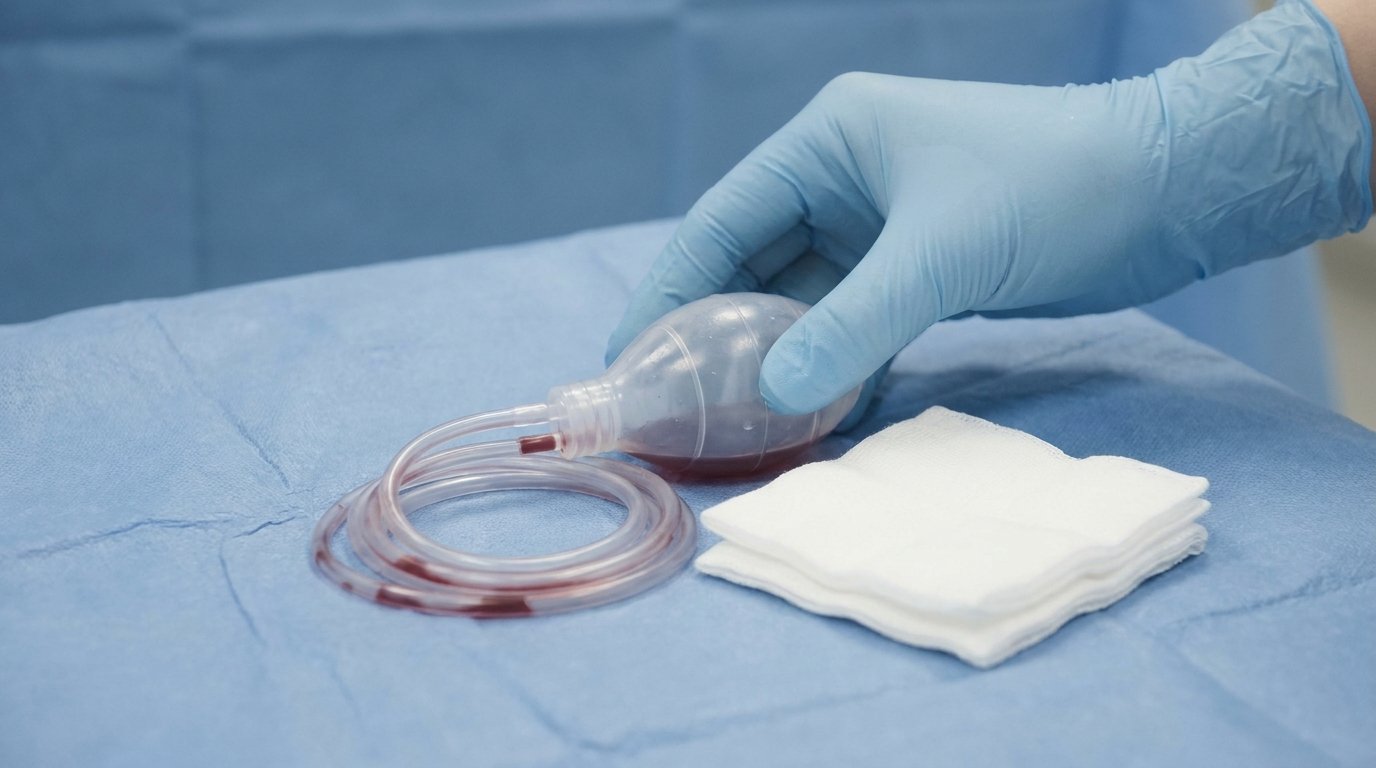
Two lifestyle factors change your personal risk more than almost anything else. Smoking and nicotine in any form reduce blood supply to healing skin, and a significant weight change after surgery can undo the shape you paid for. Surgeons routinely ask patients to be nicotine-free for weeks before and after the operation for exactly this reason.
It is also worth knowing that a lift does not freeze the breast in place. Pregnancy, breastfeeding and weight fluctuation can all loosen the result again, which is why timing matters as much as technique.
⚠️ Budget for the possibility of a second procedure Even in good hands, a minority of patients need a scar revision or a small adjustment later. Ask what that would cost and what the clinic covers before you sign anything.
🚨 Signs that need urgent contact Spreading redness, a rapidly swelling or hard breast, fever, worsening one-sided pain, calf pain or breathlessness all need immediate medical attention — not a wait-and-see approach.
Does having a breast lift abroad really cost less?
Package prices abroad are usually lower than UK private prices, mainly because staffing, facility and insurance costs differ, not because the operation is somehow smaller. Turkey, where our own clinic is based, has built a large share of its surgical work on that difference.
What changes is the shape of the spend rather than just the size of it. A package typically bundles the surgery, hospital stay, airport and clinic transfers, hotel nights and in-country aftercare into one figure, with flights usually separate. Against that you should set the real cost of travelling back for a review if something needs checking, and the value of a clinic that has a clear plan for remote follow-up once you are home.
The honest trade-off is distance. A complication that would mean a short drive in the UK becomes a phone consultation and, occasionally, a flight. That risk is manageable when the clinic is accredited, the surgeon is properly qualified in plastic surgery, and there is a written pathway for aftercare — and it is unmanageable when any of those are vague. Our guides on breast lift costs, recovery and safety in Turkey and how long to stay in Turkey for breast surgery cover the logistics in more depth.
Most breast lift patients travelling for surgery plan on roughly a week in the country, with the first review a couple of days after the operation and clearance to fly given by the surgeon rather than by the calendar.
A named, board-certified plastic surgeon you can verify; a video or in-person consultation before any deposit; written inclusions and a revision policy; consistent before-and-after photos of lifts, not only augmentations; a clear plan for aftercare once you are home.
A firm price quoted before anyone has assessed you; pressure to pay today for a discount; no named surgeon; refusal to discuss complication rates; promises about shape or scars that nobody could reasonably guarantee.
How to get a price you can actually rely on
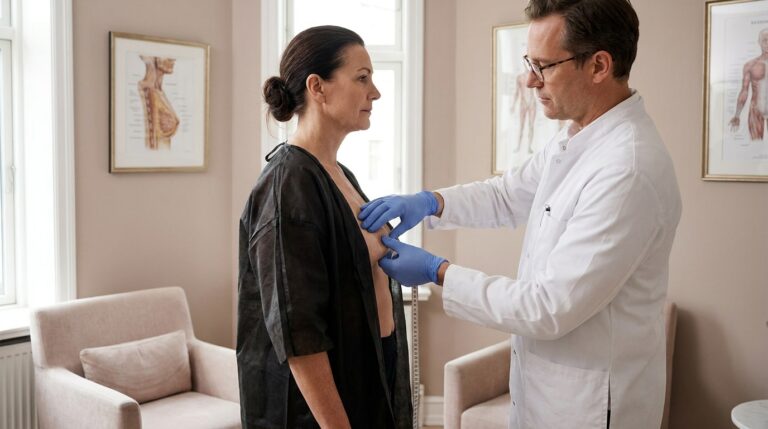
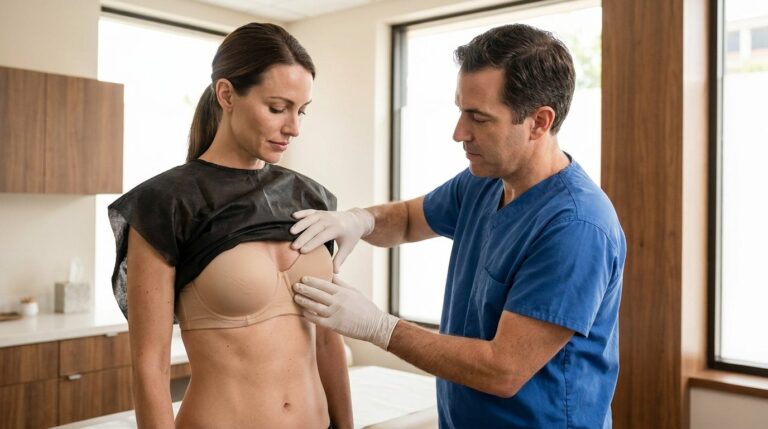
A usable quote starts with an assessment. A surgeon needs to see where the nipple sits relative to the breast crease, how much skin laxity there is, how firm your breast tissue is and whether you want volume added. Only then can anyone say which incision pattern suits you, how long theatre will take and what the plan costs.
Send recent photos and a short history when you first enquire, including pregnancies, breastfeeding, weight changes, any family history of breast disease and all medication. If you are over 40 or have a relevant family history, expect to be asked about breast screening before surgery is booked. For context on age, our breast lift patients average their mid-thirties at surgery and close to a fifth are over 40 — if you have been wondering whether you are too old or too early for this operation, the usual range is wider than most people assume.
Finally, treat the consultation as a two-way interview. You are checking the surgeon’s qualifications, how many lifts they perform, what they would do if the result needed adjusting, and whether the plan they describe matches the one you came in hoping for. If you want to see how the same logic applies to related procedures, our breast augmentation cost drivers in the UK article follows the same structure.
This article is for informational purposes only and does not constitute medical advice. Always consult a qualified surgeon for personalised guidance.
Frequently Asked Questions
References
- 📎NHS — Cosmetic procedures
- 📎American Society of Plastic Surgeons — Cosmetic procedures
- 📎British Association of Aesthetic Plastic Surgeons (BAAPS)
Related Articles
You Might Also Like

Related articles
Our specialists
 Clineca SpecialistErkan PinegözPlastic & Reconstructive Surgery
 Clineca SpecialistHakan AktaşPlastic & Reconstructive Surgery
 Clineca SpecialistOrkun UzuneyüpoğluPlastic & Reconstructive Surgery
 Clineca SpecialistSalim İskenderPlastic & Reconstructive Surgery
 Clineca SpecialistEngin SelamioğluPlastic & Reconstructive Surgery
 Clineca SpecialistCem AydınPlastic & Reconstructive Surgery
 Clineca SpecialistAlperen ÖnalEar, Nose & Throat (ENT)