
Have a question about Rhinoplasty?
In this article
- Why a revision is a different operation from your first rhinoplasty
- What a revision rhinoplasty quote in Turkey is built from
- Is revision rhinoplasty in Turkey safe, and how do you judge a clinic?
- How long to stay in Turkey for a revision
- Recovery and swelling: what the first 12 to 18 months look like
- When is it too soon for a revision, and can it be combined with other surgery?
- Setting realistic expectations before you book
A nose that did not settle the way you hoped is an unusually heavy kind of disappointment, because you already went through the surgery, the swelling and the waiting once. Most people who start reading about revision rhinoplasty in Turkey are carrying two things at the same time: a specific complaint about their nose, and a quiet worry about trusting another surgeon with it. This guide walks through what a second operation really involves, what shapes the price, how safety is judged and how long the healing honestly takes.
Why a revision is a different operation from your first rhinoplasty
A first rhinoplasty works with untouched tissue. A revision works with whatever the first operation left behind: scar tissue instead of clean planes, cartilage that may have been trimmed or removed, skin that no longer drapes predictably, and sometimes a weakened framework that has slowly shifted over years. That is why surgeons describe it as one of the harder operations in facial surgery, and why the planning stage matters more than the technique name.
The practical consequence is that your surgeon often needs to rebuild before refining. If the septum (the wall of cartilage inside the nose) was already used in the first surgery, graft material has to come from somewhere else — usually the ear or a rib. A 2024 review in Facial Plastic Surgery Clinics of North America described rib cartilage as a reliable source in exactly this situation, where septal cartilage has previously been used or removed. A 2026 paper in Facial Plastic Surgery looked at outcomes of closed rib revision surgery, noting that complex revisions frequently need structural and soft-tissue reconstruction rather than a simple reshaping.
If part of your hesitation is feeling like an unusual case, it is worth knowing that about one in eight of the nose operations we plan is a revision, and revision patients are on average four years older than first-time patients. For you, that means treating this as a normal, planned procedure with its own timeline — not an emergency repair, and not something to feel sheepish about raising in a consultation.
It also helps to know in advance which graft your surgeon is likely to propose, since that single decision changes the length of surgery, the stay and the recovery. Our overview of septal, ear and rib cartilage grafts in rhinoplasty explains how each option behaves.
📋 Bring your first operation’s paperwork Your previous surgical note, discharge summary and any pre-op photos are genuinely useful. Knowing what was removed, grafted or sutured the first time changes the plan for the second operation, and a surgeon working without that information is partly guessing until the moment of surgery.
What a revision rhinoplasty quote in Turkey is built from
A quote is assembled from a handful of identifiable parts: the surgeon’s fee, the operating theatre and anaesthesia team, how long you occupy that theatre, the hospital bed for the night, any graft harvesting, laboratory and pre-operative tests, medication, and then the travel layer — airport transfers, hotel nights and interpreting or coordination support. Most revisions fall loosely into three complexity tiers, and that tier is the single biggest driver of everything else on the list.
The lightest tier is a limited correction: a small irregularity on the bridge, a slightly asymmetric tip, something that can be camouflaged or trimmed through a short procedure. The middle tier involves reshaping with ear cartilage, or correcting a tip that has lost support. The heaviest tier is a full structural rebuild with rib cartilage, which means a longer operation, a second surgical site on the chest and a longer, more closely monitored recovery.
We do not publish figures for this, and that is deliberate rather than evasive. A revision price cannot be read off a list the way a standard procedure sometimes can, because two patients with the same complaint can need very different operations. A personalised quote is confirmed after a consultation that includes your photographs, your breathing history and your previous surgical records. For a broader view of how nose surgery pricing is assembled, our article on what affects rhinoplasty cost, your quote and your stay covers the same logic in more detail.
⚠️ Compare what is inside the package, not the headline Two quotes can look similar and cover very different things. Ask in writing whether anaesthesia, the hospital night, medication, splint removal, transfers and your follow-up reviews are included, and what is specifically excluded.
If this is your first rhinoplasty rather than a revision, our rhinoplasty in Turkey cost and safety guide explains how a primary quote is built and what the trip looks like.
Is revision rhinoplasty in Turkey safe, and how do you judge a clinic?
Safety in this context is less about the country and more about three concrete things: who operates, where they operate, and what happens afterwards. A revision should be done under general anaesthesia in a licensed hospital with a dedicated anaesthetist, resuscitation facilities and the option to keep you overnight. If a clinic proposes a complex revision in a setting without those, that is a reason to pause.
NHS guidance on cosmetic procedures makes a sensible starting point for vetting a surgeon anywhere in the world: check that they are properly qualified and registered for the surgery they are offering, ask how many of these operations they do, and establish before you commit who you will see and what will happen if something does not go to plan. For surgeons practising in Europe, board certification through bodies such as EBOPRAS is one verifiable credential among several.
The risks of a second operation overlap with the first — bleeding, infection, poor scarring, numbness, breathing changes — but the chance of needing further surgery is genuinely higher than in a primary case, because scarred tissue heals less predictably. An honest surgeon will say that out loud and will tell you which part of your complaint they are confident about and which part they are not.
Questions worth asking before you pay a deposit
- ✓How many revision cases do you perform in a typical month, and how many involve rib cartilage?
- ✓Which hospital will I be operated in, and who administers the anaesthesia?
- ✓Will you keep me overnight, and who reviews me the following day?
- ✓What is your written policy if I need a minor touch-up in two years?
- ✓Can you show me cases with a starting point similar to mine, not just dramatic transformations?
A consultation that reviews your previous operative notes, a named surgeon who answers your questions directly, surgery in a licensed hospital with an anaesthetist, written aftercare instructions, and a clear plan for follow-up once you are home.
A fixed price quoted before anyone has seen your photographs, pressure to book flights within days, no named surgeon until arrival, before-and-after images that cannot be linked to the surgeon you will actually see, and vague answers about anaesthesia or hospital.
Asking to see them is completely reasonable and one of the most common requests we get. Expect them to be shared privately with patient consent rather than published freely, and look for noses with a similar skin thickness and a similar problem to yours.
How long to stay in Turkey for a revision
Plan for a longer trip than you would for a first rhinoplasty. Seven to ten nights is the usual range, and the deciding factor is whether your surgeon wants to remove splints and review you before you fly rather than hand that job to a doctor at home. If rib cartilage is used, the chest site adds its own soreness and a little extra observation, so err towards the top of that range.
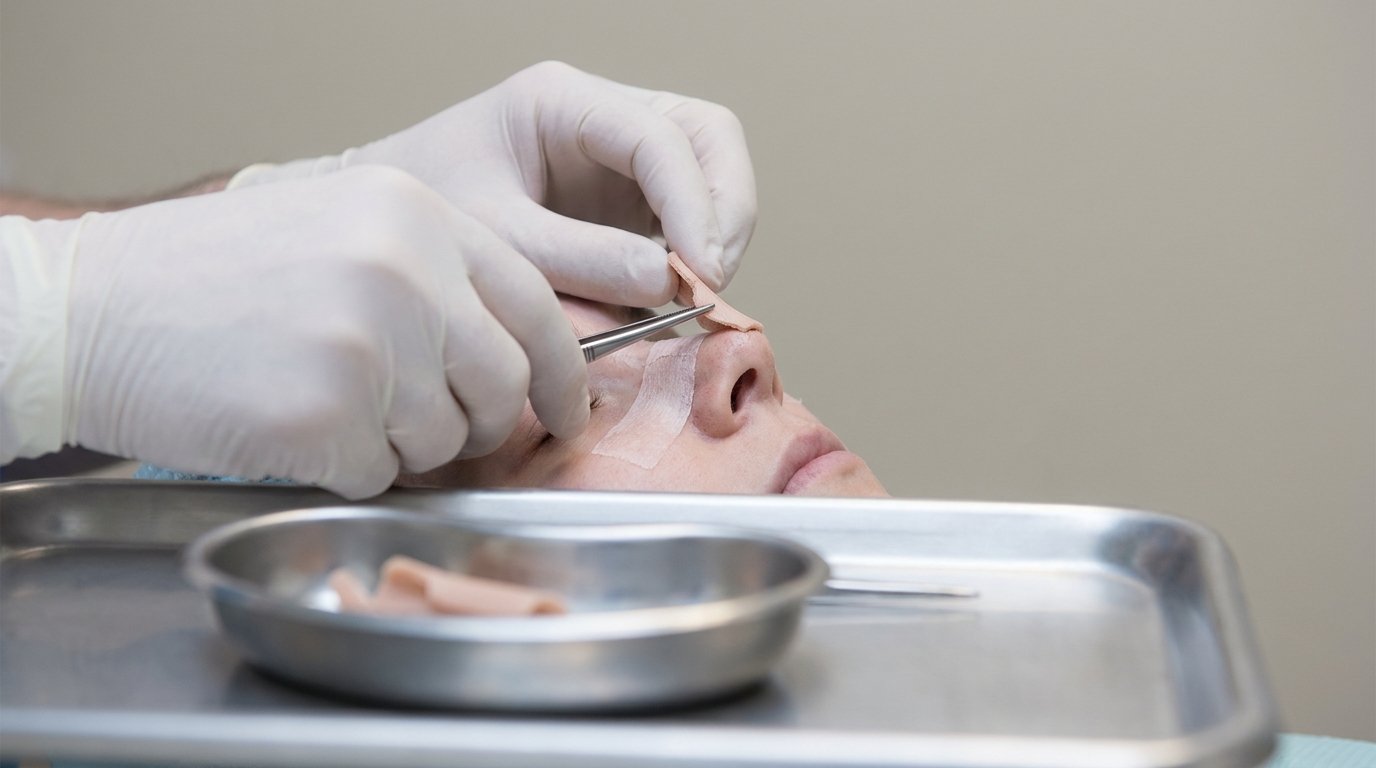
Flying itself is not the obstacle people expect; cabin pressure is tolerable, though the dry air makes the nose feel stuffier. The real argument for staying is the first week, when bleeding, swelling and any early concern are easiest to manage in the same city as your surgeon. Our guide to rhinoplasty travel plans, stay length, hotels and transfers goes through the practical side, including what kind of accommodation actually suits the first few days.
Recovery and swelling: what the first 12 to 18 months look like
The visible part of recovery is quick and the invisible part is slow. Bruising and the worst swelling settle within two to three weeks, and most people are comfortable in public by then. The nose, however, keeps changing for far longer in a revision than in a first operation, because scar tissue from the earlier surgery holds fluid and releases it grudgingly. Twelve to eighteen months is a realistic horizon for the final shape, and tip definition is almost always the last thing to arrive.
Swelling is also the thing patients research afterwards rather than before. Fewer than two in a hundred of the people who write to us about their nose ask about swelling ahead of surgery, yet it becomes the dominant question in the months that follow — so raise it at the consultation and ask your surgeon specifically how your skin thickness is likely to behave. Our detailed timeline on how long swelling lasts after revision rhinoplasty sets out what each stage tends to feel like.
Numbness in the tip, a stiff upper lip and odd tingling as sensation returns are all normal and usually fade over several months. Breathing often feels worse before it feels better, particularly while internal splints are in place.
🚨 Contact your surgeon promptly if You have heavy bleeding that does not stop with gentle pressure, fever, spreading redness or increasing pain after the first few days, sudden vision changes, or calf pain and breathlessness after flying. These need assessment rather than waiting it out.
When is it too soon for a revision, and can it be combined with other surgery?
Timing is where most people get stuck. The usual advice is to wait at least twelve months after the previous operation, and often longer where thick skin or heavy scarring is involved, because the nose you are unhappy with at month four is frequently not the nose you will have at month twelve. The exceptions are functional: a blocked airway, a collapsed nostril or a clearly displaced graft can justify acting sooner, and that is a judgement for a surgeon who has examined you.
Combining a revision with other surgery is possible, and patients often ask about pairing it with upper eyelid surgery or breast surgery in the same trip. The honest trade-off is that a complex revision is demanding on its own: it lengthens anaesthesia time, and a longer combined operation means a longer stay and a slower overall recovery paced by whichever procedure heals slowest. For a limited correction, combining is often reasonable; for a full rib-cartilage rebuild, many surgeons prefer to keep the session focused. Our article on combining rhinoplasty with another surgery sets out how that decision is usually made.
Small contour irregularities can sometimes be softened with filler as a temporary measure, which buys time while tissue settles. It carries its own risks in a previously operated nose and should only be considered by a doctor experienced in nasal injection.
If your main complaint is breathing rather than shape, septal or turbinate surgery alone may address it with a shorter recovery and no change to the outside of the nose.
Choosing to wait another six months is a legitimate plan, not a failure to act, especially if you are still inside the first year after your original operation.
Setting realistic expectations before you book
A revision aims at improvement rather than perfection, and surgeons who are candid about that tend to produce happier patients. Scarred tissue limits how much can be changed in one go, and the skin envelope you have now sets the ceiling on how much definition is achievable. If a clinic promises a precise result, treat that as a warning rather than confidence.
Patient satisfaction is the measure that matters most here, and it has been studied directly. A 2016 study in SpringerPlus examined patient-reported outcomes after revision rhinoplasty, comparing satisfaction with primary cases and looking for the factors that influence how content patients feel afterwards — a reminder that how a revision is planned and discussed is part of the outcome, not separate from it.
The most useful preparation is unglamorous. Write down the two or three things that bother you most, in order. Gather your previous operative records. Ask for before-and-after cases with a similar starting point. Then judge the consultation on whether the surgeon tells you what they cannot fix as clearly as what they can.
This article is for informational purposes only and does not constitute medical advice. Always consult a qualified surgeon for personalised guidance.
- ✓Prioritise your complaints: A ranked list of two or three concerns is far more useful to a surgeon than a general sense of dissatisfaction.
- ✓Collect your history: Operative notes, discharge papers and pre-operative photographs from the first surgery.
- ✓Confirm the setting: Which hospital, which anaesthetist, and whether you stay overnight.
- ✓Plan the calendar: Book flexible flights, allow seven to ten nights, and expect the final shape to take a year or more.
Frequently Asked Questions
References
- 📎The Use of Costal Cartilage in Rhinoplasty — Facial Plastic Surgery Clinics of North America, 2024
- 📎Closed Approach Rib Revision Rhinoplasty — Facial Plastic Surgery, 2026
- 📎Revision rhinoplasty: measurement of patient-reported outcomes and analysis of predictive factors — SpringerPlus, 2016
- 📎NHS — Cosmetic procedures
Related Articles



You Might Also Like



Related articles


Our specialists
 Clineca SpecialistErkan PinegözPlastic & Reconstructive Surgery
 Clineca SpecialistHakan AktaşPlastic & Reconstructive Surgery
 Clineca SpecialistOrkun UzuneyüpoğluPlastic & Reconstructive Surgery
 Clineca SpecialistSalim İskenderPlastic & Reconstructive Surgery
 Clineca SpecialistEngin SelamioğluPlastic & Reconstructive Surgery
 Clineca SpecialistCem AydınPlastic & Reconstructive Surgery
 Clineca SpecialistAlperen ÖnalEar, Nose & Throat (ENT)