Have a question about Breast Implants?
In this article
- Can breast surgery really reduce the gap between wide-set breasts?
- Which breast surgery options help most, and what are their limits?
- What affects how much cleavage you can realistically get?
- What are the risks, recovery trade-offs and revision issues?
- How long should you stay in Turkey, and how do you choose a safe clinic?
If you are wondering whether can breast surgery reduce the gap between wide set breasts, the real answer depends on why that gap exists in the first place. Some women have a wide breast footprint on the chest wall, some have volume loss that makes cleavage look flatter, and some have both — which is why the same operation can look very different from one patient to another.
Can breast surgery really reduce the gap between wide-set breasts?
Sometimes it can improve the appearance of the gap, but it cannot fully change the natural position of the breasts on the chest wall. That distinction matters. If your breasts sit far apart because your breast bases are naturally wide and the nipples point outward, surgery can usually create more inner fullness and a closer look in a bra or fitted clothing, yet it may not produce tight, fixed cleavage when you are braless.
This is one of the most important expectation checks before surgery. A breast implant can add volume toward the inner part of the breast, and in selected cases that softens the empty space between the breasts. A fat transfer can also add some inner fullness, though it is usually subtler. A lift can reshape droop and improve position, but on its own it does not usually bring breasts dramatically closer together.
Surgeons are careful here because pushing too hard for cleavage has trade-offs. Over-sized implants placed too close to the centre can increase the risk of an unnatural look, visible edges, implant malposition, or symmastia, which is when the space between the breasts is lost in an abnormal way. The American Society of Plastic Surgeons (ASPS) lists implant malposition and the need for revision among the recognised risks of breast augmentation, and the NHS also stresses that cosmetic breast surgery can require further procedures over time.
So the better question is not only, “Can the gap be reduced?” but also, “How much change is realistic on my anatomy?” For many patients, a good result means the breasts look fuller and better balanced rather than completely touching in the middle.
📋 A useful way to think about it Breast surgery can change volume, shape and projection more easily than it can change the underlying width of your chest or the natural breast footprint.
Which breast surgery options help most, and what are their limits?
The best option depends on whether the problem is mainly lack of volume, droop, or breasts that naturally sit laterally toward the outer chest.
Breast augmentation with implants is usually the strongest option if the main issue is a flat inner breast. Implants can increase upper-pole and inner-pole fullness, which often improves cleavage in clothing. Implant shape, width and profile all matter. A wider implant is not always better; if it is too wide for your chest, it may look obvious at the edges. If it is too narrow, it may add projection without filling the inner side enough. If you want more background on how implant choices affect shape, this article on round or teardrop breast implants is useful.
Fat transfer is a softer, more natural-feeling option for selected patients who have enough donor fat. It can fine-tune the inner breast and smooth small asymmetries, but it does not create the same push or projection as an implant. Some of the transferred fat does not survive, so the final result is less predictable and sometimes a second session is discussed. If you are considering that route, breast lift with fat transfer explains where it tends to work well and where it falls short.
A breast lift helps when the breasts have dropped and the nipple sits too low. By itself, a lift can make the breasts look more centred and tidier, but it does not usually solve a naturally wide gap if there is not enough inner volume. In many cases, lift plus implant gives a stronger change than lift alone. This is why choosing between these operations matters; breast lift or implants is a helpful comparison if you are stuck between the two.
For women who have had previous augmentation and still dislike a wide look, revision surgery may help if the issue is implant position rather than anatomy. That is more complex than first-time surgery because scar tissue, pocket position and skin quality all affect what can be changed.
Patients who mainly need more inner fullness and stronger cleavage in bras or fitted tops often get the clearest change from implants.
Patients who want a modest, softer change and accept that volume gain is limited may prefer fat transfer.
A lift helps most when droop is the main issue, but it is not a reliable way to close a naturally wide central gap on its own.
What affects how much cleavage you can realistically get?
Three things matter more than patients often expect: your chest width, your natural breast footprint, and your skin quality. If the breasts start far apart on the ribcage, surgery can enhance volume but cannot completely erase that framework. This is why two women choosing the same implant size can end up with very different cleavage.
Your nipple direction matters too. If the nipples point outward, the breasts may still read as wide-set even after volume is added. Mild asymmetry is common as well, so one side may come closer to the middle than the other. A careful surgeon should point this out before surgery rather than promising a perfectly symmetrical centre line.
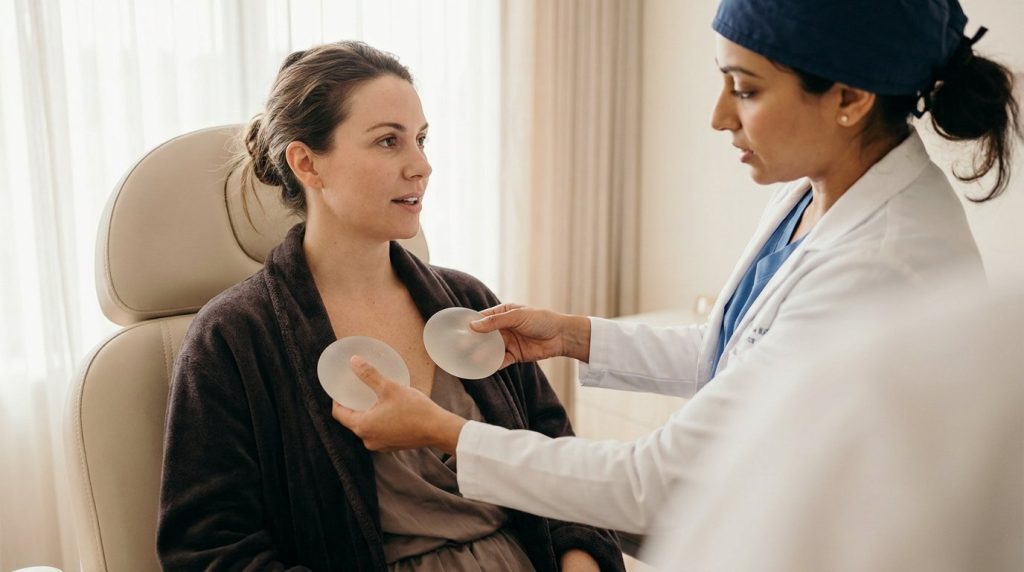
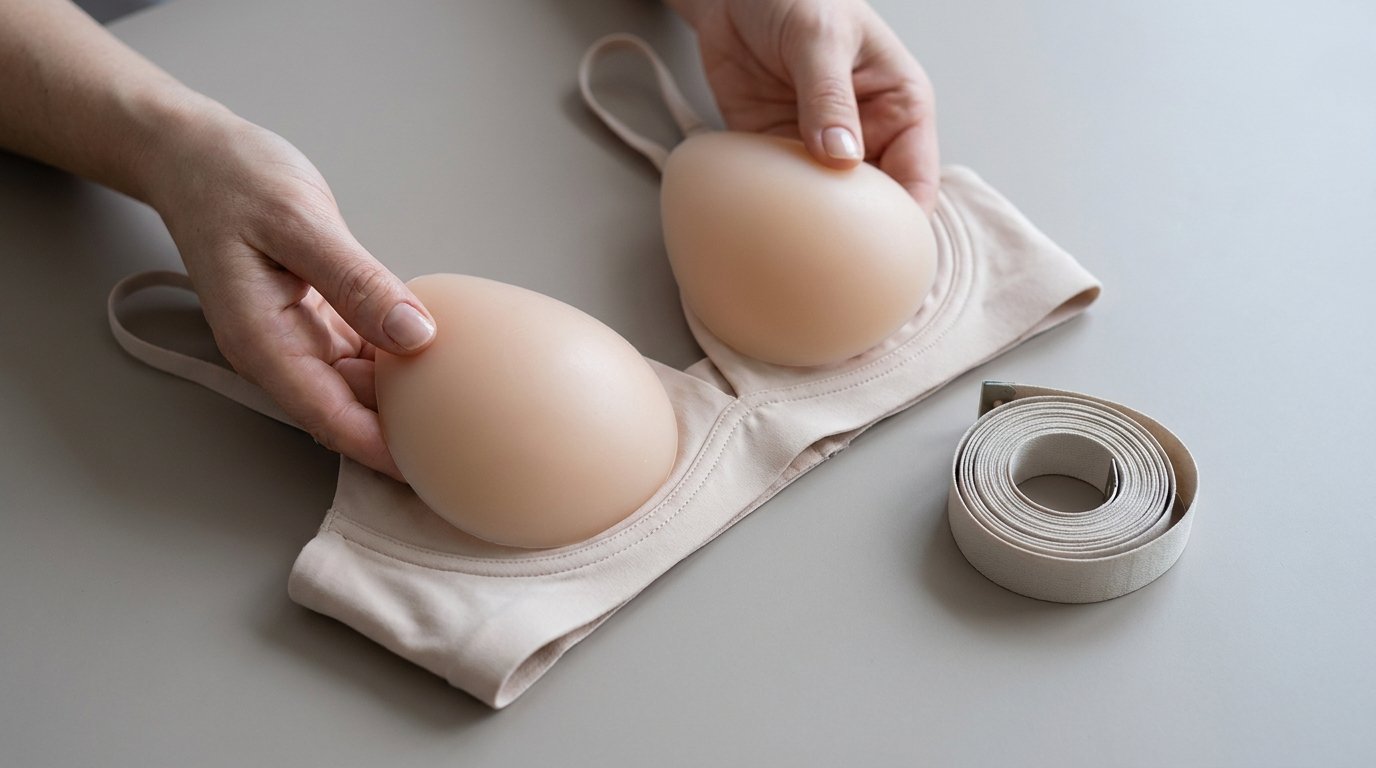
Photos in a push-up bra can also create unrealistic expectations. Cleavage in bra photos often comes from garment support, not just surgery. A good consultation usually includes trying implant sizers in a bra and discussing what is likely braless versus supported.
One more timing point is worth raising early: future pregnancy plans. In our conversations with women thinking about breast surgery, pregnancy or breastfeeding comes up in roughly one in four. That matters because future body changes can affect shape, upper fullness and long-term satisfaction, so it is worth mentioning at the first consultation even if you are still undecided. If that question is on your mind, breast surgery after breastfeeding covers the planning issues in more detail.
⚠️ Be cautious with promises about cleavage A surgeon who guarantees dramatic braless cleavage without discussing your chest anatomy, implant width and malposition risk is oversimplifying a complex decision.
What are the risks, recovery trade-offs and revision issues?
Every option that may improve a wide-set appearance comes with trade-offs, and this is where a niche question like yours becomes very practical. The ASPS procedure information for breast augmentation and the NHS cosmetic surgery guidance both make the same broad point: breast surgery can improve shape, but it also carries real risks and sometimes leads to further treatment.
With implants, the early recovery often includes chest tightness, swelling, pressure when moving the arms, and a breast shape that looks high or firm before it settles. Some patients return to desk-type work fairly soon, but feeling fully comfortable can take longer than expected. Final positioning is not immediate. If the implant pocket heals in a way the surgeon cannot fully control, one implant may sit too far outward, too high, or slightly differently from the other side. Capsular contracture, rupture over time, rippling and the need for future revision are also part of the long-term discussion. For a broader look at implant recovery, this article on breast augmentation recovery week by week may help.
With fat transfer, recovery includes both the breasts and the liposuction areas, so patients sometimes underestimate the overall soreness and swelling. The breasts may look fuller at first, then settle as swelling drops and only part of the transferred fat survives. Small lumps, oil cysts and uneven take can happen. That does not always mean something is wrong, but it can make the final result less predictable than implant surgery.
With a lift, scar pattern and skin healing become central issues. The breast shape changes over the first months as swelling fades and the tissue settles. A lift can improve shape nicely, but if the main complaint is the central gap, some patients later feel they improved droop without getting the cleavage change they pictured. That does not mean the surgery failed; it means the operation addressed a different problem better than the one bothering you most.
Revision surgery is the least predictable of all. Once scar tissue forms, it is harder to control exactly where implants settle. Some women do need revision to improve position or symmetry, but revision should be planned as problem-solving, not sold as a simple guarantee of perfection.
- ✓Ask what result is realistic without a bra and what usually needs bra support.
- ✓Ask whether your main issue is volume loss, droop, implant position, or naturally wide breast bases.
- ✓Ask how often the surgeon recommends revision for wide-set concerns and why.
- ✓Ask what aftercare is included if you are travelling for surgery.
How long should you stay in Turkey, and how do you choose a safe clinic?
If you travel for breast surgery in Turkey, the stay is usually planned around pre-op assessment, the operation itself and at least one or more early checks before flying home. The exact length depends on whether you are having implants, a lift, fat transfer, or revision surgery, because revision and combined procedures often need a little more caution.
A personalised quote is normally confirmed after photos or consultation because anatomy, implant choice, whether a lift is needed, and package details all affect the overall cost. Instead of focusing only on the headline figure, look closely at what is included: surgeon fees, hospital or theatre, anaesthesia, garments, medicines, hotel, transfers, interpretation, and follow-up arrangements. This article on what an all-inclusive surgery package in Turkey includes is useful when you compare offers.
For surgeon choice, look for clear credentials and honest planning. In Europe, EBOPRAS is one recognised board in plastic surgery, and BAAPS offers patient-facing guidance on choosing properly trained surgeons. A good clinic should answer questions promptly, explain who will perform the surgery, tell you where it takes place, and set out the follow-up plan after you return home. Fast replies are nice, but clear and consistent answers matter more.
If you are comparing travel timelines, how long to stay in Turkey for breast surgery goes into the logistics in more detail.
Be wary if a clinic promises to ‘close the gap completely’ from photos alone without discussing your chest anatomy or the possibility that a bra may still be needed for strong cleavage.
A stronger consultation explains both the best-case improvement and the anatomical limit, even if that makes the sale harder.
Frequently Asked Questions
References
- 📎American Society of Plastic Surgeons: Cosmetic Procedures
- 📎NHS: Cosmetic procedures
- 📎BAAPS
- 📎EBOPRAS
You Might Also Like

Related articles


Our specialists
 Clineca SpecialistErkan PinegözPlastic & Reconstructive Surgery
 Clineca SpecialistHakan AktaşPlastic & Reconstructive Surgery
 Clineca SpecialistOrkun UzuneyüpoğluPlastic & Reconstructive Surgery
 Clineca SpecialistSalim İskenderPlastic & Reconstructive Surgery
 Clineca SpecialistEngin SelamioğluPlastic & Reconstructive Surgery
 Clineca SpecialistCem AydınPlastic & Reconstructive Surgery
 Clineca SpecialistAlperen ÖnalEar, Nose & Throat (ENT)