
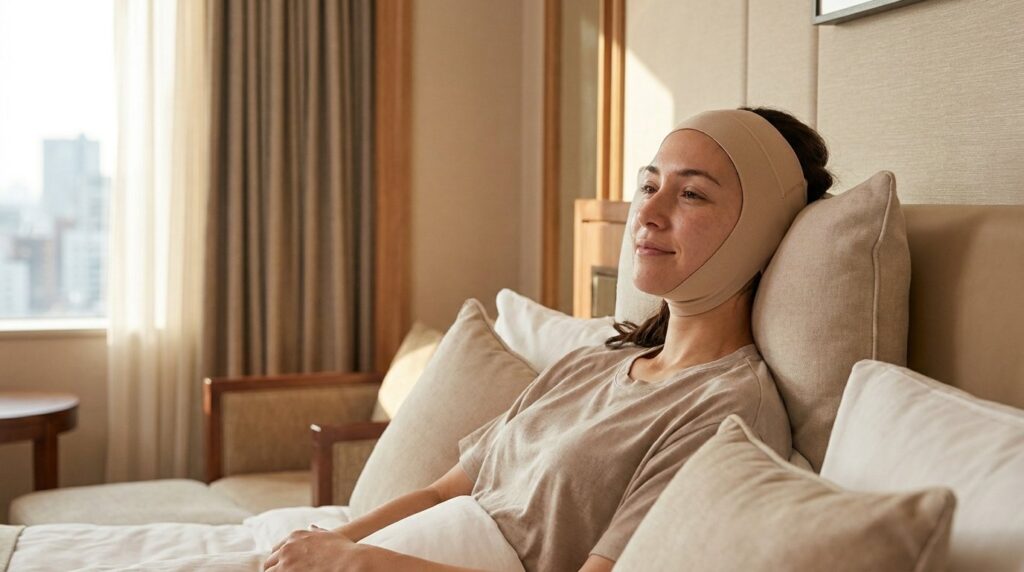
Have a question about otoplasty?
In this article
- Why does sleeping on your back matter after otoplasty?
- How long do you usually need to sleep on your back after otoplasty?
- When is it usually safe to sleep on your side again?
- How can you stop yourself rolling onto your side at night?
- What happens if you accidentally sleep on your side?
- What else affects healing after otoplasty besides sleep position?
One of the most common questions after ear surgery is how long do I need to sleep on my back after otoplasty. It sounds simple, but sleep position can affect swelling, pressure on the ears, and how comfortable those first recovery days feel. The details depend on how you heal, what your surgeon did during the operation, and whether you are still wearing a protective headband or dressing.
Why does sleeping on your back matter after otoplasty?
Otoplasty changes the shape or position of the ears by working on the cartilage and the soft tissue around it. In the early healing phase, that new shape needs protection. Sleeping on your back helps reduce direct pressure on the ears, lowers the chance of bending the cartilage while it is still healing, and often makes swelling easier to manage.
This matters most in the first days and weeks, when the ears can feel sore, tight, or sensitive to touch. If you roll onto your side too early, the pillow may press on one ear for hours without you noticing. That pressure does not always cause a serious problem, but it can increase pain, leave one side more swollen, or irritate the healing area.
The NHS advice on cosmetic procedures is clear on a broader point: following aftercare instructions is an important part of safe recovery. With otoplasty, sleep position is one of those small aftercare details that can make the early healing period smoother.
If you are planning treatment abroad, this is also worth discussing before you travel. A good consultation should cover not only the procedure itself but the practical recovery rules, including dressings, sleeping position, and when normal daily habits can return. If you are researching the procedure, a general overview of ear surgery options can help you understand what may be involved.
📋 Why surgeons are careful about pressure Ear cartilage holds its new shape gradually, not all at once. That is why many surgeons are strict about avoiding side sleeping early on.
How long do you usually need to sleep on your back after otoplasty?
For most patients, the strictest back-sleeping period is the first one to two weeks. That is usually the time when the ears are most swollen and most likely to feel tender if they are pressed against a pillow. Many surgeons then ask patients to continue avoiding side sleeping for longer, often until the ears feel less delicate and the initial healing is more secure.
In real life, that means many people are told to sleep on their back until the first dressing is removed, and then to keep protecting the ears at night while using a supportive headband if their surgeon recommends one. Some surgeons are comfortable with careful side sleeping earlier than others, while some prefer patients to stay on their back for several weeks. The exact instruction depends on the surgical technique, how much cartilage was reshaped, and how stable the ears look at follow-up.
The honest answer is that there is no single rule that fits every patient. What matters most is your own surgeon’s advice. The American Society of Plastic Surgeons (ASPS) and BAAPS both emphasise that recovery instructions vary by procedure and patient, which is especially true in operations that reshape cartilage.
A simple way to think about it is this: if the ears are still sore to lie on, still noticeably swollen, or still being protected with a dressing or headband at night, you probably should not be sleeping directly on them yet.
⚠️ Do not use someone else’s timeline as your rule Online forums can be reassuring, but your own operation and cartilage work may not match another patient’s recovery.
When is it usually safe to sleep on your side again?
Most people want a clear date, but side sleeping is better judged by healing signs than by the calendar alone. You are generally moving in the right direction when swelling is settling, bruising is fading, and the ears no longer feel sharp or sore with light touch. If one side is still more tender than the other, that is often a sign to wait a bit longer.
A cautious return works better than switching all at once. Some patients start by turning partly to the side while keeping pressure off the ear with a soft travel pillow or a donut-style pillow. Others continue sleeping on their back but rest slightly tilted. The goal is not to be perfect every second of the night. It is to avoid long, direct pressure on the healing ear.
If you had more extensive reshaping, prominent ear correction, or a revision procedure, your timeline may be longer. Revision surgery often needs more patience because the tissue can be less predictable and the ears may stay sensitive for longer.
If you are unsure, ask for guidance before changing position. That is especially important if you had surgery abroad and are now recovering at home. Before booking, it is sensible to ask how follow-up works and who to contact if you are not sure whether a change in sleep position is safe. A proper remote or in-person surgical consultation should cover these aftercare questions clearly.
The ears feel much less tender, swelling is settling, and you can touch the area gently without sharp discomfort.
One ear is still sore, hot, very swollen, or painful when pressed against a pillow.
How can you stop yourself rolling onto your side at night?
This is often the hardest part of otoplasty recovery, especially if you have always been a side sleeper. The good news is that a few simple changes can make back sleeping much easier. You do not need a complicated setup, but you do need enough support to stop yourself twisting in your sleep.
A slightly upright position can help in the first days, since it may also make swelling feel better. Many patients use extra pillows behind the shoulders and on each side of the body, or a travel pillow around the neck to reduce turning. If your surgeon has asked you to wear a headband at night, keep using it exactly as advised rather than treating it as optional.
The setup that usually works best is the one you can actually stick with. Comfort matters. If your back-sleeping position is awkward, you are more likely to shift during the night.
- ✓Use pillows on both sides of your body to make rolling over less likely.
- ✓Try a travel pillow or U-shaped neck pillow to keep your head more centred.
- ✓Sleep slightly elevated if your surgeon has said this is appropriate for you.
- ✓Keep pets, children, and anything that might bump the ears away from your sleeping space.
- ✓If you wear a post-op headband, use it for the full period advised rather than stopping early.
What happens if you accidentally sleep on your side?
A single accidental turn in your sleep does not automatically mean you have damaged your result. Most patients do this at least once and recover without any lasting problem. What matters is what happened afterwards. If you wake up and the ear just feels mildly sore or a bit more puffy, that may settle again over the day.
You should pay more attention if the ear suddenly looks more folded than before, becomes much more swollen, starts bleeding, or develops stronger pain that does not calm down. Otoplasty also carries the usual post-surgical risks such as infection or bleeding under the skin, and guidance from sources such as the NHS and Mayo Clinic supports contacting your surgical team if symptoms seem to be getting worse rather than better.
Take a photo if something looks different, then contact your clinic or surgeon. That is one advantage of choosing a provider with a clear follow-up process and a reachable team. If you are still comparing options, look for transparent information about the surgeon’s background and aftercare arrangements on pages such as the clinic’s doctor profiles and contact details on the contact page.
Do not try to “correct” the ear yourself by pressing it back into place or tightening any bandage on your own. If there is a real change, it needs proper assessment.
🚨 Call your surgical team promptly if You notice sudden marked swelling, bleeding, increasing pain, fever, discharge, or a clear change in the ear’s shape after sleeping on it.
What else affects healing after otoplasty besides sleep position?
Sleep position is important, but it is only one part of the recovery picture. The first week often depends just as much on keeping the dressing dry, taking medicines as directed, avoiding bumps to the ears, and not returning to exercise too early. If you wear glasses, ask whether they put pressure on the area and whether any short-term adjustment is needed.
Swelling and unevenness can also make people worry unnecessarily. Ears rarely look fully settled right away. Early asymmetry does not always mean a poor long-term result. Peer-reviewed plastic surgery literature, including studies indexed on PubMed in journals such as Aesthetic Surgery Journal and Plastic and Reconstructive Surgery, shows that cartilage-shaping procedures need time before the final contour can be judged fairly.
For international patients, logistics matter too. You should plan enough time in Turkey for early review appointments and for the first dressing changes if these are part of your surgeon’s routine. Cost should also be discussed in practical terms rather than as a headline number. A quote for otoplasty may differ based on the surgeon’s experience, the hospital setting, whether anaesthesia and hotel support are included, and how follow-up is handled after you fly home. The final personalised price is normally confirmed after consultation.
When choosing a clinic, look for a qualified plastic surgeon, a proper consultation, clear consent, and realistic recovery advice. EBOPRAS is one recognised European board reference patients may look for when checking specialist credentials, though qualifications should always be considered together with experience, communication, and aftercare planning.
You are given clear written aftercare instructions, follow-up arrangements, and a direct way to ask questions once you are back at the hotel or home.
Ask whether extra support pillows, a travel pillow, or a protected semi-side position later in recovery would be acceptable in your case.
Frequently Asked Questions
References
- 📎NHS: Cosmetic procedures
- 📎ASPS: Cosmetic procedures
- 📎EBOPRAS
- 📎PubMed search: otoplasty recovery cartilage healing sleep position
Related Articles

You Might Also Like

Related articles
Our specialists
 Clineca SpecialistErkan PinegözPlastic & Reconstructive Surgery
 Clineca SpecialistHakan AktaşPlastic & Reconstructive Surgery
 Clineca SpecialistOrkun UzuneyüpoğluPlastic & Reconstructive Surgery
 Clineca SpecialistSalim İskenderPlastic & Reconstructive Surgery
 Clineca SpecialistEngin SelamioğluPlastic & Reconstructive Surgery
 Clineca SpecialistCem AydınPlastic & Reconstructive Surgery
 Clineca SpecialistAlperen ÖnalEar, Nose & Throat (ENT)