Have a question about Upper Eyelid Blepharoplasty?
In this article
- What hooded eyes actually are
- Are you a candidate for hooded eyelid surgery?
- How hooded eyes blepharoplasty is performed
- Recovery week by week after hooded eyes surgery
- Risks, safety and the honest trade-offs
- What drives the cost of hooded eyes blepharoplasty
- Having hooded eyelid surgery in Turkey: stay, follow-up and choosing a clinic
- Non-surgical options and their real limits
Hooded eyes surgery is one of those operations people research for years before they book it. It usually starts with something small and practical — eyeshadow that disappears the moment the eye opens, a lash line that no longer shows, or the feeling that you look tired in photographs when you are not. What follows is an honest look at what the operation can and cannot fix, how the healing really goes, and what you should be asking before you commit to a surgeon or a flight.
What hooded eyes actually are
A hood is simply upper eyelid skin that drapes over the lid crease. When the eye opens, the crease disappears underneath that fold, so the visible part of the lid shrinks. In a strong hood the skin can rest on the lashes and, in some cases, shade the top of the field of vision.
The hood can come from more than one place, and that is the detail most online guides skip. Some people are born with a low, heavy lid and a thick fold — it runs in families and shows up in the twenties. Others develop it later, as skin loses elasticity and the eyebrow slowly settles lower, pushing extra skin down into the lid. A third group has a small pocket of fat near the inner corner that adds fullness. Many people have a mixture, and the mix decides which operation actually helps.
It helps to know the shape surgeons are aiming for. A 2012 paper in Ophthalmic Plastic and Reconstructive Surgery described the youthful female upper lid as a sigmoid curve: slightly hollow towards the nose, fuller and gently convex towards the outer corner, with the outer skin smooth rather than hooded. That is a useful way to understand why good eyelid surgery is not simply about removing as much skin as possible — remove too much from the wrong zone and the eye looks hollow and operated rather than open and rested.
Hooding versus a droopy lid margin
These two are often confused. Hooding is loose skin sitting above the lid. A droopy lid margin — ptosis — means the lid edge itself sits low because the muscle that lifts it has weakened. Skin removal does nothing for the second problem. A careful examination separates them, because the surgical plan is different and so is the price.
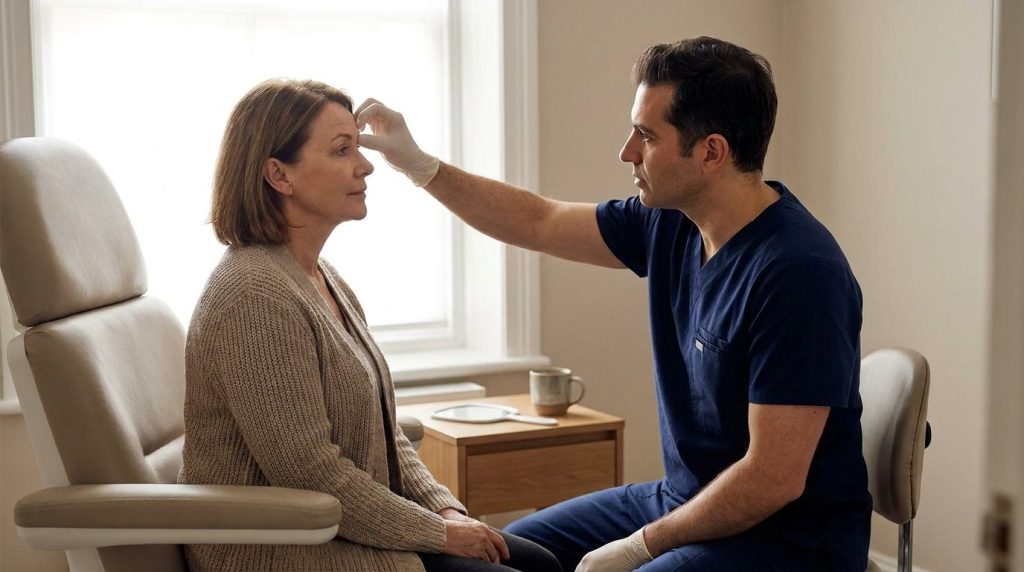
📋 A quick home test Look straight ahead in a mirror, then lift your eyebrow gently with a finger. If the hood almost disappears, part of the problem is brow position, not just lid skin — and a surgeon should discuss the brow with you before planning anything.
Are you a candidate for hooded eyelid surgery?
The best candidates have clear skin excess in the upper lid, a lid margin that lifts normally, reasonably healthy eyes and realistic expectations about what a tidier lid will change. If the hood bothers you in the mirror, that is a legitimate reason. If it genuinely blocks the upper part of your vision — you catch yourself tipping your head back to read a shelf — that is a functional problem, and we cover it in more detail in our guide on droopy lids and vision.
Age is less of a dividing line than people expect. Younger patients with a congenitally heavy lid can be excellent candidates; older patients with thin, crepey skin often get a dramatic change from a modest skin removal. What matters more is skin quality, brow position and eye health.
Several things need sorting out before surgery rather than after. Dry eye is the main one — if your eyes already sting, burn or water in the wind, surgery can make that worse for a while, so it should be assessed and treated first. Thyroid eye disease, uncontrolled blood pressure, blood-thinning medication and smoking all change the plan or the timing. None of them automatically rules you out; they just need to be on the table at consultation.
There is also an honest limit worth hearing early. Upper eyelid surgery addresses the lid. It does not lift a low brow, it does not erase crow’s feet at the outer corner, and it does not change the shape of the outer eye corner. If your brow has dropped significantly, a lid-only operation can even make the brow look heavier by comparison — which is why some patients are better served by a brow procedure, or by both. Our comparison of the difference between a brow lift and upper eyelid surgery walks through how surgeons decide.
Clear fold of loose upper lid skin, lid edge that opens fully, stable eye health, and a goal of looking more rested rather than looking like someone else.
Significant brow descent, untreated dry eye, an unrecognised droopy lid margin, or an expectation that lid surgery will change the overall shape of your eyes.
How hooded eyes blepharoplasty is performed
Planning starts with you sitting upright, eyes open, because lid skin behaves differently lying down. The surgeon marks the natural lid crease and then marks how much skin can come out while leaving enough to close the eye comfortably. A simple pinch test with forceps shows the safe amount. That margin of safety is the whole reason conservative marking beats aggressive marking.
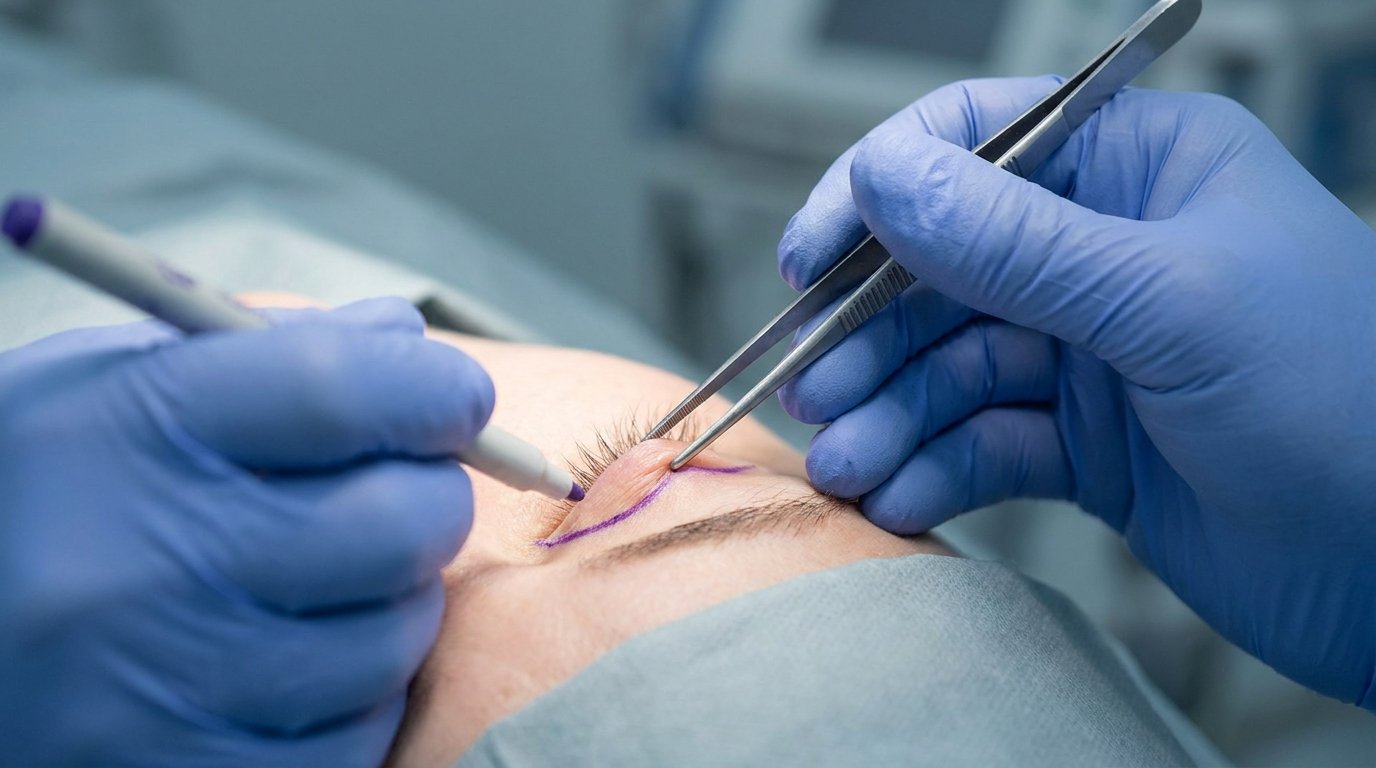
The operation itself is usually done under local anaesthetic, sometimes with sedation, and under general anaesthesia when it is combined with a bigger procedure. Most patients describe pressure and movement rather than pain, though comfort varies from person to person and the anaesthetic injection itself can sting briefly. For an isolated upper lid, surgical time is commonly under an hour.
The incision sits in the crease, so the scar hides in the fold once the eye is open. The surgeon removes the measured strip of skin, trims a sliver of underlying muscle if the lid is bulky, and gently reduces the inner fat pocket only if fullness there is part of the problem. Fine sutures close the line, and the eye is left uncovered — no dressings, no pad, which is why people are often surprised they can watch television the same evening.
When a hood needs more than skin removal
If the lid crease is poorly defined, the surgeon may set a cleaner crease while closing. If the inner corner carries a thick fold of soft tissue, that needs careful sculpting rather than simple excision — older surgical writing, including a 1980 report in Aesthetic Plastic Surgery on correcting heavy-lidded eyes, made the same point: treating a heavy lid sometimes means going beyond a plain skin-only blepharoplasty. And if the lid margin is low, a ptosis repair has to be added, or the result will look half-finished.
⚠️ Ask how much skin is being left, not how much is taken Over-resection is the single hardest eyelid complication to correct. A surgeon who can explain the amount of skin they are preserving — and show you they tested lid closure on the table — is telling you something useful about their judgement.
Recovery week by week after hooded eyes surgery
Upper eyelid recovery is short compared with most facial surgery, but it is not invisible. Expect swelling and bruising to peak in the first two to three days, then fade steadily. Bruising can track downwards into the lower lid and cheek, which looks alarming and means nothing.
Cold compresses, head elevation for sleep, and avoiding anything that spikes blood pressure in the first week all shorten the visible phase. Sutures usually come out around five to seven days. Most people feel socially presentable somewhere between the second and third week, helped by a little concealer once the incision has sealed.

The finer changes take longer. The scar passes through a pink phase before it pales, the crease settles over a couple of months, and small differences between the two sides even out over the same period. Our detailed upper eyelid healing timeline goes further into week-by-week expectations.
🚨 Contact your surgeon urgently if One eye becomes rapidly more swollen, tight and painful, you notice sudden change or loss of vision, or there is spreading redness with fever. These are uncommon but need same-day assessment, not a wait-and-see.
Risks, safety and the honest trade-offs
Upper eyelid surgery has a long track record and is usually well tolerated, but no operation is risk-free and it is worth knowing what is common versus what is rare.
Common and temporary: swelling, bruising, dry or watery eyes, blurred vision from ointment, a tight sensation when looking up, and lids that heal at slightly different speeds. Less common but real: a visible or thickened scar, asymmetric creases, mild over- or under-correction, milia along the incision, and difficulty closing the eye fully for a period. Rare: bleeding behind the eye, infection, and vision loss.
The trade-offs are worth stating plainly. Removing more skin gives a more open lid but reduces your reserve for closing the eye and increases dryness. A higher crease looks more striking in some faces and unnatural in others. And a revision on an eyelid is harder than a first operation, because the tissue is no longer spare. These are judgement calls, which is why surgeon selection matters more here than almost anywhere else on the face.
- ✓Declare your dry eye history: Even mild dryness, contact lens intolerance or previous laser eye surgery changes how conservative the plan should be.
- ✓Bring a medication list: Blood thinners, aspirin, high-dose fish oil and some supplements raise bruising risk and may need pausing with your doctor’s agreement.
- ✓Stop smoking before and after: Smoking slows wound healing and worsens scarring, and the weeks either side of surgery are the ones that count.
- ✓Plan a quiet first week: Sleeping propped up and keeping away from heavy lifting is what keeps swelling and bleeding risk down.
What drives the cost of hooded eyes blepharoplasty
Quotes for upper eyelid surgery vary widely, and the variation is rarely about the skin removal itself. It is about who operates, where, under what anaesthesia, and what else is happening in the same session. A personalised figure only becomes meaningful after an examination, because that is when the surgeon knows whether you need skin alone, skin plus a crease reset, or an added ptosis repair.
The single biggest reason published prices mislead people is combination. Roughly three in four of the people we treat for upper eyelid surgery have it alongside something else — most often rhinoplasty, lower eyelid surgery or a temporal lift — so the quote they actually receive covers more than one operation in one anaesthetic. If you are budgeting from a single-procedure figure you saw online, build in the possibility that your own plan ends up broader once a surgeon has assessed your brow, lower lids and overall facial balance.
Combining does usually cost less than two separate trips and two separate anaesthetics, and it is a common pairing — our article on combining rhinoplasty with upper eyelid surgery explains how the two are sequenced. What it does not do is shorten recovery: the timeline is set by the bigger procedure, not the eyelids.
📋 What to ask for in writing Request a quote that names the exact procedures planned, the type of anaesthesia, how many review appointments are included, who you contact after you fly home, and what happens — and what it costs — if a small revision is needed.
Having hooded eyelid surgery in Turkey: stay, follow-up and choosing a clinic
For an isolated upper lid, the practical travel question is suture removal. Most surgeons want to see you between five and seven days after surgery, so a stay of about a week lets you have the consultation, the operation, a review and the suture removal before you fly. If your eyelid surgery is part of a larger plan, the stay is dictated by the larger procedure — a nose, a facelift or a lower lid procedure can mean ten days or more. Our wider guide to blepharoplasty in Turkey sets out the logistics in more detail.
Flying itself is generally straightforward once the incisions are sealed and your surgeon has cleared you. Cabin air is dry, so lubricating drops and a water bottle make the flight more comfortable, and it is sensible to avoid rubbing the eyes while they are still numb in places.
Choosing the clinic is where you should spend your time. Ask who will actually hold the scalpel and whether you will meet that person before surgery. Ask to see before-and-after photographs taken at consistent angles, in similar lighting, with eyes open and looking straight ahead — hooding is easy to hide with a raised chin or a flattering camera height, and our piece on judging results photos explains what to look for. Confirm which hospital or licensed surgical facility the operation takes place in, and how after-hours problems are handled while you are still in the country.
A named surgeon with verifiable eyelid experience, a proper eye examination including dryness, conservative markings explained to you, a written plan, and a clear route back to the surgeon after you fly home.
A price quoted before anyone has looked at your lids, pressure to decide within hours, no named surgeon, stock before-and-after images, or a package where follow-up and revision terms are never put in writing.
Non-surgical options and their real limits
Plenty of people would rather avoid an operation, and it is fair to ask what the alternatives genuinely achieve. The short version is that non-surgical treatments can soften the appearance of a mild hood, but none of them removes excess skin.
A small amount of botulinum toxin placed to relax the muscles that pull the brow down can raise the brow tail by a few millimetres, which lifts a little of the overhanging skin. Energy-based skin tightening around the eye may firm very mild laxity, with modest and temporary results. Fillers do not treat hooding and, placed badly near the brow, can add heaviness. Eyelid tapes and strips are cosmetic camouflage, not treatment. Where the brow is the main culprit, a brow or temporal lift is the surgical answer rather than lid skin removal — our comparison of combining a brow lift with eyelid surgery covers who benefits from which.
It is also worth noticing when the eyelids are not really the issue. Heaviness that comes and goes with the time of day, allergy season or salt intake is fluid, not skin, and no surgery fixes that pattern.
This article is for informational purposes only and does not constitute medical advice. Always consult a qualified surgeon for personalised guidance.
Can give a small lift to the outer brow and take the edge off very mild hooding. Temporary, repeatable, and no help at all when there is a genuine fold of loose skin.
May firm fine laxity around the eye over several sessions. Results are subtle and gradual, and it cannot substitute for removing a hood.
The right choice when the brow has dropped rather than the lid skin stretched. Often planned together with upper eyelid surgery rather than instead of it.
Frequently Asked Questions
References
- 📎The Sigmoid Upper Eyelid Blepharoplasty: Redefining Beauty — Ophthalmic Plastic and Reconstructive Surgery, 2012
- 📎Correction of the Congenital Short Upper Lip and Heavy-Lidded Eyes — Aesthetic Plastic Surgery, 1980
- 📎Cosmetic procedures — NHS
- 📎Cosmetic procedures — American Society of Plastic Surgeons
Related Articles

You Might Also Like


Related articles

Our specialists
 Clineca SpecialistErkan PinegözPlastic & Reconstructive Surgery
 Clineca SpecialistHakan AktaşPlastic & Reconstructive Surgery
 Clineca SpecialistOrkun UzuneyüpoğluPlastic & Reconstructive Surgery
 Clineca SpecialistSalim İskenderPlastic & Reconstructive Surgery
 Clineca SpecialistEngin SelamioğluPlastic & Reconstructive Surgery
 Clineca SpecialistCem AydınPlastic & Reconstructive Surgery
 Clineca SpecialistAlperen ÖnalEar, Nose & Throat (ENT)