
Have a question about Liposuction?
In this article
- Why liposuction prices vary so much in the UK
- What actually drives your quote
- What a liposuction quote should include
- Why most quotes cover more than one procedure
- Is liposuction ever available on the NHS?
- UK versus abroad: what changes besides the price
- Recovery, time off work and the costs people forget
- How to vet a surgeon and clinic before you pay anything
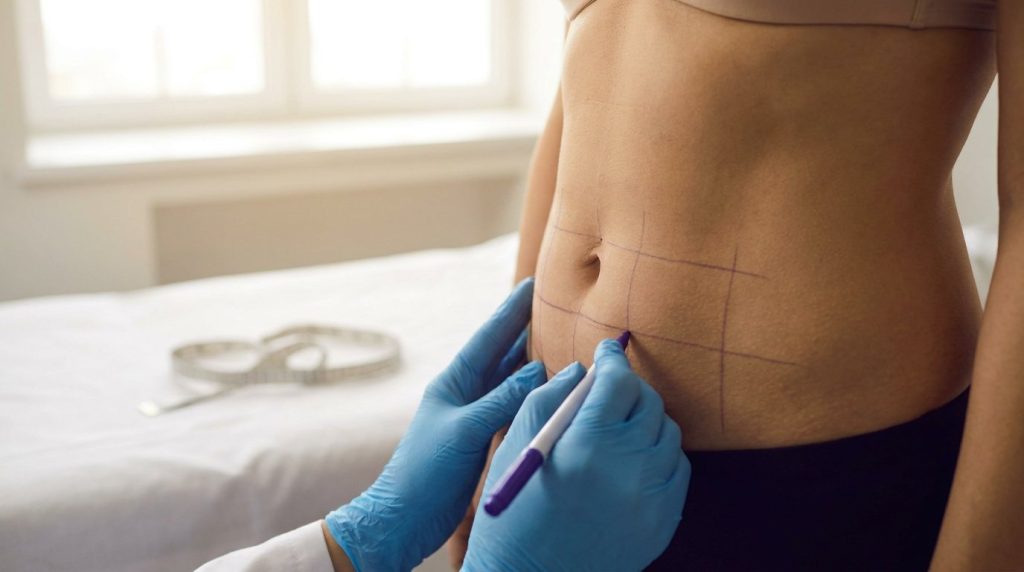
Few cosmetic procedures have a wider price spread than liposuction, which is exactly why researching liposuction cost in the UK can feel like comparing apples with bicycles. One clinic quotes for a single small area under local anaesthetic; another quotes for a full day in theatre with an overnight stay and a year of follow-up. Understanding what sits behind those numbers is the only way to judge whether a quote is fair, and whether it covers everything you will actually need.
Why liposuction prices vary so much in the UK
Liposuction is not one operation with one price tag. It is a technique that can be applied to a small pocket of fat under the chin in under an hour, or to the entire torso across a long session in a fully staffed operating theatre. The surgical skill, the anaesthetic, the equipment and the length of recovery all scale with that, and so does the cost.
That is also why you should be sceptical of a single headline figure on a website. A “from” price almost always describes the smallest possible case: one area, local anaesthetic or light sedation, no overnight stay, minimal garment and aftercare. Very few people turn out to be that case once a surgeon has examined them.
The second reason for the spread is who is operating and where. A consultant plastic surgeon on the specialist register, working in a registered hospital with a resident anaesthetist and overnight nursing cover, carries a different cost base from a day clinic running local-anaesthetic sessions. Neither is automatically right for you — but they are not the same product, and comparing their prices as if they were is the most common mistake patients make.
Finally, the body itself matters. Fat that is firm and fibrous, previous surgery in the same area, skin that has lost its spring after weight loss or pregnancy, and the number of positions you need to be turned into during surgery all affect theatre time. Theatre time is one of the biggest single costs in private surgery.
What actually drives your quote
When you receive a written quote, almost every line traces back to one of a handful of variables. Knowing them lets you ask better questions instead of just hunting for the lowest number.
The table below sets out what tends to push a quote towards the lower or higher end. No clinic can price your case from a photograph or a form, so treat all of this as the framework a surgeon works within, not a calculator. A personalised figure is only confirmed after an in-person or video consultation and a review of your medical history.
📋 Liposuction is a contouring operation, not a weight-loss one It reshapes stubborn areas in people already close to a stable weight. If your main goal is losing weight, or if loose skin is the real problem, a different plan — or no surgery at all — will serve you better. A good surgeon will say so at the consultation.
What a liposuction quote should include
A quote worth comparing is itemised. You should be able to see the surgeon’s fee, the anaesthetist’s fee, the facility or theatre fee, and what happens afterwards. When all of that is rolled into one number with no breakdown, you cannot tell what has been left out.

Here is the structure of a typical private quote, and what tends to sit outside it. Use it as a checklist when two quotes look far apart — often the gap is not the surgery at all, but the follow-up, the garments and who pays if something needs revising.
⚠️ Ask about the revision policy before you pay a deposit Liposuction results can leave small contour irregularities that may need a minor correction once swelling settles, usually after six months or more. The difference between a clinic that covers the surgeon’s time and one that re-charges the full package is significant — and it is far easier to clarify before you book than after.
Why most quotes cover more than one procedure
This is where a lot of budgets slip. People price liposuction on its own, then discover at the consultation that the result they have been picturing involves something else as well — fat transferred to the buttocks, or loose abdominal skin removed with a tummy tuck.
It is not a rare outcome either. Around three quarters of the patients who come to us for liposuction end up having it alongside at least one other operation in the same session, most commonly a Brazilian butt lift or a tummy tuck. If you are budgeting, the honest starting point is a combined plan rather than a single-area figure, because that is what the majority of people in your position are quoted for.
There is a practical upside. Combining procedures under one anaesthetic means one recovery, one set of theatre and facility fees and one period off work, which is usually better value than two separate operations months apart. The trade-off is a longer session, more swelling and a slower return to normal activity, so it has to be a plan your surgeon judges safe for your health and your body. Our guide to combined surgery and what it means for safety, cost and recovery goes into how surgeons set those limits.
If you are weighing liposuction against skin removal, it is worth reading about how tummy tuck costs are structured too, since the two are so often considered together.
Is liposuction ever available on the NHS?
For cosmetic reasons, no. Liposuction to reshape the body is not routinely funded, and the NHS guidance on cosmetic procedures is clear that these treatments are generally paid for privately.
There is a narrow set of medical exceptions. Liposuction is sometimes used in the management of conditions such as lipoedema or large benign fatty lumps (lipomas), and in reconstruction after trauma or cancer surgery. In those situations, funding depends on local commissioning policy and a referral from your GP to a specialist — it is a clinical pathway, not a cosmetic one.
If you are unsure which side of that line your case falls on, start with your GP rather than a private clinic. A GP referral costs you nothing and gives you an independent opinion on whether there is a medical route at all.
📋 Private does not mean unregulated In England, independent clinics performing surgery must be registered with the Care Quality Commission, and surgeons must hold GMC registration — with plastic surgeons appearing on the specialist register. Checking both takes a few minutes online and is the single most useful piece of due diligence you can do.
UK versus abroad: what changes besides the price
A large share of UK patients look at treatment overseas, and Turkey is the most common destination. The price difference is real, driven mostly by lower staff, facility and overhead costs rather than by the surgery itself being different. But price is only one column in the comparison, and the others deserve equal weight.
The practical differences sit in travel, follow-up and what happens if something goes wrong. Flying introduces a clot risk after any body-contouring operation, so surgeons set a minimum stay before you travel home. Aftercare is compressed into that window, and later reviews happen remotely. If you need a revision, you return — which means another flight and another stretch of leave.
You are medically fit, you can take a genuinely unhurried period off work, the surgeon’s qualifications and before-and-after work stand up to scrutiny, and the clinic puts its revision and complication policy in writing.
You are booking on price alone, the trip is squeezed around work commitments, nobody has reviewed your medical history in detail, or you are being pushed to add procedures you did not ask about.
Recovery, time off work and the costs people forget
The invoice is not the whole budget. Liposuction recovery is manageable but not trivial, and the time it takes has a cost of its own, especially if you are self-employed or have no paid leave.
Most people are up and walking the same day, sore and tight for the first week, and back to desk work within about one to two weeks for a single area. Larger, multi-area cases take longer. Bruising fades over a few weeks, while swelling is the slow part — it settles gradually over months, and the final contour is usually judged somewhere between three and six months, sometimes later. Our detailed liposuction swelling timeline, week by week sets out what is normal at each stage.
The extras that catch people out are fairly predictable once you list them:
- ✓A second compression garment, so you can wash one while wearing the other
- ✓Lymphatic drainage massage sessions, if your surgeon recommends them
- ✓Unpaid leave or reduced hours, particularly for physical jobs
- ✓Travel and parking for follow-up appointments
- ✓A possible minor revision after six months or more
If your plan includes another procedure, the recovery you should budget for is the longer of the two. A tummy tuck or a BBL sets the pace, not the liposuction.
🚨 Signs that need urgent attention Contact your surgeon or seek emergency care for breathlessness, chest pain, a hot swollen calf, a fever, spreading redness, heavy or foul-smelling discharge from an incision, or pain that worsens instead of easing. Serious complications are uncommon, but speed matters when they happen.
How to vet a surgeon and clinic before you pay anything
Cost and safety are not separate questions. The cheapest quote is rarely cheap if it buys you less theatre time, less monitoring or a surgeon you never meet until the morning of surgery.
Start with the person, not the package. Confirm the surgeon’s registration and specialty, and ask how many liposuction cases of your type they do each month and how often they revise their own work — a straight answer to that is a good sign in itself. Professional bodies such as BAAPS and the procedure information published by the American Society of Plastic Surgeons are useful for understanding what the operation does and does not achieve before you sit down for a consultation.
Then look at the photographs properly. Consistent lighting and angles, bodies similar to yours, and images taken at least three to six months after surgery are what make a gallery meaningful. Anything taken at two weeks is showing you compression and swelling, not a result. We have written separately on how to judge before-and-after photos.
Finally, pay attention to how you are treated during the enquiry. Pressure to pay a deposit before a medical review, vague answers about who is operating, and prices that only exist “today” are all reasons to slow down. A clinic that is comfortable with you taking a week to think is usually one worth considering.
If you are comparing destinations as well as clinics, our overviews of liposuction in Turkey and Vaser liposuction and what shapes its cost cover the technique and logistics questions that come up next.
This article is for informational purposes only and does not constitute medical advice. Always consult a qualified surgeon for personalised guidance.
You meet the operating surgeon; your medical history is reviewed in detail; the quote is itemised; the revision policy is written down; you are told honestly if liposuction alone will not achieve your goal.
Deposit demanded before any clinical assessment; no named surgeon; a single all-in figure with no breakdown; promises of a guaranteed result; before-and-after photos with no stated time since surgery.
If your fat layer is modest, non-surgical options such as cryolipolysis or injectable fat reduction for small areas may be discussed — they are gentler and cheaper per session, but results are subtler and usually need repeating. If loose skin is the main issue, a lift or tuck, not liposuction, is the operation that addresses it.
Frequently Asked Questions
References
- 📎NHS — Cosmetic procedures
- 📎American Society of Plastic Surgeons — Cosmetic procedures
- 📎BAAPS — British Association of Aesthetic Plastic Surgeons
Related Articles



You Might Also Like


Related articles



Our specialists
 Clineca SpecialistErkan PinegözPlastic & Reconstructive Surgery
 Clineca SpecialistHakan AktaşPlastic & Reconstructive Surgery
 Clineca SpecialistOrkun UzuneyüpoğluPlastic & Reconstructive Surgery
 Clineca SpecialistSalim İskenderPlastic & Reconstructive Surgery
 Clineca SpecialistEngin SelamioğluPlastic & Reconstructive Surgery
 Clineca SpecialistCem AydınPlastic & Reconstructive Surgery
 Clineca SpecialistAlperen ÖnalEar, Nose & Throat (ENT)