

Have a question about Breast Reduction?
In this article
- What a pedicle actually is, and why it decides nipple sensation
- Which pedicle technique preserves nipple sensation best?
- Breastfeeding after breast reduction: what the pedicle changes
- Pedicle options side by side
- Does combining a reduction with a lift change the answer?
- Cost, length of stay and choosing a surgeon you can trust
The word "pedicle" shows up early in almost every breast reduction consultation, and it is rarely explained in plain terms. It simply means the piece of living breast tissue your surgeon leaves attached to the nipple so that it keeps its blood supply and its nerves. If you are weighing up which breast reduction pedicle technique best preserves nipple sensation and breastfeeding ability, that single design decision is where most of the answer sits — and it has more moving parts than one technique name.
What a pedicle actually is, and why it decides nipple sensation
In a breast reduction, the surgeon removes breast tissue and skin, then moves the nipple and areola upward to sit on a smaller breast. The nipple is almost never detached. Instead it stays connected to a column of tissue — the pedicle — that carries blood in and out, and carries the nerves that give the nipple feeling.
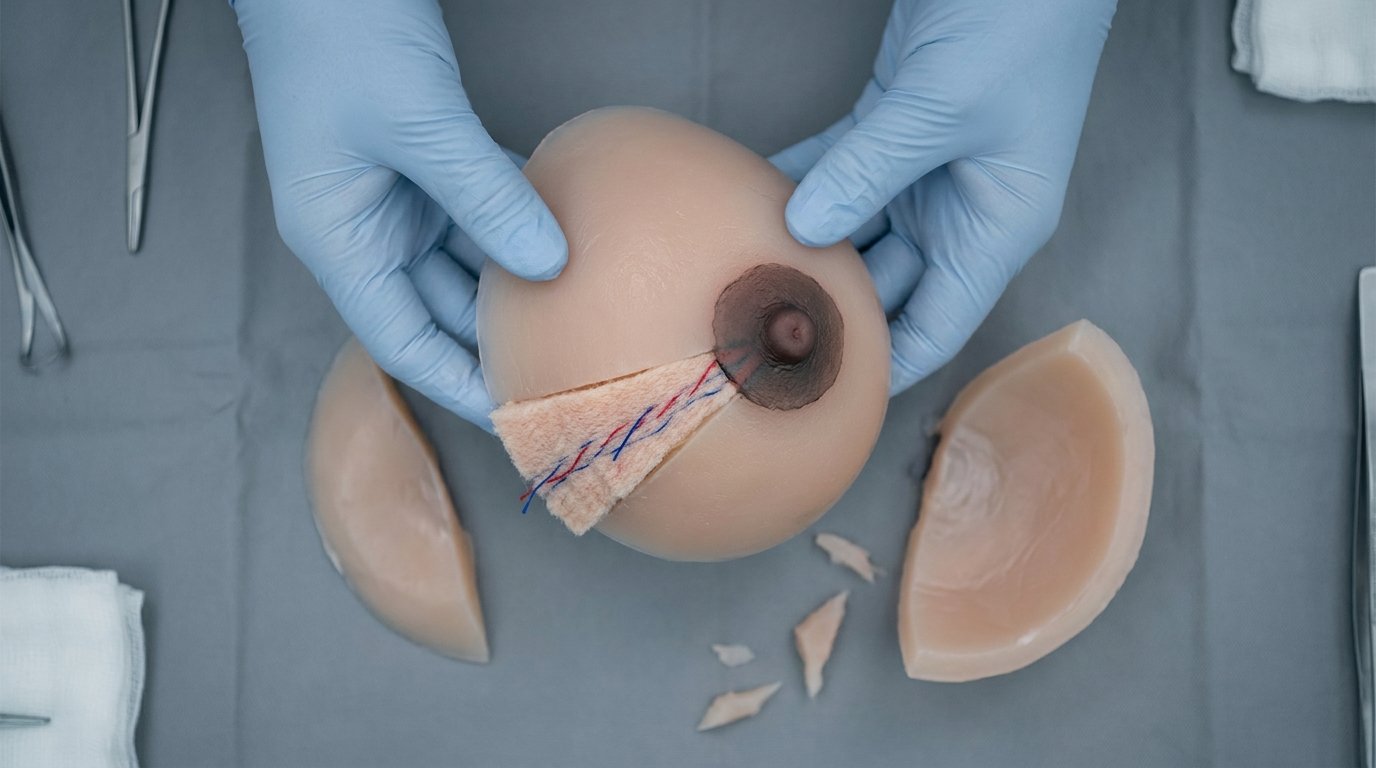
Sensation in the nipple comes mainly from nerve branches that travel in from the side of the chest and from deeper within the breast. Some run close to the chest wall before turning upward; others run nearer the skin. Whichever direction your surgeon builds the pedicle from, that direction is the tissue being protected, and the nerves travelling in the discarded tissue are the ones at risk.
This is why pedicle design is a technical decision rather than a style preference. A 2015 continuing-education review in Plastic and Reconstructive Surgery framed it exactly that way: the surgeon has to understand both the blood supply and the nerve supply of the breast in order to design an appropriate pedicle for each patient. Breast size, how far the nipple has to travel, and your own anatomy all feed into it.
📋 Why your surgeon may not promise one technique in advance Some surgeons finalise the pedicle design on the operating table, once they can see the real blood supply and tissue quality. A plan that changes for safety reasons is normal, and it should be discussed with you beforehand as a possibility.
Which pedicle technique preserves nipple sensation best?
There is no technique with a clean, proven win here, and any clinic that claims otherwise is overselling. What the evidence supports is narrower: most women keep useful nipple sensation after a pedicled reduction, and several different pedicle designs achieve that.
The inferior pedicle — where the nipple stays attached to tissue coming from below — has long been the most widely used approach, partly because surgeons consider it reliable for blood supply and for keeping the deeper nerve branches intact. A 2023 report in Plastic and Reconstructive Surgery – Global Open noted that pedicle length is the central practical concern and that most surgeons still favour the inferior pedicle, while describing a superior-pedicle alternative for cases needing the nipple lifted a long way.
Upper-based designs are strongly represented too. A 2019 literature review and series in the Journal of Plastic, Reconstructive & Aesthetic Surgery covering 938 consecutive superomedial pedicle reductions reported that this technique has been linked in the literature with good aesthetic results, longevity and shorter operating times, even though the inferior pedicle remained the more common choice in the United States. The superolateral variant, revisited in a 2019 Aesthetic Plastic Surgery paper, follows the same logic from the upper-outer side.
When researchers have compared outcomes directly, the differences have been modest rather than dramatic. A 2024 study in the Journal of Plastic, Reconstructive & Aesthetic Surgery examined how pedicle type affected both clinical results and what patients themselves reported across 588 bilateral reductions performed by thirteen surgeons, noting that pedicle choice varies widely between surgeons and that satisfaction is high in most cases.
What matters more than the label
Two factors tend to influence sensation more than the pedicle name: how much tissue is removed, and how far the nipple has to be raised. Very large reductions and long nipple elevations stretch and divide more nerve fibres, whichever route the pedicle takes.
Altered feeling in the early weeks is extremely common — numb patches, sharp zings, oversensitivity, or a nipple that feels oddly distant. Most of this settles gradually over several months as nerves recover, though a degree of permanent change is a genuine risk of the operation rather than a complication. If you want the wider healing picture, our breast reduction recovery timeline sets out what each stage usually feels like.
⚠️ Free nipple grafting is the real exception In very large reductions, or where blood supply to the nipple looks unsafe, the nipple and areola may be removed completely and replaced as a skin graft. This reliably protects the nipple’s survival, but sensation is largely lost and breastfeeding should not be expected. If your breasts are very large, ask directly whether this is on the table for you.
Breastfeeding after breast reduction: what the pedicle changes
Milk is made in glandular tissue and travels to the nipple through ducts. For breastfeeding to be possible, enough gland has to remain, and it has to stay connected to the nipple. A pedicled reduction keeps the nipple attached to glandular tissue, so some duct continuity usually survives — which is why many women who have had a pedicled reduction do go on to breastfeed, often with a supply that needs support.
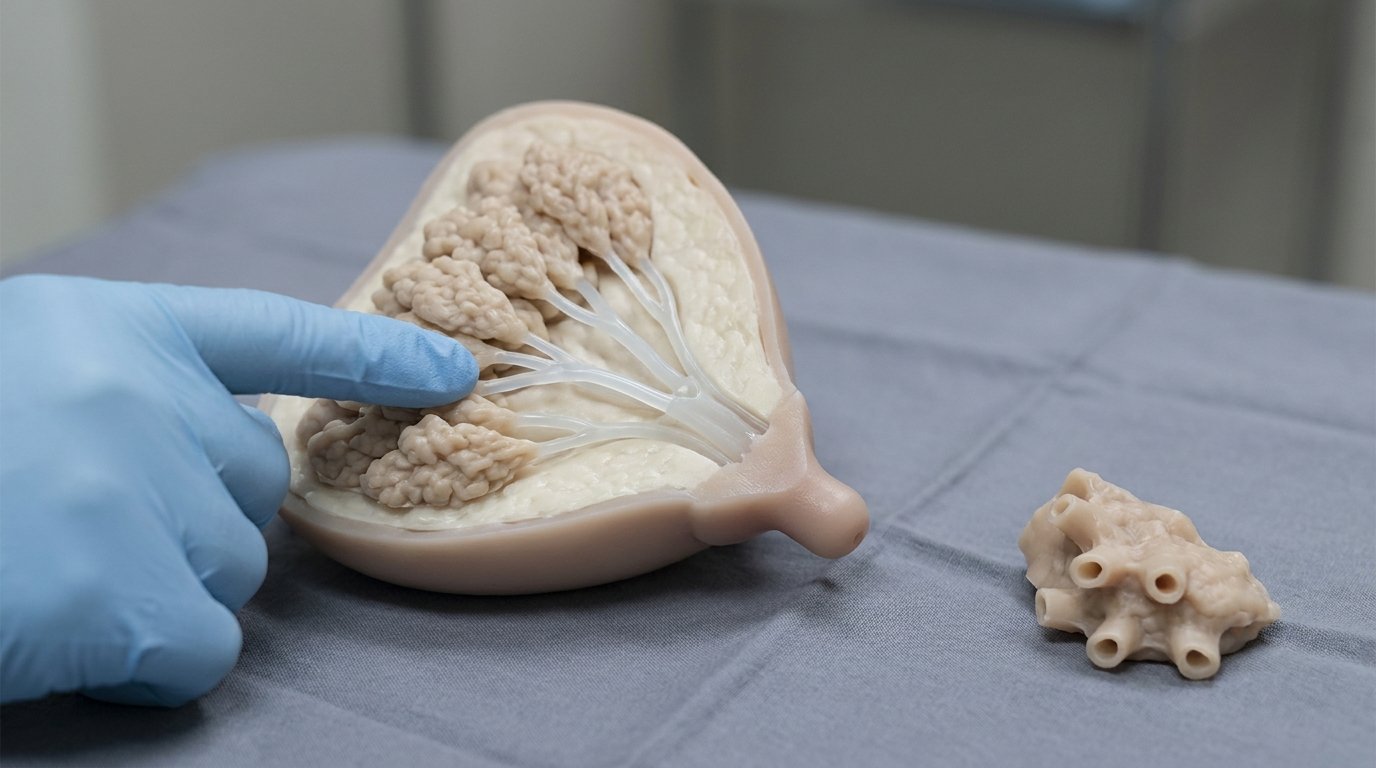
What no surgeon can honestly promise is a specific feeding outcome. Supply depends on how much gland was removed, how the ducts healed, and on factors that have nothing to do with surgery at all. Plenty of women without any breast surgery struggle with supply. A realistic framing is this: a pedicled technique keeps the door open, while a free nipple graft closes it.
Pregnancy or breastfeeding plans come up in roughly a quarter of the conversations we have with women considering breast surgery, so it is a mainstream question rather than an awkward one. Raise it at your very first consultation, because it can shift the pedicle choice, the amount of tissue removed and even the timing of surgery — our piece on breast surgery timing after breastfeeding covers the sequencing side in more detail.
It is also worth knowing that pregnancy and feeding after a reduction can change breast shape and volume again, in the same way they do for unoperated breasts. That does not undo the symptom relief most patients seek, but it can soften the cosmetic result.
- ✓Say it out loud in consultation: Tell your surgeon if a future pregnancy is possible, even if it is years away or uncertain.
- ✓Ask which pedicle is planned and why: A clear answer tied to your breast size and nipple position is a good sign.
- ✓Ask about the free nipple graft threshold: Find out whether your reduction size makes grafting likely, and what the back-up plan is.
- ✓Expect support rather than certainty: Plan for possible lactation support later instead of counting on a guaranteed full supply.
Pedicle options side by side
The table below compares the main pedicle designs on the two things this article is about. Treat it as a map for your consultation conversation, not a ranking — the right choice depends on your breast size, nipple position and tissue quality, and your surgeon may combine elements of more than one approach.
Does combining a reduction with a lift change the answer?
Almost every breast reduction already includes a lift. Removing weight without repositioning the nipple would leave a smaller breast that still sits low, so the two steps are usually part of the same operation rather than separate purchases. When patients ask about breast reduction and lift together, that is normally what is meant.
For sensation and feeding, the lift element is not a separate risk so much as a variable. The further the nipple travels upward, the more the pedicle is rotated and stretched, and the more nerve and duct fibres are tested. So if a long nipple elevation is planned, it is reasonable to ask how that influences the pedicle choice in your case.
Scar pattern follows the same planning. Most reductions use an anchor or vertical pattern around the areola and down to the fold, and our guide to breast reduction scars and how they fade explains how those marks usually settle over the first year.
Cost, length of stay and choosing a surgeon you can trust
Pedicle technique is not really a price tier. What moves a breast reduction quote is the scale of the operation, how long it takes, whether a lift or any additional procedure is performed in the same anaesthetic, the hospital and anaesthesia standard, and the length of follow-up built into your plan. A written quote for international patients usually bundles surgery, anaesthesia, the hospital stay, garments, post-operative checks, airport and hotel transfers, and an interpreter or coordinator. A personalised figure can only be confirmed after a proper consultation with photographs and your medical history.
On timing, most patients plan a stay of around a week to ten days in Turkey so drains, dressings and the first wound check are all done before flying. Our note on how long to stay in Turkey for breast surgery goes through the day-by-day logistics.
If nipple sensation and future feeding genuinely matter to you, the surgeon matters more than the technique. Look for a surgeon qualified in plastic and reconstructive surgery, operating in a licensed hospital, who examines you, measures the nipple position and explains the planned pedicle in words you follow — including what would make them change it mid-operation.
This article is for informational purposes only and does not constitute medical advice. Always consult a qualified surgeon for personalised guidance.
The surgeon names the planned pedicle and explains why it suits your breast size, asks about future pregnancy before you raise it, and states plainly that some change in nipple feeling is possible.
A promise that sensation and breastfeeding will be fully preserved, a price quoted before any assessment, or no clear answer on who performs the surgery and in which hospital.
Some women choose to delay reduction until after they have finished having children, accepting the symptoms for longer in exchange for a simpler decision. Others go ahead with a pedicled technique and plan for feeding support later. Both are legitimate; the choice belongs with you and your surgeon.
Frequently Asked Questions
References
- 📎Breast Reduction — Plastic and Reconstructive Surgery, 2015
- 📎Effect of pedicle type on breast reduction: Clinical and patient-reported outcomes — Journal of Plastic, Reconstructive & Aesthetic Surgery, 2024
- 📎Reduction mammaplasty with superomedial pedicle technique: A literature review and retrospective analysis of 938 consecutive breast reductions — Journal of Plastic, Reconstructive & Aesthetic Surgery, 2019
- 📎Breast Reduction with Total Superior Pedicle — Plastic and Reconstructive Surgery Global Open, 2023
- 📎NHS: Cosmetic procedures
Related Articles



You Might Also Like



Related articles



Our specialists
 Clineca SpecialistErkan PinegözPlastic & Reconstructive Surgery
 Clineca SpecialistHakan AktaşPlastic & Reconstructive Surgery
 Clineca SpecialistOrkun UzuneyüpoğluPlastic & Reconstructive Surgery
 Clineca SpecialistSalim İskenderPlastic & Reconstructive Surgery
 Clineca SpecialistEngin SelamioğluPlastic & Reconstructive Surgery
 Clineca SpecialistCem AydınPlastic & Reconstructive Surgery
 Clineca SpecialistAlperen ÖnalEar, Nose & Throat (ENT)