
In this article
- What pregnancy actually does to breast tissue
- Do breast implants themselves change during pregnancy?
- How each type of breast surgery responds to pregnancy
- Can you still breastfeed, and will feeling change?
- Should you wait until after having children?
- How long to wait after pregnancy before revision surgery
- Quotes, stay length and choosing the right surgeon
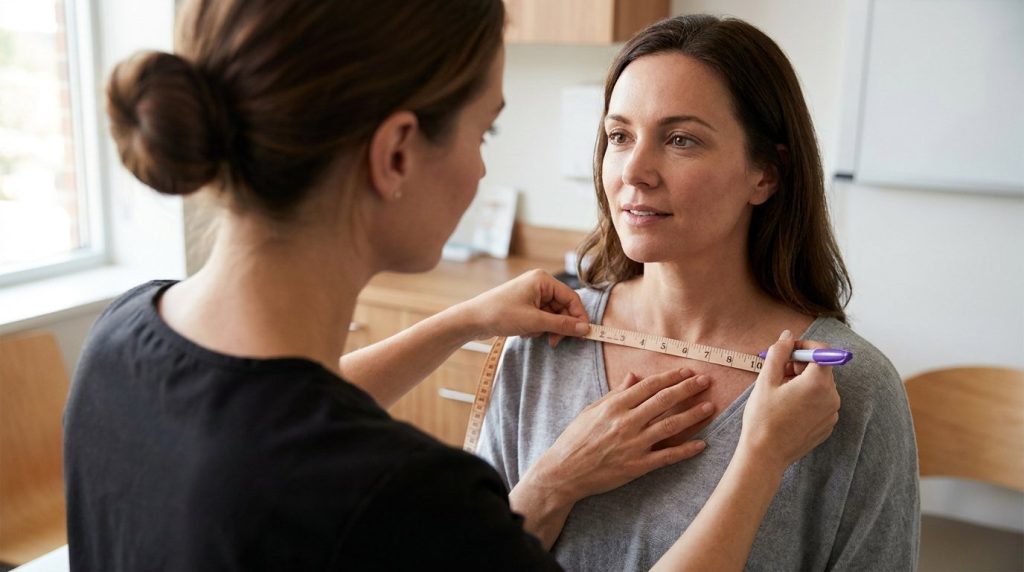
For many women in their late twenties and thirties, the decision to have breast surgery sits alongside another open question: children. So it is no surprise that one of the most frequent worries we hear is whether pregnancy after breast surgery will affect the results you have paid for and recovered from. The honest answer depends less on the surgery itself than on what pregnancy does to the tissue around it, and that is worth understanding properly before you book anything.
What pregnancy actually does to breast tissue
Pregnancy changes the breast from the inside out. Milk-producing glandular tissue grows, blood flow increases, and the skin envelope stretches to hold a larger, heavier breast for months. After you stop breastfeeding, or after birth if you do not breastfeed, that glandular tissue shrinks back in a process surgeons call involution.
The stretched skin does not always shrink with it. This mismatch is why some women finish pregnancy with breasts that feel emptier at the top and sit lower on the chest than before, even though their bra size on paper is unchanged. Weight gained and lost during pregnancy adds a second layer of change, especially if the swing was large or happened quickly.
How much any of this shows varies enormously between women. Skin quality, genetics, age, how many pregnancies you have, how long you breastfeed and how stable your weight stays all play a part. Two women with identical surgery and identical implants can look noticeably different two years after a baby, and no surgeon can predict which one you will be.
📋 The surgery is not the variable here Pregnancy affects natural breast tissue and skin in the same broad way whether or not you have had surgery. What differs is how visible the change becomes against a surgically set shape.
Do breast implants themselves change during pregnancy?
No. Modern silicone and saline implants are not affected by pregnancy hormones, milk production or breastfeeding. They do not swell, shrink or absorb anything, and pregnancy is not considered a cause of implant rupture.
What changes is the tissue in front of and around the implant. If the breast grows during pregnancy and then loses volume afterwards, the implant can end up sitting in a looser skin envelope. Visually this often reads as a fuller lower breast, a flatter upper pole, or an implant that seems more obvious because there is less natural tissue covering it. The implant has not moved so much as the cover has thinned.
Augmentation results already evolve slowly over years, as explained in our piece on how long breast augmentation results last. Pregnancy tends to compress several years of that natural change into a shorter period rather than create a brand-new problem.
How each type of breast surgery responds to pregnancy
Different procedures are vulnerable in different ways. A lift depends on skin and internal support holding a shape, so stretching matters more. An implant provides fixed volume, so volume loss matters less but skin laxity shows more. Fat transfer sits somewhere in between, because transferred fat behaves like the rest of your body fat and can gain or lose volume with weight.
The table below reflects patterns surgeons see commonly, not a prediction for any individual.
Can you still breastfeed, and will feeling change?
Most women who have had breast augmentation are able to breastfeed. The American Society of Plastic Surgeons notes that breastfeeding is generally possible after implants, while incisions placed around the areola carry more potential to affect milk ducts and nipple sensation than incisions in the fold under the breast or in the armpit.
Breast reduction and lift surgery move the nipple and remove tissue, so the picture is less predictable. Many women still breastfeed successfully afterwards, but the chance of a reduced milk supply is higher than with augmentation alone, and it is one of the specific things to raise if children are in your plans. We go into detail in our article on breastfeeding after breast augmentation.
Sensation is a separate question. Temporary numbness or extra sensitivity in the nipple is common in the first months after any breast operation, and for most patients it settles. A small number of women are left with a permanent change, which is a recognised risk rather than a complication of pregnancy.
⚠️ Tell your surgeon if breastfeeding matters to you Incision choice, implant position and lift technique can all be adjusted with future breastfeeding in mind. That conversation has to happen before surgery, not after.
Should you wait until after having children?
There is no single right answer, and this is not a decision anyone should make for you. Waiting means one operation instead of possibly two, and a final result planned around the body you will actually keep. Not waiting means years of feeling comfortable in your clothes rather than putting your own confidence on hold for a pregnancy that may be several years away, or may not happen at all.
Pregnancy or breastfeeding comes up in roughly a quarter of the conversations we have with women considering breast surgery, so if you are weighing it up, you are in very ordinary company. What matters practically is that you say it out loud at your first consultation, because a possible future pregnancy can change the technique, the incision plan and how your surgeon talks to you about longevity.
A useful way to frame it with your surgeon is not “will this last forever” but “if I have a baby in four years, what would most likely need adjusting, and how big a procedure would that be?” A good answer to that question tells you far more than any before-and-after photo.
- →If children are close in your plans: Many surgeons will discuss a simpler, more conservative plan, or suggest revisiting timing after you finish breastfeeding.
- →If children are years away or uncertain: Surgery now is reasonable, provided you accept that a revision may be wanted later.
- →If you are unsure either way: Ask specifically which incision and technique leaves the most options open for the future.
How long to wait after pregnancy before revision surgery
If your shape has changed and you are considering a correction, timing is everything. Breasts continue to change for months after you stop breastfeeding, and operating on tissue that is still settling risks planning around a shape that no longer exists by the time you heal.

As a general rule, surgeons look for breasts that have stopped changing in size, a body weight that has been steady for several months, and completed breastfeeding. ASPS patient guidance on breast lift makes a similar point, noting that pregnancy and breastfeeding stretch the skin and that many surgeons advise waiting until the breasts have settled. Our month-by-month look at breast surgery after breastfeeding walks through that window in more detail.
Some women choose to combine a breast revision with abdominal surgery once they are finished having children, which is the logic behind a mommy makeover. Combining is not automatically better; it means one recovery but a longer operation, so it should be a considered decision rather than a package choice.
🚨 Do not book revision surgery while still breastfeeding Active milk production increases infection risk and makes the final shape impossible to plan accurately. Any responsible surgeon will ask you to wait.
- ✓Breastfeeding finished, with breast size stable for at least a few months
- ✓Weight steady, without an active loss or gain plan
- ✓Sleep and daily energy recovered enough to handle a real recovery period
- ✓Clear on what specifically bothers you: volume, position, skin looseness or all three
- ✓Help arranged at home for lifting and childcare in the first weeks
Quotes, stay length and choosing the right surgeon
Revision after pregnancy is priced on complexity, not on a menu. What moves the figure is whether you need a lift alone, a lift with an implant exchange, how much scar tissue is present, whether fat transfer is involved, the anaesthesia and theatre time required, and the length of hospital and hotel stay. A complete quote should also cover pre-operative tests, garments, medication, follow-up appointments and airport transfers, so ask what is included rather than comparing headline numbers. A personalised price can only be confirmed after a consultation and a look at your current anatomy, and honest clinics will say so.
Plan your travel around healing rather than around flights. Most breast procedures need a stay of around a week to ten days abroad for checks and a wound review before flying, which we break down in our guide to how long to stay in Turkey for breast surgery. Build in slack: nobody enjoys rebooking a flight while sore.
On surgeon choice, look for board certification in plastic surgery and membership of recognised bodies such as ISAPS or EBOPRAS, a hospital with proper accreditation, and a surgeon who examines you, asks about your pregnancy plans and explains what surgery cannot fix. Clear, prompt communication before you travel is usually a fair signal of the aftercare you will get once you are home.
A surgeon who asks whether you plan to have children, explains incision choices in that context, sets out revision possibilities honestly, and gives you a written plan with follow-up arrangements after you fly home.
Promises that results are permanent regardless of pregnancy, a fixed price quoted before anyone has examined you, pressure to decide within hours, or no named surgeon attached to your case.
A modest implant exchange or fat transfer may address emptiness at the top of the breast without a full repeat lift. Which suits you depends on skin quality and how much natural tissue remains.
Frequently Asked Questions
References
- 📎American Society of Plastic Surgeons — Cosmetic Procedures (breast augmentation, breast lift, breast reduction)
- 📎NHS — Cosmetic procedures
- 📎PubMed — Breastfeeding and breast shape changes after breast surgery and pregnancy
- 📎ISAPS — Global Statistics
Related Articles


You Might Also Like


Related articles


Our specialists
 Clineca SpecialistErkan PinegözPlastic & Reconstructive Surgery
 Clineca SpecialistHakan AktaşPlastic & Reconstructive Surgery
 Clineca SpecialistOrkun UzuneyüpoğluPlastic & Reconstructive Surgery
 Clineca SpecialistSalim İskenderPlastic & Reconstructive Surgery
 Clineca SpecialistEngin SelamioğluPlastic & Reconstructive Surgery
 Clineca SpecialistCem AydınPlastic & Reconstructive Surgery
 Clineca SpecialistAlperen ÖnalEar, Nose & Throat (ENT)