
Have a question about Breast Augmentation?
In this article
- Is one shape actually better, or is it better for a certain body?
- Which looks more natural: round or teardrop?
- What are the trade-offs on safety, rotation and revision?
- How do surgeons usually decide between round and teardrop implants?
- Does recovery differ, and what should travelling patients plan for?
If you are trying to decide which is better, round or teardrop breast implants, the difficult part is that both can be the right answer. The choice is less about a “best” implant in general and more about what your tissues, chest shape and long-term plans allow without creating problems you then have to revise.
Is one shape actually better, or is it better for a certain body?
There is no single winner between round and teardrop breast implants. In practice, surgeons choose the shape that is most likely to give the look you want on your frame, with the lowest chance of visible edges, malposition, or a result that feels too obviously augmented.
Round implants are symmetrical. That means the upper and lower parts are the same shape, so if the implant shifts, the breast does not suddenly look distorted just because the device has rotated. Teardrop implants, also called anatomical implants, are fuller at the bottom and slimmer at the top. They are designed to mimic the slope of a natural breast, especially in people starting with very little breast tissue.
A 2020 paper in Aesthetic Plastic Surgery made this point clearly: both round and anatomical implants still have a place in modern breast surgery, and the better choice depends on the patient’s anatomy, goals and surgical history, not on a universal rule. That matters because online advice often turns this into a simple natural-versus-fake debate, and it is rarely that simple.
In real consultations, the main question is usually not “Which implant is better?” but “What happens on my body if we choose this one?” A round implant under a tight chest with thin soft tissue can look very different from the same implant in someone with looser skin and more existing breast volume. Likewise, a teardrop implant can look elegant in one patient and unnecessary in another.
Because breast augmentation is often chosen relatively young, the decision also has to hold up over time. The women who come to us for breast augmentation are, on average, 27 at surgery. That means the implant choice is not just about how the result looks next month; it needs to stay sensible through future weight change, ageing, and possibly pregnancy or breastfeeding.
📋 The useful way to frame the choice Ask which implant shape suits your tissues, not which shape wins in general. A good plan starts with anatomy, then adjusts for your aesthetic goal.
Which looks more natural: round or teardrop?
Teardrop implants are often described as the more natural-looking option, but that statement needs context. They can create a gentler upper-pole slope, which may suit a slim patient with little starting volume, a constricted lower breast, chest asymmetry, or a reconstructive need. That is one reason the 2020 Aesthetic Plastic Surgery review argued for keeping anatomical implants available: in selected patients, aesthetic outcomes may be better with them.
But “natural” does not come from shape alone. Pocket position, implant size, projection, your existing breast tissue, and skin quality all matter. A moderate-profile round implant placed well can look very natural. In fact, when you stand upright, many round gel implants settle with more fullness in the lower part anyway. This is why some surgeons prefer smooth round implants for many cosmetic augmentations: they can still produce a soft slope without adding the trade-off of shape-dependent rotation.
Teardrop implants are usually most attractive on paper when someone wants a restrained upper breast and does not want a pushed-up look in clothing. They can also help when the surgeon needs more control over where volume sits. On the other hand, if you want noticeable cleavage, fuller upper poles, or a visibly augmented look, round implants are often the more direct match.
A practical way to think about it is this:
- ✓Round implants often suit patients who want more upper fullness, more cleavage, easier implant positioning, and less concern about shape distortion if the implant moves.
- ✓Teardrop implants often suit patients who want a subtler slope, have very little natural breast tissue, need more lower-pole shaping, or have asymmetry or mild tuberous features that benefit from a more directional implant.
- ✓Either shape can look natural when the size, projection and pocket are chosen well for the chest wall and soft tissue.
- ✓Either shape can look artificial if the implant is too large for the tissues or the pocket is poorly planned.
If your real concern is not shape but sagging, that is a different conversation. In that case, an implant alone may not fix the breast position, and a lift can matter more than whether the implant is round or anatomical. Our article on breast lift or implants and what each one fixes explains that trade-off well.
You want more upper fullness or cleavage, and your tissues can cover the implant well.
You want a quieter slope, have little starting tissue, or need more precise lower-breast shaping.
If the breast sits low or the nipple position has dropped, a lift may matter more than implant shape.
What are the trade-offs on safety, rotation and revision?
This is where the difference becomes more concrete. The biggest shape-specific drawback of teardrop implants is rotation. Because the implant has a top and a bottom, turning inside the pocket can change the breast shape visibly. Round implants can move too, but if a round device rotates, the breast usually looks the same because the implant is symmetrical.
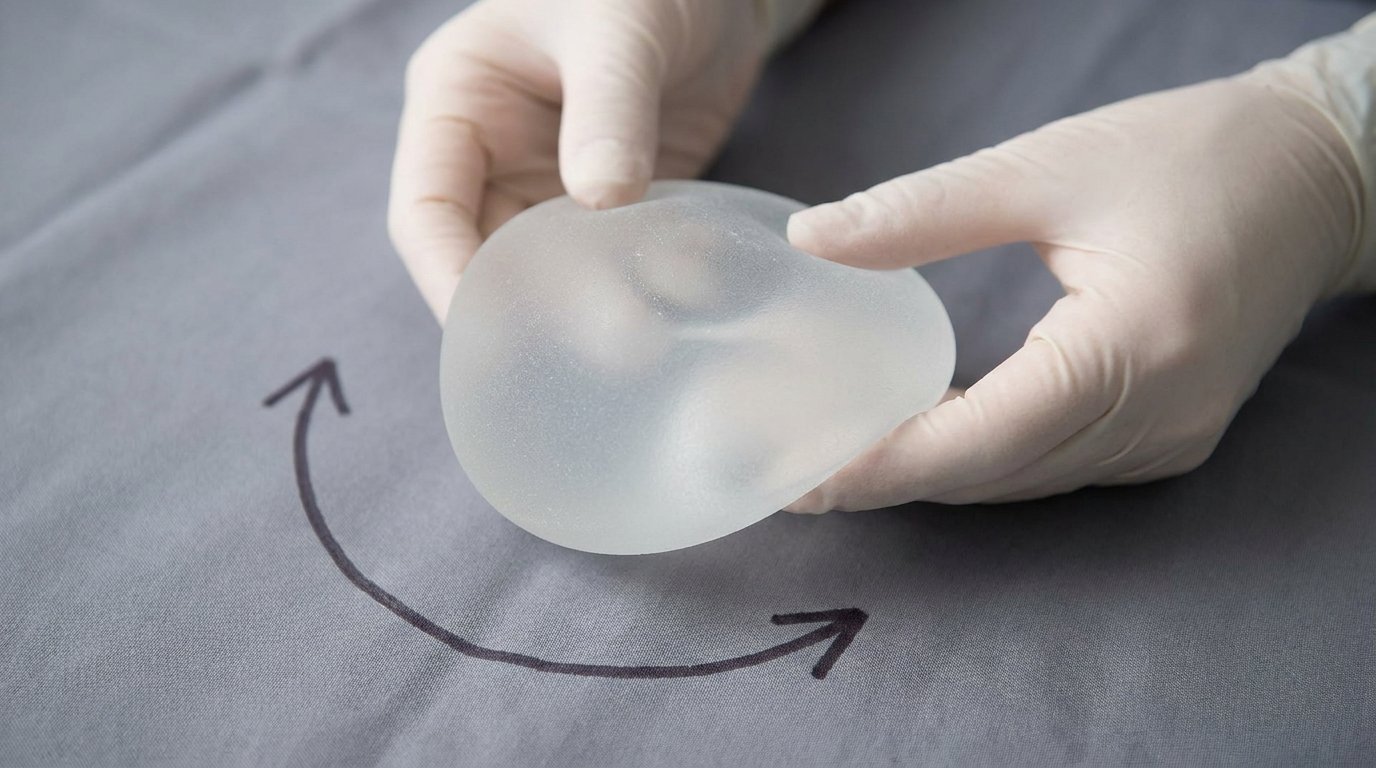
That is one reason anatomical devices demand more precise planning and pocket control. The 2020 Aesthetic Plastic Surgery paper noted that anatomical implants offer useful flexibility, but they also require proper handling and a steeper learning curve. For the patient, that translates into a simple question: does your anatomy benefit enough from a teardrop shape to justify the extra shape-related complexity?
Revision planning matters too. If a patient later wants a change in size, upper fullness, pocket position, or has a complication such as malposition or capsular contracture, round implants often give the surgeon a simpler starting point. That does not mean teardrop implants are a poor choice. It means their advantages should be strong enough to outweigh the fact that they are less forgiving if orientation changes.
There is also an implant-safety discussion many patients expect in 2026. Breast implant-associated anaplastic large cell lymphoma, or BIA-ALCL, is a rare cancer of the scar capsule and fluid around an implant rather than a cancer of the breast itself. The concern has been linked mainly to textured implants, not smooth ones, according to the ASPS and information used across major breast surgery guidance. This matters because many anatomical implants have historically used textured surfaces to help reduce rotation. Not every teardrop implant on the market is the same, and availability differs by country, but the texture question should be part of the consultation whenever anatomical devices are discussed.
Patients also ask about breast implant illness, often shortened to BII. BII is a patient-used term for a broad set of symptoms some people attribute to implants, but it is not a single formally defined disease with one diagnostic test. That does not mean symptoms should be dismissed. It means you need a surgeon who takes symptoms seriously, rules out other causes, and explains what is known and what is still uncertain. If this concern is already on your mind, our article on breast implant illness symptoms, warning signs and next steps is a useful next read.
Revision questions worth asking before your first surgery
A good consultation is not only about the first result. It should also cover what happens if you later want pregnancy, weight loss, a lift, implant exchange, or removal. One of the timing issues that keeps surfacing is future family planning: pregnancy or breastfeeding comes up in about one in four conversations we have with women considering breast surgery. That does not make implants inappropriate, but it does mean your long-term plan should be discussed at the first consultation rather than after surgery.
If you already know you may combine augmentation with a lift, ask how that changes implant selection. Shape choice can interact with skin tightening, nipple position and pocket design, which is why this is better planned as one strategy than as separate decisions.
⚠️ Teardrop implants need a texture discussion Because rotation prevention has historically involved textured surfaces, ask directly what surface is proposed, why, and what that means for risk and follow-up.
How do surgeons usually decide between round and teardrop implants?
A careful surgeon usually works through the decision in a set order. First comes your anatomy: chest width, breast base width, skin tightness, tissue thickness, nipple position and any asymmetry. Next comes the look you want in clothes and without a bra. Only after that does implant shape become meaningful.
In broad terms, round implants are often favoured when the patient wants more visible fullness, when the tissues already provide a natural drape, or when keeping revision options simpler is a priority. Teardrop implants are more likely to come up when the starting breast is very flat, the upper pole is thin, the lower pole needs shaping, or there is asymmetry that benefits from a directional implant.
This is also where 3D imaging, sizers and careful before-and-after review become more useful than generic internet photos. If you are choosing between shapes, ask to see patients with a body type close to yours, not just results that match your taste.
If your surgeon is deciding between implant augmentation and another method altogether, it is worth understanding the alternative. For selected patients who want subtle change and have donor fat available, breast lift with fat transfer as an alternative to implants can be part of the comparison, although it does not replace implants for everyone.
Does recovery differ, and what should travelling patients plan for?
Recovery after breast augmentation depends more on pocket dissection, implant placement, whether a lift is added, and your own healing pattern than on round versus teardrop shape by itself. A 2025 study in Aesthetic Plastic Surgery on enhanced recovery after breast augmentation described how modern protocols can support a smoother early recovery, but that does not mean every patient feels normal in a day or two. Most still need sensible activity limits, good pain control, and follow-up.
For international patients, the practical questions are often just as important as the implant debate. Plan your stay around in-person review, early healing checks and the possibility that swelling, tightness or dressing changes may make quick travel feel stressful. If surgery is combined with a lift, your stay and recovery planning usually follow the larger procedure rather than a straightforward augmentation alone. For a more detailed travel view, see how long to stay in Turkey for breast surgery and our broader article on breast augmentation in Turkey: cost, safety and recovery.
Cost is also part of the decision, but a quote should be read carefully rather than reduced to a headline figure. The final cost is shaped by the implant brand and surface, the complexity of the pocket, whether a lift or another procedure is being added, the hospital setting, surgeon experience, aftercare, garments, medication and travel logistics. A personalised quote should make clear what is included, what follow-up is covered, and what would happen financially if a change of plan is needed after examination.
When choosing a clinic and surgeon, look for clear implant documentation, hospital accreditation, a named operating surgeon with recognised specialist credentials, and a consultation that discusses revision risk as calmly as it discusses cosmetic goals. If the conversation avoids surface type, future imaging, capsular contracture, or what happens if you are unhappy with shape, that is not a small omission.
This article is for informational purposes only and does not constitute medical advice. Always consult a qualified surgeon for personalised guidance.
- ✓Ask which implant surface is being proposed and why
- ✓Ask to see results on body types similar to yours
- ✓Check who provides your follow-up after you return home
- ✓Read the quote for inclusions, exclusions and revision policy
Frequently Asked Questions
References
- 📎Transumbilical Silicone Implant Breast Augmentation — Plastic and Reconstructive Surgery, 2024
- 📎Transaxillary endoscopic breast augmentation — Archives of Plastic Surgery, 2014
- 📎A Decalogue on Enhanced Recovery After Breast Augmentation Surgery (ERABAS) — Aesthetic Plastic Surgery, 2025
- 📎Why Do We Need Anatomical Implants? the Science and Rationale for Maintaining Their Availability and Use in Breast Surgery — Aesthetic Plastic Surgery, 2020
- 📎Comparison Of Endoscopic Transaxillary And Peri-areolar Approaches In Breast Augmentation With Smooth Implants — Aesthetic Plastic Surgery, 2021
- 📎ASPS Cosmetic Procedures
- 📎NHS Cosmetic procedures
Related Articles



You Might Also Like



Related articles



Our specialists
 Clineca SpecialistErkan PinegözPlastic & Reconstructive Surgery
 Clineca SpecialistHakan AktaşPlastic & Reconstructive Surgery
 Clineca SpecialistOrkun UzuneyüpoğluPlastic & Reconstructive Surgery
 Clineca SpecialistSalim İskenderPlastic & Reconstructive Surgery
 Clineca SpecialistEngin SelamioğluPlastic & Reconstructive Surgery
 Clineca SpecialistCem AydınPlastic & Reconstructive Surgery
 Clineca SpecialistAlperen ÖnalEar, Nose & Throat (ENT)