

Have a question about Breast Reduction?
In this article
- What do breast reduction scars usually look like at first?
- How do breast reduction scars fade over time?
- What affects how visible the scars become?
- What can you do to help scars fade well?
- When should you worry about a breast reduction scar?
- How do you choose a clinic and surgeon if scars are one of your biggest worries?
If you are thinking about surgery, one of the hardest parts is picturing the trade-off clearly. What do breast reduction scars look like and how do they fade is really a question about shape, placement, colour, time, and whether the result usually settles into something easier to live with.
What do breast reduction scars usually look like at first?
Most breast reduction scars follow the same basic pattern as the incisions used to remove skin, reshape the breast, and move the nipple-areola complex higher. In practical terms, that usually means a scar around the edge of the areola, a vertical scar running down from the areola to the breast crease, and sometimes a scar hidden in the fold under the breast. Surgeons often call this an anchor or lollipop pattern depending on whether the fold scar is needed.
In the early weeks, scars rarely look subtle. They are usually pink to red, sometimes slightly raised, firmer than the surrounding skin, and more obvious after a shower or at the end of the day. That early look is normal. According to the NHS guidance on cosmetic procedures, scars are an expected part of breast reduction surgery, and the final appearance takes time to develop rather than showing up in the first few weeks.
A simple way to picture the usual fading pattern is this: the lines tend to look most noticeable in the first few months, then gradually flatten and lighten over the rest of the first year. For many people, they continue to mature beyond that point, which is why very early judgments about scar quality are often misleading.
If you are trying to imagine placement more than colour, the useful question is not whether there will be scars, but where clothes and bras will hide them. The areola scar sits at the colour change between darker areola skin and lighter breast skin, which often helps it blend better over time. The vertical scar is the easiest one to notice when you are undressed, while the fold scar is usually the least visible in everyday life because it rests in the natural under-breast crease.
Because scar pattern depends on the amount of skin to remove, a reduction is often planned with lifting as part of the same operation rather than as two separate ideas. In the women who come to us for breast reduction, about 37% book it together with another procedure, most often a breast lift. For you, that means the scar shape is often driven by what is needed to reshape and lift the breast safely, not by reduction alone.
For a related look at scar patterns in breast surgery, our article on breast surgery scar types and healing can help you compare how incision placement changes by procedure.
📋 The first look is not the final look Fresh scars are usually darker, firmer, and more visible than mature scars. It is common for them to look worse before they start looking better.
How do breast reduction scars fade over time?
Scar fading is usually a slow, uneven process rather than a straight line. A scar may look calmer at one month, redder again at two or three months, then gradually soften after that. This is part of normal scar maturation.
The American Society of Plastic Surgeons describes scarring as an expected trade-off of breast reduction, and peer-reviewed studies in journals such as Aesthetic Surgery Journal and Plastic and Reconstructive Surgery describe scar maturation as a process that continues for many months. That is why surgeons usually assess the trend over time, not just a single photo from one week.
A practical month-by-month picture
In the first two weeks, the incision lines usually look fresh and may have tape, glue, or scabs over parts of them. By the first month, many patients see red or pink lines with some lumpiness where the tissue is knitting together. Between the second and sixth month, scars often enter their more active phase: they can stay pink, feel tight, itch, or seem slightly raised.
From around six months onward, many scars begin to soften and lose colour more clearly, although this varies by skin tone, genetics, tension on the wound, and how well the incisions healed early on. Some continue improving through the first year and beyond. Darker skin tones can be more prone to long-lasting pigment change, while some fairer skin types stay pink for longer before finally fading.
What affects how visible the scars become?
The biggest factors are not just the incision pattern. Your skin type, your tendency to form thick or raised scars, smoking status, wound healing in the first few weeks, sun exposure, and how much tension sits on the closure all matter. Even beautifully placed incisions can heal more visibly in someone who naturally scars heavily.
Surgical technique matters too. Careful tissue handling, reducing wound tension, and keeping the blood supply healthy all help the scar mature better. This is one reason it matters to choose a properly qualified plastic surgeon rather than judging only by a quote or social media photos. BAAPS and EBOPRAS both stress the importance of specialist training and realistic consent in cosmetic surgery.
Your aftercare also plays a part. Following the bra, lifting, sleeping, and activity instructions can reduce strain on fresh incisions. If you are also planning travel, it helps to read about how long to stay in Turkey for breast surgery, because scar checks and early wound review are easier when the stay is not rushed.
One more point that patients often underestimate is breast shape change over time. If the breasts are heavy, healing under tension can make the vertical or fold scar work harder. That does not mean a poor result, but it can affect how wide or visible the line eventually looks.
No smoking, careful wound healing, low tension on the incision, and consistent scar care usually give scars the best chance to settle well.
Early wound separation, infection, strong sun exposure, and a personal history of raised scars can all make the final line more visible.
What can you do to help scars fade well?
Good scar care starts with simple things rather than expensive products. The first priority is letting the incision heal cleanly and fully. That means following your surgeon’s instructions on dressings, support bras, showering, exercise, and when to restart normal movement.
Once the wound is closed and your surgeon says it is safe, silicone is one of the most widely used first-line scar treatments. The NHS and Mayo Clinic both note that scar care should match the stage of healing, and silicone gel or silicone sheets are commonly used after the skin surface has healed. Sun protection matters too, because ultraviolet light can make scars stay darker for longer.
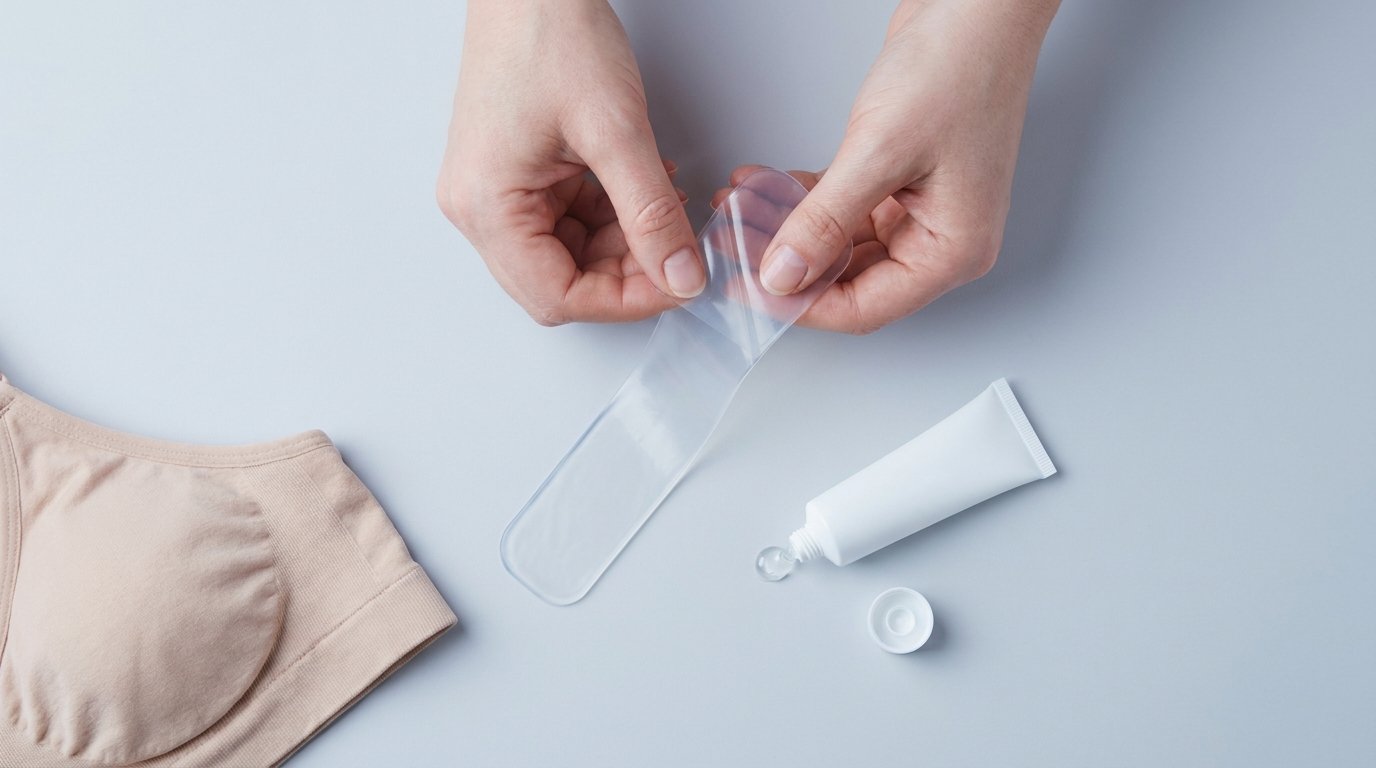
If a scar stays raised, itchy, wide, or deeply pigmented, there are treatment options worth discussing after proper assessment. Depending on the problem, these may include silicone therapy, steroid injections for thick raised scars, laser treatments for redness or pigment change, or surgical scar revision once the tissue has fully matured. None of these is the automatic next step, and timing matters. A scar that still looks angry at a few months may improve on its own with more time.
For recovery planning around the whole operation, our article on breast reduction recovery timing is useful because scar care is easier when you understand what the rest of healing is doing.
⚠️ Do not start active scar products on an open wound Silicone, massage, and other scar treatments are usually introduced only after the skin surface has healed and your surgeon confirms the timing.
- ✓Keep follow-up appointments so the incision is checked early
- ✓Wear the recommended support bra as advised
- ✓Avoid smoking and nicotine during healing if your surgeon has instructed this
- ✓Start silicone treatment only when the incision is fully closed and cleared by your surgeon
- ✓Protect scars from sun exposure with clothing or sunscreen once the skin has healed
When should you worry about a breast reduction scar?
A scar that is merely pink, firm, or a bit itchy is usually not the same thing as a problem scar. What matters more is whether the incision is healing steadily. The NHS advises seeking urgent medical review after cosmetic surgery if you develop worsening redness, increasing pain, discharge, a bad smell, fever, or wound opening.
Some concerns appear later rather than in the first week. If the scar becomes very thick, grows beyond the original incision line, or stays dark and irritated long after the rest of the breast has settled, it is worth a scar-specific review. This can help distinguish a normal maturing scar from a hypertrophic scar or keloid tendency.
If you are travelling for surgery, planning follow-up matters almost as much as planning the operation. Ask before booking who checks your wounds, how photos are reviewed after you go home, how quickly messages are answered, and what happens if a small area opens at the T-junction where the vertical and fold scars meet. These details often matter more to peace of mind than the initial sales process.
For broader package planning, what is included in an all-inclusive surgery package can help you understand whether aftercare, transfers, hotel, and reviews are clearly set out before you travel.
🚨 Red flags that need medical review Spreading redness, pus, fever, worsening pain, skin breakdown, or a bad smell are not typical scar fading issues and should be assessed promptly.
How do you choose a clinic and surgeon if scars are one of your biggest worries?
Ask to see healed results, not only early after photos. A gallery taken at six weeks tells you almost nothing about how that surgeon’s scars usually mature. You want to see the same scar pattern on different skin types and at later stages, ideally around the one-year mark if those images are available.
A good consultation should also cover the trade-off honestly. If you need a larger reduction or a bigger lift, a longer scar may be part of getting a safer shape and a better breast position. Promises of tiny scars in a patient who clearly needs more reshaping should make you cautious.
For patients coming to Turkey, look for a surgeon with recognised plastic surgery credentials, a clinic pathway that includes postoperative wound review, and a clear plan for communication once you are back home. If your main concern is whether reduction is likely to be paired with lifting, our page on breast reduction with lift explains why the two are often planned together.
The best decision is rarely the one with the shortest scar on paper. It is the one where breast shape, nipple position, wound safety, and scar quality are balanced sensibly for your anatomy.
Frequently Asked Questions
References
- 📎NHS: Cosmetic procedures
- 📎ASPS: Cosmetic procedures
- 📎PubMed search: breast reduction scar management silicone steroid laser revision
- 📎Mayo Clinic: Tests and procedures
Related Articles



You Might Also Like



Related articles


Our specialists
 Clineca SpecialistErkan PinegözPlastic & Reconstructive Surgery
 Clineca SpecialistHakan AktaşPlastic & Reconstructive Surgery
 Clineca SpecialistOrkun UzuneyüpoğluPlastic & Reconstructive Surgery
 Clineca SpecialistSalim İskenderPlastic & Reconstructive Surgery
 Clineca SpecialistEngin SelamioğluPlastic & Reconstructive Surgery
 Clineca SpecialistCem AydınPlastic & Reconstructive Surgery
 Clineca SpecialistAlperen ÖnalEar, Nose & Throat (ENT)