

Have a question about bbl revision?
In this article
- What is the usual timeline before a BBL revision is considered?
- Why can a BBL look disappointing before it is actually healed?
- When should you seek urgent review instead of simply waiting?
- What problems can actually improve with time, and what usually does not?
- How do surgeons decide whether revision is the right option?
- What recovery and travel planning should you expect for a revision?
- How should you choose a surgeon or clinic for BBL revision?
- What affects the cost of BBL revision?
In most cases, when is it too soon to consider a BBL revision after healing? If you are still in the first few months after surgery, it is usually too early to judge the final shape or plan another operation. The safest rule is to let swelling settle, fat take stabilise, scars soften, and your surgeon assess whether the issue is temporary or truly persistent.
What is the usual timeline before a BBL revision is considered?
A BBL revision means a second procedure to correct shape, volume, contour, asymmetry, or healing-related problems after a first Brazilian butt lift. The key point is that healing and the final result are not the same thing. In the first weeks and months, swelling changes the outline, some transferred fat does not survive, skin settles, and scars start to mature.
That is why a revision conversation is usually delayed until the result is stable enough to judge. In practice, many surgeons begin a serious assessment at around the six-month mark, and some prefer longer if swelling, firmness, or scar tightness are still changing. This is more useful than saying “wait until healed,” because early healing can look complete on the surface while deeper tissues are still settling.
The American Society of Plastic Surgeons describes fat grafting results as evolving during recovery rather than appearing immediately final, and published plastic-surgery literature on gluteal fat grafting also supports staged assessment rather than rushing into reoperation. If you are only a few weeks or a couple of months out, what worries you today may not be what remains later.
There are exceptions. A surgeon may recommend earlier treatment if there is a complication such as infection, tissue breakdown, a fluid collection, or a very obvious contour issue caused by something that will not improve with time alone. But that is different from a routine cosmetic revision.
A practical timing guide
The timing below is a useful way to think about it, but it never replaces an in-person surgical review:
- ✓First weeks: far too early for cosmetic judgement. Swelling, bruising, firmness, and unevenness are common.
- ✓Around the first few months: shape is clearer, but still changing. This is often the stage when patients become worried, even though the result is not final.
- ✓Around six months: a more reliable point for discussing whether a problem is likely to persist and whether revision makes sense.
- ✓Longer than six months: if asymmetry, under-correction, dents, or unwanted fullness are still present, revision planning is often more realistic.
If you want a background page on the original procedure, a general overview of a Brazilian butt lift can help you understand how fat transfer and contouring work before you think about revision.
📋 The headline timing For most cosmetic concerns, the early months are too soon. A clearer revision decision is often made once the result has stabilised, commonly around six months or later.
Most surgeons do not assess a Brazilian butt lift result as fully settled in the early healing phase. A meaningful revision discussion often happens only after several months, and many surgeons prefer to wait around six months or longer unless there is a clear complication that needs earlier treatment.
Why can a BBL look disappointing before it is actually healed?
This is the part many patients find frustrating. You may feel physically better well before the result is stable enough to judge. The outline can change as swelling falls, as the body reabsorbs some of the transferred fat, and as the tissues soften.
A common pattern is to love the size early on, then feel disappointed when fullness drops. That does not automatically mean the surgery failed. Some early volume is temporary swelling, not permanent fat take. Plastic-surgery texts and peer-reviewed studies on autologous gluteal fat grafting describe variable fat retention, which is one reason responsible surgeons are cautious about judging the result too early.
Another issue is firmness. Areas can feel hard or lumpy in the recovery period. Sometimes that is normal healing. Sometimes it is scar tissue or a small fat-related irregularity. The difference matters, and it usually takes an experienced examination to tell.
Donor areas also affect the final impression. If the liposuctioned waist, flanks, or lower back are still swollen, the buttock shape may look broader, flatter, or less balanced than it eventually will. In other words, you are not only waiting for the buttocks to settle. You are waiting for the whole body contour to reveal itself.
The NHS guidance on cosmetic procedures stresses that recovery and results take time, and that patients should understand the healing process before deciding on further surgery. That is especially relevant for BBL, where small changes in swelling can alter how the whole silhouette looks.
A BBL can look uneven, too small, too high, too low, or oddly firm while it is still settling. Early swelling can hide the true shape, and some of the transferred fat does not survive. That is why a result can improve for months before it is fair to call it a failed outcome.
When should you seek urgent review instead of simply waiting?
There is an important difference between being unhappy with the appearance and having a problem that needs medical attention. A cosmetic revision can wait. A complication should not.
The ASPS has issued strong safety guidance on gluteal fat grafting because BBL carries specific risks, especially if fat is placed incorrectly. If you have chest pain, shortness of breath, fainting, or feel suddenly very unwell, seek urgent care immediately. Those symptoms are not part of ordinary recovery.
You should also contact your surgeon or treating team promptly if you develop increasing redness, heat, fever, wound opening, pus, a rapidly enlarging swelling, or a painful fluid-filled area. These symptoms do not mean you definitely need a revision, but they do mean you need assessment.
A later revision is sometimes the answer after a complication has healed. But the first step is not planning more cosmetic surgery. It is making sure your recovery is medically safe.
🚨 Get urgent help for these symptoms Shortness of breath, chest pain, fainting, severe worsening pain, fever, skin darkening, or sudden one-sided leg swelling need urgent medical assessment.
- ✓Shortness of breath or chest pain
- ✓Fever or chills with worsening redness
- ✓Rapidly increasing swelling or fluid leakage
- ✓Skin turning very dark, pale, or blistered
- ✓One-sided calf swelling or pain
Waiting is appropriate for normal swelling and gradual shape changes, but not for red-flag symptoms. Fever, worsening pain, sudden swelling, fluid leakage, skin colour change, shortness of breath, or one-sided leg swelling need prompt medical review because they may signal infection, a collection, blood clot, or another complication.
What problems can actually improve with time, and what usually does not?
The hardest part of revision timing is knowing whether you are seeing a healing issue or a final-result issue. Mild asymmetry in the early months can improve. So can a tight, overfilled, or oddly projected look if swelling is part of the picture.
What tends to be less likely to resolve on its own is a problem that stays stable and obvious over time. Examples include a persistent hollow, a flat area where volume never settled, a clear donor-site dent, or a shape mismatch that still looks the same in repeated photos taken weeks apart.
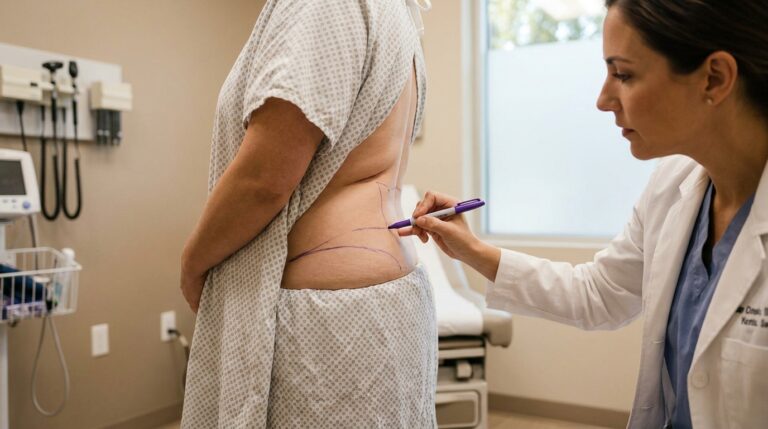
Your surgeon may compare serial photographs, examine tissue softness, and ask whether the area has been changing or not. That is much more reliable than judging by memory, because body-image anxiety can make normal recovery feel worse from day to day.
If the concern is volume loss, the key question is whether enough time has passed for the surviving fat to declare itself. If the concern is a contour issue from liposuction, the surgeon will also assess skin quality, scar pull, and whether the donor area has fully settled.
Temporary swelling, firmness, mild unevenness, and a shape that changes week to week often improve without revision. A contour dent that stays the same for months, clear under-correction, persistent asymmetry, or a donor-area deformity is less likely to fix itself and may justify a later revision discussion.
How do surgeons decide whether revision is the right option?
Revision planning is more detailed than many patients expect. The surgeon is not only asking, “Do you want more volume?” They are also asking whether your tissues can safely tolerate another operation, whether there is enough usable donor fat, and whether the problem is better treated with contour refinement rather than simply adding more fat.
For example, a patient with persistent flatness but little donor fat may not be a strong candidate for repeat fat transfer. In some cases, other approaches such as contouring the surrounding areas, scar release, or discussing buttock augmentation with implants may come up. That does not mean implants are the best choice for everyone. It means revision should be tailored to the actual problem.
This is also where expectations matter. Revision can improve proportion and contour, but it may not create a dramatic change if your anatomy limits what is safely achievable. A good consultation should make those trade-offs plain.
If you are arranging an assessment abroad, ask whether the reviewing surgeon wants operative notes from the first BBL, photos from before and after surgery, and any records of complications. That information can change the advice significantly.

The surgeon explains why the result needs more time or why a specific correction is appropriate, instead of offering a quick second operation without a proper assessment.
You are promised a fast fix before healing has stabilised, without a detailed exam, records review, or discussion of the limits of revision surgery.
A surgeon deciding on BBL revision looks at timing, tissue quality, scar maturity, donor-fat availability, your general health, and whether your concern is truly stable. Revision is not always another fat transfer. It may involve liposuction adjustment, scar release, implants, a lift, or no surgery at all.
What recovery and travel planning should you expect for a revision?
Revision recovery is not one standard timeline because the operation itself can vary a lot. A minor contour correction may be simpler than your first surgery. A larger revision can be more involved, especially if there is scar tissue, multiple areas of liposuction, or a need for another round of fat transfer.
Travel planning matters more than many patients realise. If you are flying for surgery, your surgeon will advise when it is safe to travel based on mobility, swelling, wound care, and clot risk. This should be personalised rather than guessed. Mayo Clinic and NHS travel advice broadly support avoiding unnecessary long travel when you are not moving well after surgery, because immobility raises clot risk.
For international patients, ask in advance how long you are expected to stay for checks, dressing changes, and early review. Also ask what happens if you return home and then develop a concern. A proper plan for remote follow-up is part of safe medical travel, not an optional extra.
If you are still at the information-gathering stage, you can request a case review through the clinic’s consultation page. Keep the focus on timing, safety, and whether your result is truly ready to assess, rather than assuming surgery is the next step.
Recovery after a BBL revision depends on what is being corrected. A small contour touch-up is not the same as repeat liposuction plus fat transfer. You should plan around sitting restrictions, follow-up needs, flight timing, and the possibility that revision recovery may feel slower than expected.
How should you choose a surgeon or clinic for BBL revision?
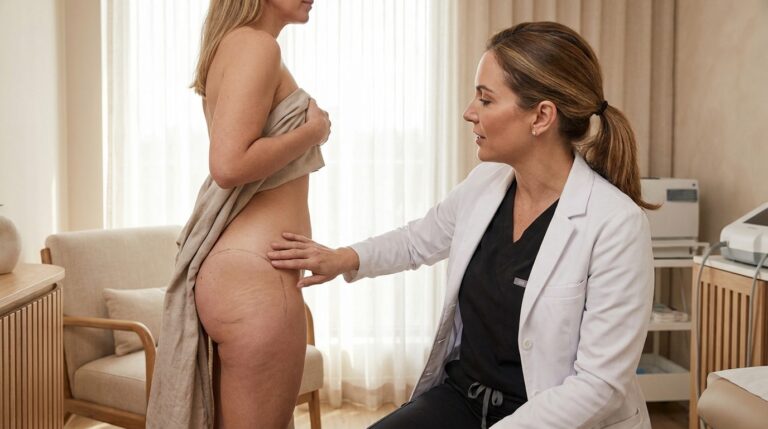
Revision surgery is the wrong place to shop by confidence alone. You need careful judgement. A responsible team should ask for your surgical history, examine whether your concern is stable, and explain if waiting is safer than operating now.
It also helps to check the surgeon’s professional background and the clinic’s setup for aftercare. If you are comparing options, look for transparent information about the medical team and how follow-up is organised. Pages such as the surgeons page and clinic information can answer some basic questions, but your real test is the consultation itself.
Good revision consultations are specific. They explain the likely reason for the problem, the realistic timing, what improvement may be possible, and what risks are added by operating again. If the advice feels rushed or oddly certain before your tissues have settled, take that as a sign to slow down.
- →Ask about timing: Why is now the right time for revision, and what would be gained by waiting longer?
- →Ask about records: Do you need my first operation notes, photos, and recovery history before advising surgery?
- →Ask about the method: Would you use repeat fat transfer, liposuction adjustment, scar release, or another option?
- →Ask about aftercare: Who will review me in person, and what is the plan if I have concerns after I travel home?
Choose a surgeon with clear experience in revision body contouring, honest timing advice, and a structured safety process. You should feel free to ask where the operation takes place, who provides aftercare, what happens if complications arise, and whether the team is willing to tell you to wait.
What affects the cost of BBL revision?
Revision pricing is rarely straightforward because the surgery itself can range from a focused touch-up to a more complex reshaping procedure. A quote usually reflects how many areas need liposuction, whether more fat can be harvested, the difficulty of working through scar tissue, and what kind of anaesthetic, facility, and follow-up support is needed.
If you are comparing quotes, check what is actually included. Some plans cover garments, medications, transfers, hotel support, and follow-up visits, while others separate these out. That is why the cheapest-looking option is not always the better value.
The safest approach is to treat cost as one factor, not the deciding factor. In revision surgery, judgement, timing, and aftercare matter at least as much as the fee itself.
The cost of BBL revision varies with the complexity of the correction, whether new liposuction and fat transfer are needed, the amount of theatre time, aftercare, compression garments, and travel-related logistics. A personalised quote is normally given after consultation because revision cases differ much more than first-time procedures.
Frequently Asked Questions
References
- 📎American Society of Plastic Surgeons — Cosmetic Procedures
- 📎NHS — Cosmetic procedures
- 📎PubMed search: gluteal fat grafting safety
- 📎PubMed search: autologous fat grafting buttock augmentation revision
Related Articles


You Might Also Like



Related articles

Our specialists
 Clineca SpecialistErkan PinegözPlastic & Reconstructive Surgery
 Clineca SpecialistHakan AktaşPlastic & Reconstructive Surgery
 Clineca SpecialistOrkun UzuneyüpoğluPlastic & Reconstructive Surgery
 Clineca SpecialistSalim İskenderPlastic & Reconstructive Surgery
 Clineca SpecialistEngin SelamioğluPlastic & Reconstructive Surgery
 Clineca SpecialistCem AydınPlastic & Reconstructive Surgery
 Clineca SpecialistAlperen ÖnalEar, Nose & Throat (ENT)