Have a question about BBL Revision?
In this article
- Why do patients seek a BBL revision in the first place?
- What are the most common specific reasons patients need a BBL revision?
- How do surgeons assess whether the problem is fat loss, scar tissue, or fat necrosis?
- When is the right time to have a BBL revision?
- What can and cannot be fixed with BBL revision?
- How should patients think about safety, travel, and choosing a revision surgeon?
Patients often ask what are the most common reasons patients need a BBL revision when the first result looks uneven, smaller than expected, or simply not like the shape they had in mind. That question matters because revision surgery is usually more complex than a first Brazilian butt lift, and the right next step depends on what actually went wrong, how the tissues healed, and how long it has been since the original operation.
Why do patients seek a BBL revision in the first place?
The most common reason is not usually a dramatic complication. More often, it is dissatisfaction with shape, volume, symmetry, or the way the buttocks blend into the hips and lower back after healing. Fat grafting is less predictable than an implant-based procedure because not every transferred fat cell survives. The Aesthetic Society and ASPS both describe fat survival as part of the normal uncertainty of fat transfer, which is why a result can soften or shrink over the first months even when the operation itself was technically straightforward.
Another common reason is that the first surgery did not match the patient’s body frame. Some patients want a stronger projection than their available donor fat can safely provide in one session. Others realise later that the waist, flanks, sacrum, or outer thighs were not shaped enough, so the buttocks themselves are blamed when the real issue is the overall silhouette. In practice, revision is often about balance rather than simply adding more fat.
There are also patients who need revision because of clear medical or healing problems. These include fat necrosis, which means small areas of damaged fatty tissue that can become firm or lumpy, contour irregularities from liposuction, scar tethering, persistent asymmetry, or skin laxity that makes the result droop. In a smaller group, the original procedure may have been performed with poor technique or unsafe planning.
If you are still deciding whether the issue is volume loss, contour, or a more structural problem, it helps to understand how a standard BBL procedure overview differs from a true revision. They are related procedures, but revision planning is usually more detailed because the tissues have already been operated on once.
The usual driver is an unsatisfactory shape after full healing, not an urgent medical crisis. That said, hard lumps, increasing pain, redness, or drainage need prompt assessment.
A surgeon may recommend revising the surrounding liposuction zones, or considering a buttock lift when skin looseness is the main problem.
What are the most common specific reasons patients need a BBL revision?
A good consultation breaks the problem into categories. That matters because each category points toward a different fix.
The most frequent reasons include:
- ✓Volume loss after healing. Some transferred fat does not survive, so the buttocks end up smaller than expected.
- ✓Asymmetry. One side may retain fat better than the other, or the original transfer may have been uneven.
- ✓Poor shape or projection. The buttocks may look flat from the side, too round in one area, or disconnected from the hips.
- ✓Contour irregularities from liposuction. Dents, waviness, or uneven transitions around the waist, flanks, lower back, or thighs can make the whole result look off.
- ✓Fat necrosis or palpable lumps. Firm areas can develop where fat did not survive normally.
- ✓Scar tissue and tethering. Internal scar bands can distort the shape and make revision technically harder.
- ✓Ptosis, or drooping. If skin quality is poor or there has been major weight change, the buttocks may sag rather than project.
- ✓A result that does not fit the patient’s goals. This may sound vague, but it is real. Sometimes the first operation technically healed well, yet the proportions are not what the patient wanted.
A smaller but important group seeks revision after a serious complication or after learning that the original technique may not have followed current safety practice. The BBL carries a unique risk profile. Multi-society safety statements, including guidance discussed in Aesthetic Surgery Journal Open Forum and recommendations from national plastic surgery bodies, have emphasised that fat should be placed in the subcutaneous layer above the muscle, not into or below the gluteal muscle, because deeper injection is linked to fatal fat embolism.
That point matters in revision. If the first operation was done aggressively, the surgeon planning the correction has to think not only about aesthetics, but also about what planes were likely used before, how much scar tissue is present, and whether adding more fat is sensible at all.
⚠️ Lumps are not always just ‘normal swelling’ A firm area may be simple scar tissue, but it can also be fat necrosis, a seroma, or another problem that needs imaging or an in-person exam.
How do surgeons assess whether the problem is fat loss, scar tissue, or fat necrosis?
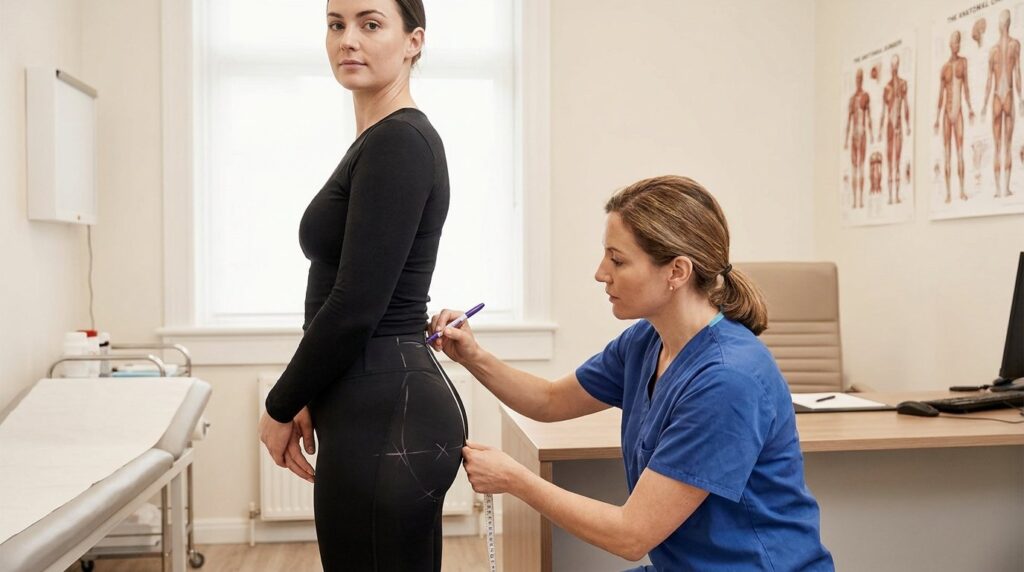
This is where revision planning becomes more medical and less social-media driven. An experienced plastic surgeon starts with the timeline. A buttock that looks smaller at six weeks may still be settling, while a contour that is unchanged at six months is more likely to reflect the final healing pattern. Most surgeons want to know the original technique, how much fat was transferred if records exist, what compression garments were used, whether there was infection or wound trouble, and whether weight changed after surgery.
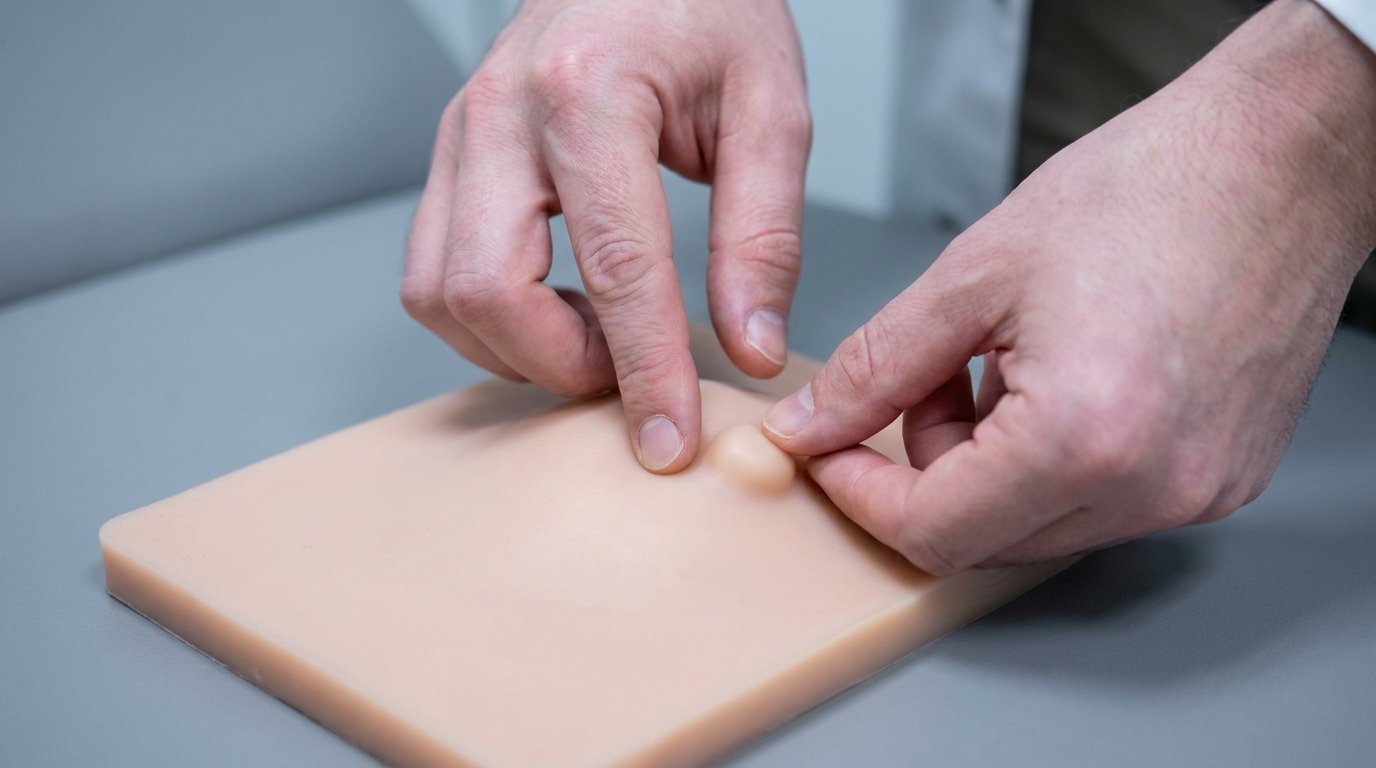
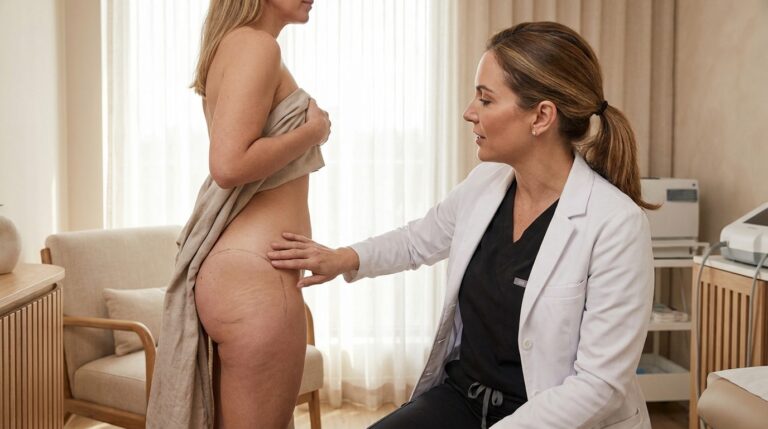
The physical exam then looks at three things at once: skin quality, soft-tissue thickness, and mobility of the tissues over deeper structures. Soft, even fullness suggests one issue; firm nodules, tenderness, or fixed areas suggest another. Fat necrosis often feels like a firmer lump within the fatty layer. Scar tethering may show up as dimpling or a pulled-down area that does not move naturally when the patient stands or flexes.
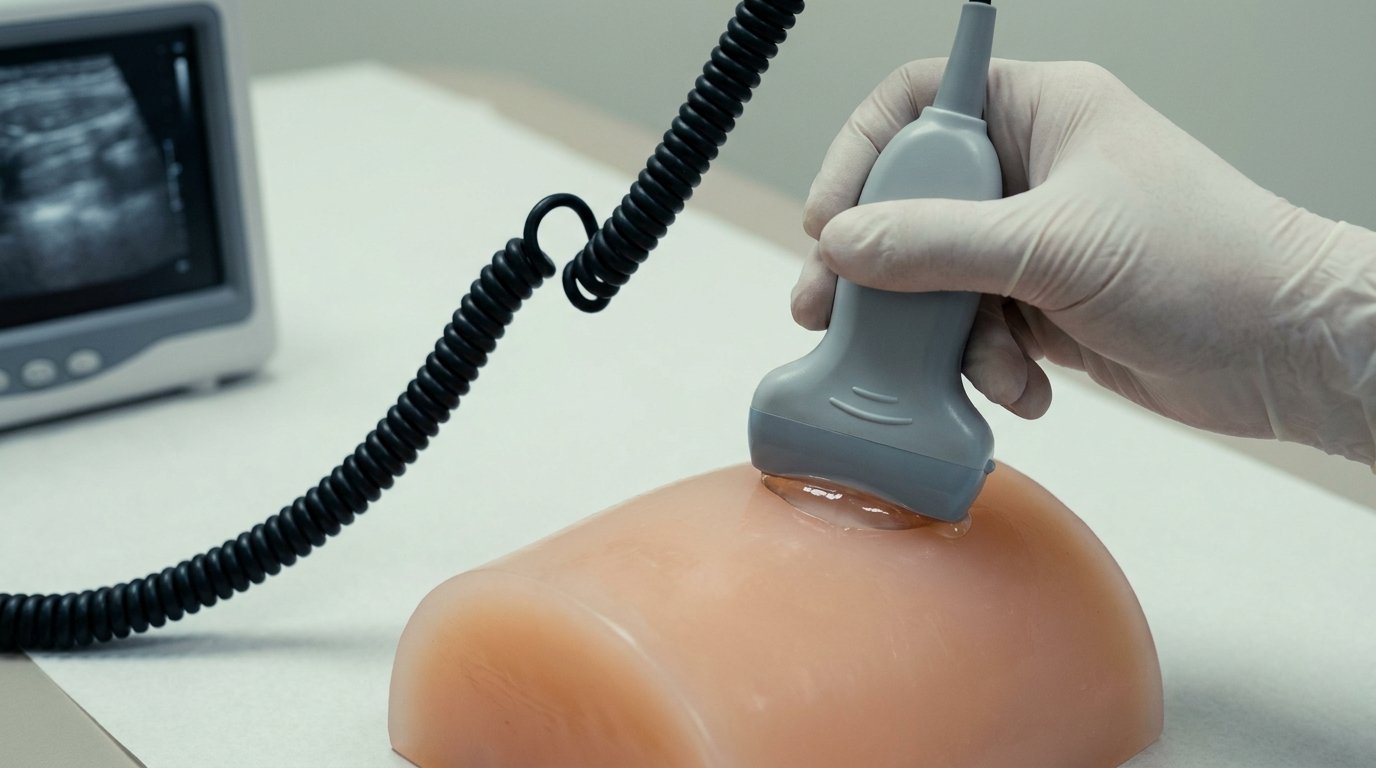
Imaging can help when the exam is unclear. Ultrasound is often used to assess fluid collections, suspicious lumps, and the character of the soft tissue. In selected cases, MRI gives a better map of fat, fibrosis, and deeper tissue changes. Review articles in Plastic and Reconstructive Surgery and Aesthetic Surgery Journal discuss imaging as a useful tool when surgeons need to distinguish retained fat, oil cysts, fibrosis, and fat necrosis before planning secondary treatment.
What surgeons usually want to rule out
A proper assessment tries to answer a few practical questions before anyone talks about another operation:
- ✓Is the main issue under-correction, or is the real problem irregular liposuction around the buttocks?
- ✓Is there enough donor fat left for safe grafting?
- ✓Are the lumps likely to be scar, fat necrosis, or a fluid collection?
- ✓Has healing finished enough for the tissues to be judged accurately?
- ✓Is the skin too loose for fat transfer alone to work well?
Those details shape the recommendation. Some patients need targeted liposuction revision and small-volume fat grafting. Others need treatment of scar tissue first. And some are better served by a lifting procedure if skin laxity is the real problem, such as a buttock lift, rather than trying to fix drooping with more fat alone.
When is the right time to have a BBL revision?
In most cases, revision should wait until the tissues have settled and the surviving fat is stable. That usually means several months rather than a few weeks. Many surgeons prefer to assess a true BBL result after at least six months, and sometimes longer if swelling, firmness, or scar maturation is still evolving. That timing is consistent with standard post-fat-transfer healing principles described by ASPS and peer-reviewed aesthetic surgery literature.
There are good reasons not to rush. Early swelling can hide asymmetry. Scar tissue is still active in the first months, and operating too soon can make contour problems worse. The donor areas also need time to soften before anyone can judge whether more liposuction is possible.
There are exceptions. If there is infection, a significant fluid collection, tissue breakdown, or a concerning painful mass, the patient should be reviewed promptly. That is not the same as doing a full aesthetic revision early; it means treating the medical issue first.
For travel patients, the timing question matters twice. First, you need enough time after the original BBL before revision is even sensible. Second, you need enough time in the destination country for assessment, surgery if appropriate, and early follow-up. A quick in-and-out trip is rarely ideal for revision work because the surgeon may want to re-examine the area after swelling begins to settle.
The NHS advises that anyone considering cosmetic surgery abroad should think carefully about aftercare and what happens if complications develop after returning home. That advice is especially relevant for revision cases, which have more variables than first-time surgery.
📋 Revision timing is individual The safest timing depends on healing, tissue quality, donor fat, and whether there were complications after the first operation.
What can and cannot be fixed with BBL revision?
Revision can improve many common problems, but it has limits. If the main issue is modest volume loss with enough donor fat still available, a secondary fat transfer may help. If the shape problem comes from uneven liposuction around the flanks or lower back, careful contour correction can make a major visual difference even without a very large graft.
Revision becomes less straightforward when there is dense scar tissue, poor skin elasticity, or very little donor fat left. In those cases, simply adding more fat may not create a smooth or lasting improvement. Some patients need a combination approach, and a minority may discuss implant-based options such as buttock augmentation with implants if fat transfer alone cannot achieve the goal. That is not automatically better; implants have their own trade-offs, including implant-specific complications and a different feel and recovery profile.
Weight stability also matters. If weight has dropped since the original surgery, the buttocks can lose fullness because grafted fat behaves like fat elsewhere in the body. If weight has increased, proportions may shift in less predictable ways. A revision done before weight is stable is harder to judge and may disappoint even if the surgery itself goes well.
An honest surgeon will also explain when the best plan is to do less, not more. Overfilling in a scarred area is not a smart correction. Current safety thinking around gluteal fat grafting focuses on conservative technique, subcutaneous placement, and avoiding aggressive high-volume decisions just to chase a dramatic result.
Stable weight, healed tissues, clear aesthetic concern, realistic goals, and enough donor fat or a suitable alternative plan.
Ongoing swelling, active smoking, recent infection, unstable weight, or expectations that a second surgery can guarantee a perfect match.
How should patients think about safety, travel, and choosing a revision surgeon?
Revision BBL is not the place to shop only by photos or price language. The key question is whether the surgeon can explain why the first result failed and what specific method will be used now. Patients should ask how the anatomy will be assessed, whether imaging is needed for lumps or suspected fat necrosis, how donor fat availability is checked, and what safety protocol is followed for gluteal fat grafting.
Credentials matter. Look for a plastic surgeon with recognised specialist training and a setting that can explain its standards of anaesthesia, operating theatre safety, and follow-up. Bodies such as EBOPRAS help patients understand board-level standards in European plastic surgery training, while BAAPS and ASPS provide patient-facing guidance on choosing a qualified surgeon and understanding risks.
If you are travelling for treatment, ask practical questions early. How long should you stay before surgery for an exam? How many follow-up visits are expected? What happens if a lump, seroma, or wound problem appears after you fly home? Revision cases need more than a smooth airport transfer; they need a clear aftercare pathway.
Cost should also be approached in a grounded way. Quotes vary because revision complexity varies. The main drivers are usually the amount of correction needed, whether liposuction revision is included, whether imaging or extra assessment is required, the expected operating time, the anaesthesia plan, compression garments, medicines, and follow-up. A personalised quote is normally confirmed after consultation and review of photos or an in-person exam, not from a one-line message.
For patients who want to understand the clinical team and consultation process before making plans, the informational pages on the clinic’s doctors, about page, and consultation process can help frame the right questions. Those details should support your decision, not replace a proper medical assessment.
🚨 Be cautious with revision promises No responsible surgeon can promise a perfect correction, especially in previously operated tissue with scar formation or fat loss.
Frequently Asked Questions
References
- 📎Aesthetic Surgery Journal Open Forum: gluteal fat grafting safety and practice advisory literature via PubMed
- 📎Plastic and Reconstructive Surgery: gluteal fat grafting safety, anatomy, and outcomes via PubMed
- 📎ASPS cosmetic procedures
- 📎NHS cosmetic procedures guidance
Related Articles


You Might Also Like



Related articles

Our specialists
 Clineca SpecialistErkan PinegözPlastic & Reconstructive Surgery
 Clineca SpecialistHakan AktaşPlastic & Reconstructive Surgery
 Clineca SpecialistOrkun UzuneyüpoğluPlastic & Reconstructive Surgery
 Clineca SpecialistSalim İskenderPlastic & Reconstructive Surgery
 Clineca SpecialistEngin SelamioğluPlastic & Reconstructive Surgery
 Clineca SpecialistCem AydınPlastic & Reconstructive Surgery
 Clineca SpecialistAlperen ÖnalEar, Nose & Throat (ENT)