

Have a question about chin implant?
In this article
- What is the difference between a chin implant and chin reduction for facial balance?
- How do surgeons decide which option will improve facial balance?
- What happens in chin implant surgery versus chin reduction surgery?
- What is recovery like after a chin implant compared with chin reduction?
- Which option is usually safer and what are the main trade-offs?
- How does pricing work and what should a quote include?
- How do you choose a clinic and plan a chin surgery trip to Turkey?
If you are researching what is the difference between a chin implant and chin reduction for facial balance, the real question is usually not just “bigger or smaller.” It is about how the chin sits with the nose, lips, jawline and neck, and whether adding projection or taking bone away will actually improve the profile you see in the mirror.
What is the difference between a chin implant and chin reduction for facial balance?
The short version is anatomical. A chin implant adds forward projection and sometimes a little width to a weak or recessed chin. Chin reduction does the opposite: it reduces an overly prominent chin, usually by reshaping or removing part of the chin bone. For facial balance, the better choice depends on why the chin looks out of proportion in the first place.
A chin implant is usually considered when the lower face looks under-projected from the side. The aim is not to create a “strong” chin for its own sake, but to bring the chin into better proportion with the forehead, nose, lips and neck. This can make the jawline look clearer, even though the jaw itself has not been changed. If you are also considering profile work such as a chin augmentation procedure or rhinoplasty, surgeons often assess the whole side view rather than one feature in isolation.
Chin reduction is more suitable when the chin projects too far, looks too tall, too wide, or creates a heavy lower face. In these cases, adding volume would make the imbalance worse. Reduction works by reshaping the bone, so it is a different operation from implant placement even though both aim to improve harmony.
There is an important third category that patients often miss. Some people do not really need an implant or a reduction. They may have a bite problem, a jaw-position issue, or a chin shape that would respond better to sliding genioplasty. Sliding genioplasty is a bone-cutting procedure that moves your own chin bone forward, backward, up or down. In more complex cases with a true upper or lower jaw mismatch, orthognathic surgery may be more appropriate. That is why a careful facial and bite assessment matters before choosing between implant and reduction alone.
The American Society of Plastic Surgeons (ASPS) lists chin augmentation among established facial contouring procedures, while NHS guidance on cosmetic procedures stresses the need for a proper assessment of expectations, risks and suitability before surgery. For chin-bone procedures specifically, published studies in journals such as Plastic and Reconstructive Surgery and Aesthetic Plastic Surgery discuss how skeletal structure, soft tissue thickness and occlusion all affect planning.
A chin that is set back or lacks projection, especially when the profile looks soft and the neck-chin angle is less defined.
A chin that projects too far, looks too broad or too tall, or dominates the profile.
If the issue is jaw position or bite rather than chin projection alone, sliding genioplasty or orthognathic surgery may be a better fit.
How do surgeons decide which option will improve facial balance?
Good planning starts with the whole face, not the chin alone. A surgeon will usually look at the profile, front view and smiling view, and ask how the chin relates to the lips, nose, neck and lower jaw. Photos are useful, but the exam matters just as much because skin thickness, muscle tension and dental bite can change what surgery should do.
For a chin implant, the key question is whether more projection will improve the profile without making the chin look too wide or artificial. For chin reduction, the question is where the excess lies. Sometimes the chin is too prominent only from the side. In other cases, it also looks too long or square from the front. That affects the surgical plan.
A common mistake is judging the chin without considering the nose. A larger nose can make the chin look weaker than it really is, while a recessed chin can make the nose seem more prominent. This is why some patients discuss both procedures together. It does not mean both should be done, only that they should be assessed together.
When you attend a consultation, useful questions include whether the imbalance is in projection, width, height or jaw position; whether an implant would sit naturally with your bone structure; and whether bone surgery would give a cleaner result. A proper consultation should also cover what surgery cannot fix, such as loose neck skin or a heavy under-chin fat pad, which may call for different treatment.
📋 Profile balance is not one measurement The best plan depends on the relationship between chin, lips, nose, neck and bite, not on whether the chin looks small or large in one photo.
What happens in chin implant surgery versus chin reduction surgery?
A chin implant is usually placed through a small incision either inside the mouth or under the chin. A pocket is created over the chin bone and the implant is positioned to increase projection. The material is typically solid and shaped for facial use. The operation is generally shorter and less invasive than bone reduction, although it is still real surgery with swelling, bruising, infection risk and a healing period.
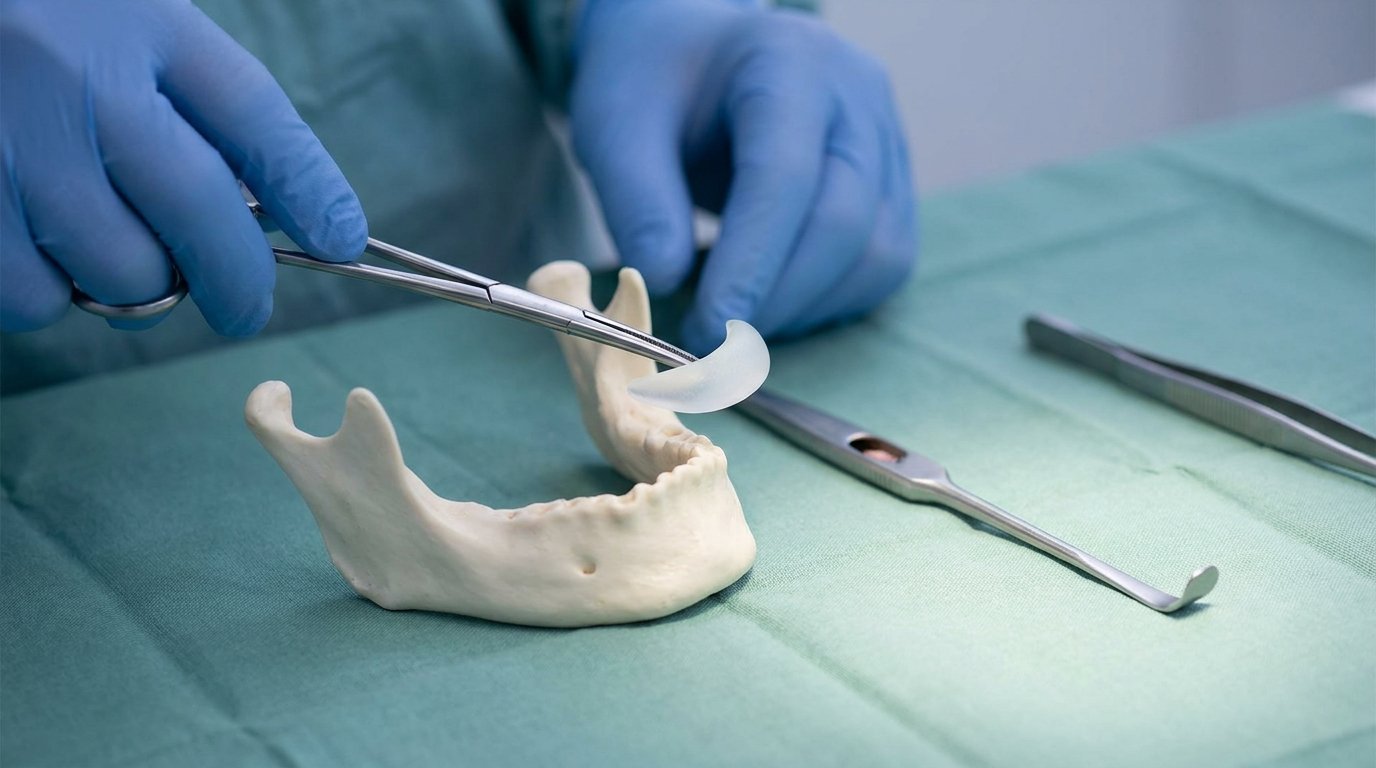
Chin reduction usually involves working directly on the bone. The surgeon reshapes the prominent part of the chin, and in some cases adjusts height or width as well as projection. Because this changes your own bone, planning is more technical than simply choosing implant size. Recovery can also feel a little more intense, especially in the first week.
Both procedures may be done under general anaesthesia, depending on the case and the surgical setting. Temporary numbness of the lower lip or chin can happen with either approach because sensory nerves pass through this area. Mayo Clinic information on surgical procedures and NHS cosmetic surgery guidance both emphasise that nerve symptoms, bleeding, infection and scarring are standard risks that should be discussed before surgery.
Published literature in Facial Plastic Surgery & Aesthetic Medicine and Aesthetic Plastic Surgery has also looked at implant-related issues such as malposition, asymmetry and the need for revision in selected cases. That does not mean these problems are common in every patient, but it does mean the operation should be planned by a surgeon experienced in lower-face anatomy.
What is recovery like after a chin implant compared with chin reduction?
This is one of the biggest practical differences. With both operations, expect swelling, tightness and some change in lower-lip feeling early on. Most patients find the first few days the most awkward rather than truly dramatic, especially because talking, smiling and chewing can feel stiff.
After a chin implant, many people are presentable for light social contact in around one to two weeks, but visible swelling can last longer than patients expect. Returning to desk-based work is often possible within about a week, sometimes sooner if swelling is mild and there is no heavy public-facing role. Exercise usually needs to wait longer. Final settling takes more time than the early recovery suggests.
After chin reduction, the timeline is often a little longer. The first week can involve more swelling and soreness because bone has been reshaped. Desk work may still be realistic after around one to two weeks, but this varies more from person to person. If the operation is more extensive, bruising and tenderness can linger. The contour keeps refining over several weeks, and subtle swelling may take months to fully settle.
For medical travellers, a sensible stay in Turkey is usually longer than patients first assume. Many clinics advise staying roughly a week or a little more after chin surgery so the surgeon can review early healing, remove or check dressings if needed, and make sure there are no immediate concerns before you fly. If bone work is more involved, or if chin surgery is combined with another facial procedure, the stay may be longer.
You should also plan for soft foods in the early phase, especially if the incision is inside the mouth. Sleeping with the head elevated, avoiding pressure on the chin, and delaying strenuous exercise are standard parts of recovery. If you are unsure how this fits your travel plan, it is better to discuss it during an online or in-person consultation than to guess.

⚠️ Swelling can distort the early result A chin can look too big, too small or uneven in the first days after surgery. Early appearance is not the final shape.
Which option is usually safer and what are the main trade-offs?
Neither option is “safer” in a simple, universal way. A chin implant is generally less invasive than reducing and reshaping bone, but it has implant-specific risks. These include shifting, visible edges in thin tissues, asymmetry, infection and, in some cases, removal or revision. Chin reduction avoids a permanent implant, but it is more dependent on precise bone planning and can involve a more demanding recovery.
The trade-off often comes down to added material versus bone change. Some patients like the idea of a reversible implant-based approach. Others prefer using their own anatomy and avoiding an implant, even if the surgery is technically more involved. There is no single correct preference.
What matters most for safety is case selection and surgeon experience. BAAPS and the NHS both stress that cosmetic surgery should be carried out by appropriately trained professionals in regulated settings, and that patients should understand revision risk, not just best-case outcomes. If a clinic rushes you toward one method without discussing alternatives such as sliding genioplasty, that is not a good sign.
- ✓Good signs: The surgeon reviews profile photos, front view, bite and lower-face proportions before recommending a plan.
- ✓Good signs: You are told clearly whether your issue is projection, width, height, jaw position or a mixture.
- ✓Good signs: The clinic explains risks, revision possibilities and realistic swelling timelines.
- ✓Good signs: There is a clear post-op review plan before you travel home.
How does pricing work and what should a quote include?
The cost difference between a chin implant and chin reduction for facial balance is usually driven by complexity rather than by one simple rule. Chin reduction often involves more technical bone work, while an implant case may involve the implant itself and planning around size, shape and placement. Combining chin surgery with another procedure also changes the quote.
A useful quote should explain what is actually included. That usually means surgeon fees, anaesthesia, hospital or surgical facility fees, routine pre-op testing, standard post-op checks, and any hotel or transfer arrangements if they are part of a medical-travel package. You should also ask what is not included, such as medicines after discharge, revision surgery, extra nights in the hotel, or treatment for an unrelated medical issue.
The safest way to think about price is that the final figure should follow the plan, not lead it. If the right operation for your anatomy is a reduction or a sliding genioplasty, choosing an implant only because it seems simpler can be poor value in the long run. A personalised quote is normally confirmed after consultation and photo or in-person assessment.
How do you choose a clinic and plan a chin surgery trip to Turkey?
Start with the surgeon, not the sales process. Look for a clinic that is clear about who performs the operation, what their surgical background is, and how follow-up is handled once you return home. If you want to review the team and credentials, use the clinic’s official doctors page and about page rather than relying only on social media clips.
Ask whether your case has been assessed for implant, reduction and genioplasty options. If the answer is always the same operation regardless of anatomy, that should make you cautious. EBOPRAS is one of the recognised European bodies patients often check when looking into plastic-surgery training standards, although board status is only one part of the picture.
For travel logistics, build in enough time for pre-op review, surgery, early post-op checks and some flexibility in case swelling or minor wound issues need another visit before flying. Keep your return journey simple if possible. Long layovers, heavy luggage and rushed airport transfers are not ideal right after facial surgery.
It is also worth asking how the clinic handles communication after you go home. You want to know who to contact if swelling seems uneven, numbness persists, or you are unsure whether healing is normal. If you are still at the information-gathering stage, a structured online consultation is usually the best starting point.
Frequently Asked Questions
References
- 📎ASPS Cosmetic Procedures
- 📎NHS Cosmetic Procedures
- 📎PubMed: genioplasty chin augmentation reduction facial balance
- 📎PubMed: chin implant complications aesthetic plastic surgery
Related Articles


You Might Also Like



Related articles



Our specialists
 Clineca SpecialistErkan PinegözPlastic & Reconstructive Surgery
 Clineca SpecialistHakan AktaşPlastic & Reconstructive Surgery
 Clineca SpecialistOrkun UzuneyüpoğluPlastic & Reconstructive Surgery
 Clineca SpecialistSalim İskenderPlastic & Reconstructive Surgery
 Clineca SpecialistEngin SelamioğluPlastic & Reconstructive Surgery
 Clineca SpecialistCem AydınPlastic & Reconstructive Surgery
 Clineca SpecialistAlperen ÖnalEar, Nose & Throat (ENT)