
Inlays & Onlays in Istanbul
Inlays and onlays are partial crowns or fillings that are used to treat low to moderate tooth decay
What Are Inlays & Onlays?
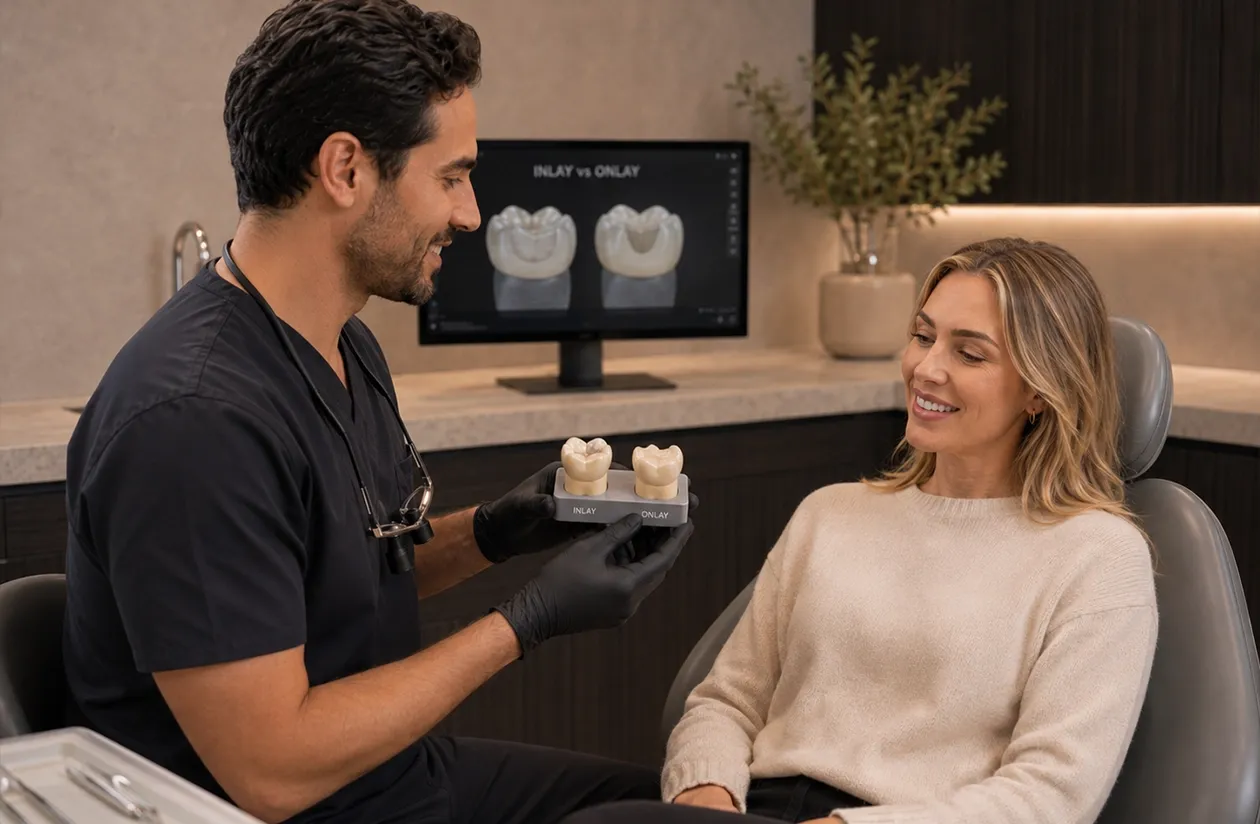
Inlays and onlays are partial crowns or fillings that are used to treat low to moderate tooth decay. It completes the tooth by adding tooth colored composite resin, gold or porcelain custom manufactured inserts where the tooth doesn’t have much structure left due to decay. Inlays are similar to the conventional fillings but the addressed area is within the bumps on the chewing surface of the tooth. Onlays are extensive in a sense that they cover one or more bumps, hence called partial crowns.
Who Is A Good Candidate For Inlays & Onlays?
If you have metal fillings that are unaesthetic or you have large cavities on your teeth that are not available to restore with conventional fillings, you are a good candidate for inlays & onlays.
What Are The Expected Outcomes Of Inlays & Onlays?
The outcomes of Inlays & Onlays can be analyzed in three main categories: health-related, aesthetical, and psychological. Decaying teeth can affect your overall facial aesthetics. It often looks bad and can cause a bad smell. Inlays and onlays can replace the missing part of the teeth due to decay and create harmony in your facial and oral aesthetics. Tooth decay can cause aching and sensitivity. It may affect your appetite, and consequently other health issues may present themselves. After getting inlay/onlays you can enjoy eating without having any problems. After the treatment, you’ll get rid of your insecurities and will be more confident with your smile. It will affect your mental health in a very positive way.
How Are The Inlays & Onlays Done?
The inlays & onlays treatment can be done in two different ways; indirect fillings, and direct fillings.
Local Anesthesia
In the indirect approach, two visits are required. In the first visit to the dentist’s office, decay or the existing filling will be removed. During this process your dentist will apply local anesthesia, and remove the decayed area or the filling with an appropriate instrument such as a drill, air abrasion device or a laser. After your dentist makes sure the area is free of any decay/fillings, they will prepare the area for the inlay/onlay by cleaning.
Preparation In Dental Laboratory
Then they will take an impression of your teeth to send to a dental laboratory for your inlay or onlay to be made. A temporary filling will be placed while your inlay/onlay is being made. When the laboratory sends back the custom inlay/onlay, during your second visit the dentist will remove the temporary filling and check the fitting of the inlay/onlay. If it fits then they will cement the permanent inlay/onlay to the tooth, if it doesn’t fit a new impression can be taken to be sent to the dental laboratory for new inlay/onlay to be made.
Dental Office
In direct application, the same procedure is followed as in the indirect approach with the difference being the inlay/onlay is made in the dental office. This allows the procedure to be done in just one visit.
Risks and Complications
If you are considering getting inlays-onlays, it's important to be aware of the potential risks and complications. Local Anesthetic: These may include allergic reactions, nerve damage, or the development of a blood clot. Your dentist will discuss these risks with you and take steps to minimize them. Allergy for the Inlay/Onlay Material: Inlays and onlays are typically made of materials such as composite resin, porcelain, or gold. If you have an allergy to any of these materials, you may experience a reaction after your inlay or onlay is placed. Your dentist will work with you to choose a material that is safe for you. Misfitted Inlay/Onlay: If an inlay or onlay is not properly fitted, it can cause discomfort, toothache, and even damage to your tooth or surrounding teeth. Your dentist will take precise measurements and use advanced techniques to ensure that your inlay or onlay fits properly. Tooth Decay: Even with an inlay or onlay in place, your tooth is still susceptible to decay. It is important to maintain good oral hygiene and visit your dentist regularly for checkups and cleanings to prevent tooth decay. Sensitivity: After having an inlay or onlay placed, you may experience sensitivity to hot and cold foods and beverages. This is usually temporary and can be managed with over-the-counter sensitivity toothpaste. If the sensitivity persists, your dentist can provide you with additional treatment options.
What To Expect During A Inlays & Onlays Recovery?
After having an inlay or onlay placed, you may experience some discomfort and sensitivity. It is important to follow your dentist's instructions for post-procedure care to ensure a smooth recovery. During the first week after your inlay or onlay procedure, you may experience some discomfort and sensitivity. This is normal and can be managed with over-the-counter pain relievers. You should avoid chewing on the side of your mouth where the inlay or onlay was placed until your dentist gives you the green light. It is also important to avoid eating hard, chewy, or sticky foods, as these can damage your inlay or onlay. As the weeks go by, you should notice an improvement in your comfort level and a decrease in sensitivity. However, you may still experience some sensitivity to hot and cold foods and beverages. This is usually temporary and can be managed with over-the-counter sensitivity toothpaste. It is important to continue practicing good oral hygiene during your recovery. This includes brushing twice a day with a soft-bristled toothbrush and fluoride toothpaste, flossing daily, and rinsing with mouthwash. You should also continue to visit your dentist for regular checkups and cleanings. If you have any concerns or experience any unusual symptoms during your recovery, don't hesitate to contact your dentist. After meeting with your dentist at their office during your consultation you express your expectations and the dentist checks the condition of your teeth. They will inform you about their professional opinion while taking your expectations and the condition of your teeth into consideration. Then, photos of your teeth will be taken for a 3D simulation. The size, model and color can be decided by you, and you can even choose the color from the tooth color chart. After deciding, on the first operation day teeth will be scraped and if there is a need for an extraction it will also take place on the first day. Temporary veneers will be put on and your dentist will prescribe you with painkillers and antibiotics. You will stay at the hotel for about 4-5 days. During your stay you will be visited by a wellbeing specialist, and if you’re having any problems your dentist will be contacted. After these 4-5 days, your permanent veneer will be applied and it will be all done.
What To Do Before Inlays-Onlays Surgery?
If you are considering getting inlays or onlays, there are a few steps you can take to prepare for the procedure and ensure a successful outcome. The first step is to schedule an appointment with your dentist for the inlay or onlay procedure. Be sure to choose a time that is convenient for you and allows enough time for the procedure. It is important to inform your dentist of any medical conditions or medications you are taking, as these may affect the success of the procedure or the way it is performed. This includes any allergies, chronic conditions, and medications you are currently taking. Depending on the type of anesthesia used during the procedure, you may need someone to drive you home after the inlay or onlay is placed. It is also a good idea to have someone available to help you at home for the first 24-48 hours after the procedure. To ensure the success of the inlay or onlay procedure, it is important to avoid eating or drinking anything for at least six hours before the procedure. This will help prevent nausea and vomiting during the procedure.
What To Do After Inlays-Onlays Surgery?
Here are the some instructions after having an inlay/onlay procedure. After the first operation where a local anesthesia is used, you may feel numbness on your mouth but that will pass in a few hours. You can resume all your daily activities without any problem. Some tooth sensitivity can be present but it goes away within a few weeks. The temporary fillings can fall out, fracture or wear out in a month so make sure to get them replaced by the permanent inlays/onlays. After your inlay/onlay is permanently cemented, there is no need for a special care for them, however, you should follow good oral hygiene practices, brushing twice and flossing once a day and biannually visiting your dentist for cleanings. You should contact your dentist in the cases of your tooth being extremely sensitive or the sensitivity lasts for 2 to 4 weeks, you feel sharp edges on the affected tooth.
Who performs your inlays & onlays
Dt. Ceren Saruhanoğlu
Doctorate in Prosthodontics (Istanbul University) · aesthetic dentistry & smile design · founder of Bright Dental Studio
Frequently asked questions
How long does the procedure take?+
The duration of the procedure depends on the level of decay the affected tooth has and whether the approach is indirect or direct. It can take as little as an hour to several hours.
How long do the inlays & onlays last?+
The inlays and onlays are very durable and last up to 30 years.
Does the procedure hurt?+
The procedure is not painful. During the removal of existing fillings or the tooth decay, local anesthesia will be applied so you won’t feel anything other than a slight discomfort.
Are the inlays & onlays bad for the teeth?+
Although the inlays and onlays can weaken the tooth structure, it is to a much lower extent than the traditional fillings.
I have tooth decay that caused more than half of my tooth to weaken. Can I still get onlays or do I need to have crowns?+
The natural tooth must have enough structure to support an onlay. Onlays can cover up to ¾ of the natural tooth. Although, if the structure is too compromised, then a crown will be a better option.
My tooth has a cavity, what should I opt for; fillings or inlay or onlay?+
Each of the fillings and inlays and onlays remove existing decay. The cavity size determines which approach would be the best. Inlays are for bigger cavities than the fillings, and the onlays are for even bigger cavities. If the damage on your tooth is too big, the filling will be too small to repair it. As the material for fillings and inlay/onlay also differ, filling uses a composite resin material for natural color, or amalgam fillings. For inlays, amalgam, gold, or ceramic can be used. Ceramic inlays are stronger than composite fillings. And finally, the onlays are partial dental crowns and composite resin, ceramic, and gold can be used as materials. These are similarly more durable than fillings.
Can I get an onlay for my front tooth?+
It is possible to restore front teeth with onlays. Ceramic and porcelain onlays (partial crowns) are the best choice for the front teeth. If the tooth is in a worse condition than an onlay can restore, dental crowns are a better option.
Plan your inlays & onlays
Pick your surgeon and dates — we’ll tell you exactly when to fly and what's included.