
In this article
Whether you need a travel companion for surgery abroad is one of the first questions people ask once a date is booked, and the honest answer sits between law and common sense: no rule forces you to bring anyone, but for a tummy tuck, BBL, facelift or any combined operation most surgeons will strongly advise it. Smaller procedures and dental work are a different story, and plenty of people fly to Turkey alone without drama. What follows is the practical detail — when a companion is genuinely needed, what they actually do, and how to travel solo safely if nobody can come with you.
Do I need someone with me for surgery in Turkey?
There is no Turkish law and no visa condition requiring you to bring a companion. Clinics treat solo international patients every week. The real question is clinical, not legal: who takes you back to the hotel, who notices if something changes overnight, and who helps you move around during the first few days.
One rule is close to universal in surgical practice worldwide. If you have had a general anaesthetic or sedation and you are being discharged the same day, a responsible adult should collect you and stay with you for roughly the first 24 hours. Judgement, balance and memory are not fully back to normal even when you feel fine, and you should not be alone in a hotel room while that wears off.
In Turkish health-tourism practice this is usually solved in two ways. Either you bring a companion, or the clinic keeps you in hospital overnight and provides a driver, a nurse visit or a patient host for the hotel days. Both are reasonable. What is not reasonable is being discharged at 6pm after a general anaesthetic, dropped at a hotel with no transport, no local contact number and nobody checking in.
So ask the question in writing before you book: if I travel alone, exactly who is with me on the day of surgery, and who is reachable at 3am on night two?
📋 Ask this before you pay a deposit Does the package include an overnight hospital stay, hotel transfers and a 24/7 contact number? If you are travelling alone, these are not luxuries — they replace the jobs a companion would otherwise do.
Which procedures really need a companion, and which don’t
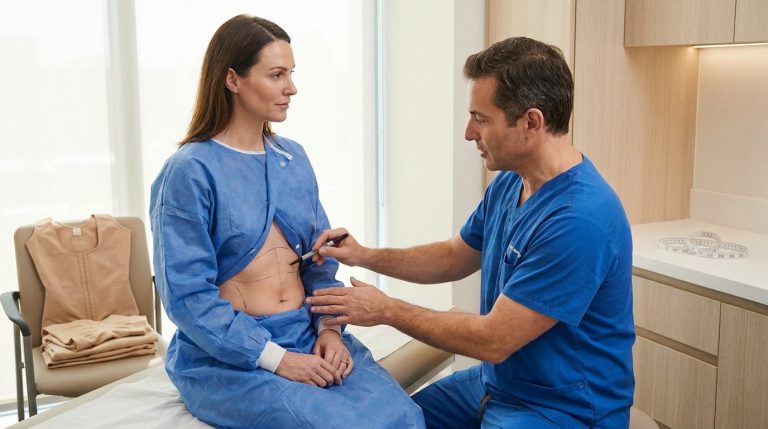
The deciding factors are anaesthetic depth, how much the operation limits your movement, and whether you can manage dressings, drains or a compression garment with one pair of hands. A rhinoplasty patient can usually dress themselves on day two. A tummy tuck patient who cannot stand straight, has drains and must get up slowly from bed has a very different week.
The table below reflects how surgeons commonly advise international patients. Treat the fly-home column as a typical earliest window, not a promise — your own clearance comes from the surgeon who operated on you, at your final check. Our guides on how long to stay in Turkey after plastic surgery and aftercare, hotel nights and flying go deeper on stay length.
⚠️ Combined surgery changes the maths Two operations in one anaesthetic means more swelling, more fluid shift and less mobility than either procedure alone. If you are planning a [combined procedure](https://www.clineca.com/blog/combined-surgery-in-turkey-safety-cost-recovery/), assume you need help for the first few days and plan the trip around that.
What a companion actually does during the trip
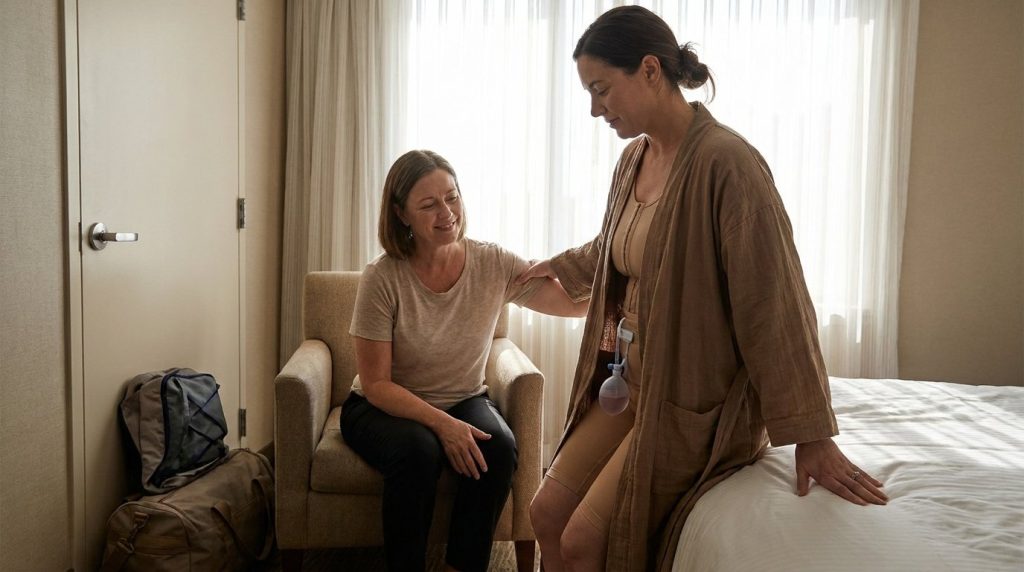
People imagine hand-holding. In practice the job is logistics and observation. Someone who can carry a bag, fetch water, remember what the nurse said and spot that your left calf looks different from your right is worth more than sympathy.
On the day of surgery they hold your phone, passport and valuables, sit through the discharge instructions when you are still woozy, and get you into the transfer car. During the hotel days they handle food, pharmacy runs and the slow walks around the room that help your circulation. On control-visit days they are a second set of ears, which matters because post-op advice arrives in a rush and you will forget half of it.
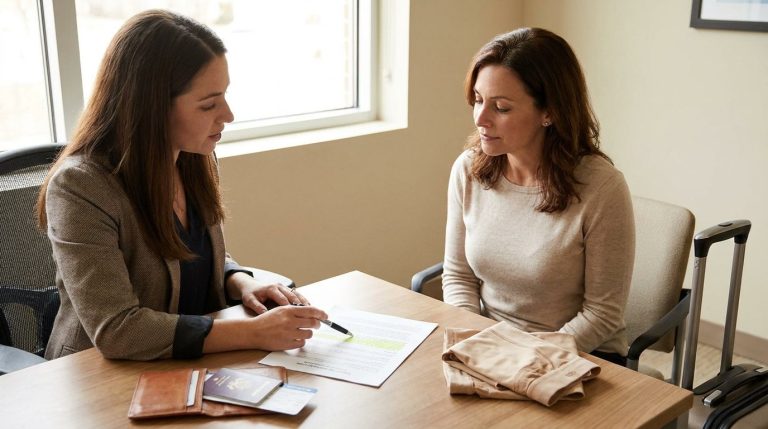
There is a less obvious benefit too. A companion who was in the consultation can confirm what was agreed if a question comes up later, and they can escalate on your behalf if you feel too unwell to argue. Our packing list for surgery in Turkey is worth going through together before you fly.
- ✓Day of surgery: Holds documents, hears the discharge instructions, manages the hotel transfer.
- ✓Nights one and two: Stays in the room, helps you sit up and reach the bathroom, watches for fever or bleeding.
- ✓Hotel days: Food, fluids, medication timing, compression garment adjustments, short assisted walks.
- ✓Travel home: Carries luggage, requests airport assistance, reminds you to stand and move during the flight.
Flying home: blood clot risk and why the timing matters
This is the part solo travellers underestimate. Surgery itself makes the blood more likely to clot, and sitting still for hours in a cramped seat adds a second risk factor on top. That combination is why a clot in a leg vein — deep vein thrombosis, usually shortened to DVT — is taken seriously after cosmetic surgery, and why surgeons set a minimum number of days before you board a plane. In rare cases a clot can travel to the lungs, which is a medical emergency.
The practical protections are simple and you must apply them whether or not you have company. Walk the cabin roughly every hour on a long flight, flex your ankles while seated, drink water rather than alcohol, and wear the compression stockings your clinic gives you if they have advised them. Choose an aisle seat so getting up is easy, and book airport assistance in advance if you cannot carry a bag.
Timing is not a formality either. Flying too early after procedures that cause heavy swelling, or while a drain is still in, makes problems harder to manage at 35,000 feet. For body procedures with sitting restrictions the rules are stricter again — see our guide on flying after a BBL for how seating and cushions are handled.
You should also understand what happens if something goes wrong after you land. Most routine follow-up can be done remotely, but complications after surgery abroad need local medical care first, and a companion who knows your surgical details makes that conversation much faster.
🚨 Do not fly without clearance Your fly-home date should be confirmed at a face-to-face check by the surgeon or clinical team, not assumed from a booking page. If swelling, a drain, a fever or wound concerns are still unresolved, the sensible answer is to extend the hotel stay.
Travelling alone: how to make it safe
Solo trips work well when the procedure is modest and the clinic is set up for unaccompanied patients. They go badly when someone has a major body operation, books the cheapest hotel across town, and has no one to call when they feel wrong at night.
Stack the odds in your favour. Pick a hotel that is close to the hospital, has a lift, room service and 24-hour reception. Accept the overnight hospital stay if it is offered. Make sure you have the clinic’s emergency number, your surgeon’s name, a written list of your medications and your implant or graft details saved on your phone and on paper. Then give a family member at home your flight details and daily check-in time, so somebody notices if you go quiet.

Red flags to act on at 2am
The point of this list is that you ring the clinic’s emergency line immediately rather than waiting for morning. None of it is a reason to panic, but all of it is a reason to be seen.
- ✓Pain, tightness or swelling in one calf or thigh, especially on one side only
- ✓Chest pain, a racing heart, or breathlessness that is new or getting worse
- ✓A fever at or above 38°C, or shaking chills
- ✓Bleeding that soaks through a dressing, or a drain that suddenly fills with bright red blood
- ✓Pain that your prescribed medication no longer controls, or that climbs sharply after being stable
- ✓A wound that opens, smells, or starts leaking cloudy fluid
- ✓Fainting, confusion, or being unable to keep fluids down
If you cannot reach anyone at the clinic within minutes for chest symptoms or heavy bleeding, go to the nearest emergency department. That is why staying near the hospital matters more than the hotel’s view.
Overnight hospital stay included, named nurse or patient host, 24/7 answered phone line, hotel within a short drive, written discharge notes in your language.
Same-day discharge after general anaesthetic with no escort, WhatsApp-only contact during office hours, hotel chosen for price alone, vague answers about who is responsible after hours.
Some patients extend the hospital stay by a night, arrange paid nursing assistance at the hotel, or shift to a smaller or staged procedure so the recovery is manageable alone.
What bringing a companion adds to the cost
A companion affects the trip budget, not the surgical fee. The extra spend is their flight, the difference between a single and a double room, their food, and any paid activities while you rest. Many Turkish clinics build companion accommodation into all-inclusive packages at little or no extra charge, because the hotel room is booked anyway — but airport transfers for a second person are sometimes charged separately, so confirm it rather than assume.
On the medical side, the things that move a quote are the procedure itself, how long you are in theatre, the anaesthetic, implants or grafts, the number of hospital nights and the hotel days your surgeon wants you to stay. A longer recommended stay is a cost factor in its own right. Your personalised price is confirmed after a consultation and a review of your medical history, and a written quote should spell out exactly which nights, transfers and follow-up checks are included and which are not.
If you are deciding between travelling alone and bringing someone, weigh the extra flight against the alternative: paying for extra hospital nights or private nursing to cover the same gap. For bigger body surgery, the companion is often the cheaper and more comfortable option.
This article is for informational purposes only and does not constitute medical advice. Always consult a qualified surgeon for personalised guidance.
Frequently Asked Questions
References
- 📎NHS — Cosmetic procedures: what to consider, including treatment abroad
- 📎American Society of Plastic Surgeons — Cosmetic procedures information
Related Articles



You Might Also Like

Related articles
Our specialists
 Clineca SpecialistErkan PinegözPlastic & Reconstructive Surgery
 Clineca SpecialistHakan AktaşPlastic & Reconstructive Surgery
 Clineca SpecialistOrkun UzuneyüpoğluPlastic & Reconstructive Surgery
 Clineca SpecialistSalim İskenderPlastic & Reconstructive Surgery
 Clineca SpecialistEngin SelamioğluPlastic & Reconstructive Surgery
 Clineca SpecialistCem AydınPlastic & Reconstructive Surgery
 Clineca SpecialistAlperen ÖnalEar, Nose & Throat (ENT)