Have a question about Chin Implant?
In this article
- What a recessed chin really is (and how surgeons judge it)
- Why some chins sit back
- Non-surgical options and where they stop working
- Chin implant vs sliding genioplasty vs filler
- Risks and honest trade-offs you should hear before you book
- Recovery: what the first three months actually feel like
- What drives the cost, and planning a trip to Turkey
- Choosing a surgeon for chin surgery abroad
A recessed chin — also called a receding chin or recessed jaw — simply means the chin sits further back than the rest of the face, so the profile looks soft, short or slightly jowly even in slim, healthy people. The usual ways to change it are a chin implant, a sliding genioplasty (moving the chin bone forward), dermal filler for a mild case, or jaw surgery with braces when the bite is also off. Which of those actually suits you depends less on how the chin looks in the mirror and more on what sits underneath it: bone position, soft tissue, and the way your teeth meet.
What a recessed chin really is (and how surgeons judge it)
In profile, a balanced chin usually projects to roughly the same vertical line as the lower lip. When the chin sits noticeably behind that line, the lower face reads as weak or short — the nose looks bigger than it is, the neck looks fuller than it is, and the jawline loses its corner.
Surgeons separate two very different situations, and the distinction decides your whole treatment plan. The first is a soft chin point with a normal bite: your teeth meet correctly, but the bony chin itself is small or set back. The second is retrognathia, where the whole lower jaw sits back, so the bite is affected too — the upper teeth overlap the lower ones heavily, and chewing or breathing may be part of the picture.
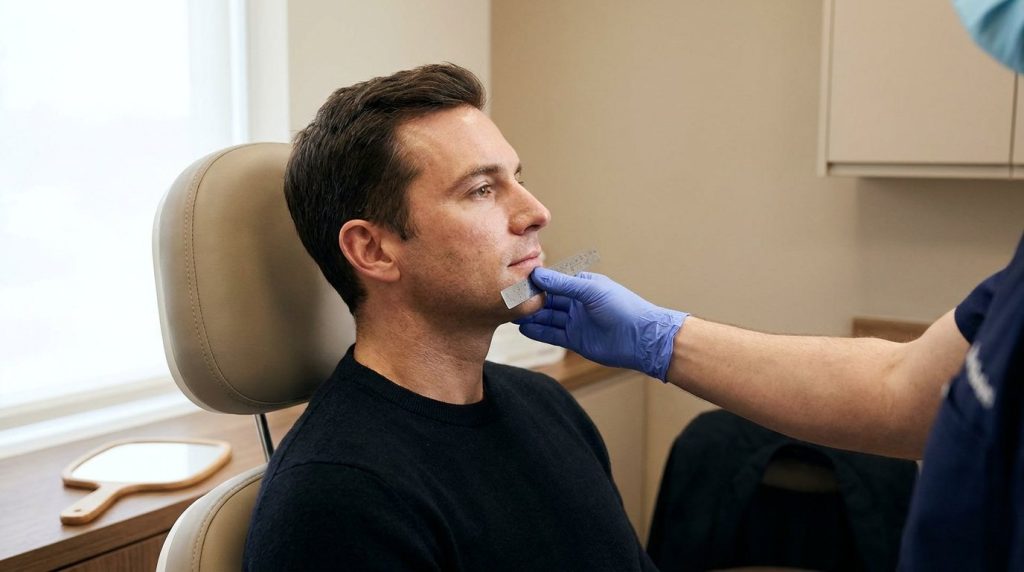
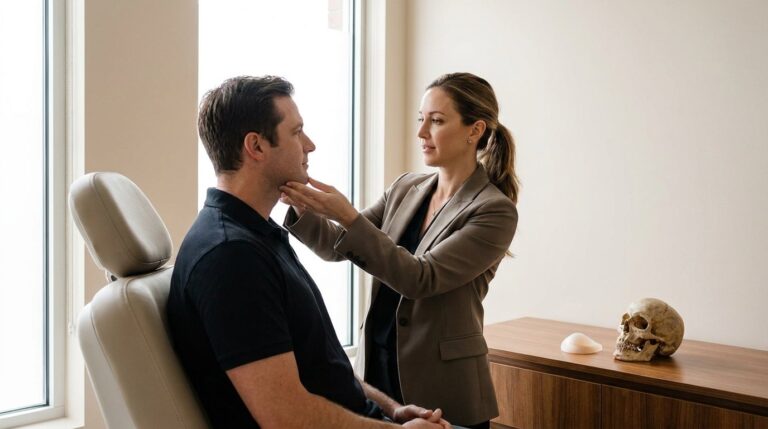
A proper assessment is quick but specific. Expect photographs from the front, side and three-quarter view, a look at your bite with your jaw relaxed, a check of how much the chin point moves your lower lip and the skin under your jaw, and often a scan or X-ray if bone position is in question. When the teeth and jaws genuinely do not line up, the fix belongs to a combined orthodontic and jaw-surgery plan rather than a cosmetic implant. A 2022 case report in World Journal of Clinical Cases described exactly this kind of co-ordinated care for skeletal jaw discrepancies, where orthodontic, surgical and gum-health planning were handled together rather than in isolation.
📋 Chin, neck or both? A weak chin point and a heavy under-chin area often travel together. Bringing the chin forward tightens the profile a little, but it does not remove fat under the jaw — that needs a separate conversation about neck contouring.
Why some chins sit back
Most of the time the answer is simply inherited facial structure. Jaw shape runs in families, and a short or posteriorly placed chin bone is as normal a variation as a narrow nose or a long midface.
Other causes do exist. Growth patterns in childhood matter, and problems such as long-term mouth breathing or early jaw joint injury can influence how far the lower jaw develops. Some people are born with conditions that affect jaw growth. Ageing then adds its own layer: bone remodels slightly, the chin pad descends, and skin laxity makes an already modest chin look weaker than it did at twenty.
Tooth position can also create an illusion. If the upper front teeth sit forward, the chin looks more recessed than it measures — which is one reason a dentist and a facial surgeon sometimes need to look at the same photographs before anyone picks up a scalpel.
Non-surgical options and where they stop working
For a mild recession, dermal filler placed on the chin point can add a few millimetres of projection and sharpen the profile without surgery. It is quick, needs no anaesthetic beyond local numbing, and you can judge the result almost immediately — which makes it a reasonable trial run before committing to an implant.
The trade-offs are real. Filler is temporary and needs topping up, the cost repeats every time, and chasing a big change with large volumes tends to look blurred rather than defined. Filler also cannot lengthen a short chin convincingly or correct a bite problem. If your chin is clearly behind the lip line, most surgeons will tell you honestly that filler buys a softened look, not a new jawline.
The chin area also has an important blood supply, so injections here belong only with an experienced medical injector who can manage complications. Our longer comparison of a weak chin treated with a chin implant versus fillers goes deeper into who each option genuinely suits.
Best for mild recession or as a trial. No downtime worth the name, fully reversible with hyaluronidase, but temporary and limited in how much projection it can add.
If the complaint is really a soft under-chin area rather than a short chin point, contouring the neck may do more for the profile than adding projection.
Braces or aligners move teeth, not the chin bone. They can improve the bite and sometimes the lip position, but they will not project a small chin.
Chin implant vs sliding genioplasty vs filler
A chin implant is a shaped, solid silicone or similar biocompatible piece placed on the bone through a small incision, usually inside the lower lip or in the crease under the chin. It adds forward projection and, with the right shape, width at the jaw corners. The operation is short and often done under sedation or general anaesthetic, sometimes alongside other facial surgery.
A sliding genioplasty is bone surgery: the surgeon cuts the chin segment and fixes it in a new position with small plates and screws. It can move the chin forward, reduce its height, correct a sideways tilt or do several of those at once, and nothing foreign is left behind apart from the fixation hardware. It is the stronger tool for larger or asymmetric corrections.
When the bite is wrong as well as the profile, neither option is the right answer on its own — that is orthognathic (jaw-realignment) surgery territory, planned with an orthodontist over many months.
📋 The nose and chin usually come up together In our consultations, patients who dislike their profile rarely isolate one feature — a chin that sits back makes the nose look larger, so many people end up discussing both. Our article on [rhinoplasty with chin augmentation for profile balance](https://www.clineca.com/blog/rhinoplasty-with-chin-augmentation-profile-balance/) explains when combining them makes sense and when it adds unnecessary recovery.
Risks and honest trade-offs you should hear before you book
Chin augmentation is a well-established operation, but it is still surgery and the complication list deserves plain language rather than a footnote.
Position and symmetry. An implant can sit slightly off-centre or ride up from the chin point, which shows up as an uneven profile or a visible edge. Careful pocket dissection and, in many cases, fixing the implant to the bone with a tiny screw reduce the risk, but malposition remains one of the most common reasons for a second operation.
Bone changes under an implant. Pressure from an implant can cause the bone beneath it to remodel over the years. In most patients this is limited and has no visible effect, but it is one reason surgeons avoid oversized implants and why a sliding genioplasty is often preferred for bigger corrections.
Infection. It is uncommon, yet an implant placed through the mouth sits close to oral bacteria. If an infection takes hold around the implant, antibiotics alone rarely settle it — the implant usually has to come out, with a replacement considered months later once tissues have healed.
Nerve and feeling. The mental nerve, which supplies sensation to the lower lip and chin, runs close to the surgical field. Numbness or tingling for several weeks is common and usually temporary; lasting altered sensation is rare but possible, and it is a genuine risk rather than a formality.
Other things to weigh up. Lower lip movement can feel odd for a while, bleeding or a collection of fluid can occur, and if you have had gum recession or thin gum tissue, the intraoral approach needs extra thought. Some patients also simply want a different size once swelling settles, which is why a frank conversation about implant dimensions before surgery saves a revision later.
⚠️ Signs to report quickly Spreading redness, increasing pain after the first few days, fever, a bad taste or discharge inside the lip, or an implant that feels like it has shifted all warrant same-day contact with your surgical team — not a wait-and-see week.
🚨 No procedure guarantees a result Any clinic promising a precise outcome, a pain-free recovery or a zero-risk implant is overselling. Ask instead for the specific risks in your case and the plan if a revision is needed.
Recovery: what the first three months actually feel like
Most people are surprised by two things — how manageable the pain is, and how long the final definition takes to appear. Swelling in the chin pad is stubborn because the tissue is thick and gravity does not help.
Tape or a supportive dressing is common for the first few days. If the incision is inside the mouth you will be on a soft diet and a prescribed mouthwash, and chewing feels awkward before it feels sore. Sleeping with your head elevated genuinely reduces morning puffiness in the first week.

The table below reflects a typical uncomplicated course; your surgeon’s instructions always override it. For a closer look at how the shape settles, see our timeline on chin implant swelling and when it starts to look natural.
- ✓Sleep on your back with an extra pillow for the first week or two
- ✓Keep to soft food and avoid biting into anything with your front teeth while an intraoral incision heals
- ✓Rinse as instructed after every meal if the incision is inside the mouth
- ✓Skip contact sport and anything that risks a knock to the chin for at least six weeks
What drives the cost, and planning a trip to Turkey
Cost talk is only useful when you know what you are comparing. A chin implant done under local anaesthetic as a standalone procedure and a sliding genioplasty with overnight monitoring are different operations with different price logic, so a figure quoted for one tells you nothing about the other.
The variables that move a quote are the technique chosen, the surgeon’s experience and specialty, the type of anaesthetic and whether an anaesthetist is involved, the hospital or clinic facility and whether you stay overnight, imaging and lab work, the implant itself, and whether the chin is being combined with another procedure in the same session. A quote should also state what happens if you need a revision and who pays for what. A personalised price is only meaningful after a consultation that includes photographs and, where relevant, a scan.
For travel planning, a standalone chin implant usually means a short stay with a review before you fly home; bone surgery or combined facial work needs longer. Our detailed pages on chin implant surgery in Turkey, including the recovery timeline and how long to stay in Turkey after plastic surgery set out the logistics in more depth.
⚠️ What a package should spell out Ask in writing which surgeon operates, the implant brand and size planned, whether an anaesthetist is present, how many nights are covered, who you contact after you fly home, and the exact revision terms.
Choosing a surgeon for chin surgery abroad
Chin work is millimetre surgery on the most-photographed part of the profile, so credentials matter more than marketing. Look for a surgeon qualified in plastic surgery or maxillofacial surgery (the specialty dealing with the face and jaws), working in a licensed facility, who assesses your bite rather than only your side profile.
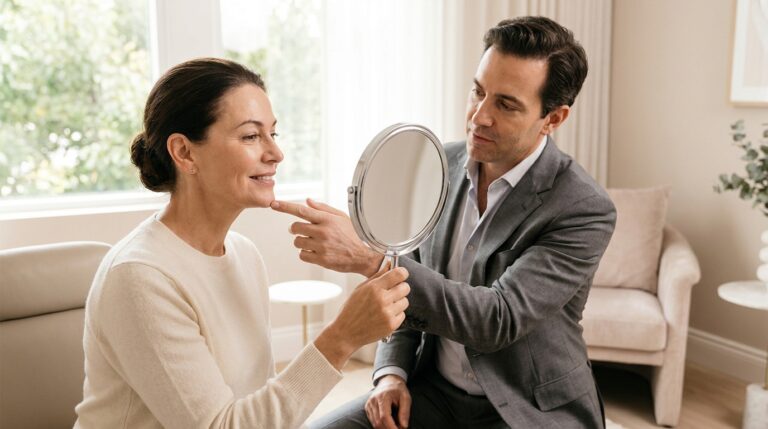
A good consultation feels like a filter, not a sales call. You should hear why an implant is being recommended over a genioplasty in your particular case, what size and shape is planned, what the surgeon will not promise, and what the plan is if the result is not quite right. Before-and-after photographs should be of the surgeon’s own patients, taken in matched lighting and angles — our guide on how to judge before-and-after photos explains what to look for.
If you want neutral background reading before you decide, the American Society of Plastic Surgeons and the NHS both publish patient-facing information on facial cosmetic procedures and the questions to ask any provider.
This article is for informational purposes only and does not constitute medical advice. Always consult a qualified surgeon for personalised guidance.
Named, verifiable surgeon; bite and dental assessment included; imaging where needed; written consent covering specific risks; clear revision policy; direct access to clinical staff after you travel.
Prices quoted before any photographs, promises of a guaranteed look, pressure to decide within hours, no named operating surgeon, stock before-and-after images, or dismissal of your questions about risk.
Frequently Asked Questions
References
- 📎Multi-disciplinary treatment of maxillofacial skeletal deformities by orthognathic surgery combined with periodontal phenotype modification: A case report — World J Clin Cases, 2022
- 📎American Society of Plastic Surgeons — Cosmetic Procedures
- 📎NHS — Cosmetic Procedures
Related Articles



You Might Also Like



Related articles

Our specialists
 Clineca SpecialistErkan PinegözPlastic & Reconstructive Surgery
 Clineca SpecialistHakan AktaşPlastic & Reconstructive Surgery
 Clineca SpecialistOrkun UzuneyüpoğluPlastic & Reconstructive Surgery
 Clineca SpecialistSalim İskenderPlastic & Reconstructive Surgery
 Clineca SpecialistEngin SelamioğluPlastic & Reconstructive Surgery
 Clineca SpecialistCem AydınPlastic & Reconstructive Surgery
 Clineca SpecialistAlperen ÖnalEar, Nose & Throat (ENT)