Have a question about Upper Eyelid Blepharoplasty?
In this article
- Ptosis or just excess skin: what is actually drooping?
- How to tell which one you have
- Ptosis surgery vs upper eyelid blepharoplasty, side by side
- How ptosis surgery is done
- When the eyebrow is the real problem
- Recovery: how the two timelines differ
- What drives the cost of ptosis surgery
- Risks, revisions and what happens if the diagnosis is wrong
- Choosing a surgeon and planning your stay in Turkey
Two people can look in the mirror, see the same tired, half-closed eyes, and need two completely different operations. One needs loose skin taken away; the other needs the eyelid itself lifted, which is what ptosis surgery does. Those two problems look almost identical in a selfie, and they are routinely confused — by patients, and sometimes in the consultation room too.
Ptosis or just excess skin: what is actually drooping?
The upper eyelid can sag in two separate ways, and the difference comes down to one landmark: the lid margin, the edge of the eyelid where your lashes grow.
With excess skin — surgeons call it dermatochalasis — the lid margin sits where it should, but the skin above it has stretched and folds down over the crease. In heavier cases that fold rests on the lashes or hangs over the outer corner, giving the hooded look that makes eyeliner impossible to see. The lifting muscle is working perfectly; it is simply carrying a curtain of surplus skin.
With ptosis, the lid margin itself is too low. A 2025 review in Progress in Retinal and Eye Research describes ptosis as an abnormally low upper lid margin when you look straight ahead, caused by a congenital or acquired problem with the muscles or nerves that control the lid. The commonest version in adults is a stretched or detached levator tendon — the thin attachment that pulls the lid upward. Isolated ptosis is often an appearance concern, but when the lid drops far enough it starts to block the upper field of vision.
Severity is measured in millimetres rather than impressions. An older paper in Aesthetic Plastic Surgery grouped the drop as minimal at around 1–2 mm, moderate at 3–4 mm, and severe above 4 mm, where the lid can cover the pupil entirely. It may affect one eye or both, and it may have been there since birth or appeared decades later.
The two problems also coexist very often. A low lid margin plus a heavy skin fold plus a dropped eyebrow is one of the most common patterns in people over forty, which is exactly why a quick glance at a photograph is not a diagnosis.
⚠️ Sudden or changing droop needs a doctor first If one eyelid dropped suddenly, if the droop gets noticeably worse through the day, or if it comes with double vision, a different pupil size or weakness elsewhere, see a doctor or eye specialist before you book cosmetic surgery. Those patterns can point to a nerve or muscle condition that needs diagnosing, not an eyelid operation.
How to tell which one you have
There is a simple check you can do at home. Sit in front of a mirror in good light, look straight ahead, and let your forehead relax completely — no raised brows. Now ask where the problem sits. If your lash line is in a normal position but skin folds over it, the issue is mostly skin. If the lid edge itself cuts across the coloured part of your eye lower on one or both sides, ptosis is likely in the mix.
Then lift the skin fold gently with a fingertip, pressing just below the eyebrow. If the eye suddenly looks open and awake, skin removal alone may do the job. If the eye still looks sleepy with the fold held out of the way, the lid is not being lifted properly.
Old photographs help more than people expect. Pictures from your twenties and thirties show your natural lid height and crease, which is the reference point a good surgeon works toward rather than some generic ideal.
What the clinic measures
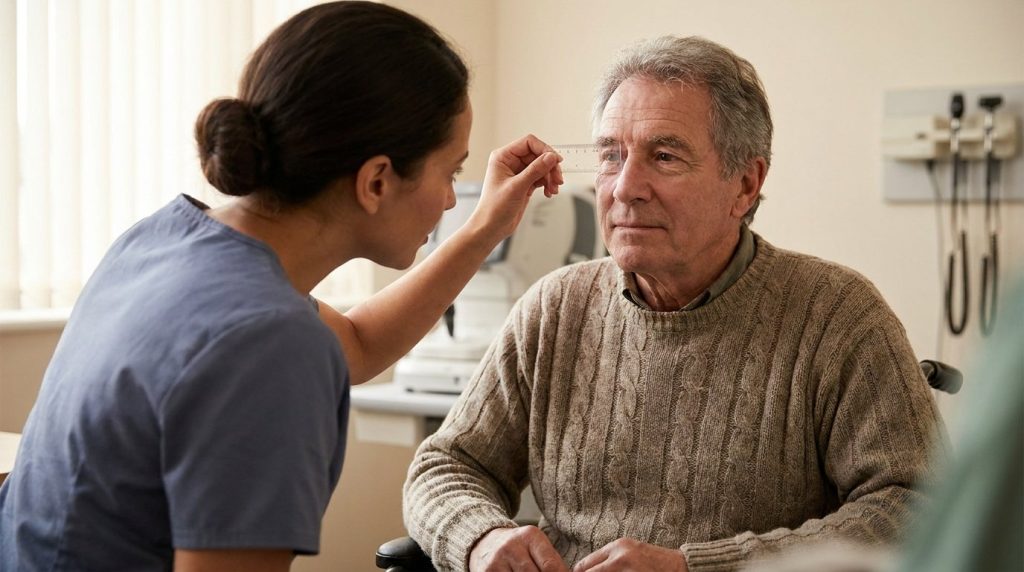
A proper eyelid assessment is a measuring exercise, not a style conversation. Expect the surgeon or an orthoptist to record how high the lid margin sits relative to the centre of the pupil, how far the lid travels when you look from down to up (how strong the lifting muscle is), where your natural crease sits, and how high your eyebrow is on each side. Tear film and blink quality get checked too, because dry eyes change what is safe to remove.
A few findings matter particularly:
- ✓Brow compensation — permanently raised eyebrows, deep forehead lines and eyes that feel heavier by evening suggest you are using your forehead to hold the lid up.
- ✓Asymmetry between sides — lifting one low lid can make the other look lower afterwards, a quirk of how the brain drives both lids together, and it should be discussed before surgery.
- ✓Field of vision — if the droop blocks the upper field, a visual field test documents it, which matters for medical rather than cosmetic grounds.
- ✓Variability — a droop that comes and goes, or worsens with fatigue, needs medical assessment before any surgical plan.
If you are mainly worried about vision rather than appearance, our guide on whether droopy lids affecting your sight make you a candidate goes through that assessment in more detail.
Ptosis surgery vs upper eyelid blepharoplasty, side by side
Both operations usually go through the same fine incision in the natural eyelid crease, and both take well under an hour per side. What differs is the target tissue, the precision required and how predictable the result is.
📋 They are frequently done together A 2024 paper in Plastic and Reconstructive Surgery notes that eyelid ptosis often presents alongside loose upper lid skin and a dropped brow, and that ptosis correction is advocated during upper blepharoplasty when it is indicated. Combining them in one session is standard practice rather than an upsell.
How ptosis surgery is done
There is no single ptosis operation. The choice depends on how far the lid has dropped and, crucially, how much strength the lifting muscle still has.
Levator advancement through the crease. This is the workhorse for adults with acquired ptosis and reasonable muscle function. The surgeon opens the natural eyelid crease, finds the stretched tendon of the lifting muscle, and shortens or reattaches it with fine sutures so the lid sits higher. Loose skin can be trimmed through the same incision in the same sitting.
The inside-the-lid approach. For mild ptosis in people whose lid responds well to drops that briefly stimulate the muscle, the correction can be made from the back surface of the lid, tightening a small strip of muscle and lining. There is no skin incision, so bruising is often lighter — but it only suits selected cases, and it does nothing about surplus skin.
Frontalis sling. When the lifting muscle is very weak, which is typical of ptosis present from birth, the lid is instead connected to the forehead muscle with a sling so the brow does the lifting. It is a bigger operation with a different look and a different aftercare routine.
What makes ptosis correction harder than skin removal is that the surgeon is chasing a target measured in single millimetres, in a tissue that swells as soon as it is touched, in two eyes that must match. That is why many surgeons prefer light sedation over deep general anaesthesia: they want to sit you up during the procedure and look at your lid height with your eyes open.
- →Mild droop, strong muscle: Inside-the-lid tightening or a small levator advancement, often combined with modest skin removal.
- →Moderate droop, strong muscle: Levator advancement through the eyelid crease, with skin adjusted to match.
- →Severe droop, weak muscle: Larger levator surgery, or a frontalis sling where the forehead muscle takes over the lift.
- →No true droop, only hooding: Skin-only blepharoplasty, sometimes with a brow procedure if the eyebrow has dropped.
When the eyebrow is the real problem
A third structure confuses this comparison constantly: the eyebrow. If the brow has descended with age, it pushes a fold of forehead skin down onto the eyelid. The eyelid then looks guilty of something the brow is doing.
This matters because removing eyelid skin can pull the brow slightly lower. In someone whose brow has already dropped, aggressive skin removal can flatten the upper lid and leave the outer corner just as heavy as before. A 2016 review in Facial Plastic Surgery Clinics of North America makes the same point from the surgeon’s side: the brow and upper lid should be assessed as one unit, and the ageing upper lid sometimes lacks volume rather than having too much, so adding fullness can be part of the plan instead of subtracting it.
In practice, that assessment often turns a single operation into a combined one. Around 74% of the people who come to us for upper eyelid surgery end up having at least one other procedure in the same session — most often rhinoplasty, lower eyelid surgery or a temporal lift to support the outer brow. The practical consequence for you is simple: the quote and the recovery window you should be planning around are usually the combined ones, not those for an isolated eyelid operation.
If the brow is part of your picture, it is worth reading how a brow lift differs from upper eyelid surgery before you decide.
Our upper eyelid patients average 43 at the time of surgery, with roughly six in ten over forty — a reminder that this is typically an age-related mix of low lid, loose skin and dropped brow rather than a single isolated fault.
Recovery: how the two timelines differ
Day-to-day recovery feels similar for the first fortnight. The difference shows up later, in how long the final lid height takes to declare itself.
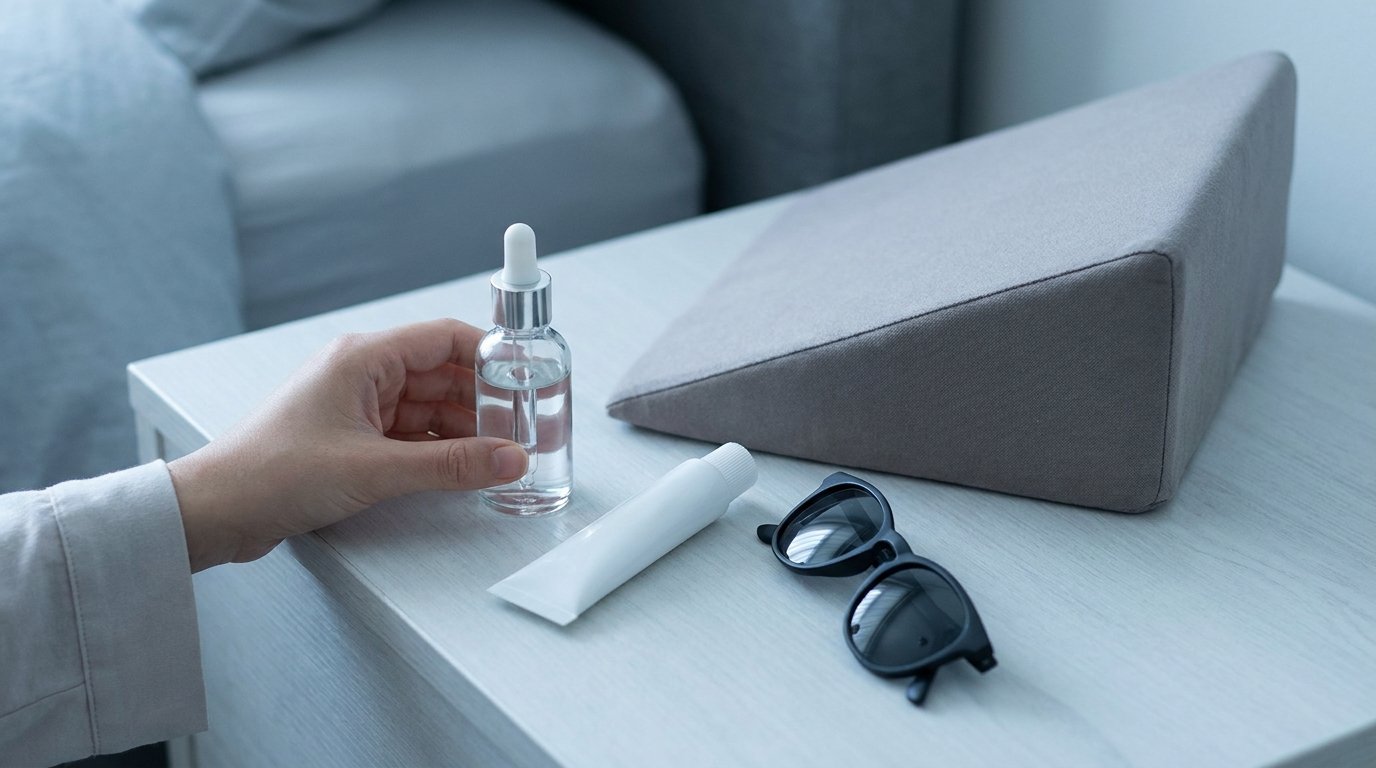
📋 Dry eyes are the usual nuisance Temporary incomplete blinking after upper lid surgery leaves the eye surface exposed, so grittiness, watering and light sensitivity are common for a few weeks. Lubricating drops by day and ointment at night, plus sunglasses outdoors, handle most of it. Tell your surgeon beforehand if you already use dry-eye drops.
- ✓Sleep with your head raised for the first week to limit lid swelling
- ✓No contact lenses or eye make-up until your surgeon clears you, usually around two weeks
- ✓Avoid heavy lifting, bending forward and strenuous exercise for two to three weeks
- ✓Wear sunglasses outdoors; fresh eyelid scars darken with sun exposure
- ✓Expect uneven swelling between sides — it is not the final result
What drives the cost of ptosis surgery
Eyelid quotes vary far more than patients expect, and almost none of the variation is about the eyelid itself. It is about how much surgery, how much theatre time and how much follow-up sits behind the figure. A personalised price can only be confirmed after an examination, because the plan is only decided once the lid height, muscle strength and brow position have been measured.
⚠️ Ask what the quote covers before comparing numbers A figure that excludes anaesthesia, follow-up or a revision policy is not comparable to one that includes them. Ask in writing which procedures the price covers, how many nights are included and what happens if a small adjustment is needed later.
Risks, revisions and what happens if the diagnosis is wrong
The most disappointing eyelid outcome is not a complication. It is a technically clean skin removal performed on someone whose real problem was a low lid margin. The hood goes, the scar heals beautifully, and the eyes still look sleepy — because nothing lifted the lid. That is the single strongest argument for insisting on measurements before you agree to a plan.
The specific risks of ptosis surgery sit mostly around height and symmetry. Under-correction is the commonest, which is why revision rates are higher than for skin-only surgery. Over-correction leaves the lid too high and the eye too exposed, which can aggravate dryness. Crease height can end up slightly different between sides, and swelling can hide both problems for weeks.
More general risks apply to both operations: bruising, bleeding, infection, delayed healing, visible or thickened scarring, numbness along the lid, temporary blurred vision, and a dry-eye flare. Serious problems such as bleeding behind the eye or vision loss are very rare but real, and they are part of why where you have surgery matters as much as what you have.
One honest expectation to set: with true ptosis, the aim is a lid height that looks natural and symmetrical to an ordinary observer, not a millimetre-perfect match. Surgeons who promise exact symmetry are promising something the tissue does not reliably deliver.
Choosing a surgeon and planning your stay in Turkey
Because so much of the result depends on diagnosis rather than dexterity, the consultation itself is your best screening tool. A surgeon who measures, photographs and explains which of the three culprits — lid, skin, brow — is doing the damage is telling you something useful. One who glances at your face and quotes a package price is not.
Ask directly: is my lid margin low, or is this skin? How strong is my lifting muscle? Will my brow need anything? What happens if the height is not right at three months? Those four questions separate a measured plan from a sales script.
For travel, the practical constraint is suture removal and the first follow-up rather than the surgery itself. Most upper eyelid patients plan around a week in Turkey, with stitches out before flying home and a review appointment before departure. If you are combining procedures, the stay is set by the larger operation — our guides on how long to stay in Turkey after plastic surgery and on eyelid surgery cost, safety and recovery in Turkey cover that planning in detail, and our upper eyelid healing timeline sets out what each week looks like.
This article is for informational purposes only and does not constitute medical advice. Always consult a qualified surgeon for personalised guidance.
Lid height and muscle strength are measured and recorded; standardised photographs are taken; your brow position is discussed; the surgeon is willing to tell you that you need less surgery than you asked for; a written revision policy exists.
A quote before any examination; no mention of the lid margin or the brow; pressure to decide within hours; promises of perfect symmetry; no named surgeon; no plan for follow-up once you have flown home.
Botulinum toxin placed to relax the muscles that pull the brow down can lift the eyebrow slightly, and filler can restore lost volume around the brow — but nothing injectable raises a drooping lid margin or removes surplus eyelid skin. For people who cannot have surgery, specially made glasses with a lid prop are the usual non-surgical route.
Frequently Asked Questions
References
- 📎Unraveling ptosis: A comprehensive review of clinical manifestations, genetics, and treatment — Progress in Retinal and Eye Research, 2025
- 📎Ptosis: causes, presentation, and management — Aesthetic Plastic Surgery, 2003
- 📎Upper Lid Blepharoplasty — Facial Plastic Surgery Clinics of North America, 2016
- 📎Eyelid and Brow Rejuvenation: Upper Blepharoplasty with or without Ptosis Correction and Brow Lift — Plastic and Reconstructive Surgery, 2024
- 📎NHS — Cosmetic procedures
Related Articles
You Might Also Like



Related articles

Our specialists
 Clineca SpecialistErkan PinegözPlastic & Reconstructive Surgery
 Clineca SpecialistHakan AktaşPlastic & Reconstructive Surgery
 Clineca SpecialistOrkun UzuneyüpoğluPlastic & Reconstructive Surgery
 Clineca SpecialistSalim İskenderPlastic & Reconstructive Surgery
 Clineca SpecialistEngin SelamioğluPlastic & Reconstructive Surgery
 Clineca SpecialistCem AydınPlastic & Reconstructive Surgery
 Clineca SpecialistAlperen ÖnalEar, Nose & Throat (ENT)