
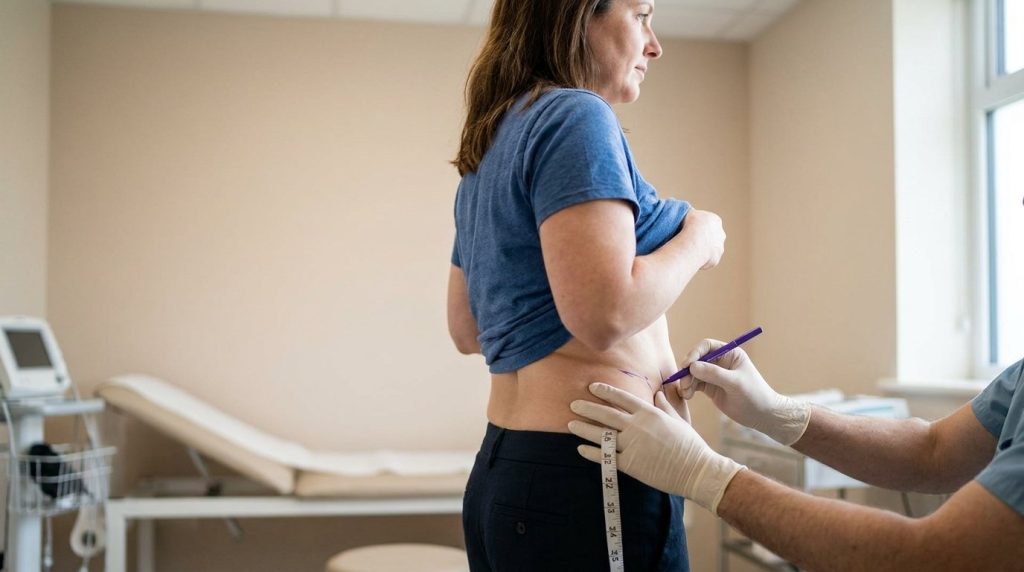
Have a question about Body Lift?
In this article
- Why does skin stay loose after major weight loss?
- When are you actually ready for skin removal surgery?
- Which body contouring procedure matches your loose skin?
- One big operation or several stages?
- What drives the cost of skin removal in Turkey?
- Recovery, scars and how long to stay in Turkey
- Safety, alternatives and choosing the right clinic
Losing a very large amount of weight changes your health, your clothes size and your energy — and then it leaves something nobody warned you about. Loose skin after weight loss surgery is one of the most common complaints among bariatric patients, and it rarely behaves the way people expect. Understanding why the skin stays behind, and what can honestly be done about it, is the difference between chasing creams and planning a real solution.
Why does skin stay loose after major weight loss?
Skin is elastic, but not infinitely so. When fat volume increases over years, the skin stretches to cover it, and the collagen and elastin fibres inside it are permanently damaged in the process. Once the fat is gone, those fibres cannot spring back to their original length — so the skin hangs instead of shrinking.
Several things decide how much hangs. Age matters, because skin quality naturally declines over time. So does how long you carried the extra weight, how much weight you lost, how quickly you lost it, your genetics, and whether you smoke. Patients who drop a very large amount in the first year after bariatric surgery almost always notice it most around the abdomen, inner thighs, upper arms, chest and neck.
An overview published in the Indian Journal of Plastic Surgery in 2008 described exactly this pattern: most patients after massive weight loss are left with loose, drooping skin envelopes and oddly shaped bulges, and the excess skin and fat can appear almost anywhere on the body rather than in one predictable place. That is why assessment is done area by area, not as a single “fix”.
It also explains why no cream, wrap, supplement or massage removes hanging skin. Building muscle can fill out a frame slightly and good hydration and protein intake support healing, but once the skin envelope is genuinely stretched beyond its recoil, the only way to remove it is to cut it out.
📋 Loose skin is not a sign you did something wrong Hanging skin after rapid weight loss is a mechanical result of stretched tissue, not a failure of diet or exercise. Many patients reach a healthy BMI and still have a full apron of abdominal skin.
When are you actually ready for skin removal surgery?
Timing is the single most important factor, and it is where many people get turned away at consultation. Surgeons generally want your weight to be stable before removing skin — commonly for at least six months, and often around 12 to 18 months after bariatric surgery, once the rapid loss phase has settled. If you operate while weight is still dropping, new looseness appears after the scars have healed.
Nutrition matters just as much. Bariatric surgery can leave patients low in protein, iron, vitamin B12, vitamin D and zinc, all of which the body needs to close a long incision. A responsible clinic will ask for recent blood work and may delay surgery until levels are corrected.

Smoking is the other common blocker. Nicotine narrows the small blood vessels that keep skin edges alive, and body contouring relies on long incisions with tight closure. Most surgeons ask patients to stop several weeks before and after surgery.
You also need to be realistic about what you are trading. Skin removal exchanges loose, chafing, hard-to-dress skin for a flatter contour plus a permanent scar. Patients who are comfortable with that trade are usually happy; patients hoping for an invisible result are not.
- ✓Stable weight: No significant loss or gain for roughly six months, with the fast post-bariatric phase behind you.
- ✓Corrected nutrition: Protein and vitamin levels checked and treated, since healing a long incision needs good reserves.
- ✓Nicotine-free: No smoking or vaping for the window your surgeon specifies before and after the operation.
- ✓Stable health and mindset: Controlled blood sugar and blood pressure, no active infection, and realistic expectations about scars.
Which body contouring procedure matches your loose skin?
Body contouring after weight loss is not one operation. It is a menu, and the right items depend on where your skin hangs and how much of your body is involved. Someone with a single abdominal apron needs something very different from someone whose skin is loose from the chest to the knees.
A lower body lift is the workhorse for post-bariatric patients, because it treats the abdomen, hips, outer thighs and buttocks in one circumferential pass. Where the looseness runs vertically down the middle of the stomach as well as horizontally, a fleur-de-lis style tummy tuck with a vertical incision often gives a tighter waist than a standard horizontal-only approach. Arms, inner thighs, breasts and the upper back are each addressed separately.
If you are unsure whether your thighs justify their own operation, our guide on thigh lift candidacy after major weight loss walks through the honest trade-off between scar length and contour.
One big operation or several stages?
Many patients arrive hoping to have everything done at once. Sometimes that is reasonable; often it is not. A clinical review of total body lift surgery published in Aesthetic Surgery Journal in 2008 looked at 75 cases over five years and found that most were completed in a single stage, while a minority needed two or three stages — in total, those 75 patients involved more than 600 individual procedures. The lesson is that combining is possible, but it is planned carefully rather than taken for granted.
Staging decisions come down to operating time, blood loss, how much skin is being removed and your general fitness. Very long single operations increase the risk of blood clots, fluid shifts and wound-healing problems, so a surgeon may prefer to split, for example, the lower body lift from the arm and breast work, leaving around three months between stages.
For international patients, staging also shapes travel. Two stages means two trips, two recovery periods and two sets of flights — worth budgeting for from the start rather than discovering later. Our overview of combining plastic surgery procedures in Turkey explains how surgeons weigh those limits.
⚠️ Be cautious with "everything in one go" offers If a clinic agrees to every area in a single very long operation without reviewing your bloods, weight history and clotting risk, treat that as a warning sign rather than good value.
What drives the cost of skin removal in Turkey?
Skin removal after weight loss in Turkey is usually quoted as a package, and the number depends far more on the scope of surgery than on the city. Two patients both asking for a “body lift” can receive very different quotes because one needs a single horizontal excision and the other needs a circumferential lift with liposuction and a longer anaesthetic.
The main drivers are how many areas are treated, whether muscle repair or liposuction is added, how long you are under general anaesthetic, how many nights of hospital care you need, and the seniority of the surgical team. Post-bariatric cases also tend to need more follow-up, more drains and longer compression wear than a routine tummy tuck.
A properly written quote should make clear what is inside it, so you are not surprised later. Ask specifically about anaesthesia, hospital nights, compression garments, drain removal, medication, transfers, interpreter support and what happens if you need a revision. We break down package contents in detail in our guide to what an all-inclusive surgery package in Turkey includes. Your own price is confirmed only after a consultation with photographs and a medical review — anything quoted before that is a guess.
Recovery, scars and how long to stay in Turkey
Body contouring recovery is longer than most people expect, because the incisions are long and under tension. The first week is about drains, walking short distances and managing tightness rather than sharp pain. By two to three weeks most patients move comfortably around a hotel or home. Desk work is often possible from around three to four weeks after a single-area lift, later after a circumferential one.
Swelling settles slowly. Compression garments are usually worn for roughly six to eight weeks, and the final contour keeps refining for six to twelve months as swelling resolves and scars mature. Scars start red and raised, then fade to pale lines over about a year to eighteen months, though they never disappear and some patients heal thicker than others.
For international patients, the usual plan is to stay in Turkey for around ten to fourteen days after a major lift so drains can be removed and the wounds checked before you fly. More extensive or staged surgery can mean longer. Our articles on body lift recovery week by week and how long to stay in Turkey after plastic surgery cover the day-to-day detail.
This article is for informational purposes only and does not constitute medical advice. Always consult a qualified surgeon for personalised guidance.
🚨 Contact your clinic urgently if You develop a fever, spreading redness or foul-smelling discharge from the wound, calf pain or swelling, chest pain or breathlessness. These need same-day assessment, wherever you are.
Safety, alternatives and choosing the right clinic
Post-bariatric body contouring carries more risk than standard cosmetic surgery, because the wounds are long, the tissue has been stretched, and nutrition is sometimes borderline. The realistic complication list includes fluid collections (seromas), small areas of wound separation, infection, numbness, asymmetry, thickened scars and blood clots. Good clinics reduce these risks with proper screening, clot prevention, drains, compression and close follow-up — they do not promise they cannot happen.
Non-surgical skin tightening is often asked about, and it has a narrow role. Energy-based treatments can help mild laxity, not a hanging apron of skin. If your looseness is moderate and you want to understand where the boundary lies, our piece on J-plasma after weight loss explains who is and is not a candidate.
When you compare clinics, look past the photo galleries. You want a surgeon who operates on post-bariatric bodies regularly, works in a licensed hospital, reviews your blood results before agreeing to anything, and gives you a written plan including staging and aftercare. Our guide to plastic surgery safety in Turkey sets out the checks worth making before you book.
Board-certified plastic surgeon with post-bariatric experience, licensed hospital with intensive care, pre-op bloods and anaesthetic review, written staging plan, named contact for problems after you fly home.
A firm price before any medical review, no interest in your weight stability or vitamin levels, pressure to book immediately, promises of barely visible scars, or no clear plan for complications once you leave Turkey.
Wait until weight is stable, correct nutritional deficiencies, use supportive compression wear for comfort and chafing, and treat skin-fold irritation medically in the meantime.
Frequently Asked Questions
References
- 📎Body contouring surgery in a massive weight loss patient: An overview — Indian Journal of Plastic Surgery, 2008
- 📎A clinical review of total body lift surgery — Aesthetic Surgery Journal, 2008
- 📎ASPS: Cosmetic Procedures
Related Articles

You Might Also Like

Related articles
Our specialists
 Clineca SpecialistErkan PinegözPlastic & Reconstructive Surgery
 Clineca SpecialistHakan AktaşPlastic & Reconstructive Surgery
 Clineca SpecialistOrkun UzuneyüpoğluPlastic & Reconstructive Surgery
 Clineca SpecialistSalim İskenderPlastic & Reconstructive Surgery
 Clineca SpecialistEngin SelamioğluPlastic & Reconstructive Surgery
 Clineca SpecialistCem AydınPlastic & Reconstructive Surgery
 Clineca SpecialistAlperen ÖnalEar, Nose & Throat (ENT)