
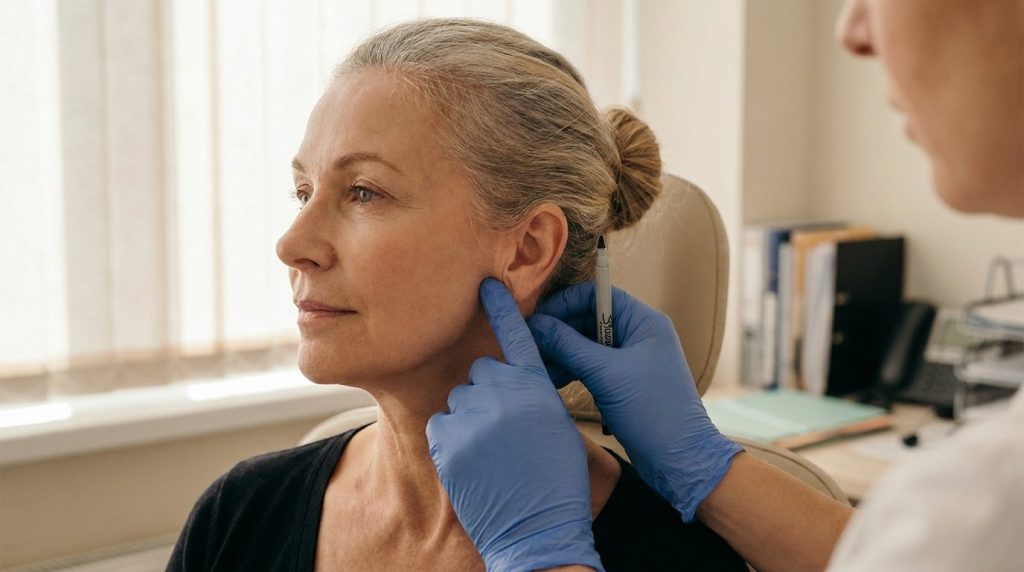
Have a question about face lift?
In this article
- What Causes Jowls in the First Place
- What Jowl Removal Surgery Actually Involves
- Are You a Candidate for a Jowl Lift?
- Non-Surgical Jowl Treatments and Where They Stop Working
- Recovery After Jowl Removal Surgery, Week by Week
- Risks, Scars and Honest Trade-Offs
- What Drives the Cost of Jowl Removal Surgery
- Having Jowl Surgery Abroad: Stay Length, Safety and Choosing a Clinic
Jowls tend to announce themselves in photographs rather than mirrors — a softening of the jawline, a shadow either side of the chin that was not there five years ago. Searching for jowl removal surgery brings up everything from threads and fillers to full facelifts, which makes it hard to tell what actually lifts sagging tissue and what simply disguises it. This guide walks through the real options, how recovery unfolds, and the practical side of having the procedure done abroad.
What Causes Jowls in the First Place
A jowl is not extra skin alone. It is a bundle of skin, fat and deeper soft tissue that has slipped below the line of the jawbone, so the crisp border between face and neck turns soft and wavy.
Several things happen at once. The skin loses elasticity and no longer snaps back. The deeper support layer — a sheet of muscle and fibrous tissue that holds the cheek in place — loosens and drifts downward. Fat pads that once sat high on the cheek descend, while the bone along the jaw and chin gradually thins with age, removing some of the scaffolding underneath.
There is also a fixed ligament near the front of the jaw that tethers the skin firmly to the bone. Tissue sliding down from the cheek piles up behind it and cannot cross, which is why jowls often look like a distinct pouch with a small notch in front of them.
Genetics decide a lot about when this starts. Weight gain and repeated weight loss stretch and empty the skin, sun damage breaks down collagen, and skin affected by years of smoking heals and recoils poorly. None of these are reversed by creams, facial exercises or massage, because none of them reach the layer where the sagging is happening.
📋 Why skin creams cannot lift a jowl Topical products work on the outer millimetre of skin. Jowling starts several layers deeper, in fat and the fibrous support sheet, so even a good skincare routine improves texture without changing the jawline shape.
What Jowl Removal Surgery Actually Involves
Jowl removal surgery is usually a lower facelift: the surgeon lifts and repositions the deeper support layer of the cheek and jaw, then trims the skin that is left over. The old idea of simply pulling skin tight has largely been abandoned, because skin alone stretches again within months and can create a wind-blown look.
There are a few recognised approaches, and the right one depends on how much tissue has descended and whether the neck is involved.
A short-scar or mini lift uses an incision around the ear and tightens the support layer over a smaller area. It suits early jowling where the neck is still reasonably tight. A standard SMAS facelift lifts that deep sheet more extensively and gives a stronger correction along the jawline. A deep plane facelift releases the ligaments that hold tissue down, so the whole cheek-and-jowl block can be moved as one unit — more involved surgery, but often a more durable jawline in heavier faces. Our comparison of SMAS and deep plane facelift techniques goes into the trade-offs in more detail.
If the looseness continues under the chin, a neck lift is often added. The surgeon tightens the strap muscle of the neck through a small incision under the chin and sometimes removes fat there. Many patients assume one covers the other, and it is worth reading whether the neck is included in a facelift before you compare quotes, since this single decision changes both the plan and the price.
Fat grafting is sometimes combined with the lift. Replacing lost volume higher on the cheek takes tension off the lower face and tends to look more natural than lifting a deflated face tighter.
⚠️ Beware the one-size-fits-all plan If a clinic recommends exactly the same operation to every patient with jowls, without looking at your neck, skin quality and bone structure, treat that as a reason to get a second opinion.
Are You a Candidate for a Jowl Lift?
The best candidates have visible tissue hanging over the jawline, reasonable skin quality, stable weight and no uncontrolled medical problems — most are in their late forties to their sixties, though age matters far less than tissue condition.
Surgery works by moving tissue and removing excess, so there needs to be something to move. Patients whose main complaint is hollowness rather than sag often do better with volume restoration first. Patients with heavy, early jowling in their early forties may be well served by a mini facelift, which asks less of recovery while still repositioning the deeper layer.
Smoking is the single biggest modifiable risk. Nicotine narrows the small blood vessels that feed lifted skin, which raises the chance of delayed healing and wound breakdown along the incisions. Most surgeons ask for several weeks of complete abstinence before and after surgery, including vapes and patches.
Blood pressure matters too. Poorly controlled hypertension increases the risk of bleeding under the skin in the first day or two, which is the most common reason a facelift patient needs to go back to theatre.
Tissue you can lift with your fingers and like the result of; a jawline that looked sharper in photos a decade ago; stable weight; a non-smoker or committed quitter; realistic expectations about scars and swelling.
Very early, barely visible jowling; ongoing weight loss; uncontrolled blood pressure or diabetes; active smoking you are not ready to stop; hoping to look like a different person rather than a rested version of yourself.
Volume support higher in the cheek, skin-tightening treatments and good sun protection can buy time, and they do not burn any bridges — a facelift later is not made harder by having had them.
Non-Surgical Jowl Treatments and Where They Stop Working
Non-surgical options are genuinely useful early on, and genuinely disappointing once a jowl has formed. Knowing which stage you are at saves both money and frustration.
Dermal filler does not remove a jowl. Placed along the jaw and chin, it rebuilds a border so the sag casts less shadow, and placed higher on the cheek it can take a little weight off the lower face. The effect is camouflage, it needs repeating, and overfilling a heavy lower face tends to make it heavier.
Energy-based skin tightening — radiofrequency, microneedling with radiofrequency, focused ultrasound — stimulates collagen and can firm skin modestly. Results are gradual, usually subtle, and best in people with mild laxity. Fat-dissolving injections only address fat under the chin, not sagging tissue over the jaw.
Thread lifts sit in between. Barbed sutures are passed under the skin to hoist tissue upward, and a 2009 paper in Dermatologic Surgery describing a specialised suture and insertion device reported early results in a small series of twenty patients whose sagging facial tissue was resuspended this way. That is encouraging as a technique description, but it is a small early series rather than long-term evidence, and in practice thread results are temporary and most useful for mild cases.
Many patients arrive at surgery after years of injectables, and the turning point is usually the same: treatments that used to make a visible difference stop registering. If that sounds familiar, our piece on becoming a facelift candidate when fillers stop helping describes that transition.
- →Mild laxity, sharp jaw still visible: Skin-quality treatments and careful volume support are reasonable first steps.
- →Jowl visible in photos, jaw border blurred: Non-surgical results tend to be short-lived; a surgical lift gives a clearer change.
- →Jowl plus loose neck skin or bands: Surgery that addresses face and neck together is usually the only approach that holds.
- →Mainly fat under the chin, skin still tight: Targeted fat removal under the chin may be enough on its own.
Recovery After Jowl Removal Surgery, Week by Week
Most patients are presentable to strangers at around two weeks, back to desk work in one to two weeks, and settled into their final result between six and twelve months — with the biggest visible change happening in the first three weeks.
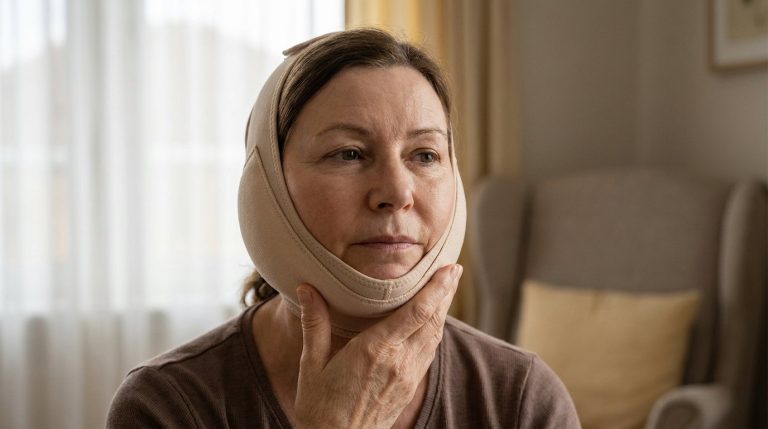
The first two days are the most restricted. Expect tightness rather than sharp pain, a head wrap or light dressing, and sleeping propped up on your back. Some surgeons place a small drain overnight to reduce fluid collecting under the skin.

Bruising travels downward with gravity, so it often looks worse in the neck and along the collarbone than on the face itself. Swelling peaks around day three and then recedes unevenly — one side almost always lags behind the other, which is normal and not a sign of a problem.
Numbness around the ears and along the jaw is expected and can last weeks to months as small sensory nerves recover. Tightness in front of the ear and a lumpy, cord-like feeling under the skin usually soften by the second or third month. For a fuller picture of the swelling curve, see our breakdown of how long facelift recovery takes.
🚨 Contact your surgeon urgently if One side swells rapidly or becomes tense and painful in the first 48 hours, you develop spreading redness with fever, a wound edge turns dark, or you notice new weakness moving one side of your mouth. These need assessment the same day, not an email in a few days.
Risks, Scars and Honest Trade-Offs
A lower facelift is well-established surgery, but it is still surgery under anaesthesia and it carries real risks that deserve naming before you book.
Bleeding under the skin is the most common early complication and usually declares itself within the first day, which is one reason overnight observation matters. Infection is uncommon. Temporary weakness of a facial nerve branch can occur and almost always recovers; permanent nerve injury is rare but possible. Wound-healing problems in front of or behind the ear are strongly linked to smoking.
Scars are the trade-off nobody can remove. They run in the crease in front of the ear, sometimes inside the ear cartilage, around the earlobe and back into the hairline, plus a short line under the chin if the neck is treated. Placed well they are easy to hide, but they exist permanently, and they go through a pink, firm phase for a few months before fading.
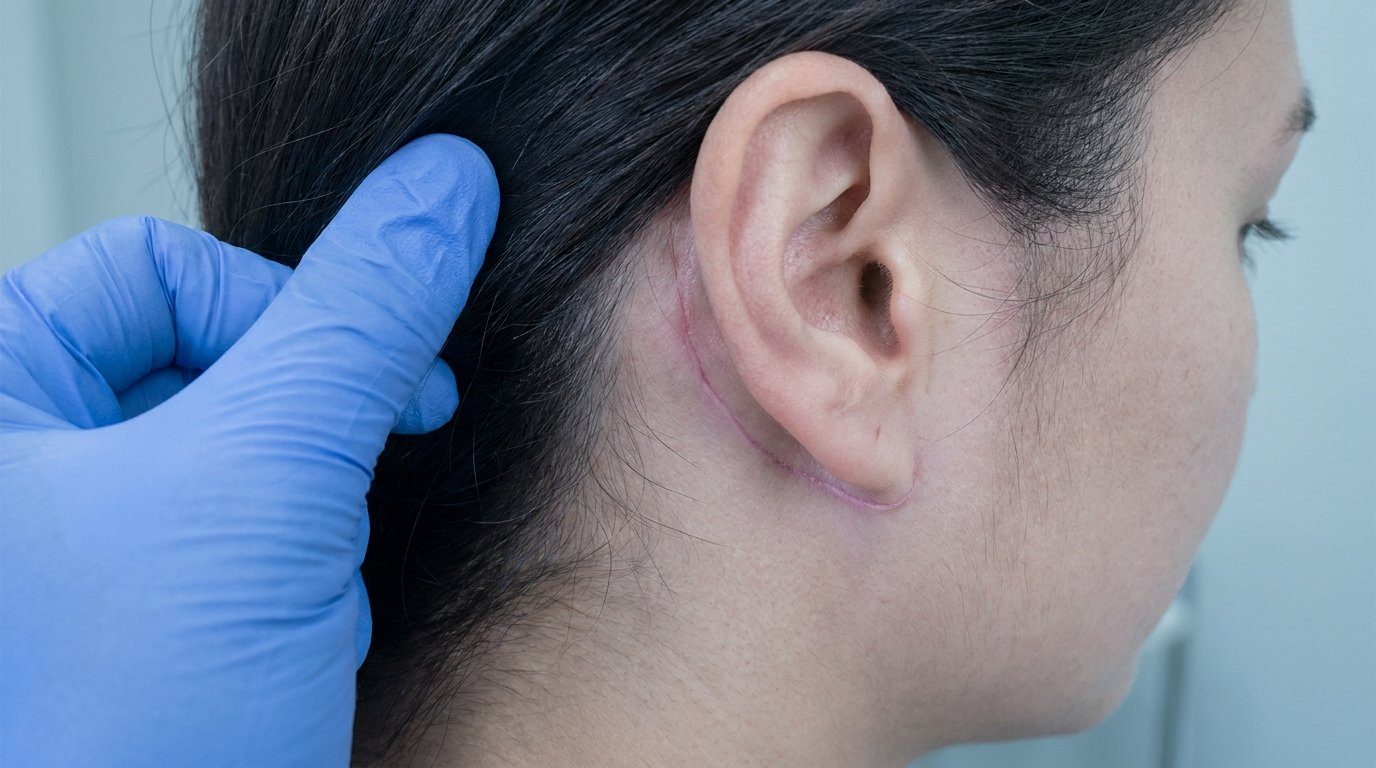
The other honest trade-off is that surgery resets the clock without stopping it. Ageing continues, so a jawline lifted at fifty-five will look like a fifty-five-year-old jawline that has aged, not a frozen one. Most patients keep a clear improvement over their untreated starting point for many years, and some choose a smaller refresh later rather than a second full lift.
Restores a defined border between face and neck, removes the hanging pouch beside the chin, and improves the neck at the same time when both are treated.
It does not improve skin texture, pigmentation or fine lines around the mouth, and it does not prevent future ageing. Those need separate skin treatments.
What Drives the Cost of Jowl Removal Surgery
Cost is driven mainly by how much surgery you actually need, who performs it, and what the quote covers beyond the operation itself — a firm figure only becomes meaningful after a consultation that includes your photographs and medical history.
A short-scar lift on a slim, early-stage face is a different operation from a deep plane facelift combined with a neck lift and fat grafting, and the price gap reflects theatre time, anaesthesia time and the complexity of the dissection. Revision work on a face that has been lifted before usually costs more again, because scar tissue makes the surgery slower and less predictable.
Where you have it done matters too. Country, city, hospital grade and the surgeon’s experience all feed into the number, which is why the same operation can be quoted very differently in London, Istanbul and Los Angeles. Our overview of facelift cost drivers in the UK explains how those components are normally itemised.
When you compare quotes, compare inclusions rather than headline numbers. Ask explicitly what happens — and who pays — if you need an extra night in hospital or a minor procedure to drain a collection of blood.
📋 Questions that reveal the true cost Ask which technique is planned, whether the neck is included, how many nights of accommodation are covered, who manages your follow-up at home, and what a revision would involve. A quote that cannot answer these is not a quote.
Having Jowl Surgery Abroad: Stay Length, Safety and Choosing a Clinic
Facial lifting travels reasonably well as a medical tourism procedure, mostly because the early risks show up in the first few days — while you are still nearby and under the care of the team that operated.
Plan on staying roughly seven to ten days after a lower facelift. That window typically covers the first dressing change, suture removal and a final check before flying, and it means any bleeding or healing issue is handled in person. Flying too early is not just about comfort; you want to be reachable if something changes. Our guide to how long to stay in Turkey after plastic surgery sets out realistic timings for different operations.
On the safety side, look for a licensed hospital or surgical facility rather than an unaccredited clinic room, a surgeon with recognised specialist qualifications in plastic or facial surgery, a named anaesthetist, and a written plan for the first 24 hours after surgery. If you are weighing up the overall picture of treatment abroad, our article on whether plastic surgery in Turkey is safe covers the checks worth making before you commit.
Follow-up deserves as much attention as the surgery. Ask who you contact at week three if a scar thickens or a lump appears, whether video reviews are offered, and whether the clinic will correspond with a doctor at home. A procedure that depends on nobody having questions afterwards is poorly planned.
This article is for informational purposes only and does not constitute medical advice. Always consult a qualified surgeon for personalised guidance.
Clear surgeon credentials you can verify; surgery in a licensed hospital with overnight observation available; consistent before-and-after photos of patients with similar faces to yours; a written quote listing inclusions; an honest discussion of scars and risks.
No named surgeon until arrival; pressure to decide within hours; dramatic discounts for booking today; photos that look edited or inconsistent; no answer on who handles complications after you fly home.
Frequently Asked Questions
References
- 📎A novel specialized suture and inserting device for the resuspension of ptotic facial tissues: early results — Dermatologic Surgery, 2009
- 📎NHS — Cosmetic procedures
- 📎American Society of Plastic Surgeons — Cosmetic procedures
Related Articles



You Might Also Like



Related articles
Our specialists
 Clineca SpecialistErkan PinegözPlastic & Reconstructive Surgery
 Clineca SpecialistHakan AktaşPlastic & Reconstructive Surgery
 Clineca SpecialistOrkun UzuneyüpoğluPlastic & Reconstructive Surgery
 Clineca SpecialistSalim İskenderPlastic & Reconstructive Surgery
 Clineca SpecialistEngin SelamioğluPlastic & Reconstructive Surgery
 Clineca SpecialistCem AydınPlastic & Reconstructive Surgery
 Clineca SpecialistAlperen ÖnalEar, Nose & Throat (ENT)