

Have a question about plastic surgery?
In this article
- What actually goes wrong, and when it tends to show up
- The warning signs that mean contact someone today
- What if something goes wrong while you are still in Turkey?
- Surgery abroad aftercare in the UK: who will actually see you
- Who pays for revision or complication care?
- How to cut your risk before you book
Almost every conversation about medical travel focuses on the good version of the story: the flight out, the surgery, the hotel, the flight home. The harder question — what happens if complications after surgery abroad appear once you are already back in your own kitchen, 2,000 miles from the surgeon who operated — is the one most people put off asking. It deserves a proper answer before you book, not after.
What actually goes wrong, and when it tends to show up
Most problems after cosmetic or dental surgery are not dramatic emergencies. They are the ordinary, treatable things that can follow any operation anywhere in the world: a wound that opens slightly at the edge, a pocket of fluid under a tummy tuck flap, a red and tender incision, a tooth that stays sensitive, a scar that thickens, or a result that looks uneven while swelling is still settling.
Timing matters more than most people realise. Bleeding and blood-pressure problems cluster in the first two or three days, which is exactly when a good clinic keeps you nearby. Wound infections usually declare themselves between roughly day four and day fourteen. Scar quality, contour irregularities and genuine asymmetry only become judgeable months later, which is why reputable surgeons refuse to discuss revision too early.
The awkward middle ground is the infection window, because it often overlaps with the flight home. A 2024 study in the Irish Journal of Medical Sciences looked at infections linked to cosmetic surgery performed abroad and noted that these complications frequently appear after the patient has travelled back to their home country, so they present to local services rather than to the operating team. The same study examined which organisms were involved and their antibiotic resistance patterns — a useful reminder that a local doctor may want wound swabs and cultures before settling on treatment, rather than guessing at the usual first-line antibiotic.
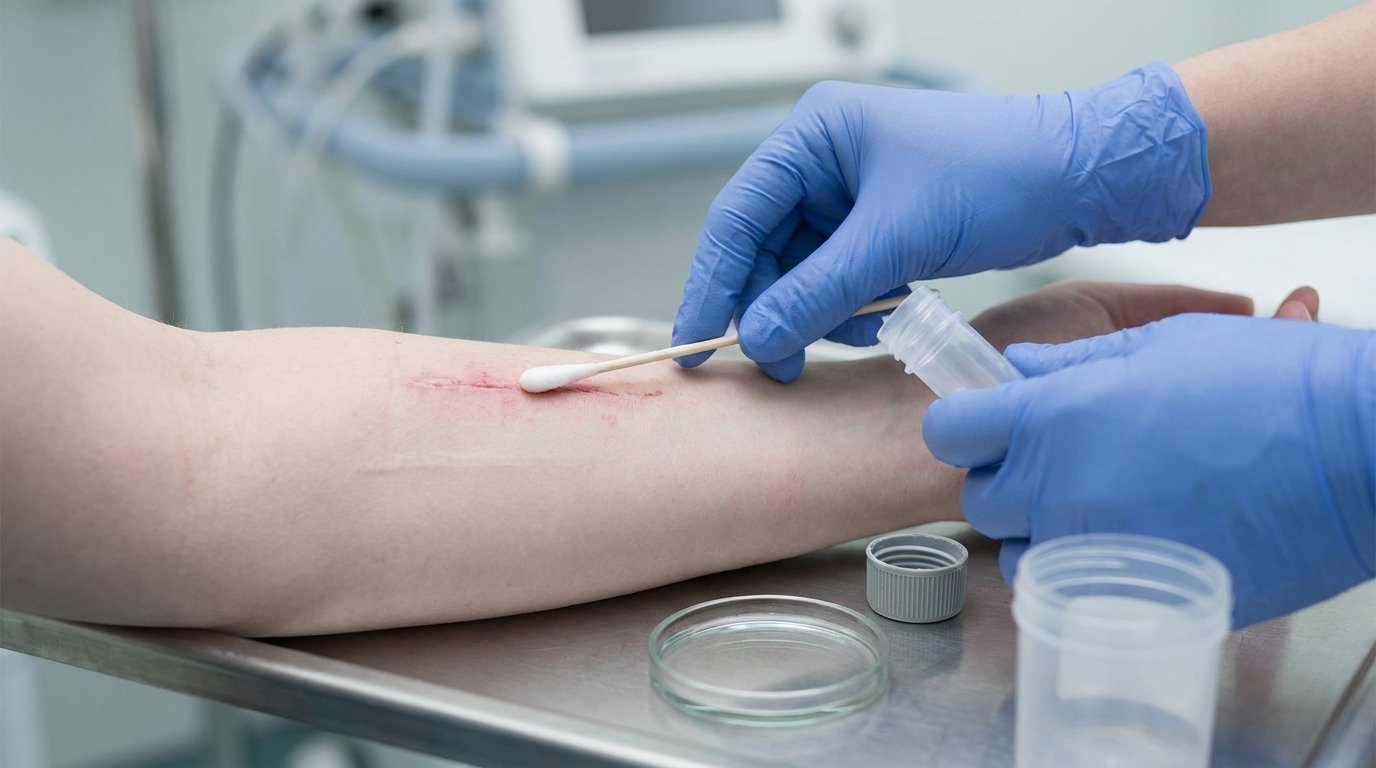
A smaller number of problems need urgent hospital care wherever you are: a blood clot in the leg or lung, significant bleeding, a spreading skin infection, or a collection of pus that has to be drained. These are rare, but they are the reason you plan ahead instead of hoping.
📋 Swelling is not a complication Firmness, bruising, numbness and lumpiness are part of normal healing for weeks, sometimes months. Judging your result — or panicking about it — in the first fortnight is the single most common source of unnecessary distress.
The warning signs that mean contact someone today
Normal recovery is uncomfortable but it trends in one direction: slowly better. The signs worth acting on are the ones that go the other way — pain that increases after day three, swelling that suddenly worsens on one side, or a temperature that climbs when it had settled.
Treat the following as reasons to contact your clinic’s aftercare line and, if you feel unwell with them, a local doctor or urgent care service on the same day:
- ✓Fever, chills or feeling generally unwell, especially after day three
- ✓Spreading redness or heat around an incision, or cloudy, smelly or increasing discharge
- ✓Pain that is getting worse rather than easing, or pain not controlled by your prescribed medication
- ✓A calf that is swollen, hot or tender, or breathlessness and chest pain (possible clot — this is an emergency)
- ✓A wound edge that opens, or a sudden increase in swelling on one side only
With dental work, the equivalents are a swelling under the jaw or in the face, difficulty swallowing, a crown or temporary that comes off and leaves a sharp or exposed tooth, and a bite that feels badly wrong rather than just new.
🚨 Do not wait for your follow-up appointment Chest pain, breathlessness, a swollen painful calf, heavy bleeding or a rapidly spreading skin infection need emergency assessment where you are — call local emergency services or go to the nearest A&E. Tell your clinic afterwards, not first.
What if something goes wrong while you are still in Turkey?
This is the easiest scenario to handle, and it is one argument for staying slightly longer than the minimum. While you are in the country, the surgeon who operated can see you, examine the wound, drain a seroma, change a dressing or adjust a plan in a single visit. Nothing has to be explained twice.
That only works if the practical details are agreed in writing before surgery. Ask who you call at 2am, in which language, and whether that number is staffed by a clinical person or a sales coordinator. Ask whether an unplanned review, a dressing change or an extra night in hospital is already inside your package or billed separately. Ask what happens to your flight and hotel if the surgeon says you are not fit to fly on the planned day.
Stay length is part of risk management rather than a comfort preference. Our guide to how long to stay in Turkey after plastic surgery sets out typical windows by procedure, and the broader aftercare, hotel and flying guide covers the first week in more detail.
Flying home without adding a new problem
Cabin pressure changes are relevant to recovery. For dental patients in particular, a 2023 paper in the British Dental Journal reviewed flight-related problems after dental treatment — barotrauma and barodontalgia, meaning pressure-related tissue injury and tooth pain triggered by changes in cabin pressure — and set out guiding principles for how long to leave between a dental procedure and flying. The practical takeaway is simple: ask your dentist or surgeon to confirm your fit-to-fly date rather than assuming your booked return flight is automatically fine.
For body and facial surgery, the usual flight precautions matter more than the altitude: move your ankles, walk the aisle, drink water, skip alcohol, and follow any clot-prevention advice such as compression stockings or prescribed blood thinners.
- ✓A 24/7 clinical contact: A named route to a doctor or nurse, in a language you speak, valid after you fly home.
- ✓Your operative details in writing: Procedure performed, implant or graft details with batch stickers, anaesthetic record, and every medication given.
- ✓A written revision and complication policy: What the clinic covers, for how long, and what you would pay for.
- ✓A fit-to-fly confirmation: From the treating surgeon or dentist, not from your travel agent or your own calendar.
Surgery abroad aftercare in the UK: who will actually see you
Back home, there are three realistic doors. Your GP can assess a wound, take swabs, prescribe antibiotics and refer onwards. NHS 111 or urgent care can triage out-of-hours worries. A&E handles the genuine emergencies — bleeding, suspected clots, severe infection — and the NHS treats emergencies regardless of where the original surgery took place.
What the NHS is not set up to do is finish private cosmetic work. Routine follow-up, stitch management on a healthy wound, drain removal, scar treatment and especially aesthetic revision generally sit outside NHS care, and policies vary between local areas. That is a funding reality rather than a judgement on you, and it is best understood before you travel instead of discovered in a waiting room.
This is where paperwork quietly becomes the most valuable thing in your suitcase. A UK clinician who has your operation note, implant details and medication list can act quickly. A clinician who has nothing but your description of “a tummy tuck in Istanbul” has to start from scratch, often with imaging and tests that take days.
It also helps enormously to have a local private option identified in advance — a GP you can get into quickly, or a private clinic or nurse-led wound service willing to see post-operative patients. Arranging that before you fly out takes one phone call. Arranging it on day nine with a leaking wound is far harder.
Registering with a UK clinician before you travel
Tell your GP practice that you are having surgery abroad, and ask whether they will do post-operative dressing changes or suture removal, and on what terms. Some practices will, some will not. Knowing which one you have is the point.

⚠️ Keep your records together Photograph your operation note, discharge summary, implant stickers, prescriptions and clinic contact details, and store them in your phone and in your email. If a complication starts, you may not be in a state to go hunting for a folder.
Who pays for revision or complication care?
There is no single answer, which is exactly why you should get the answer in writing from your own clinic before surgery. Costs break down into clinical fees, hospital or theatre time, anaesthesia, and then the travel and accommodation that come with returning. A revision package quoted after consultation usually bundles the clinical elements; flights, extra hotel nights and time off work almost always sit with the patient.
Two other things shape the figure. Revision surgery is often technically harder than the first operation — scar tissue, altered blood supply and less available tissue all add complexity, and that complexity is what drives a quote more than anything else. And timing matters: most surgeons will not revise soft tissue until healing has settled, usually many months later, so a revision budget is a future budget, not an immediate one.
Standard travel insurance typically excludes anything arising from elective treatment you flew out to have. Dedicated medical-travel or complication cover exists, but read the exclusions line by line: the limits, the time window after surgery, whether it pays for repatriation, and whether it covers treatment in your home country or only abroad.
A personalised price is only meaningful after a consultation that includes your photographs, medical history and goals. Our breakdown of what is actually included in an all-inclusive surgery package is a good place to see which lines to check before you commit.
📋 Ask one blunt question "If I need a revision in 12 months, what exactly do you cover and what do I pay for?" A clinic that answers clearly and in writing is telling you something useful about how it operates.
How to cut your risk before you book
Complication risk is never zero, and no honest clinic will tell you otherwise. What you can influence is how likely a problem is and how well it gets handled. Most of that is decided at the booking stage, not in recovery.
Start with the surgeon rather than the package. You want a named, board-certified plastic surgeon or maxillofacial surgeon — a specialist in surgery of the face and jaws — who you can identify by name before you pay a deposit, who will do a proper consultation including your medical history, and who regularly performs the specific operation you want. A video consultation with the person holding the scalpel is worth more than a glossy brochure. Our guides on choosing a surgeon in Turkey and how safety is actually assessed go into the credential checks in more depth.
Then look at the setting and the plan. Surgery should happen in a licensed hospital or accredited surgical facility with an anaesthetist and intensive care access, not in a day clinic that is improvising. Combining multiple procedures raises anaesthetic time and recovery load, so a surgeon who declines part of your wish list on safety grounds is doing their job.
Finally, be honest in your pre-operative questionnaire. Smoking, uncontrolled diabetes, obesity, blood-thinning medication, recent weight-loss drugs and a history of clots all change the risk calculation and sometimes the timing. Hiding them does not make them disappear; it just removes the surgeon’s chance to plan around them.
This article is for informational purposes only and does not constitute medical advice. Always consult a qualified surgeon for personalised guidance.
You know your surgeon’s name and credentials, the hospital is licensed and named, a pre-op consultation covers your medical history, aftercare and revision terms are in writing, and nobody rushes your decision.
Price-first messaging, no surgeon named until you arrive, pressure to book this week, a long list of procedures agreed without examination, and vague answers about what happens if something goes wrong.
Postponing until you have stopped smoking, stabilised your weight, or arranged UK-side follow-up is a legitimate option — and it usually improves both safety and the result.
Frequently Asked Questions
References
- 📎The microbial etiology and resistance patterns of cosmetic tourism-related infections in Ireland — Irish Journal of Medical Sciences, 2024
- 📎Dental tourism and the risk of barotrauma and barodontalgia — British Dental Journal, 2023
- 📎NHS — Cosmetic procedures
Related Articles



You Might Also Like

Related articles



Our specialists
 Clineca SpecialistErkan PinegözPlastic & Reconstructive Surgery
 Clineca SpecialistHakan AktaşPlastic & Reconstructive Surgery
 Clineca SpecialistOrkun UzuneyüpoğluPlastic & Reconstructive Surgery
 Clineca SpecialistSalim İskenderPlastic & Reconstructive Surgery
 Clineca SpecialistEngin SelamioğluPlastic & Reconstructive Surgery
 Clineca SpecialistCem AydınPlastic & Reconstructive Surgery
 Clineca SpecialistAlperen ÖnalEar, Nose & Throat (ENT)