Have a question about Breast Lift?
In this article
- What does a lift change, and what do implants change?
- How is the choice actually made?
- Which is more common in practice?
- How do the two compare day to day?
- What does each route ask of you afterwards?
- Do the scars differ?
- Does one recover faster than the other?
- What do people get wrong before the consultation?
- How long does each option hold?
- Who should wait?
A breast lift and breast implants answer two different complaints that are easy to confuse: a lift changes where the breast sits, while implants change how full it is. In broad terms, a breast that has dropped but still has tissue to reshape needs a lift; a breast that has emptied at the top needs volume, and a lift alone will look neat but flat. This article sets out how the choice is actually made, what each option cannot do, and why the answer splits far more evenly than most people assume before their consultation.
What does a lift change, and what do implants change?
A lift moves the breast tissue and the nipple higher on the chest and removes the skin that is no longer holding them in place. It changes shape and position. It does not change size in any meaningful way, and it does not create fullness where there is no tissue left to reposition.
An implant does the opposite. It adds volume, and it adds most of it in the upper pole — the part above the nipple that empties first after weight loss, breastfeeding or simply time. It does not lift a breast that has dropped substantially; placing volume behind loose skin usually makes the drop more obvious rather than less.

Put simply: a lift makes the breast sit where it used to sit, and an implant makes it as full as it used to be. They are not competing options so much as answers to different questions, which is why the consultation matters more here than almost anywhere else in breast surgery.
There is also a middle route worth knowing about, fat transfer instead of an implant, which suits a smaller change in fullness. And there is a third possibility that gets forgotten: sometimes the honest answer is that neither is needed yet. A breast that has dropped slightly and still has good tissue can look considerably better in a well-fitted bra than it does in a consultation photograph, and that is worth knowing before committing to surgery.
How is the choice actually made?
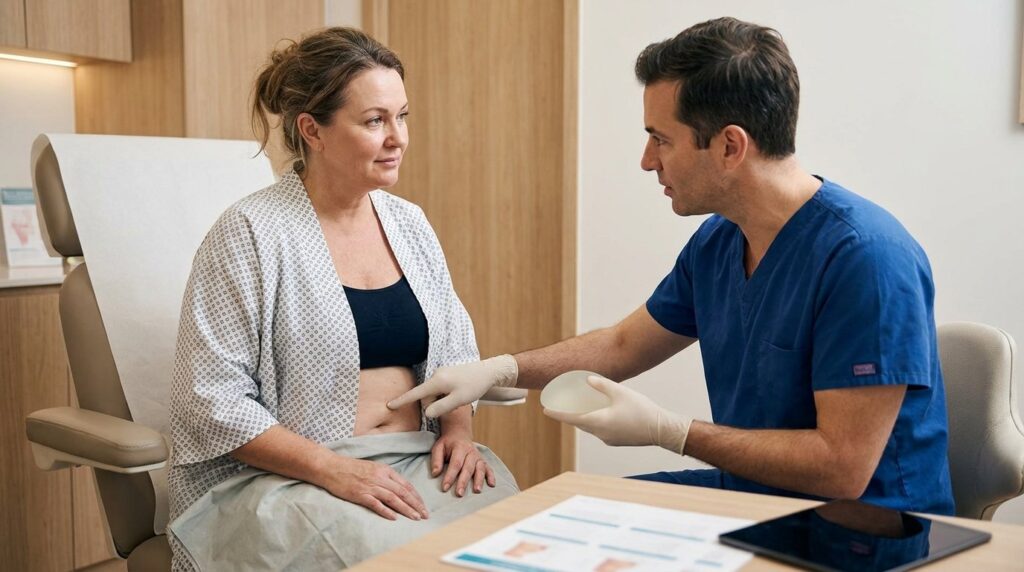
On how much breast tissue is left, not on how much lift you want. The surgeon looks at three things: where the nipple sits relative to the fold beneath the breast, how much tissue remains in the upper pole, and how far the skin has stretched.
The question almost always arrives in the same shape. Someone is happy with their size but the breasts have dropped after weight loss or breastfeeding, and they want to know whether a lift alone will be enough. The answer turns on that upper pole. If there is still tissue there to reposition, a lift alone will look full and the result holds. If volume is the main complaint rather than position, breast augmentation is the operation that answers it. If it has emptied, a lift alone gives a well-placed but flat breast, and that is where nearly all the disappointment in this operation comes from.
This is also why photographs are a poor guide. Two people with identical starting sizes can need different operations, because the tissue behind the skin is doing different things.
Skin quality matters almost as much as volume. Skin that has been stretched twice and has lost its recoil behaves differently from skin that stretched once and stayed elastic, and it changes how long the lift holds. This is the part that cannot be judged from a photograph at all.
📋 The upper pole decides it. Fullness above the nipple is what a lift cannot create. That single question is what the surgeon is answering when they examine you.
Which is more common in practice?
It splits close to the middle, which is the most useful thing to know before you walk into a consultation with your mind made up. A little over half of the breast lifts we plan include an implant; the rest are a lift on its own.
Neither is the standard answer. That matters because it means anyone telling you what you need before examining you — including a website, including a photograph, including a friend who had a good result — is guessing. It also means neither choice is the compromise; both are ordinary.
The even split also explains why price comparisons between clinics are so unreliable here. Two quotes for a breast lift can describe two different operations, and the cheaper one is sometimes cheaper because it does not include the implant that your examination would have called for.
How do the two compare day to day?
The differences that show up in daily life are smaller than the differences on paper. Both restrict your arms for the same first fortnight, both need a support garment, and both settle over months rather than weeks.
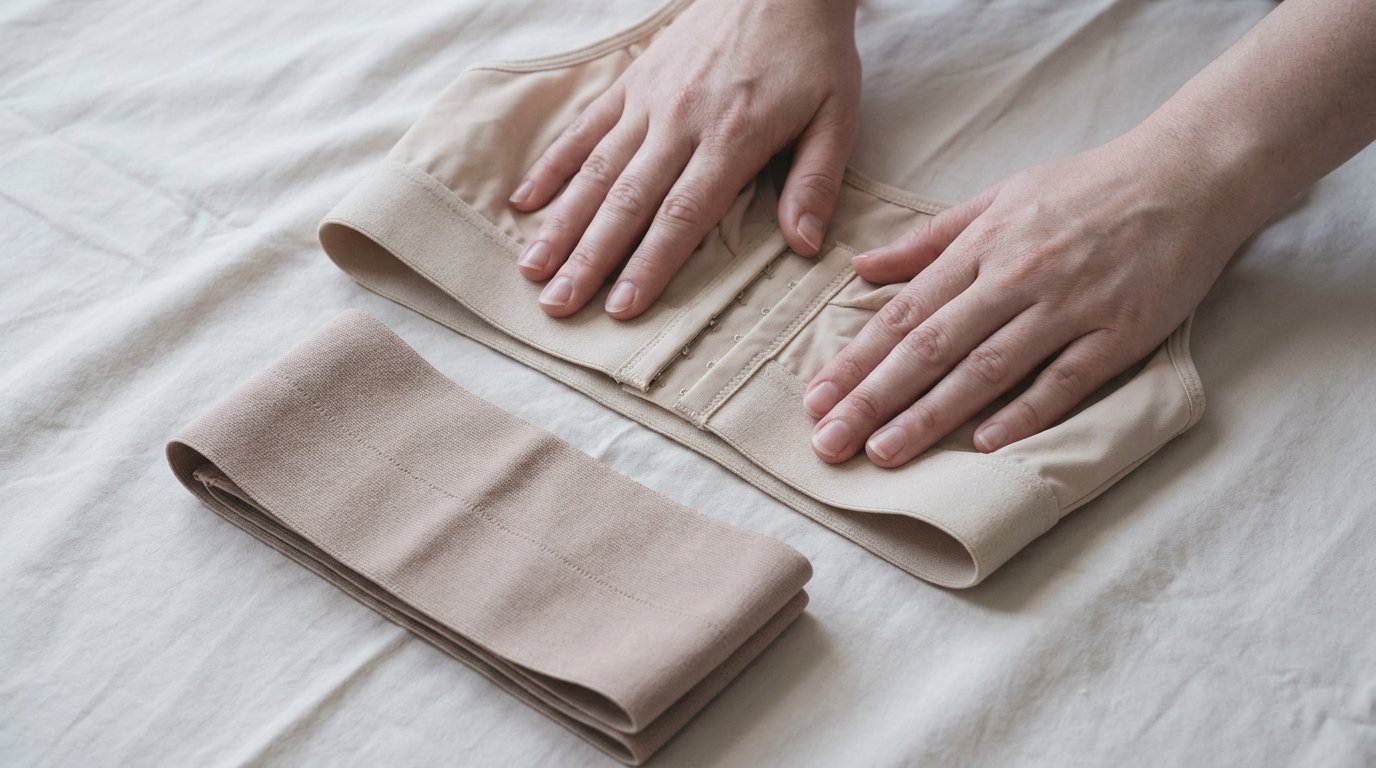
In the first fortnight, most people cannot tell you from the outside which route someone took. The visible difference emerges around the second month, when the upper pole either fills out or settles flat, which is precisely when the original decision stops being reversible.
What does each route ask of you afterwards?
The two routes diverge less in the operating theatre than in the years that follow. Neither is maintenance-free, but the maintenance is a different kind, and knowing which kind suits your life is a legitimate part of the decision.
📋 Ask what happens in ten years, not ten weeks. Both routes age. The useful question is which kind of ageing you would rather manage.
Do the scars differ?
The scar pattern comes from the lift, not from the implant. How much skin has to be removed decides whether you need a scar around the areola only, a vertical line down to the fold, or the full anchor pattern that adds a line along the crease.

Adding an implant does not add a scar. In some cases it slightly reduces how much skin needs to come out, because the volume takes up part of the slack. What decides your pattern is the distance the nipple has to travel and how much loose skin is left once it gets there.
Scar quality depends far more on your skin and on how the wound is looked after than on which operation you had. Sun, tension and smoking all matter more than the pattern itself, and all three are things you control rather than things the surgeon does.
Does one recover faster than the other?
They are closer than people expect, because the lift is the larger part of the operation in both cases. Adding an implant adds a deeper soreness in the first week, particularly if it sits under the muscle, and a slightly longer wait before reaching above your head is comfortable.
The overall shape of recovery is the same: a demanding first fortnight, a return to desk work somewhere in weeks two to three, and a final shape that keeps refining for months. Where they differ most is later, when implant patients start asking about how the shape is settling and lift-only patients have stopped asking anything at all.
The most common surprise in both groups is how long the swelling lasts compared with how quickly the pain goes. Being comfortable at three weeks and still not looking finished at three months is normal, and people who expect the two to arrive together find the middle period harder than it needs to be.
What do people get wrong before the consultation?
Three things, and all three are understandable. The first is arriving with the operation already chosen, usually from a photograph of someone whose starting point was different. The photograph shows a result; it does not show the tissue that made that result possible.
The second is describing the problem in the wrong vocabulary. People say they want to be bigger when what bothers them is that the breast sits low, and they say they want a lift when what bothers them is that the top looks empty in a bra. Those are different operations, and the words point at the wrong one surprisingly often.
The third is treating the implant decision as permanent versus temporary. A lift is not permanent either — skin keeps ageing, and pregnancy or weight change will alter both routes. The honest framing is that one route adds a device to maintain and the other does not.
A useful test before you book anything: can you say in one sentence what bothers you when you look in the mirror, without naming an operation? If you can, the consultation will be quick and accurate. If you cannot, the consultation is exactly where that sentence gets found.
📋 Describe the complaint, not the operation. Say what bothers you when you look in the mirror. Choosing the procedure is the surgeon’s job, and it is a different one depending on what you actually describe.
How long does each option hold?
A lift holds for as long as your skin and gravity allow, which is a real answer rather than an evasive one. Skin keeps ageing after surgery, and a lift does not stop that; what it does is reset the starting point. Most people are looking at years rather than decades before they notice drift, and pregnancy or significant weight change will shorten that considerably in either route.
Implants run on a separate clock. They are not lifetime devices, and planning as though they are is the most common mistake in this decision. That does not mean an operation is scheduled in advance; it means the possibility of replacement or removal belongs in your thinking alongside the cost and recovery of the first operation.
The practical difference is what happens if you do nothing later. A lift that has drifted looks like a breast that has aged. An implant left in place indefinitely is a device that needs watching, which is why anyone with implants should expect an occasional review rather than assuming silence means everything is fine.
📋 Neither route is permanent. One ages with your skin; the other adds a device to keep an eye on. The honest comparison is between two kinds of maintenance, not between temporary and forever.
Who should wait?
Anyone whose weight is still moving, anyone planning a pregnancy in the near future, and anyone still breastfeeding. All three change breast volume and skin quality, and all three can undo an otherwise good result.
Waiting is not a soft answer or a way of turning you away. It is the difference between one operation and two, and the people who regret operating early are almost always the ones who were told to wait and did not.
Waiting also gives you something a rushed decision does not: time to see whether the complaint is stable. Some people find that what bothered them after a pregnancy bothers them much less a year later, and that is a legitimate outcome rather than a wasted consultation.
⚠️ Weight first, surgery second. Operating on a breast that is still changing means operating on a shape that will not be there in six months.
Frequently Asked Questions
References
Related Articles



You Might Also Like



Related articles


Our specialists
 Clineca SpecialistErkan PinegözPlastic & Reconstructive Surgery
 Clineca SpecialistHakan AktaşPlastic & Reconstructive Surgery
 Clineca SpecialistOrkun UzuneyüpoğluPlastic & Reconstructive Surgery
 Clineca SpecialistSalim İskenderPlastic & Reconstructive Surgery
 Clineca SpecialistEngin SelamioğluPlastic & Reconstructive Surgery
 Clineca SpecialistCem AydınPlastic & Reconstructive Surgery
 Clineca SpecialistAlperen ÖnalEar, Nose & Throat (ENT)