
Have a question about Liposuction?
In this article
- The two-phase wear schedule most surgeons use
- Why compression matters after liposuction
- Stage 1 versus stage 2 garments, plus foams and boards
- Fit matters more than hours logged
- If your liposuction is combined with a BBL or tummy tuck
- Living in it: showers, sleep, work, washing and flights
- Cost, what a quote usually includes, and checking the plan with your clinic
Almost every patient asks how long to wear a compression garment after lipo before they even ask about scars, and the honest answer sits somewhere between a strict rule and a moving target. Surgeons do not all use the same protocol, and the garment you are given in theatre is rarely the one you will be wearing a month later. What follows is the practical version: the usual phases, how many hours a day they involve, and the details that decide whether the garment helps your result or quietly works against it.
The two-phase wear schedule most surgeons use
Most liposuction aftercare plans split garment wear into two phases. The first phase covers roughly the first two weeks and is round-the-clock: the garment stays on day and night, coming off only for showering once your surgical team says that is allowed. The second phase runs from about week three to week six, when many surgeons drop you down to daytime-only wear or something close to twelve hours a day.
From there, plans diverge. Some surgeons stop at six weeks. Others ask for light compression during long days or workouts up to the third month, especially after large-volume or 360-degree treatments where swelling takes longer to settle. The amount of fat removed, the number of areas treated, your skin quality and whether drains were used all shift the schedule, which is why your written discharge instructions beat anything you read online, including this page.
It also helps to know what the garment is competing against. Swelling after liposuction does not peak and vanish in a week — it builds for a few days, settles unevenly, and can still be visible at the six-week mark, as the liposuction swelling week-by-week timeline sets out in more detail. The garment is there for that whole slow curve, not just the dramatic early part.
📋 Your surgeon’s protocol wins These phases describe common practice, not a universal standard. If your discharge sheet says eight weeks of full-time wear, follow it — the person who saw your tissue in theatre knows how much dead space they created.
Why compression matters after liposuction
Liposuction leaves behind a network of narrow tunnels through the fat layer, plus a layer of skin that is no longer sitting on the volume it used to. Tissue fluid collects in that space. Compression reduces the gap, encourages the skin to re-adhere to what lies beneath, and limits how much fluid and bruising accumulate while the small vessels seal. For most people it also simply feels better — the garment stops the heavy, sloshing sensation you get when you stand up without it.
Compression is not unique to cosmetic surgery; it is a long-standing tool anywhere fluid needs managing. A 2025 narrative review in Scandinavian Journal of Surgery on lymphedema care describes compression garments as a cornerstone of conservative treatment while being frank that they are hard to wear day in, day out. That second half is worth holding onto: discomfort is expected, and the plan works best when it is realistic rather than heroic.
What the evidence does not give us is a single proven number of weeks. Protocols are built on surgical experience and on how each patient’s swelling behaves, so two surgeons can reasonably ask for different things after the same operation. Treat any source that claims one exact duration is scientifically settled with mild suspicion.
⚠️ Stopping early has a cost you may not see straight away Abandoning the garment in week two usually does not cause pain — it tends to show up later as more persistent swelling or fluid collecting in a pocket, which then needs draining in clinic. Tell your surgeon you are struggling instead of quietly stopping.
Stage 1 versus stage 2 garments, plus foams and boards
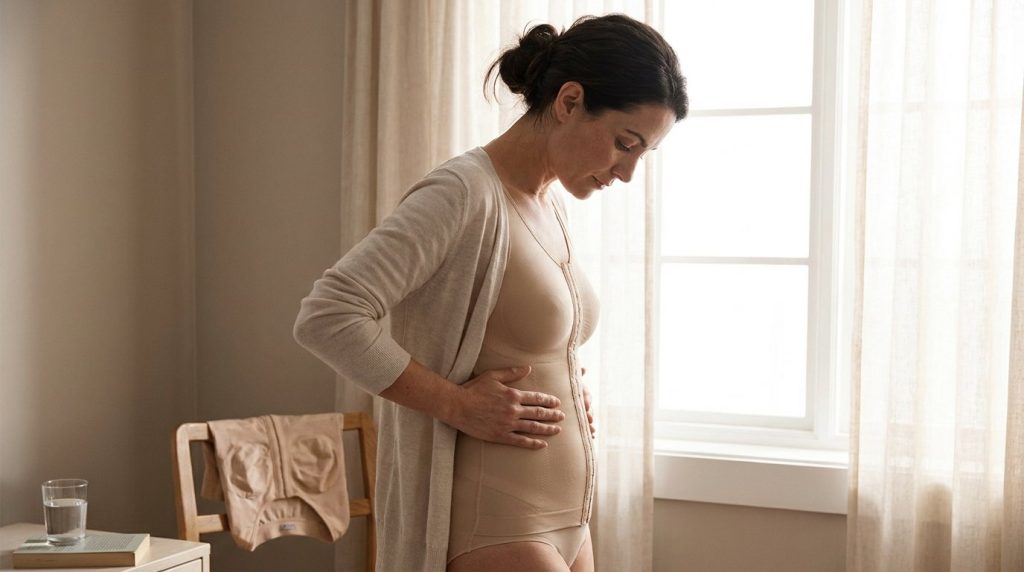
The garment you leave the operating room in is a stage 1: softer, usually fastened with hooks or zips so you can get into it without bending or stretching, and cut to sit over dressings. It is designed for a swollen, tender body that cannot pull anything over its head.
Stage 2 garments come in once the dressings are off and the first wave of swelling has eased, often somewhere between week two and week four. They are firmer, flatter under clothes and more sculpting, which is exactly why they are wrong for the first days — you would not get into one comfortably, and you do not want that much pressure on freshly treated tissue.
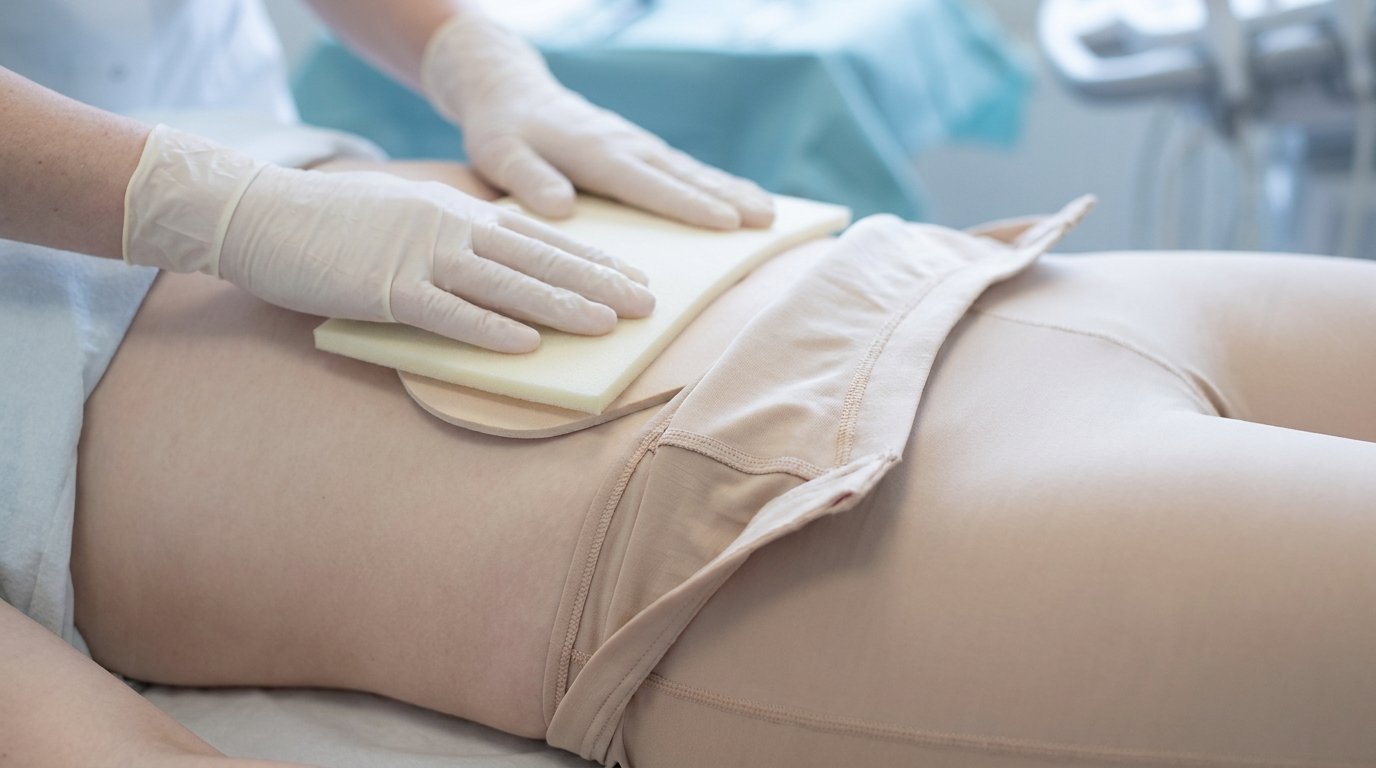
Many surgeons add foam sheets, lipo pads or abdominal boards underneath the garment for the first few weeks. The purpose is to spread pressure evenly and stop seams, hems and skin folds from pressing lines into soft tissue. If your team gave you foam, use it; patients who leave it in the suitcase sometimes come back with a visible crease exactly where the garment edge sat.
Fit matters more than hours logged
A garment that is too tight does not speed anything up. Excess pressure can restrict circulation, irritate the skin and, where a seam digs into one spot, leave a dent in the contour you paid to improve. Conversely, a garment so loose that it rolls or rides up gives you nothing but false reassurance.
The standard you want is firm, even and boring. You should be able to breathe normally, walk comfortably and feel pressure spread across the whole treated area rather than concentrated in a band. Most patients need a size change at least once during recovery, because the body you are wearing it on in week one is not the body you have in week four.
If you bought your own garment before surgery, do not assume the size is right. Buy after measurement where possible, or expect to order a second one later.
🚨 Remove it and call your clinic if You develop numbness that does not settle within minutes of taking the garment off, skin that stays pale or dusky, a spreading hot red area, a wound opening, or calf pain and breathlessness. These need assessment, not a tighter garment.
Even pressure across the whole area, no rolling at the edges, skin colour and sensation normal, you can take a full breath and walk for twenty minutes without wanting it off.
Pins and needles, cold or dusky skin, deep red grooves that stay after removal, pain that eases the moment you take it off, or blistering and raw patches where a seam sits.
The garment slides down, bunches behind the knees or rides above the treated area, and you feel swollen and heavy when standing even though the garment is on.
If your liposuction is combined with a BBL or tummy tuck
Standalone liposuction is less common than people assume, and that changes the garment conversation. Around three in four of our liposuction patients have it as part of a combined operation, most often alongside a Brazilian butt lift or a tummy tuck — so if you are planning one of those pairings, the compression instructions that apply to you are the combined ones, not the ones written for lipo alone.
With fat transfer to the buttocks, the garment must hold the treated areas firmly while leaving the grafted buttock uncompressed. A garment with a cut-out, or one sized so it does not press on the graft, is standard; squeezing the buttocks in the early weeks risks the survival of the transferred fat. Sitting restrictions and travel rules then run on their own clock, which is covered in our guidance on flying after a BBL.
With a tummy tuck, you are usually in an abdominal binder or a garment that supports a long incision as well as the liposuctioned flanks, and surgeons often ask for a longer total wear period. In combined plans the rule of thumb is simple: pace everything by the more demanding procedure. If your lipo-only schedule says six weeks and your tummy tuck schedule says eight, you are on eight.
📋 Ask before you buy Patients who order garments online before a combined operation frequently buy the wrong style — a full-coverage compression suit is useless if your surgeon needs the buttocks left free. Wait for the clinic’s specification.
Living in it: showers, sleep, work, washing and flights
The practical side is what people underestimate. You will be in this thing almost continuously for a fortnight, so the logistics deserve a little planning before you travel.
- ✓Showering. Once your team clears you, you can usually take the garment off for a shower and put it straight back on. Dry your skin fully first; damp skin under compression chafes quickly.
- ✓Two garments, not one. A second garment means you can wash one and wear the other. Hand wash or use a gentle cycle and let it air dry — a tumble dryer kills the elastic and with it the compression.
- ✓Sleep. Most patients sleep in the garment throughout phase one. A slightly propped position and a pillow under the knees takes pressure off the lower back.
- ✓Work. Desk-based work is often manageable within one to two weeks, and the garment sits discreetly under loose clothing. Jobs with lifting or long standing usually need longer.
- ✓Flying home. Keep the garment on for the flight. Compression plus getting up to walk the aisle every hour or so is sensible on any post-surgical journey, and it is one reason clinics want you to stay in Turkey for a set number of nights before travelling — see our guidance on how long to stay in Turkey after plastic surgery.
One more honest note: the garment is sweaty, especially in an Istanbul summer. Cotton layers underneath, loose outer clothing and a slightly larger second garment for the hottest part of the day make the difference between compliance and giving up in week two.
- ✓Pack a second garment: Washing and drying in a hotel room takes longer than you think.
- ✓Pack loose, dark clothing: Easy to pull on over a bulky stage 1 garment and forgiving of leakage in the first days.
- ✓Keep the foam pieces: They stop seams and folds pressing lines into treated areas.
- ✓Photograph your instructions: Discharge sheets get lost; a phone photo travels with you.
Cost, what a quote usually includes, and checking the plan with your clinic
Garments are a small part of the overall spend, but they are a common gap in quotes. In Turkey, package pricing for liposuction normally bundles the first garment because it is fitted at the end of surgery. What varies is whether a stage 2 garment, a replacement in a different size, foams or boards and any post-operative lymphatic drainage sessions are included or added later. Ask for that in writing before you book, alongside the wider cost drivers set out in our overview of liposuction in Turkey. A personalised price can only be confirmed after a consultation, once the areas and the volume involved are agreed.
On safety and clinic choice, the garment plan itself is a useful signal. A clinic that measures you, specifies a stage 2 garment, explains when to switch and tells you who to message if something feels wrong is running proper aftercare. A clinic that hands over one garment with no instructions and no follow-up route is telling you something too.
Questions worth asking before you fly home
Ask how many total weeks of compression your surgeon expects for your specific plan, when you should move to stage 2, who reviews your progress remotely and what they want you to do if you spot a soft, fluid-filled swelling. Fluid collections are manageable when reported early and far more annoying when ignored for a month. Make sure you leave with a named contact rather than a general inbox.
Finally, keep expectations proportionate. Compression supports healing and comfort; it does not create the result on its own, and no garment compensates for skin that needed tightening rather than fat removal. If you are unsure which of those applies to you, that is a consultation question, and an honest surgeon will tell you plainly.
This article is for informational purposes only and does not constitute medical advice. Always consult a qualified surgeon for personalised guidance.
⚠️ No guarantees on contour Wearing a garment exactly as instructed improves comfort and supports smooth healing, but no garment can promise a particular shape. Final contour depends on your anatomy, skin elasticity and surgical technique.
Frequently Asked Questions
References
- 📎Modern surgical treatments for lymphedema — Scandinavian Journal of Surgery, 2025
- 📎ASPS — Cosmetic Procedures
- 📎NHS — Cosmetic Procedures
Related Articles

You Might Also Like



Related articles
Our specialists
 Clineca SpecialistErkan PinegözPlastic & Reconstructive Surgery
 Clineca SpecialistHakan AktaşPlastic & Reconstructive Surgery
 Clineca SpecialistOrkun UzuneyüpoğluPlastic & Reconstructive Surgery
 Clineca SpecialistSalim İskenderPlastic & Reconstructive Surgery
 Clineca SpecialistEngin SelamioğluPlastic & Reconstructive Surgery
 Clineca SpecialistCem AydınPlastic & Reconstructive Surgery
 Clineca SpecialistAlperen ÖnalEar, Nose & Throat (ENT)