
Have a question about Tummy Tuck?
In this article
- What a tummy tuck scar actually is
- How low is a tummy tuck scar, and will underwear cover it?
- Tummy tuck scar timeline: month by month
- Why some tummy tuck scars fade better than others
- Scar care that is worth your effort
- Red flags: when a healing scar needs a doctor
- If the scar does not settle: what can still be done
- Healing the scar when you had surgery in Turkey
A tummy tuck trades loose skin for a line across the lower abdomen, and most people think about that line long before they think about the flat stomach. Tummy tuck scar healing is also one of the least linear parts of the whole recovery, which is why so many patients message their surgeon in month two convinced something has gone wrong. What follows is what the scar does over time, where it should sit, and which parts of scar care genuinely change the end result.
What a tummy tuck scar actually is
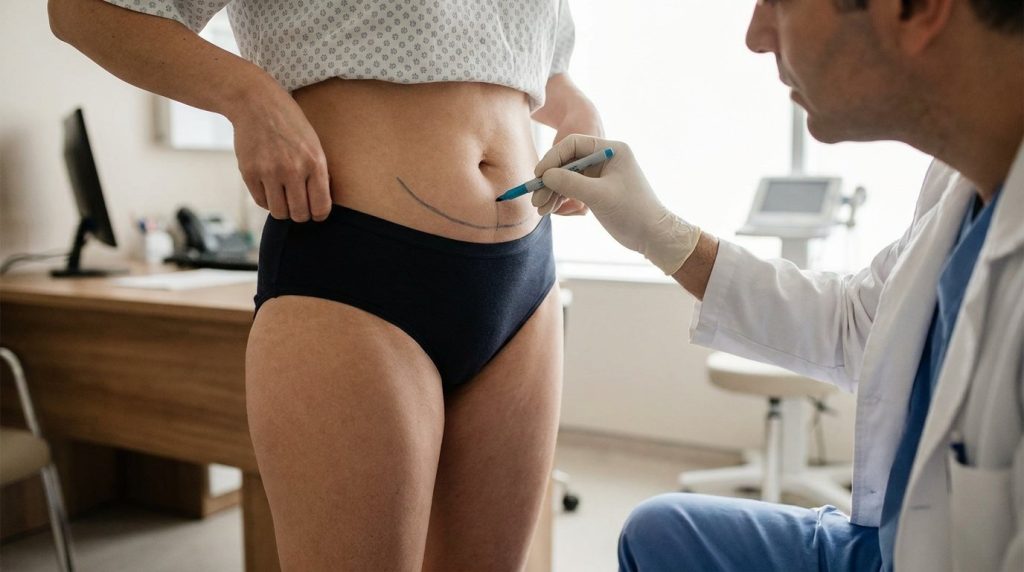
A full tummy tuck (abdominoplasty) leaves one long horizontal scar running low across the lower abdomen, roughly from hip to hip, plus a smaller circular or oval scar around the belly button. The navel is detached from the skin that gets removed and brought out through a new opening, so that second scar is unavoidable in a full procedure.
The line is long because the surgery is about skin, not fat. To pull the upper abdominal skin down and remove the stretched, loose portion below it, the surgeon needs an opening wide enough to lift the whole flap. A short incision can only remove a short strip of skin — that is the real trade-off behind every “smaller scar” version of the operation, and it’s covered in more detail in our comparison of mini and full tummy tuck techniques.
How the scar is closed matters as much as where it sits. Most surgeons close in layers, bring the deep tissue together so the surface skin is under as little tension as possible, and use dissolving stitches under the skin rather than through it. Tension is the single biggest enemy of a fine scar, which is why the closure technique and your own healing behaviour in the first three months carry so much weight.
📋 Scar quality is partly out of anyone’s hands Technique and aftercare shift the odds, but your genetics, skin tone and healing tendencies set the baseline. No surgeon can promise a particular scar appearance, and a good consultation will say so plainly.
How low is a tummy tuck scar, and will underwear cover it?
In a well-planned full tummy tuck the horizontal scar sits low — generally a few centimetres above the pubic hairline, lower than a typical caesarean scar, and angled slightly upward towards each hip so it follows a bikini or brief line rather than cutting straight across. The goal is a line that disappears under the underwear you actually wear.
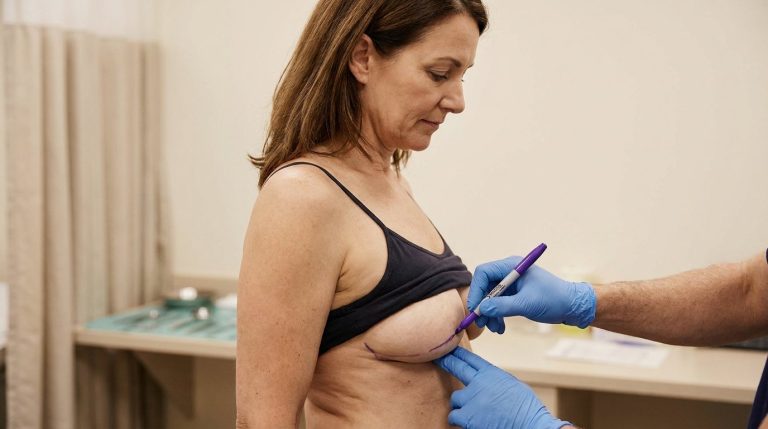
That last point is worth taking literally. Bring the lowest-cut garment you plan to wear — briefs, bikini bottoms, swim shorts — to your pre-operative marking appointment and put it on while the surgeon draws. Markings are made with you standing up, and a few centimetres decided in that ten-minute conversation will matter for the rest of your life.
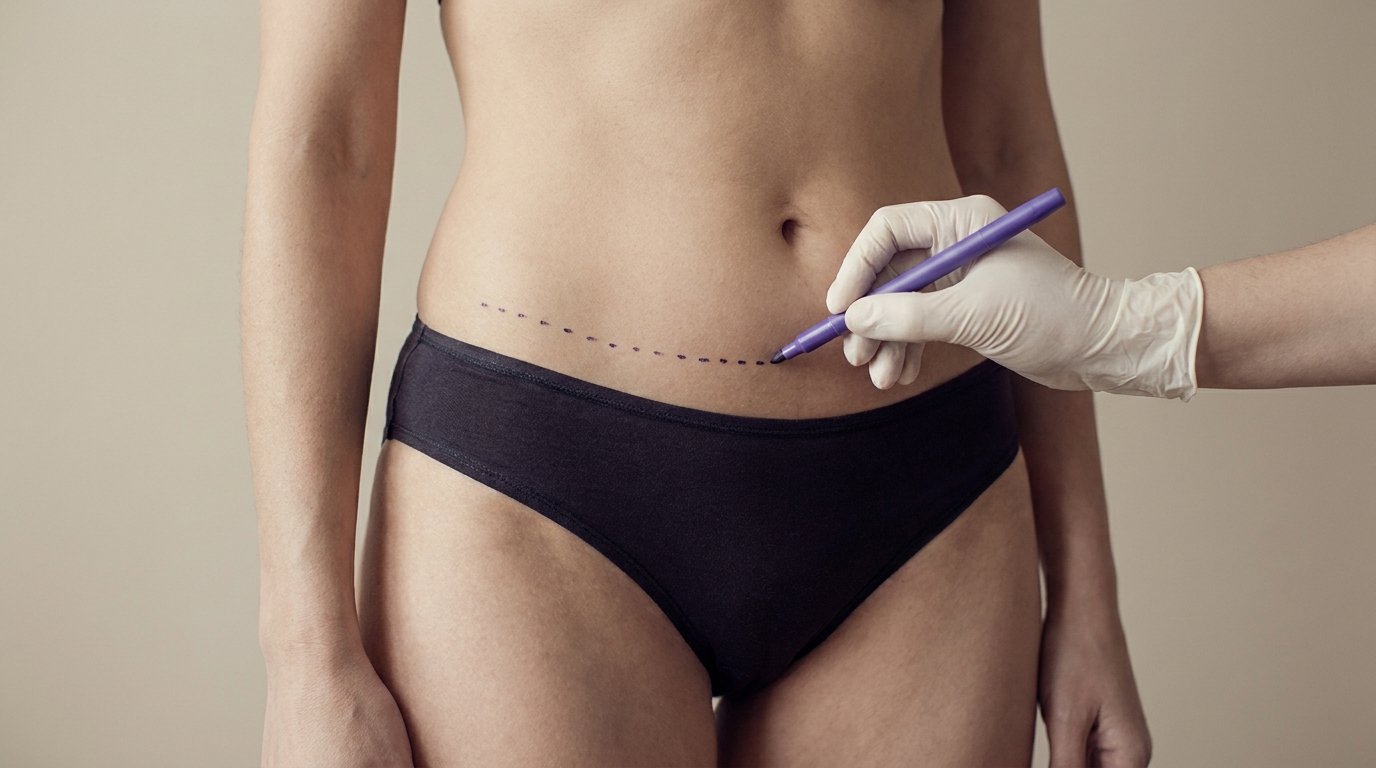
There are limits on how low the line can go. The scar ends up where the two edges meet comfortably, and that depends on how much skin you have to spare. If your loose skin is limited, pulling the incision very low can force the closure under tension or leave the navel sitting too high. Surgeons also avoid distorting the pubic area by dragging it upward. In practice, the final height is a compromise between the lowest possible placement and a relaxed, well-balanced closure.
Hip ends, dog ears and tattoos
The outer ends of the scar are where small puckers of skin — often called dog ears — can appear, especially in patients with fuller hips. Some settle on their own over several months; others need a small in-office revision later. If you have abdominal tattoos, expect the design to be cut, shifted or partly removed, and discuss it in advance; we cover the specifics in our article on tummy tucks and existing tattoos.
Tummy tuck scar timeline: month by month
Scars do not fade steadily. They get redder, firmer and more obvious for the first two to three months, then slowly reverse course over the following year or more. Knowing that pattern in advance prevents a lot of unnecessary worry.
The early weeks are dominated by swelling, tape or glue over the incision, and numb skin above the line. Numbness is normal and often lasts months, because small sensory nerves were cut. Most patients find the scar reaches peak appearance — raised, pink to dark red or brown, firm to the touch, sometimes itchy — somewhere around weeks eight to twelve. From there it softens, flattens and pales, with the most visible change happening between months four and nine.
Final maturity is slow. Most scars are close to their long-term appearance by twelve months and fully settled by eighteen to twenty-four months. A mature tummy tuck scar is typically a thin, flat, pale or slightly lighter line — noticeable close up, easy to miss at a glance, and nothing like what it looked like at the three-month mark. It never disappears entirely.
If you want the broader picture of how the scar timeline sits inside overall healing, our week-by-week abdominoplasty recovery guide runs alongside this one.
⚠️ Darker skin tones need extra patience Richly pigmented skin is more prone to lasting darkening of the scar line and, less commonly, to thickened or keloid scarring. Tell your surgeon if you or close relatives have ever formed raised scars, because it changes both the closure plan and the aftercare plan.
Why some tummy tuck scars fade better than others
Two patients can have the same operation by the same surgeon and end up with visibly different lines. Some of that is genetic luck. A surprising amount of it, though, comes down to tension, blood supply and behaviour in the first three months.
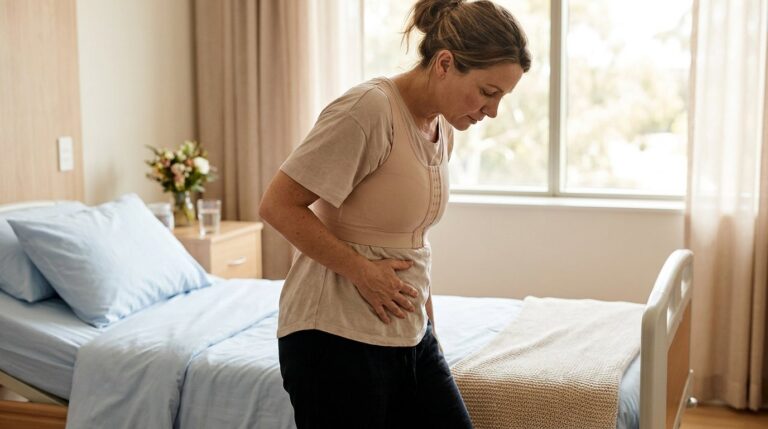
Standing up straight too early is the classic avoidable mistake. Pulling the closure taut while it is still fragile widens the scar and nothing later fully undoes that; our guide on when you can stand up straight after a tummy tuck explains the staged approach. Smoking and nicotine in any form — including vapes and patches — constrict the small vessels feeding the wound edges and are associated with delayed healing and poorer scars. Significant weight gain or loss during the first year stretches or slackens the line. Diabetes, anaemia and poor nutrition slow everything down.
Fluid collections under the flap, known as seromas, and any wound infection also hurt the end result, because a scar that heals in two stages instead of one almost always ends up wider. That is a large part of why drains, compression garments and prompt follow-up matter more here than in smaller procedures.
- →Tension across the closure: The strongest single factor. Hence the bent-forward posture, the garment and the activity limits in the first weeks.
- →Nicotine in any form: Reduces blood flow to the wound edges and raises the risk of delayed healing and a thicker scar.
- →Stable weight: Big fluctuations in the first twelve months stretch or slacken the healing line.
- →Sun exposure: Ultraviolet light on an immature scar locks in darkening that can last years. Cover it or block it for at least a year.
- →Individual healing tendency: A personal or family history of thickened or keloid scars should change the plan before surgery, not after.
Scar care that is worth your effort
Scar care is less about miracle products and more about doing a few boring things consistently for a long time. Nothing you apply will erase the line. The realistic aim is a scar that is flatter, paler and narrower than it would otherwise have been.
Silicone is the mainstay, available as sheets or gel, and it is the option with the most support behind it for softening and flattening scars. Start only once the wound is completely closed with no scabs or open areas — usually around three to four weeks, but your surgeon decides. Then use it daily for months, not weeks. Paper taping over the scar is a second approach some surgeons prefer, because it supports the closure and reduces mechanical stress on the line.
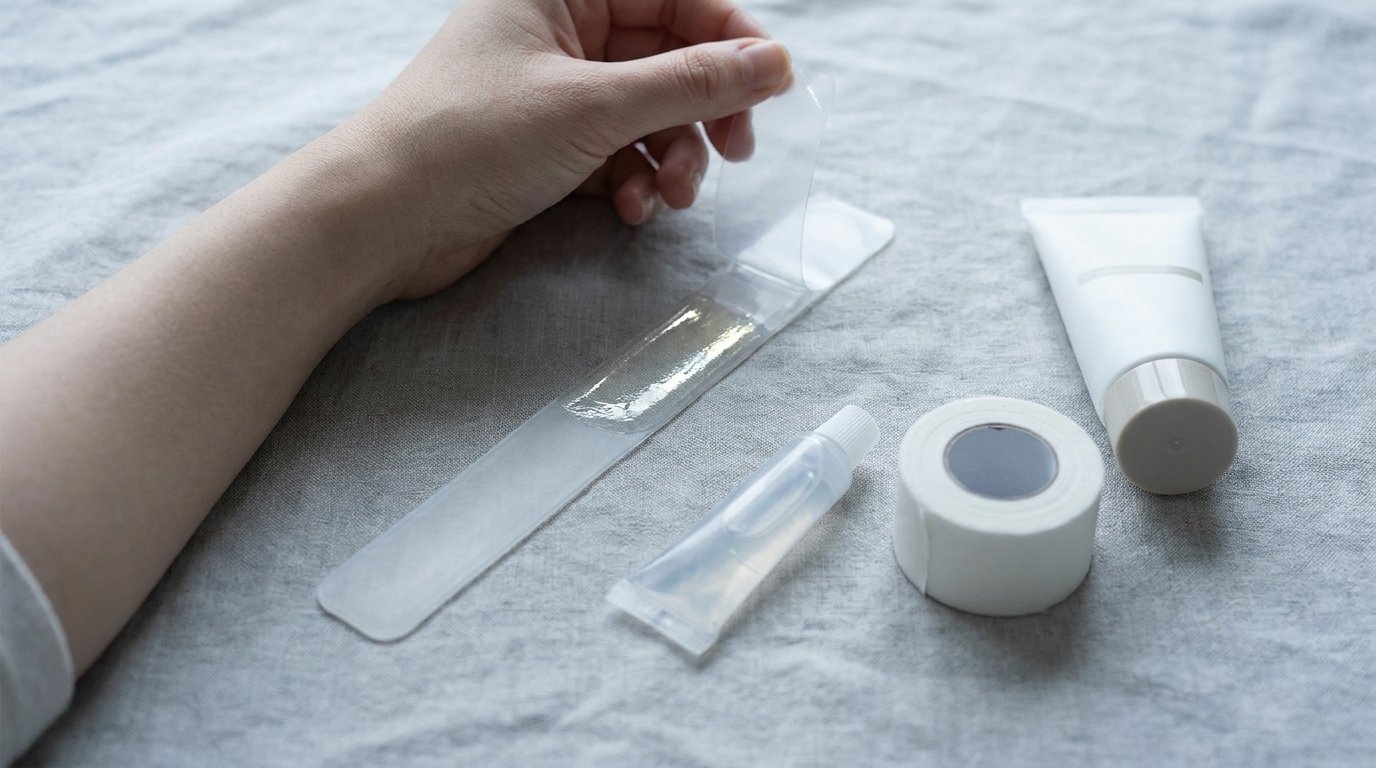
Gentle massage, once you are cleared for it, helps soften a firm ridge. Sun protection is non-negotiable for the first year: high-factor sunscreen when the scar is exposed, and clothing or a high-waisted swimsuit when you are on a beach. Keep the compression garment on for the full period you were given, because it limits both swelling and movement across the incision.
One practical note on planning: around 87% of our tummy tuck patients have at least one other procedure in the same session, most often a breast lift, a breast lift with implants, or liposuction. If that is your plan too, the scar care you go home with covers several healing lines at once with different timetables, and the overall recovery is paced by whichever procedure is slower — so build your aftercare schedule around the combined operation rather than the tummy tuck alone.
⚠️ Do not start products early Applying oils, creams or silicone to a wound that is still scabbed, weeping or partly open can irritate it or cause a reaction, and a setback in week three costs you far more than a few early days of treatment gain.
- ✓Silicone sheets or gel daily, starting only after full closure and continuing for several months
- ✓Paper tape over the line if your surgeon uses that protocol instead of silicone
- ✓Compression garment worn for the full prescribed period, not until you feel better
- ✓High-factor sunscreen or clothing cover over the scar for at least twelve months
- ✓Light scar massage once cleared, to soften a firm or ridged section
- ✓Stable weight, no nicotine, and protein-adequate eating while the wound matures
Red flags: when a healing scar needs a doctor
Most of what alarms patients in the first three months is normal — redness, firmness, itching, lumps along the line, uneven appearance from side to side, numbness above the scar. What is not normal is anything that gets worse day over day rather than better.
Contact your surgeon or clinic the same day if the skin around the incision becomes hot, increasingly red and spreading, if you develop a fever, if fluid or pus leaks from the line, if a section of the scar opens, or if the central portion turns dusky, grey or black. Sudden fullness and a sloshing feeling in the lower abdomen can mean a fluid collection that needs draining. Calf pain, chest pain or breathlessness are emergencies unrelated to the scar itself but common enough after abdominal surgery to be worth naming.
If you had surgery abroad, agree your escalation route before you fly home: a direct contact for the surgical team, plus a local doctor or clinic you can reach quickly. Our article on managing complications after surgery abroad sets out how that arrangement should look in practice.
🚨 Same-day contact warranted Spreading redness and heat, fever, pus or foul-smelling discharge, an opening wound edge, dusky or blackening skin along the scar, or sudden lower-abdominal swelling. None of these resolve by waiting.
If the scar does not settle: what can still be done
A minority of scars stay raised, dark or wide beyond the first year, and there are real options at that point. The important rule is timing: almost nothing surgical should be done to a scar before it has matured, because an immature scar is still improving on its own and revising it early simply creates a new immature scar.
Thickened or keloid scars often respond to steroid injections, sometimes combined with pressure therapy or silicone. Lasers are used for two different problems — vascular lasers for persistent redness, resurfacing or fractional lasers for texture — and usually need several sessions. Microneedling is sometimes added for texture. A surgical revision, in which the scar is cut out and closed again more favourably, is reasonable for a genuinely wide scar, a stepped section or stubborn dog ears at the hips, and is typically considered after about a year. Medical tattooing can camouflage a pale, flat scar when colour rather than texture is the issue.
First-line and low-risk for a firm, raised line. Needs months of daily use rather than occasional application.
Used for thickened or keloid scars. Given in a series; can thin or lighten the surrounding skin, so dosing is judged carefully.
Vascular lasers for lingering redness, fractional lasers for texture. Multiple sessions and usually best after the scar has matured.
Appropriate for a wide or stepped scar or hip puckering, generally no earlier than about twelve months. Trades the current scar for a new one that then has to heal.
Healing the scar when you had surgery in Turkey
Travelling for a tummy tuck adds a layer to scar care, because the most delicate fortnight overlaps with your flight home. Plan to stay roughly ten to fourteen days so that drains can be removed, the first dressing changes happen under supervision, and your surgeon can see the incision at least once before you leave. Flying with fresh drains or an unchecked wound is a poor trade for a cheaper flight. Our guidance on how long to stay in Turkey after plastic surgery breaks this down by procedure.
Before you fly, make sure you leave with written wound-care instructions, a spare compression garment, enough silicone product or tape to last until you can restock, a clear schedule for when to start each stage of scar care, and a named contact for photo-based follow-up. Ask what happens if the scar misbehaves at month four: who reviews the photos, who prescribes, and whether any revision of a problem area is covered or quoted separately.
Choosing a surgeon with scars in mind
Ask to see long-term photographs — twelve months and beyond — of patients with a similar body type and skin tone to yours, not just six-week results while everything is still taped. Check that your surgeon is a qualified plastic surgeon with recognised credentials, that the hospital is properly accredited, and that the person marking your incision is the person operating. A 2024 analysis in Annals of Plastic Surgery set out to identify what drives malpractice litigation following body contouring surgery, abdominoplasty included — a reminder that documented consent and a frank pre-operative conversation about scar placement and limits are part of good surgical care, not paperwork.
On cost, scar-related factors do move a quote, and a personalised price is only confirmed after consultation. What shapes it is the complexity of the procedure, whether muscle repair or liposuction is added, whether other procedures are combined in the same session, the anaesthesia and hospital time required, how many follow-up visits and garments are included, and whether later scar treatment or minor revision sits inside the package or outside it. Ask for the inclusions in writing rather than comparing headline figures.
This article is for informational purposes only and does not constitute medical advice. Always consult a qualified surgeon for personalised guidance.
📋 Judge photos at the right stage A six-week photo tells you almost nothing about scar quality. Ask specifically for images at twelve months or later, from patients whose skin tone and body shape resemble yours.
Frequently Asked Questions
References
- 📎An Updated Analysis of Body Contouring Malpractice Cases — Annals of Plastic Surgery, 2024
- 📎ASPS — Cosmetic Procedures
- 📎NHS — Cosmetic Procedures
Related Articles


You Might Also Like


Related articles

Our specialists
 Clineca SpecialistErkan PinegözPlastic & Reconstructive Surgery
 Clineca SpecialistHakan AktaşPlastic & Reconstructive Surgery
 Clineca SpecialistOrkun UzuneyüpoğluPlastic & Reconstructive Surgery
 Clineca SpecialistSalim İskenderPlastic & Reconstructive Surgery
 Clineca SpecialistEngin SelamioğluPlastic & Reconstructive Surgery
 Clineca SpecialistCem AydınPlastic & Reconstructive Surgery
 Clineca SpecialistAlperen ÖnalEar, Nose & Throat (ENT)